Wajer
| Category | fast day boats and large tenders |
|---|---|
| Based | Friesland, the Netherlands, with yards at Heeg and Lemmer |
| History | about thirty years of building across two generations of the same family |
| Scale | more than 350 in-house staff, with design, build, sales and service kept internal |
| Range | Wajer 38, 44 and 55, each in standard, hardtop or S form, plus the Wajer 77 |
| Wajer 38 | 11.83 m, 3.75 m beam, 0.90 m draft, 8.4 tonnes half load, 46 knots top on the larger IPS option |
| Wajer 44 | 13.10 m, 4.00 m beam, 12.7 tonnes, 38 knots top, 300 nm range |
| Wajer 55 | 16.80 m, 4.65 m beam, 20.9 tonnes, three Volvo Penta D6 IPS600 of 440 hp, 390 nm range |
| Wajer 77 | 23.45 m, 5.80 m beam, 51 tonnes, three Volvo Penta IPS 1200 D13 of 900 hp, 25 knot cruise |
| Range | 250 to 390 nautical miles depending on model |
| Service | five Wajer Care hubs at Amsterdam, Saint-Tropez, Ibiza, Mallorca and Miami |
| Prices | no price is published for a new boat. the Wajer Approved pre-owned page prices used ones, from EUR 435,000 VAT paid for a 2005 Wajer 37 to EUR 2,200,000 VAT paid for a 2025 Wajer 44, read July 2026 |
| Wajer 44 price, BOOTE, 13 January 2024 | the article text says about EUR 2 million and its own technical data table says from EUR 8 million. Wajer's own pre-owned page, read July 2026, asks EUR 2,200,000 VAT paid for a 2025-build 44, which points at the text figure and against the table |
| Wajer 44 delivery time, BOOTE, 13 January 2024: about 1.5 years, with more than 50 boats ordered since the summer 2023 premiere | |
| Wajer Care | no price, no fee, no annual charge and no charging basis is published on Wajer's own pages as of July 2026 |
| Wajer Care service level | the published commitment is 24/7 support. No response time is stated on Wajer's own pages |
A Friesland yard that stayed in the family
Wajer has been building boats in Friesland for about thirty years across two generations of the same family, in a northern Dutch province with a long boatbuilding tradition. The company now runs three facilities, the Wajer Boathouse and Wajer Yachts at Heeg and Wajer Super Yachts at Lemmer, with more than 350 people employed directly. Design, construction, sales and service are all kept in house.
The lineage runs from the original Captain's Launch through the Wajer 34 and 37 to the current range. What changed along the way was the ambition. A launch is a harbour boat. The current 77 is a 51 tonne yacht with three suites, and the company sells and services it across two continents. The family ownership has held through that transition.

The range from 38 to 77
Four hulls, offered in nine configurations. The 38 is 11.83 m long, 3.75 m in the beam, draws 0.90 m and weighs 8.4 tonnes at half load, running twin Volvo Penta IPS 400 units of 300 hp with an IPS 650 option that lifts the top speed to 46 knots. The 44 is 13.10 m and 12.7 tonnes on IPS 500 units of 380 hp. Each hull comes in standard, hardtop and S form.
The 55 is 16.80 m and 20.9 tonnes on three Volvo Penta D6 IPS600 units of 440 hp, cruising at 28 knots with a top speed of 38. The 77 is a different order of boat at 23.45 m, 5.80 m in the beam and 51 tonnes, driven by three IPS 1200 D13 units of 900 hp for a 25 knot cruise. It sleeps six in three suites and carries a Williams 325 jet tender of its own.
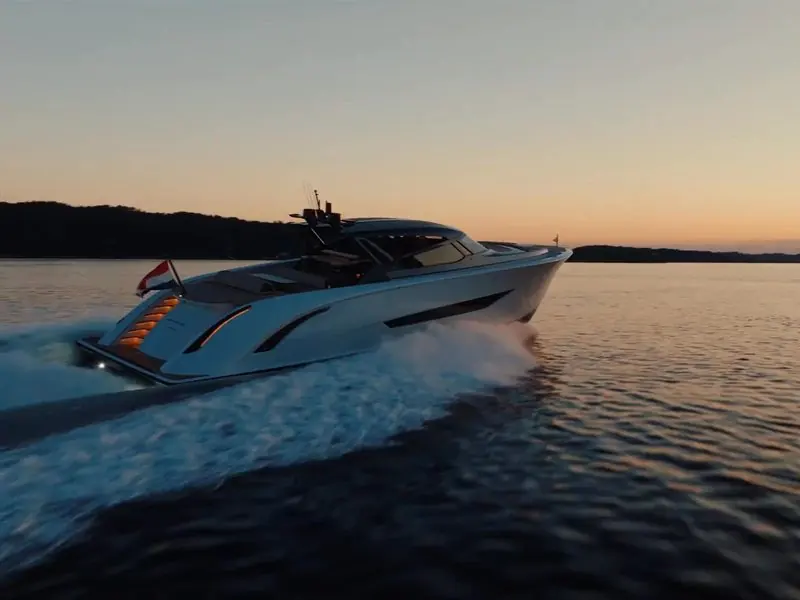
Eight and a half tonnes of day boat that no yacht crane will ever lift.
What the numbers actually mean
Two figures matter more than the top speeds. The first is draft. A Wajer 38 draws 0.90 m and a 44 draws 1.10 m, which opens up the shallow anchorages of the Balearics, the Bahamas and the Croatian islands that a deeper boat cannot reach. The second is the cruising speed. All four hulls settle at 25 to 28 knots, and that is the speed at which the boat is comfortable and the fuel figures work.
The top speeds are real and are a function of the engine option chosen. A 38 on the larger IPS package will see 46 knots and a 77 will see 37. Volvo Penta IPS pod drives are the common thread, which brings joystick manoeuvring and a service network that reaches every marina an owner is likely to use. It also means the drives are a specialist item when something goes wrong.

Range, and the limit it sets
Published range runs from 250 nautical miles on the 38 to 390 on the 55, with the 44 at 300 and the 77 at 350. These are day boat numbers. A Wajer will take an owner from Saint-Tropez to Portofino and back with fuel in hand, and it will not cross a sea without planning. Anyone imagining passage-making should read the range figures again before ordering.
In practice the range shapes how these boats are used. They live in one cruising ground for a season, based at a marina or alongside a larger yacht, and they do day trips. Wajer transports boats between its own hub locations for owners who move with the seasons, which is a tacit acknowledgement that the boat will not always deliver itself.
As a superyacht owner's second boat
The most common reason an owner buys one is that the yacht is somewhere else. A 38 or a 44 sits in a home marina and is available on a Saturday without a crew, a passage plan or a two week notice period. On a large yacht it also works as a chase boat, running guests to shore and back at 28 knots and covering distances the ship's tender cannot.
What it will not be is a garage tender. At 8.4 tonnes the 38 is far beyond any yacht crane, and the 44 at 12.7 tonnes is beyond most. A Wajer travels on its own bottom, on a shadow vessel or on a ship. Owners who want a boat this size alongside a yacht are buying a berth and a logistics arrangement at the same time.
Wajer Care, the five hubs, and the number that is missing
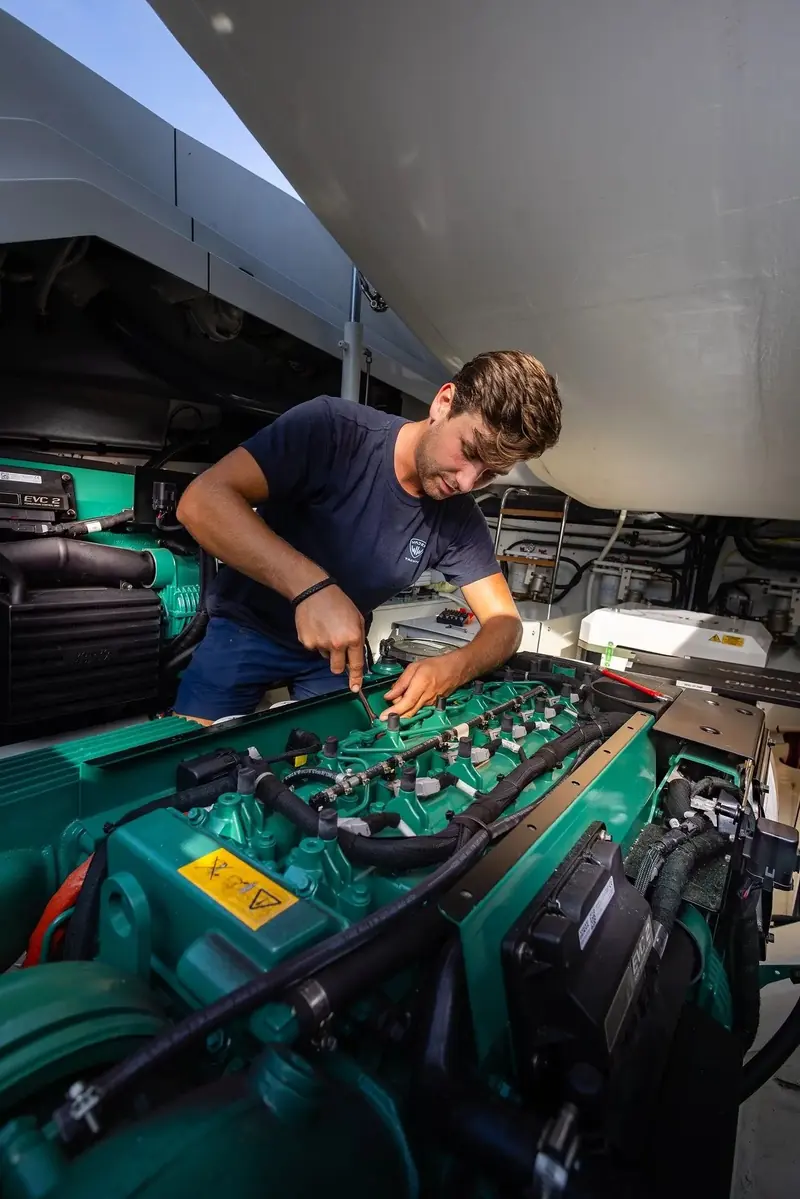
The service business is the part of Wajer that other builders do not have. Five hubs at Amsterdam, Saint-Tropez, Ibiza, Mallorca and Miami provide maintenance and technical support, with what the company calls flying doctors for problems outside those places. Winter storage, deep cleaning, engine work, storm protection and transport between hubs are all handled by the yard, there is an owner app for arranging it, and the service list extends to fuelling, stocking, paperwork and restaurant bookings. Boats of 77 feet and above are offered dedicated crew. For an owner who does not want to employ anyone, this is the whole proposition.
It is also the least documented part of the purchase. As of July 2026 Wajer publishes no price for Wajer Care, no annual fee, no schedule of what is included against what is billed, and no statement of whether it comes with a new boat or is bought separately. The published service commitment is 24/7 support, with no response time attached to it. The one outside characterisation, in BOOTE's January 2024 coverage of the 44, describes Wajer Care as a club membership under which the yard cleans the boat in summer and checks systems and replaces technical parts in winter. An owner should get the programme priced in writing, with the inclusions and the exclusions listed, before signing for the boat, because the argument for buying a Wajer at all rests on it. The other limitation is geography. Outside those five hubs the support is a visit and not a facility.
What it costs, and the one published figure that contradicts itself
Wajer publishes no price for a new boat, which is quoted individually with engine package, interior and options driving the number, but it does price the used ones itself. The Wajer Approved pre-owned page, read July 2026, runs from a 2005 Wajer 37 at EUR 435,000 VAT paid to a 2025 Wajer 44 at EUR 2,200,000 VAT paid, with three 55s between EUR 1.85 million and EUR 1.95 million. The public record is thin and it is not consistent. BOOTE's review of the 44, published on 13 January 2024, says in its text that the price is around two million euros and gives a starting price of from eight million euros in its own technical data table on the same page. The discrepancy has not been resolved publicly and Wajer says nothing, so neither number should be treated as a quote. The same article is more useful on the queue: delivery time of about 1.5 years, and more than fifty boats ordered since the model's premiere in summer 2023. On a boat with that order book, the delivery slot is the negotiation.
What is visible is the demand side. The used market is active, boats are traded through the yard's own pre-owned programme, and the company runs charter and an exchange scheme that gives owners access to other Wajers at other hubs. Running cost is dominated by three Volvo Penta diesels on the larger hulls and by berthing. A 16.80 m boat pays a 16.80 m tariff in Saint-Tropez or Porto Cervo in August, which is among the most expensive berthing in the Mediterranean and is priced by length and season. Servicing through the yard's own hubs is not the cheap option and it is the one that protects the resale.
Against the rest of the fast day boat market
The direct rivals are Frauscher from Austria, Brabus Marine from Germany, and at a different price point the Finnish builder Axopar. Each has taken a different route. Frauscher sells design and Austrian lake-boat engineering, Brabus sells aggression and the association with the car tuner, and Axopar sells volume and value. Wajer's answer is finish, silence and the service network behind the boat.
Where Wajer wins is with an owner who wants the boat to be handled for them and does not want to think about winter storage or a mechanic. Where it loses is with an owner who wants a boat to keep somewhere Wajer does not operate, or who wants the lowest running cost. The boats are also conspicuous, and in some anchorages that is the point and in others it is not.
Crew, licences and handling
The 38 and 44 are designed to be driven by the owner. Joystick control through the Volvo Penta pods makes berthing manageable for someone who is not a professional, and automatic fenders deploy without a crew member on the side deck. A boat licence is required in every Mediterranean country for craft of this power, and the requirement varies by state, so the paperwork should be sorted before delivery.
The 55 and 77 change the picture. A 51 tonne boat at 23.45 m is a ship in most harbours and Wajer offers dedicated crew from 77 feet upward for a reason. Insurance conditions on the larger hulls often specify qualified operation. An owner intending to drive the boat personally should establish what the underwriter expects before the contract is signed.
Practical detail
| New-boat price | Not published by Wajer; the one press figure in circulation (BOOTE, January 2024) is internally inconsistent between about EUR 2 million in text and EUR 8 million in its own spec table |
|---|---|
| Used-market benchmark | Wajer's own Approved pre-owned page, read July 2026, ran from EUR 435,000 VAT paid for a 2005 Wajer 37 to EUR 2,200,000 VAT paid for a 2025 Wajer 44 |
| Delivery time | About 1.5 years for a 44, per BOOTE, 13 January 2024, with more than 50 boats ordered since the model's summer 2023 premiere |
| Where to get it serviced | Five Wajer Care hubs: Amsterdam, Saint-Tropez, Ibiza, Mallorca and Miami; the published commitment is 24/7 support with no stated response time |
| What is NOT published | Wajer Care's price, fee structure, annual charge or response time - none of it appears on the company's own pages as of July 2026 |
| Check before buying | Cabin volume if overnight use matters - Wajer's own co-owner says the 44 suits two to three nights aboard at most, not extended cruising |
Request a quote for Wajer.
Tell us the model and where it needs to go. The desk obtains a written offer from the maker or an authorised dealer, checks it against the prices published on this page, and comes back to you by email. No obligation, no fee.
- 01A written offerPriced in your currency, with VAT, delivery and lead time stated, not a brochure figure.
- 02Delivered where the yacht isTo the marina, the yard or your address, with the paperwork a lithium pack or a crane lift needs.
- 03IndependentYotters is tied to no single dealer, so the offer is compared before it reaches you.
What owners and crew report
The build feels notably stiff and solid under real sea state
Testing the 38 S as a chase boat in Miami, the reviewer took a big wake from a passing boat at speed and reported feeling the quality directly - the hull stayed solid and stiff rather than flexing or slamming.
Kate Lardy, sea trial for Boat InternationalEngine and wind noise are unusually well controlled at cruise
On both the 38 and the 44, testers singled out the quiet running as the standout - barely audible at six knots on the 38, and still very quiet at 30 knots on the 44, credited to soft engine mounts, extra insulation and a windshield shaped to cut buffeting.
Kate Lardy and Kevin Koenig, sea trials for Boat InternationalWajer's own co-owner is candid that the 44 is not built for extended nights aboard
Asked directly about overnighting, Dries Wajer told the reviewer you would have to really be in love with your wife to spend more than a couple of nights aboard - the company's own account of the trade-off it made prioritising deck space and styling over cabin volume, good for two to three nights at most.
Dries Wajer, Wajer co-owner, quoted in Boat InternationalAdding a gyrostabiliser is a real speed trade-off, not a free upgrade
The optional gyrostabiliser fitted to test boats adds enough weight to shave a few knots off the top speed - the company sells it as a comfort option and does not claim it comes free of performance cost.
Kate Lardy, sea trial for Boat International
What is good, and what to watch
Strong points
- Sea-trial-verified quiet running and a stiff, solid hullTwo independent Boat International sea trials, on the 38 and the 44, both single out cabin quiet and hull rigidity under load as standout traits - not marketing language, but what testers felt taking real chop and wake.
- A genuine Mediterranean and US service networkFive Wajer Care hubs at Amsterdam, Saint-Tropez, Ibiza, Mallorca and Miami put a service point in most of the places a superyacht's chase boat actually operates.
- Shallow draft built for exactly the second-boat role owners buy it forA 0.90 m draft on the 38 lets it run onto a beach that a yacht's own tender cannot reach, which is the specific gap Wajer is bought to fill.
What to watch
- Cabin space is deliberately sacrificed, and the builder says so itselfWajer's own co-owner concedes the 44 suits two to three nights aboard at most - the company chose styling and deck volume over overnight accommodation, so a buyer wanting a genuine cruising cabin is buying the wrong boat.
- New-boat pricing is not published anywhere, and the one press figure on record is internally contradictoryA January 2024 BOOTE feature on the 44 gives about EUR 2 million in its text and EUR 8 million in its own data table; Wajer's pre-owned page pricing a 2025-build 44 at EUR 2,200,000 VAT paid supports the lower figure, but no clean source ever states a new-boat price outright.
- Wajer Care's service terms are undisclosedNo price, fee, annual charge, charging basis or response time is published for Wajer Care anywhere on the company's own pages - the 24/7 support commitment is stated with no service-level detail behind it.
Who it is for: Owners who want a fast, beautifully finished boat available at an hour's notice in one of five places, without employing anyone to run it.