Azimut Fly 60
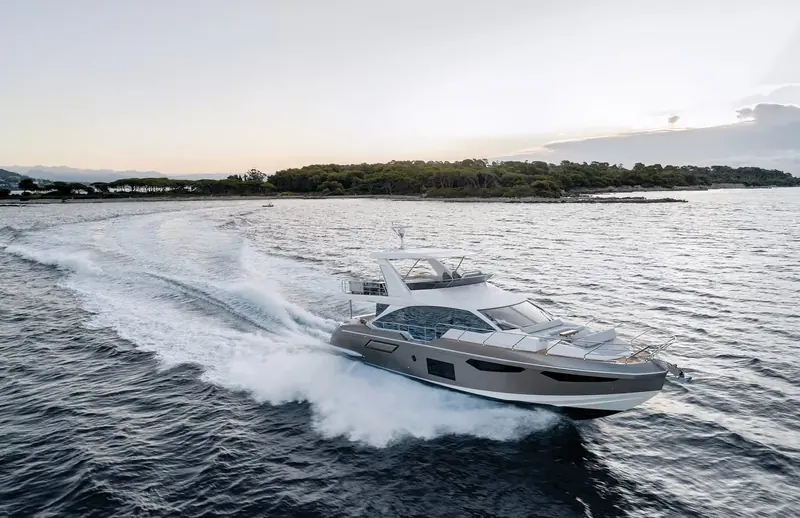
| LOA | 18.25 m |
|---|---|
| Beam | 5.05 m |
| Cabins | 3 plus crew cabin |
| Engines | 2 x Volvo Penta D13 (900 hp each) |
| Top speed | up to 31 knots |
| Owner's cabin | full-beam amidships |
| Deck | barrierless cockpit-to-saloon flow, optional hardtop flybridge |
| Collection | Flybridge range |
A step up in the Fly range
The 60 sits just above the 53 and adds usable length in every dimension. It keeps three cabins for guests plus a crew cabin, so the accommodation stays family-focused. The extra size shows most in the deck spaces and the sense of volume, since the cabin count stays the same. Owners moving up from smaller cruisers get more room to entertain and a more assured ride, with the extra length shrugging off a building breeze that would unsettle a smaller boat. It is a size that balances easy handling with genuine cruising comfort.
The boat carries the same illuminated, open design brief as the rest of the Fly line. Italian interior detailing lifts the finish above the class. The added length brings a steadier feel at sea and a little more range. It suits buyers who want a real family cruiser they can still run themselves. The step up from the 53 is felt in comfort more than complexity.
Deck and outdoor living
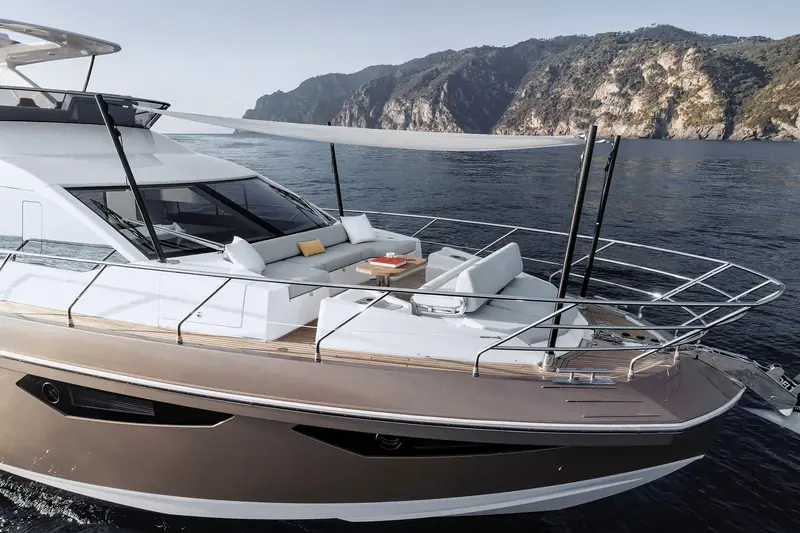
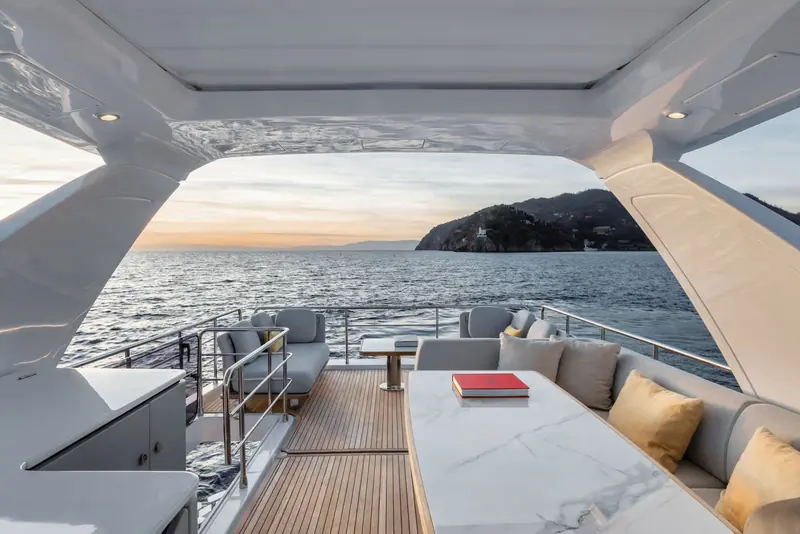
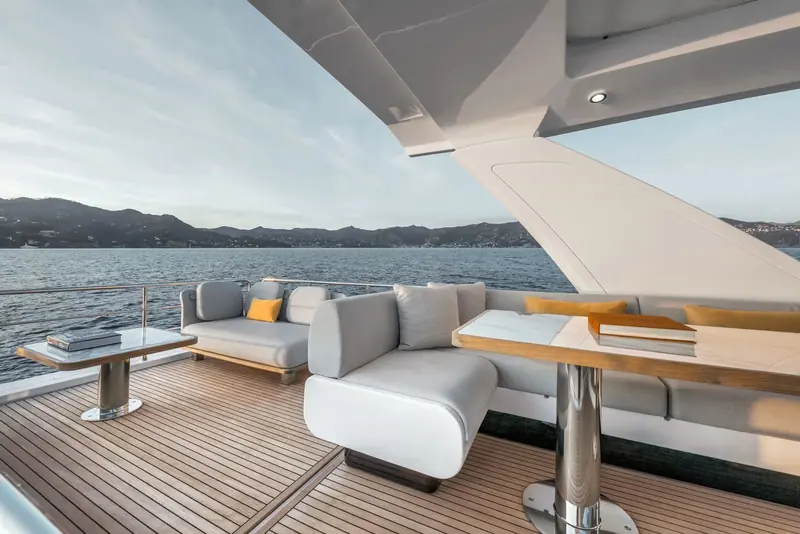
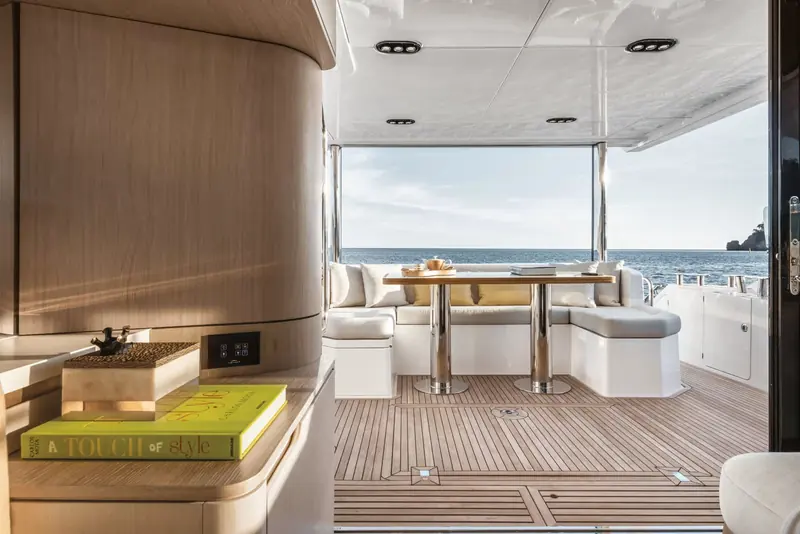
The cockpit flows into the saloon through wide glazing, and the flybridge offers a helm, seating and sunbathing under an optional hardtop. The upper deck is the social heart of the boat, big enough for the whole family at anchor. A foredeck lounge adds a second outdoor room forward. The layout gives guests genuine choice about where to gather. It is drawn for long, sunny days on the water.
The transom hosts a bathing platform and a garage for the tender, keeping the aft deck clear for dining. Wide side decks make moving around the boat safe and easy for guests of all ages. Stowage handles water toys for an active day out. The bathing platform brings swimmers down close to the sea. At anchor the 60 spreads people across several distinct zones.
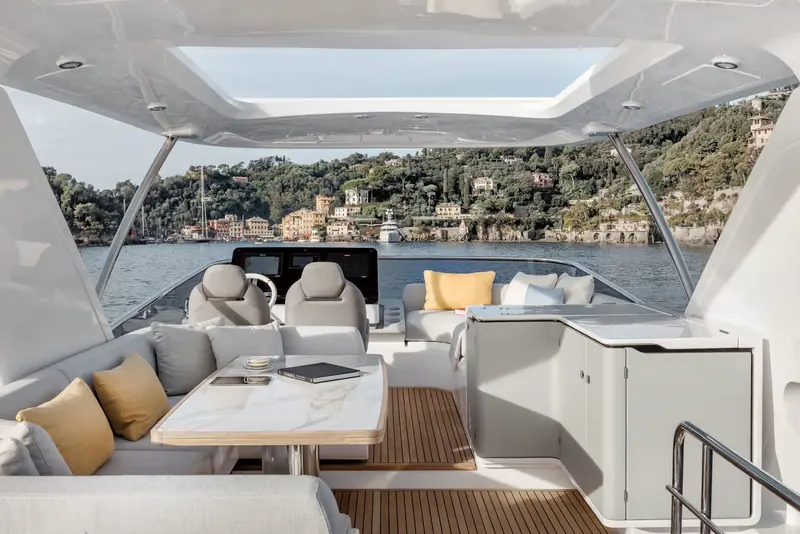
Eighteen metres of open, light-filled flybridge for a family that wants comfortable coastal cruising it can run itself.
Interior and layout
Below deck the 60 offers a full-beam owner's cabin amidships and two further guest cabins, all with natural light from hull windows. The Italian interior brings warm materials and clean detailing that feel a class above the length. The main-deck saloon stays bright and connected to the cockpit. Headroom and volume are generous for the size. It is a calm, comfortable space to spend a week aboard.
The galley is placed to keep the cook part of the action, and a crew cabin adds flexibility for owners who occasionally hire help. Storage is worked out for family trips with everything aboard. The owner's cabin gives a real sense of retreat from the guest spaces. Materials are chosen to wear well through the seasons. It is a practical, welcoming interior for family cruising.
Engineering and performance
Twin Volvo Penta D13 engines at 900 hp drive the 60 to a top speed of around 31 knots. The installation gives a strong, easy cruise for covering coastal miles. Efficiency and a smooth ride are part of the appeal. The boat holds a stable attitude through the mid-range. It is set up to make family passages relaxed.
The hull is tuned for stable, level running so passages stay comfortable for everyone aboard. Handling is approachable for an owner-driver, with the size still easy to berth. Controls stay light and predictable at cruise. The boat feels planted as conditions build. The 60 rewards owners who like to run their own boat and to take the helm themselves on the longer summer passages.
The owner it suits
The Fly 60 is for the family that has outgrown a smaller cruiser and wants more deck space and volume without moving to a crewed yacht. Its three cabins and generous flybridge suit holidays and weekends with guests aboard. It stays a boat an owner can handle themselves. The extra length adds comfort without adding difficulty. For many families it is the natural next step.
It also fits owners who value the option of occasional crew while keeping running costs sensible. The crew cabin adds flexibility for longer trips away. For summer coastal cruising with the family, the 60 hits a comfortable middle of the range, roomy enough to host and compact enough to berth almost anywhere. Its size keeps it manageable in most marinas. Owning one is straightforward and rewarding.
Двигатели и системы
| Engines (current, 2023-on generation) | 2 x Volvo Penta D13, 900hp / 662kW each, straight shaft drive - not an IPS pod-drive model. |
|---|---|
| Alternate engine option (unconfirmed for current generation) | A MAN i6 800hp twin-engine alternative appears in some aggregator sources but could not be independently confirmed on the builder's current page - it also appears in second-generation material. |
| Gearbox and drive | Conventional straight-shaft inboard transmission paired with the Volvo D13s; no pod-drive option offered on this model. |
| Generator | Kohler, approximately 20-21kW, confirmed via a 2022-hull brokerage listing. |
| Stabiliser | Seakeeper 9 gyro-stabiliser reported as available - single-source confirmation only. |
| Thrusters | Bow and stern thrusters with joystick control, operable from both flybridge and lower helm - single-source confirmation only. |
| Watermaker | Not published in any source found - confirm directly with a dealer or surveyor. |
| Fuel tankage | 2,800 litres / 740 US gallons, confirmed by two independent sources. |
| Water tankage | 750 litres / 198 US gallons, confirmed by two independent sources. |
| Range | Reported as approximately 779nm at 8kn and 291nm at 24kn, but from a single source only - not independently corroborated. |
| Cruise and max speed | Cruise approximately 26kn, max approximately 31kn, confirmed by two sources. A separate broker listing for a 2022-model hull with the same engines advertises 38kn top speed, which is not corroborated by any independent test or spec source - flagged as a conflict, not resolved. |
| Hull and construction | Azimut's own marketing describes carbon-fibre lamination for reduced weight, plus electronic power steering and active trim control (the yard's own account, not independent test data). Planing hull, LOA 18.25m, beam 5.05m, draft 1.46m, full-load displacement approximately 36 tonnes. Exterior design by Stefano Righini, interior by Achille Salvagni, naval architecture by Pierluigi Ausonio. |
Что сообщают владельцы и экипажи
Electronic steering builds confidence for less experienced drivers
Speed-adaptive power steering praised as easy to handle even for less experienced skippers, with turning response automatically softened at higher speed. This review covers the second-generation hull (2017 launch), tested and published 2018, not confirmed to apply unchanged to the current 2023-on generation.
Niccolo Volpati, BarchemagazineStrong soundproofing and fuel efficiency for the size
Measured noise around 70 dB(A) at 25 knots and fuel consumption judged impressive for an 18m, 36-tonne flybridge. Same second-generation (2017-launch) test hull, published 2018.
Niccolo Volpati, BarchemagazineBold interior with real ergonomic detail complaints
Praised the Achille Salvagni interior's wow factor and three outdoor entertaining zones, but flagged a lack of dedicated handholds, steering that felt lifeless at times, an optional joystick called dim-witted, 86 dB(A) noise at 25 knots, and dashboard squeaks. Explicitly the new-generation hull tested shortly after the 2017 relaunch, not the current 2023-on model.
Jack Haines, Motor Boat and YachtingPre-delivery prototype had a rudder-geometry handling flaw, fixed before customer deliveries
On hard, high-speed turns to port the prototype hull resisted and dug in with spray, traced to the outer rudder producing too much lift; the fix was a rudder-angle adjustment before production units shipped. This was the second-generation prototype, around 2017-2018, not the current model.
Power and Motoryacht editorsOwner-reported cruise comfort but real cockpit noise
One Fort Myers-based owner reported a comfortable 26-knot cruise but cockpit noise around 86 dB(A). The hull generation of this owner's boat could not be confirmed.
owner account cited by Denison Yacht SalesDocumentation gaps complicate independent servicing
Reported never finding a schematic for any system when servicing Azimuts - a brand-general comment, not confirmed to be Fly 60-specific.
Capt Ralph, YachtForums
Сильные стороны и что учесть
Сильные стороны
- Distinctive, high-impact interior designAchille Salvagni's interior drew a serious wow-factor verdict and was singled out as a real differentiator against flybridge competitors.
- Confidence-inspiring, speed-adaptive steeringElectronic power steering that eases turning input at speed was called easy to handle even for less experienced skippers.
- Good soundproofing and fuel efficiency for an 18m flybridgeAround 70 dB(A) at 25 knots and fuel burn judged impressive for a 36-tonne, three-cabin flybridge on the second-generation test hull.
- Shallow draft for a boat this size1.46m draft opens up skinny-water cruising grounds most 60-footers cannot reach.
На что обратить внимание
- Cabin and helm ergonomic detail complaintsReviewers flagged a lack of dedicated handholds, lifeless-feeling steering, a weak optional joystick, dashboard squeaks and 86 dB(A) cockpit noise at cruise.
- Servicing and parts-sourcing friction reported by ownersForum owners describe missing system schematics and slow-to-source Italian-made components as recurring frustrations with the brand generally.
- Early production hulls needed a handling fixThe pre-delivery prototype of the second-generation 60 had a rudder-geometry issue causing poor port-side turning response at speed, corrected before customer deliveries - worth checking on any very early used hull of that generation.
Практическая информация
| Nameplate collision warning | Azimut 60, Azimut 60 Flybridge and Azimut Fly 60 have been used across at least three distinct hull generations (approximately 2012, 2017 and 2023 launches), and brokers and spec aggregators often recycle the same spec block across all of them. Several reviews used in researching this page are confirmed second-generation (2017-launch) material even though their reported numbers closely resemble current listings. Confirm hull year against the builder's data plate, not the listing headline. |
|---|---|
| Price - new | Not published by Azimut. The prior second generation had a quoted base price of roughly EUR 1.73m ex-options in 2019, not usable as a current reference. Dealer and broker asking prices seen for 2023-2024 Fly 60 hulls run roughly USD 1.9m to 2.4m. |
| Price - used and brokerage | 2016-2022 hulls trade roughly USD 1.3m to 2.15m depending on hours and spec. |
| Running costs | Not published by Azimut or any brokerage source found. Only anecdotal fuel-burn figures exist, and they are from the second-generation test hull, not confirmed to carry over to the current generation. |
| What is not published | No independently confirmed range figure (only one source, not corroborated by a second). No watermaker spec found. No official current-generation fuel-burn table. No new-boat MSRP. |
Для кого: The family upgrading from a smaller cruiser who wants more deck space and three cabins in a self-run flybridge.