Venus
| LOA | 78.2 m |
|---|---|
| Gross tonnage | 1,876 GT |
| Delivered | 2012 |
| Builder | Feadship (De Voogt Naval Architects) |
| Exterior and interior design | Philippe Starck |
| Construction | aluminium hull and superstructure |
| Propulsion | two MTU 16V 4000 M73 diesel engines |
| Top speed | about 22 knots, cruise about 16 knots |
A minimalist statement on the water
Delivered in 2012 at 78.2 metres, Venus stands apart from almost every other Feadship for her stripped-back, minimalist character. She was built as project Aqua to an uncompromising design brief that favoured pure lines and restraint. At 1,876 GT she carries a light aluminium structure that few yachts of her length share. She remains one of the most recognisable and original yachts the yard has produced. Her light structure and clean form set her apart from every conventional yacht of her size.
Her importance lies in how completely she broke from convention. Venus set aside the usual language of the superyacht for a clean, almost architectural form. She showed that Feadship would build a radical single vision to the highest standard. More than a decade on she still looks contemporary and unlike anything around her. Her design has proved remarkably durable in a fast-moving market.
Philippe Starck and pure lines
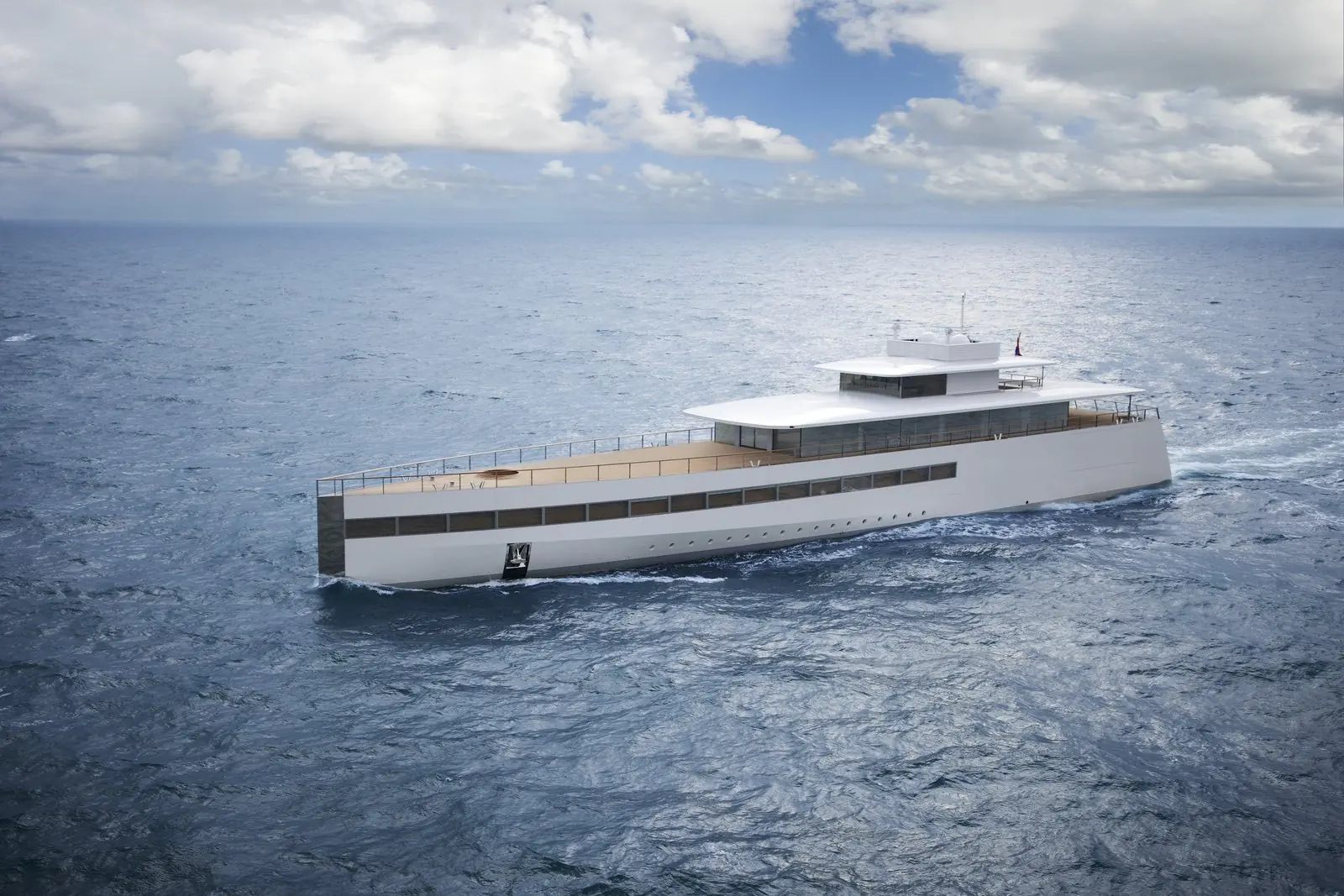
Both the exterior and the interior are the work of the designer Philippe Starck, giving Venus a rare unity of vision from bow to stern. The profile is spare and precise, with long uninterrupted walls of glass and a pared-back superstructure. She is built with an aluminium hull and superstructure, unusual at this length, which keeps weight low and helps her speed. De Voogt Naval Architects developed the hull. The whole form was drawn to feel calm, clean and quietly radical.
The design carries its restraint through every exterior detail. Custom glass panels form much of the superstructure, opening the interior to light and the surroundings. Teak decks and clean metal give her a calm, tactile character up close. The outdoor spaces follow the same minimalist hand across every level. The result reads almost as a piece of architecture on the water.
A 78 metre Feadship designed by Philippe Starck, a minimalist all-aluminium yacht that runs at 22 knots.
Light and restraint below decks
Inside, Starck carried the minimalist theme through the guest spaces, favouring light, space and a small number of fine materials. The interior avoids ornament in favour of clean volumes and carefully controlled daylight. The owner's quarters and guest cabins share the same calm and precise character. Feadship joinery gives the pared-back rooms real quality up close. Space and daylight do the work that ornament does on other yachts.
The all-glass structure makes the interior feel unusually open to the sea. Long sightlines run through the yacht and out to the horizon on every side. Social spaces are arranged with the same discipline as the exterior. Custom glass and fine timber give the pared-back rooms a warm, tactile quality. The result is a home at sea that feels serene, bright and quite unlike a conventional yacht.
A light hull built for speed
Venus is powered by twin MTU 16V 4000 M73 diesel engines driving an aluminium hull that is light for her length. That combination gives her a top speed of around 22 knots and an easy cruise near 16 knots. The light structure helps both her pace and her efficiency through the water. Her hull is set up for comfortable passage-making across open water. Her internal volume comes to 1,876 GT within that light aluminium shell.
Building an aluminium yacht of nearly 80 metres is a demanding piece of engineering that rewards careful weight control. The light structure lifts performance while keeping the calm ride expected of a Feadship. Systems were built for reliable cruising over long distances. Stabilisation keeps her steady at anchor and under way. The build stands as a demanding feat of aluminium engineering at her length.
An icon for a design-led owner
Venus answers the brief of an owner who wanted a yacht as a pure work of design, built without compromise to a single vision. Her minimalist form gave her an identity that no other yacht shares. Vessels with this much design history hold a fascination that goes far beyond their specification. She is one of the most collectible Feadships afloat. Yachts drawn by a single designer of this stature rarely reach the open market.
For an owner she offers a light-filled, architectural home at sea with genuine speed and reach. The character suits a buyer drawn to restraint and originality over convention. The size gives ample space for family and guests within a spare, calm interior. Venus stands as one of the most distinctive yachts the yard has ever delivered. Her design keeps her instantly recognisable at any anchorage.
Двигатели и системы
| Beam / draft | 11.8 m beam; draft reported as 3.0 to 3.1 m depending on source (Wikipedia gives 3.00 m, YachtCharterFleet gives 3.1 m) |
|---|---|
| Hull / superstructure | Steel hull, aluminium superstructure (BOAT International, YachtCharterFleet) |
| Naval architecture | De Voogt Naval Architects, built at the Feadship (Royal Van Lent) Aalsmeer yard |
| Main engines | Two MTU 16V 4000 M73 engines, rated 2,560 kW / 3,430 bhp each at 1,970 rpm (MTU/Rolls-Royce official spec sheet), consistent with YachtCharterFleet's cited 3,433 hp per engine |
| Engine configuration | 16-cylinder, 170/190 mm bore and stroke, 69.0-litre displacement, common-rail injection, sequential turbocharging with two water-cooled turbochargers (MTU spec sheet) |
| Speed | Top speed about 22 knots, cruise about 16 knots (BOAT International, YachtCharterFleet, Superyachts.com) |
| Range | Reported as either about 5,000 nm or about 5,500 nm at cruise depending on source. Treat as approximate |
| Glass structure | 15 tonnes of structural glass walls supported by a concealed 10-tonne aluminium frame. Lloyd's Register had reservations about load-bearing glass, resolved through this hidden structure. Glass engineering by Eckersley O'Callaghan, also known for Apple's Fifth Avenue store and the Steve Jobs Theater (BOAT International) |
| Accommodation | 12 guests in six staterooms, crew of up to 22 (BOAT International, YachtCharterFleet) |
Что сообщают владельцы и экипажи
Jobs never boarded the finished yacht
Steve Jobs died in October 2011, a year before Venus was delivered in October 2012. He is reported to have said: "I know it's possible I will die and leave Laurene with a half-built boat. But I have to keep going."
BOAT InternationalDesign intent: concealed technology
A photographer who documented the yacht noted the absence of visible satellite and radar equipment as central to the clean aesthetic: "The glass, the polished metal, the minimalist look, and the fact that you couldn't see any satellites distracting from her design."
Giovanni Romero, via BOAT InternationalFamily usage pattern
Reported sightings cruising the Australian Gold Coast, Fethiye, Istanbul and the Greek Cyclades, and docked in Cairns in August 2023.
BOAT International
Сильные стороны и что учесть
Сильные стороны
- Design pedigree and engineering featThe collaboration between Philippe Starck, De Voogt Naval Architects and Feadship produced a load-bearing glass superstructure (15 tonnes of glass on a hidden 10-tonne aluminium frame) that required resolving Lloyd's Register's concerns, a genuine structural achievement engineered with Eckersley O'Callaghan (BOAT International).
- Concealed systems for visual purityThe radar arch and satellite equipment are hidden in a box so the exterior reads as unbroken straight lines and 90-degree angles, an unusual discipline for a yacht this size (BOAT International).
На что обратить внимание
- Glass-yacht engineering tradeoffsTrade press notes that balancing solar gain, privacy and transparency is an inherent conflict on glass-walled yachts generally. No published critique names Venus's own heat or privacy performance specifically, so this is a general tradeoff rather than a documented complaint about this hull.
- Age relative to the current fleetDelivered in 2012, Venus's minimalist boxy styling and 22-knot top speed now sit beside faster, more amenity-dense 2020s builds. No named source directly criticizes this; it follows from her build date against current market norms.
Практическая информация
| Build cost | Never officially confirmed. Press estimates range from about EUR 105 to 120 million, roughly USD 120 to 130 million (Wikipedia, BOAT International, SuperYachtFan), convergent but not identical figures |
|---|---|
| Charter status | Private, not chartered, confirmed by BOAT International and YachtCharterFleet listings |
| Running costs | Estimated at USD 10 to 15 million a year using the standard industry rule of thumb. This is an estimate, not a disclosed figure (SuperYachtFan) |
| December 2012 impoundment | Briefly detained at the Port of Amsterdam over a payment dispute with a designer worth about EUR 3 million, resolved within days (Wikipedia) |
| July 2024 collision | Collided with Ricardo Salinas Pliego's 105 m Lady Moura while both were anchored off Naples during a sudden 50 to 55 knot squall. Venus's bridge was reportedly unmanned at the time. Damage on both vessels was described as minimal and cosmetic and the matter was resolved amicably (BOAT International, SuperyachtNews, Dockwalk, Marine Insight) |
| Not publicly known | Exact build cost, generator, stabilizer, thruster and watermaker specifications, tankage, precise range and interior details beyond press-toured highlights |
Для кого: The design-led owner who wants a yacht as a pure architectural statement, light and fast, unlike anything else afloat.