Nausicaa
| LOA | 114.2 m |
|---|---|
| Gross tonnage | 6,593 GT |
| Beam | 18.7 m |
| Delivered | May 2026 (build name Project Cosmos) |
| Builder | Lurssen (Germany) |
| Exterior and interior design | Marc Newson |
| Hull | Ice Class 1D |
| Propulsion | diesel-electric with electric azimuth pods, provision for a methanol fuel-cell system |
A concept made real
Nausicaa is unusual because she began life as a fully resolved design concept and was built with remarkable fidelity to it. At 114.2 metres and 6,593 GT across six decks, she carries the singular vision of Marc Newson, a designer better known for products and furniture than for yachts. The yard delivered her in May 2026 after a build that began in 2022 under the code name Project Cosmos. She represents a rare case of a designer's original drawing surviving the compromises of a real construction programme.
Her significance is as much about ambition as about size. She was planned around advanced propulsion ideas that pushed at the limits of what was available. Whether or not every element arrived on schedule, the intent placed her at the front of a wider industry conversation about cleaner power. Nausicaa is a statement about where large yachts might be heading.
A singular vision
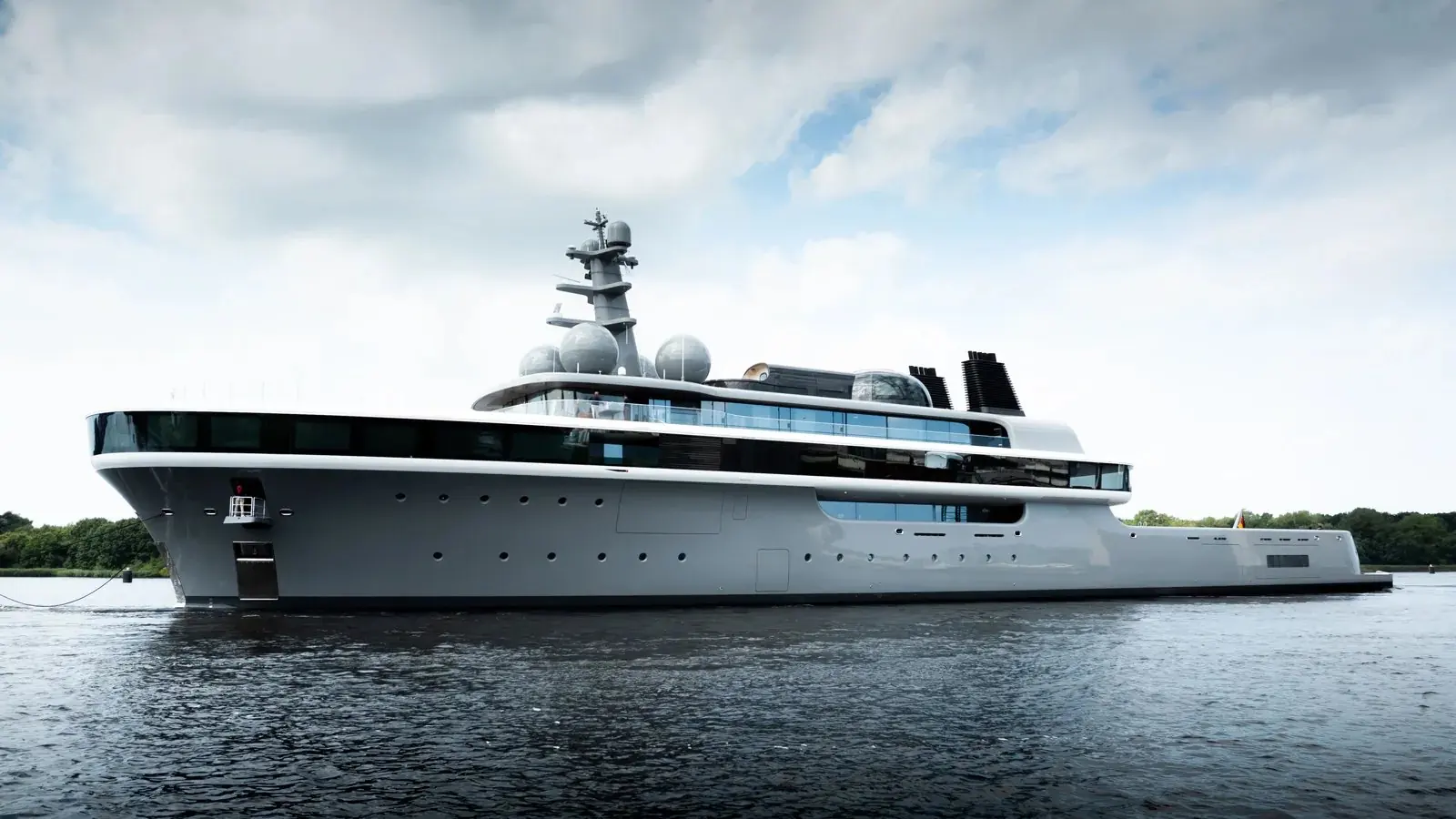
Marc Newson designed both the exterior and the interior, an unusually complete authorship for a yacht of this scale. His signature shows in the smooth, sculptural forms that run through the vessel, closer to a considered product than a conventional ship. A continuous band of glass wraps the upper level, and a nineteen-metre observation lounge sits behind it. The overall look is clean, curved and quietly futuristic.
The design's centrepiece is the Skydome, a 56-square-metre private study for the owner formed from seven curved glass panes, each 62 millimetres thick and weighing more than a tonne. Building glass to that specification was an engineering feat in its own right. The feature gives the owner a panoramic room unlike anything on a traditional yacht. It captures the whole project's blend of design ambition and technical difficulty.
A single designer's concept, built almost exactly as it was drawn.
The fuel-cell question
Nausicaa was conceived around a fuel-cell system designed to convert methanol into hydrogen and generate electricity, a technology still emerging in yachting. At the owner's request the vessel was built with provision for that system. As delivered she operates on a diesel-electric plant built around five generators and fully electric azimuth pods, backed by a battery bank of up to two megawatts. Coverage of her delivery noted that the fuel-cell technology remained a work in progress, and that the ship put to sea on her diesel-electric plant.
That honest account matters, because it shows both the appetite for cleaner technology at this level and the practical limits of getting it to sea. The diesel-electric arrangement is itself modern and efficient, with the pods allowing quiet and precise handling. The battery capacity supports low-noise operation at anchor and in port. The architecture leaves room for the fuel-cell future the owner wanted.
Living inside a design object
Life aboard Nausicaa unfolds in spaces that feel like a single continuous work of design. Reported features include a bespoke sushi bar and a two-level art gallery, both consistent with Newson's aesthetic. An eighteen-metre open aft deck carries a swimming pool described as deep enough for diving, along with a jacuzzi. The whole interior was shaped as one idea rather than assembled from separate rooms.
Her Ice Class 1D certification means she can operate in light ice and colder regions, extending where the owner can take her. A dry dock and tender-handling system allow her to carry and launch a substantial tender from within the hull. The result is a yacht that pairs artful living spaces with genuine reach. She was designed to go to unusual places in unusual style.
An experimental commission
Nausicaa is reported to have been built for a Japanese entrepreneur and art collector. As with other Lurssen yachts that attribution is reported rather than officially confirmed. The commission fits the pattern of an owner willing to fund a genuinely experimental project. It takes a particular kind of client to build a yacht around unproven technology.
In the market Nausicaa occupies a category of one. Her authorship by a single designer, her fuel-cell provision and her uncompromised concept make her difficult to compare with anything else afloat. That singularity is both her appeal and, for a future buyer, a question, since bespoke visions rarely suit the next owner as neatly as the first. For now she stands as one of the most distinctive large yachts Lurssen has ever built.
Why she trades cabins for engineering
Nausicaa's nine suites for eighteen guests is a strikingly low number for a 114-metre, 6,593 GT hull - most yachts her length carry two or three times as many guest cabins. The reason is where her volume actually goes: a five-engine diesel-electric plant with electric azimuth pods in place of a conventional shaftline, up to 2MW of battery storage, and provision for a methanol-to-hydrogen fuel-cell system that Lurssen itself has never fitted before.
That trade only makes sense for an owner who wanted the engineering and the 56 square metre glass Skydome study more than an extra deck of cabins, and it is consistent with a yacht built to Ice Class 1D for higher-latitude cruising rather than a fixed Mediterranean-Caribbean circuit. Boat International's own delivery report is careful to call the fuel-cell system 'emerging technology', which is the honest way to describe a feature nobody has yet reported using at sea. Peter Lurssen himself framed the project around the yard's long record in structural glasswork rather than the propulsion system, saying innovation in glass has long been a hallmark of the yard and that Nausicaa pushes the boundaries of scale and structural complexity - a reminder that the Skydome, not the fuel cell, is what Lurssen itself chose to lead with at delivery.
Двигатели и системы
| Propulsion | A five-engine diesel-electric plant (two primary, three auxiliary, reported as MTU 16V4000 units) driving fully electric azimuth pods rather than a conventional shaftline - unusual for a Lurssen this size. |
|---|---|
| Battery and fuel cell | Up to 2MW of battery storage, enough to run every hotel system at peak load on electric power alone, plus provision for a methanol-to-hydrogen fuel-cell system - a first for Lurssen and still 'emerging technology' by Boat International's own description, not yet a proven fixture across the fleet. |
| Speed | Reported cruising speed around 14 knots with a top speed over 20 knots - unverified against a second technical source. |
| Hull | Steel displacement hull reinforced to Ice Class 1D, with an aluminium superstructure - built for higher-latitude cruising, not just the Mediterranean and Caribbean circuit. |
| Tenders | A 16-tonne-capacity tender and toy handling system built into the 18-metre aft deck. |
Что сообщают владельцы и экипажи
Too new for independent owner or crew reports
Nausicaa was delivered in May 2026, a few months before this page was written; no owner, crew or charter guest account has been published yet, and everything here comes from the builder's delivery release and broker listings.
Heart research
Сильные стороны и что учесть
Сильные стороны
- A genuine engineering first for LurssenThe diesel-electric plant, 2MW battery and methanol fuel-cell provision are a real departure from a conventional shaftline, aimed squarely at cutting fossil-fuel running hours at anchor.
- A one-off centrepiece in the SkydomeThe 56 sq m owner's study built from seven hot-bent glass panes, each 62mm thick and over a tonne in weight, is the kind of single feature that defines a yacht for a generation.
- Built for more than warm-water cruisingAn Ice Class 1D hull and a five-engine diesel-electric plant point to genuine higher-latitude capability, not just a marketing line.
На что обратить внимание
- The fuel-cell system is provision, not proofBoat International itself frames the methanol fuel-cell as emerging technology; nothing published yet confirms how much of her at-anchor power the system actually carries in real use.
- Very few cabins for her size9 suites and 18 guests on a 114m, 6,593 GT hull is a low density even for a full-custom flagship, so she trades guest capacity heavily for engineering and public space.
- No independent review exists yetShe was delivered only months before this was written, so every figure here comes from the builder's own release and broker aggregation, not a sea trial or an owner account.
Практическая информация
| Reported price | Around $350 million (SuperyachtFan) - a single-source figure, not independently confirmed. |
|---|---|
| Guest and crew capacity | 9 suites for up to 18 guests, with 36 crew - a low guest-to-crew ratio even by superyacht standards, reflecting how much of her volume goes on engineering and the Skydome study rather than extra cabins. |
| Ownership | Reported to belong to the Japanese entrepreneur Yusaku Maezawa; Boat International's own delivery report names only the owner's nationality, not the individual. |
| Delivery history | Built under the yard name Project Cosmos and delivered as Nausicaa in May 2026, only a few months before this page was written. |
Design
| Экстерьер | Marc Newson Ltd |
|---|---|
| Морская архитектура | Lurssen |
Для кого: A design-led owner willing to fund an experimental, singular vision and to accept the risks that come with pioneering marine technology.
Ориентировочная цена: Reported build cost ~US$350 to 500 million (Luxurylaunches, SuperYachtFan).