Black Pearl
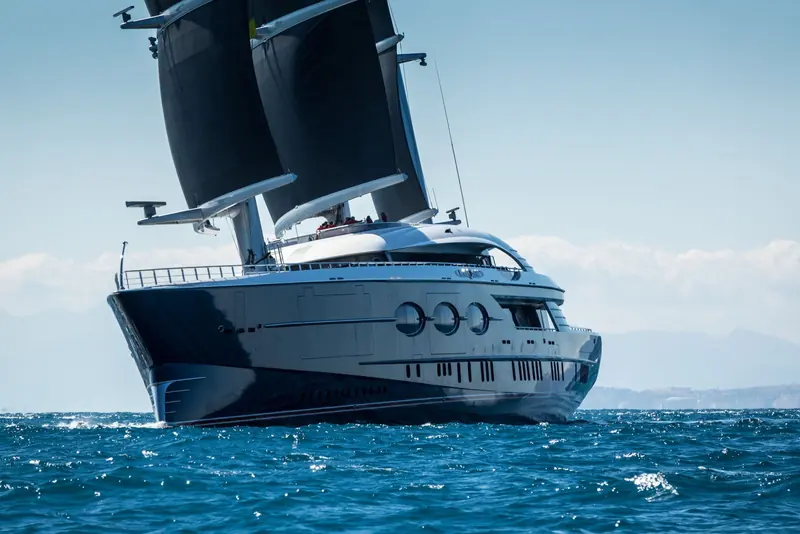
| Builder | Oceanco, Alblasserdam, Netherlands |
|---|---|
| Length | 106.7 metres |
| Type | three-masted DynaRig sailing yacht, the largest in the world |
| Launched 2016, delivered 2018 | |
| Gross tonnage | approximately 2,864 GT |
| Rig | three rotating carbon masts around 70 metres, roughly 2,900 square metres of sail |
| Naval architecture and rig | Dykstra Naval Architects |
| Auxiliary power | two MTU diesels, top speed around 17.5 knots |
The yacht that made DynaRig serious
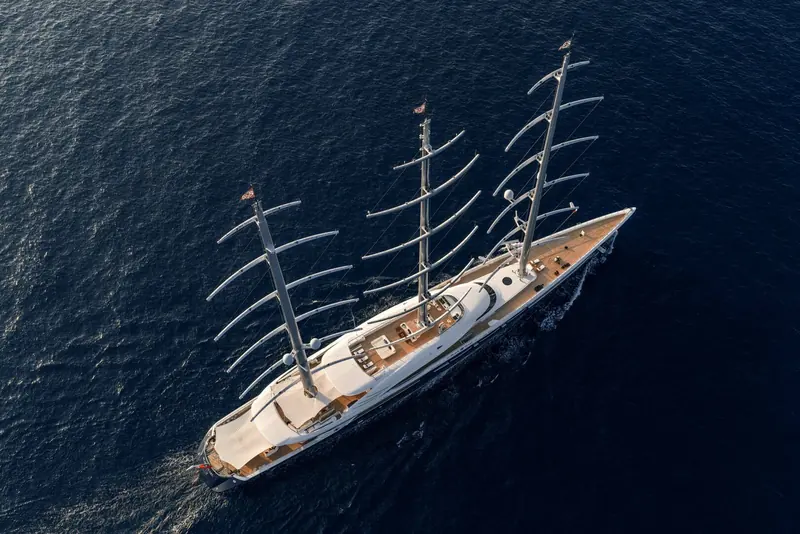
DynaRig had existed as an idea for decades before Black Pearl gave it a definitive large-scale form. The concept places free-standing rotating masts carrying curved yards, so the sails set as continuous surfaces without traditional rigging. Maltese Falcon had proved the principle at 88 metres, and Black Pearl took it further to 106.7 metres. That step made her the largest DynaRig yacht afloat and settled any question about whether the system could scale.
Her significance is as much environmental as technical. From the outset the design chased very low fuel use, with a widely repeated claim that she could cross the Atlantic on around twenty litres of fuel under the right conditions. Whether or not that figure holds in every crossing, the ambition behind it shaped the whole boat. Black Pearl became a reference point for owners who wanted performance under sail with a light energy footprint.
Black hull, three towers of carbon
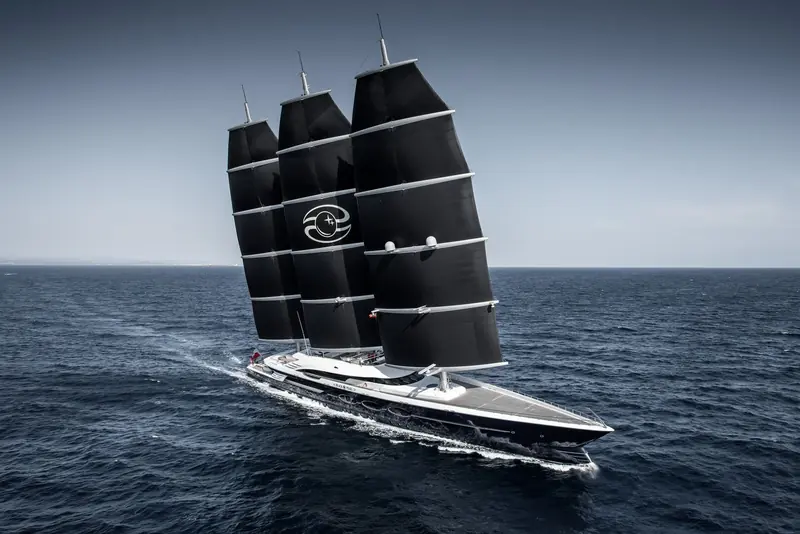
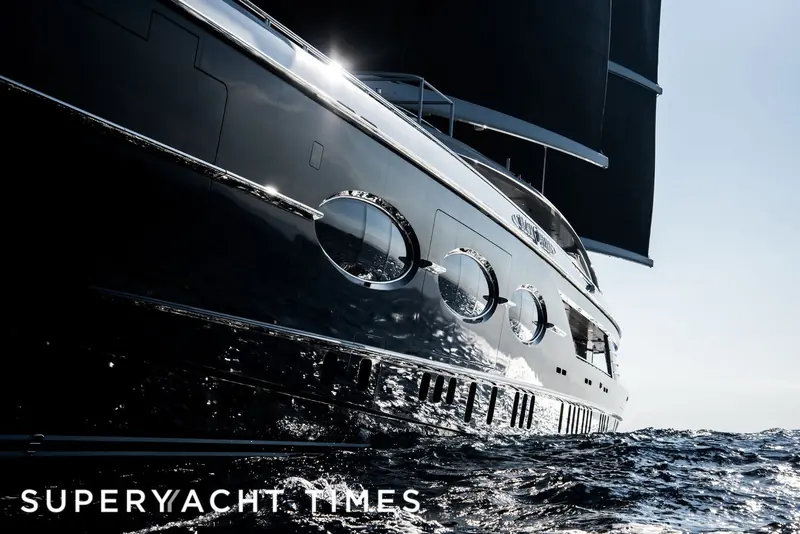
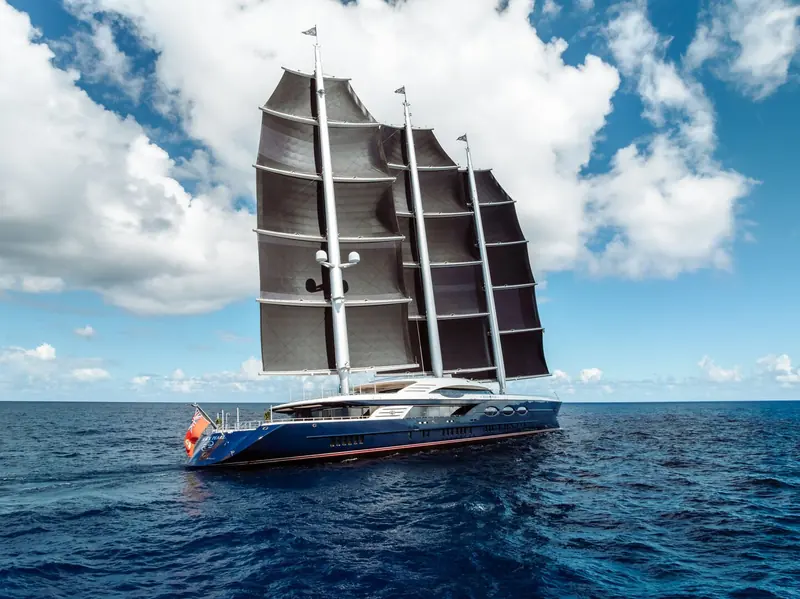
The exterior came from a collaboration that included Nuvolari Lenard and Ken Freivokh Design, and the result is unmistakable on the water. A dark hull sits beneath three carbon masts standing around seventy metres tall, each one able to rotate to trim its sails. The whole rig sets roughly 2,900 square metres of sail, and the yard has said the full suite can be deployed in about seven minutes. Very little breaks the line of the deck when the sails are stowed.
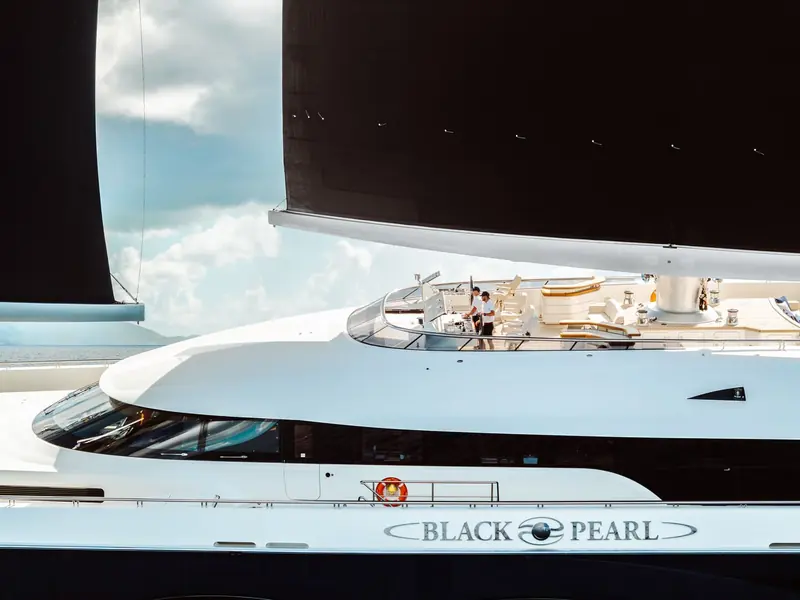
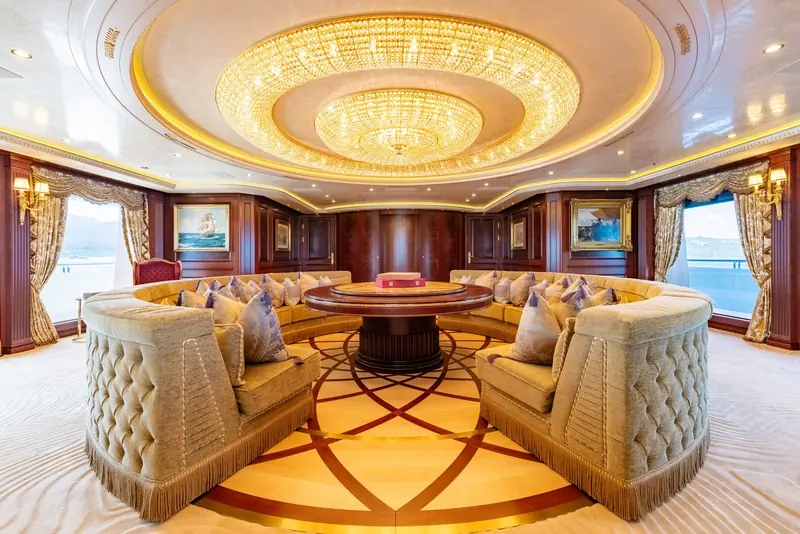
Below the rig the yacht carries a full interior across three decks within a 15 metre beam. The styling leans dark and dramatic in keeping with the name, and the accommodation supports around a dozen guests. Because the masts are unstayed there is no forest of standing rigging to interrupt the deck spaces. That openness is one of the quiet advantages of the DynaRig layout.
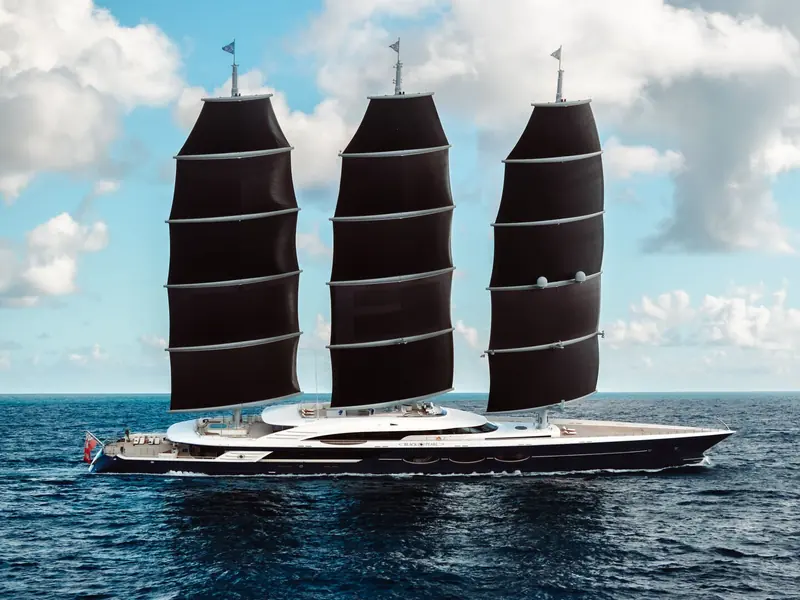
The largest DynaRig sailing yacht afloat, built to make power from the wind.
A boat that makes its own power
The most interesting engineering on Black Pearl is what happens when she sails. Her propellers can be allowed to spin as she moves through the water, driving generators that recharge large onboard batteries. Heat capture systems reclaim energy that would otherwise be lost, and the stored power runs the yacht's systems without constant recourse to the diesels. Two MTU engines remain aboard for manoeuvring and calms, giving a top speed of around 17.5 knots.
Dykstra Naval Architects led the rig and sailing systems that tie all of this together. Managing three rotating masts and a very large sail area safely means heavy automation, since no crew could handle these loads by hand. The regenerative approach turns the act of sailing into a source of electricity rather than a drain on it. That loop is the heart of the yacht's claim to efficiency.
Sailing in near silence
For guests the appeal of Black Pearl is the experience of moving at speed with the engines shut down. Under sail she is quiet in a way that a motor yacht cannot match, and the regenerative systems mean that quiet does not cost her electrical power. The internal volume of roughly 2,864 GT gives generous living space for a sailing yacht. Long ocean passages are within her comfortable range rather than at the edge of it.
The dark aesthetic continues inside, and the layout favours an owner who intends to use the sails rather than treat them as decoration. Accommodation for around twelve guests keeps the vessel personal in scale despite her length. Deck spaces open up once the rig is stowed, giving room to gather in the open air. She reads as a serious sailing yacht that happens to carry the comforts of a large motor yacht.
A green flagship caught in a legal storm
Her owner died in 2021, and the yacht then became entangled in a lengthy dispute over the estate, which kept her in the news for reasons unrelated to her design. Ownership questions of that kind are common at the top of the market, where holding structures are complex and privacy is prized. The reporting around her should be read with that context in mind.
Set against her legal history, the yacht's reputation still rests on what she proved technically. She remains the largest DynaRig sailing yacht in the world and a benchmark for low-energy sailing at scale. Later projects, including Oceanco's own Koru, built on the confidence that boats like Black Pearl created. Her place in the yard's story is as proof that ambition on this scale could actually work.
Двигатели и системы
| Rig | Three unstayed, rotating carbon DynaRig masts, about 70 metres each, roughly 2,900 square metres of sail deployable in about 7 minutes (Dykstra Naval Architects) |
|---|---|
| Auxiliary engines | Twin MTU diesels, top speed about 17.5 knots, used for manoeuvring and calms |
| Power generation | Free-wheeling propellers drive generators under sail, recharging onboard batteries; heat-capture systems reclaim further energy |
| Hull and superstructure | Steel hull, aluminium superstructure, carbon-fibre masts |
| Tonnage | Approximately 2,864 GT |
Что сообщают владельцы и экипажи
She sails in almost anything
'She'll sail in pretty much any wind. In zero breeze, she'll drift along quietly and she's comfortable up to around 50 knots,' says her rotational first officer - a working crew account of how forgiving the rig is across the full range of conditions she meets on charter.
Oliver Scrimshaw, rotational First OfficerPhotographs undersell her
'When we walk through, she's so much better in person than in the photograph,' the yacht's captain has said of guests' reaction on stepping aboard for the first time.
Captain Christian TruterA verified, and much smaller, fuel figure
An early, widely repeated claim put an Atlantic crossing at around twenty litres of fuel; a documented 2023 crossing of 5,600 nautical miles instead burned about 32,000 litres, against roughly 200,000 litres a comparable motor yacht would need for the same passage. The real number is far less dramatic than the early claim, and still a fraction of a motor yacht's.
Oceanco / press reporting on the 2023 crossing
Сильные стороны и что учесть
Сильные стороны
- The regenerative loop is real, not just marketingA documented 2023 Atlantic crossing burned roughly 32,000 litres against an estimated 200,000 for a comparable motor yacht covering the same distance - a genuine, verified efficiency gain even if it falls well short of the boat's own early twenty-litre claim.
- A rig built to be used, not admiredCrew describe a boat that is comfortable across a very wide wind range, from drifting in zero breeze to sailing in strong conditions, which is unusual for a yacht this size.
- Scale without a forest of riggingThe unstayed DynaRig masts leave the deck open in a way a conventionally rigged sailing yacht of the same length could not manage, freeing real living space above and below.
На что обратить внимание
- The original efficiency claim overstated the realityThe often-repeated 'twenty litres across the Atlantic' figure is roughly 1,600 times smaller than what a documented 2023 crossing actually burned; the boat is still far more efficient than a motor yacht her size, but the popular number was never an honest one.
- An estate dispute has shadowed her since 2021Her owner's death tied the yacht up in a lengthy ownership dispute that had nothing to do with her engineering, but kept her name in the press for reasons a prospective charterer or buyer would want to understand before asking further.
- Diesel power is modest once the wind dropsThe two MTU engines fitted for manoeuvring and calms give a top speed of only around 17.5 knots, well below what her sail plan can achieve in a strong breeze.
Практическая информация
| Charter rate | From about EUR 800,000 to EUR 850,000 per week plus expenses (2026 season rate, Boat International) |
|---|---|
| Guests and cabins | 12 guests across 7 cabins - 1 full-beam master, 2 VIP suites, plus double and twin cabins |
| Crew | 27, consistently reported across Boat International, IYC and other charter brokers |
| Verified fuel use | About 32,000 litres for a documented 5,600 nautical mile Atlantic crossing in 2023, against an estimated 200,000 litres for a comparable motor yacht on the same passage |
| What is not published | Any sale price or resolution of the post-2021 estate dispute over ownership; Oceanco and the family have not detailed either |
Design
| Экстерьер | Ken Freivokh Design |
|---|---|
| Интерьер | Nuvolari Lenard |
| Морская архитектура | Dykstra Naval Architects (hull and three 70 m DynaRig carbon masts) |
Для кого: An owner who wants genuine sailing performance and a low energy footprint at a length usually reserved for motor yachts.
Ориентировочная цена: Reported build value approx. US$200 million (SuperYachtFan / trade press). No official asking price.