Vanguard, a 24m Hybrid Explorer, Cuts to USD 2.7m
What is Vanguard and what does she cost now?
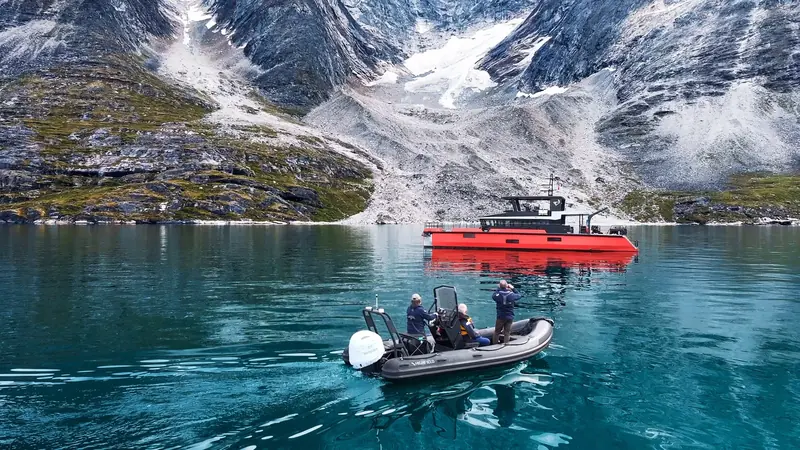
Vanguard is a 23.86-metre hybrid expedition yacht built in 2023 by Naval Yachts, now listed by Northrop and Johnson at USD 2,700,000 after a summer voyage that took her into Greenland's High Arctic waters with two ice pilots aboard.
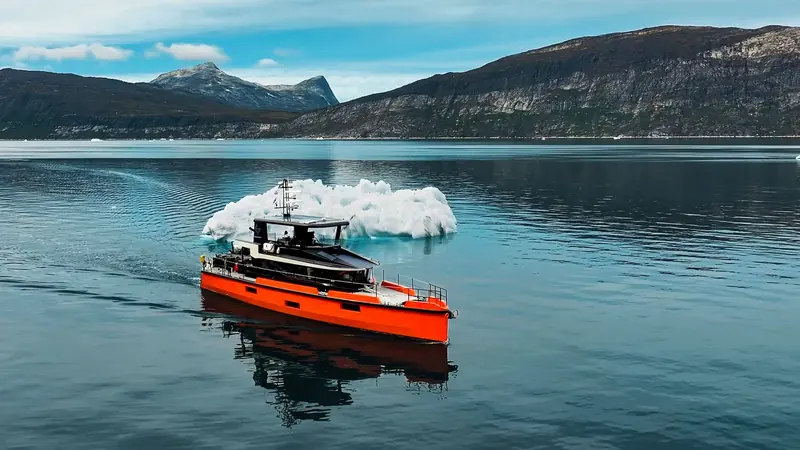
Naval Yachts delivered Vanguard in 2023 on its XPM 78 platform, a design built specifically for long-range, self-sufficient cruising rather than marina-hopping. She has since logged more than 9,000 nautical miles, according to her listing broker Northrop and Johnson, including a recent transit up the US Atlantic coast and into Greenland's High Arctic, a run made with two ice pilots aboard given the ice conditions involved. That voyage record is unusual for a yacht this size to carry into a brokerage listing: most 24-metre yachts for sale have a charter history or none at all, not a documented cold-water passage. Naval Yachts builds the XPM range in Antalya, Turkey, aimed squarely at owners who want to cruise independently for weeks at a time rather than move between marinas each night, a smaller-yard answer to the long-range explorer brief that larger builders usually price well into eight figures.
The current asking price of USD 2,700,000 is confirmed on both Northrop and Johnson's own listing and BOAT International's yachts-for-sale page, each citing identical specifications. Earlier marketing of the yacht carried higher asking figures before settling at the current price, consistent with a slow-moving category: small, genuinely capable explorer yachts are a narrow niche, and a buyer for one is choosing a specific kind of cruising rather than the fastest or most comfortable boat available at the price.
What makes Vanguard different from a standard 24-metre motor yacht?
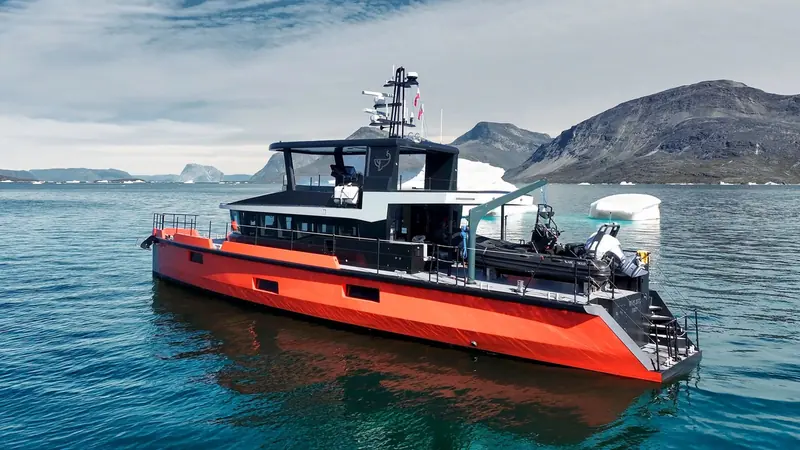
Vanguard runs a diesel-electric Praxis hybrid propulsion system through an ice-reinforced hull, giving her a 7,000-plus nautical mile range and 3.5 litres per nautical mile fuel consumption at a 9-knot cruise, figures built for range rather than speed.
The hybrid propulsion is a Praxis diesel-electric system with an integrated energy management network, feeding twin John Deere 4045 AFM85 M1 engines rated at 160hp each, modest output for a 66 GT yacht built to cross oceans rather than plane across a bay. Cruising speed is 9 knots, maximum 11, and fuel consumption at cruise runs to 3.5 litres per nautical mile against a 9,885-litre fuel capacity, together giving her the 7,000-plus nautical mile range Northrop and Johnson cites. The hull carries ice reinforcement, DMS Magnus Master stabilisers and a commercial-grade dynamic positioning system, equipment drawn from the survey and offshore-support world rather than the leisure-yacht catalogue most 24-metre builds pull from. The dynamic positioning system, more commonly specified on survey and offshore-support vessels than on leisure yachts this size, lets her hold a fixed position over a dive site or a glacier front using her own thrusters rather than dropping anchor, useful in water too deep or too uneven on the bottom to anchor safely at all.
None of that makes Vanguard fast or spacious. Guest capacity is 8, across three en-suite cabins plus a convertible salon berth, modest for the length against a typical flybridge motor yacht of the same size built purely for coastal charter. What the equipment list buys instead is genuine independence: a yacht that can hold position without a bow thruster running constantly, take an unplanned Arctic detour with the right ice pilots aboard, and run for a week or more between fuel stops in places a standard 24-metre motor yacht would not attempt to go.
How does Vanguard compare with other small expedition yachts on the market?
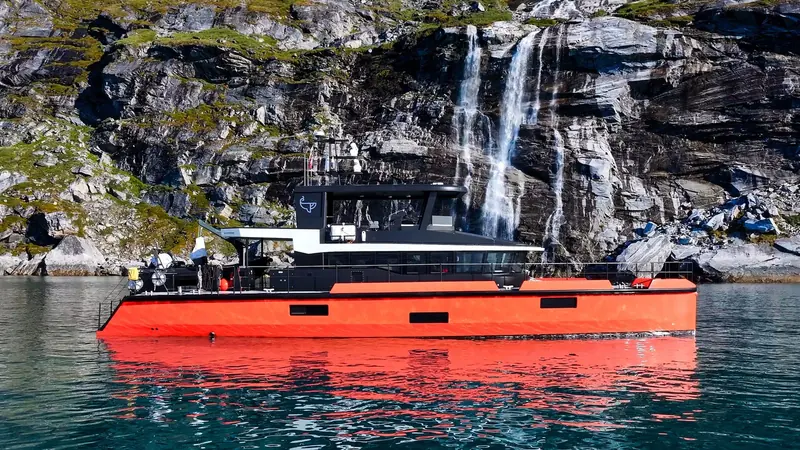
Few 24-metre yachts on the brokerage market carry ice-class construction and a documented cold-water voyage, which puts Vanguard closer in capability to explorer yachts twice her price than to the flybridge motor yachts she is closest to in length.
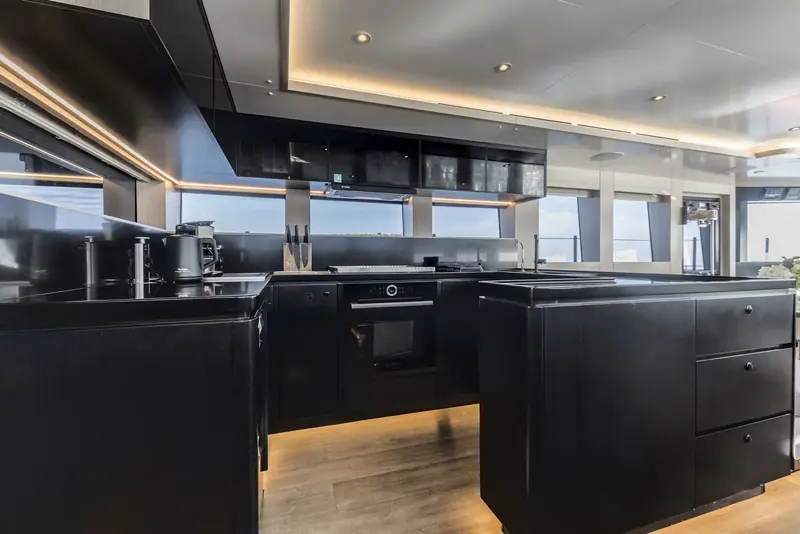
The explorer-yacht category below 30 metres remains thin. Most true expedition builds, ice-classed, long-range, built for genuine self-sufficiency, start in the 30 to 40-metre range and price well into eight figures; a 24-metre with the same underlying capability is unusual specifically because the category rarely gets built at this length. Vanguard's interior, finished by Arista Marine, is functional rather than showy, dark cabinetry and a compact galley amidships ahead of the machinery space, a layout that prioritises system access and weight distribution over the open, light-filled saloons more common on a coastal 24-metre. A handful of yards, among them Bering and Naval Yachts itself, have tried to bring genuine expedition capability down to this length, but the category has stayed thin because the ice-class steel, stabilisation and long-range fuel capacity it requires eat into the interior volume a 24-metre hull can otherwise offer.
That positioning cuts both ways for a buyer. Against a similarly priced flybridge motor yacht of the same length, Vanguard is slower, carries fewer guests and offers a plainer interior. Against a true 35-metre-plus explorer yacht, she is a fraction of the price and genuinely capable of comparable voyages, just with less onboard space and a smaller crew complement to run the systems that make those voyages possible.
Why has the asking price on a proven, working yacht kept falling?
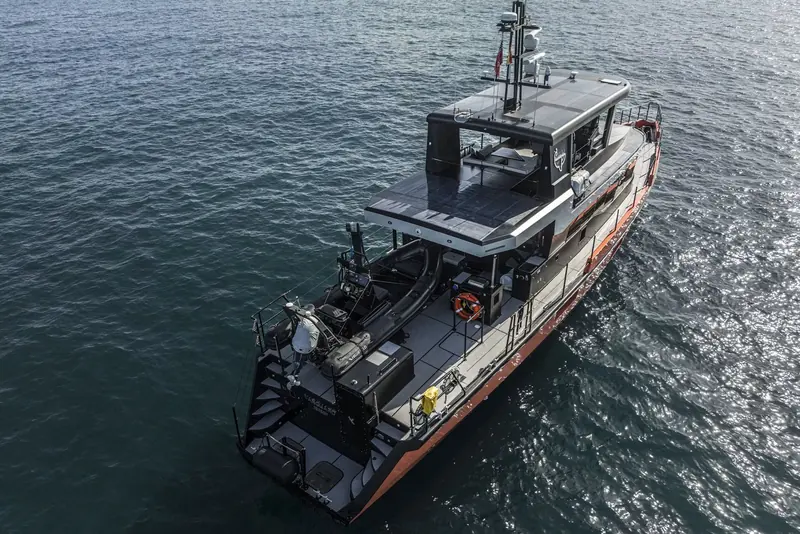
A completed, documented Arctic voyage did not stop Vanguard's asking price from falling, which says more about how few buyers are actively shopping the small-explorer category than it does about the yacht's actual capability.
The route itself, north from the US Atlantic coast into Greenland's High Arctic waters, is the kind of passage normally associated with dedicated expedition or research vessels rather than a privately owned 24-metre, and it required two ice pilots aboard specifically for the waters Vanguard was entering. A price reduction after a successful voyage, rather than before it, is not the usual pattern for a brokerage listing: a completed Arctic transit with ice pilots aboard is the kind of proof most sellers would expect to support a price, not precede a cut. That sequence points to a narrow buyer pool for a boat this specific rather than any fault found in the voyage itself. An expedition-minded buyer who wants speed and volume alongside genuine range will look past a 9-knot cruiser regardless of price; a buyer who wants exactly what Vanguard offers is a small, specific audience, and a niche category moves on its own schedule rather than the broader brokerage market's.
Vanguard is new enough, and specific enough in her use, that no independent owner report beyond her broker's account of the voyage record exists in public reporting; this desk found no third-party crew or owner interview describing time aboard her. For a buyer actually considering the small-explorer category, the honest comparison is not against other 24-metre motor yachts on price alone, but against what a genuinely capable ice-classed passage costs to buy versus to build, and on that measure a proven boat at USD 2.7m is priced well below what a new commission to the same brief would cost today.
What is good, and what to watch
Strong points
- A proven, not theoretical, capabilityOver 9,000nm logged including a documented High Arctic transit, rare for a brokerage listing at this length to carry.
- Genuine range on modest fuel7,000-plus nautical miles at 3.5 litres per nautical mile puts real ocean-crossing range within a 24-metre hull.
- Priced far below a comparable new buildUSD 2.7m for a proven ice-capable yacht undercuts what commissioning the same brief today would cost.
What to watch
- Slow and modestly powered9-knot cruise and 160hp-per-side engines trade speed entirely for range, a real limitation for an owner who also wants to cover ground quickly.
- Thin accommodation for the length8 guests across 3 cabins plus a convertible berth is modest against a coastal 24-metre built purely for comfort.
- A genuinely narrow resale poolThe falling price despite a proven voyage record suggests few active buyers are shopping this specific category, which could repeat for the next owner.
Practical detail
| Length / gross tonnage | 23.86m, 66 GT |
|---|---|
| Asking price | USD 2,700,000 (Northrop and Johnson, September 2026) |
| Builder / platform | Naval Yachts, XPM 78, delivered 2023 |
| Propulsion | Praxis diesel-electric hybrid; 2x John Deere 4045 AFM85 M1, 160hp each |
| Speed / range | 9kn cruise, 11kn max; 7,000+ nm range; 3.5 l/nm at cruise |
| Fuel capacity | 9,885 litres |
| Guests / cabins | 8 guests: 3 en-suite cabins plus a convertible salon berth |
| Notable equipment | Ice-reinforced hull, DMS Magnus Master stabilisers, commercial-grade dynamic positioning |
| Voyage record | 9,000+ nm since delivery, including a High Arctic transit to Greenland with two ice pilots aboard |
| What is not published | No independent owner or crew report beyond the broker's account; no confirmed sale date |
Questions this story answers
What happened?
Northrop and Johnson has cut the asking price on Vanguard, a 23.86-metre hybrid explorer yacht, to USD 2,700,000, months after the boat logged over 9,000 nautical miles including a run to Greenland's High Arctic with ice pilots aboard. For a buyer weighing the small-explorer category against a used flybridge motor yacht of similar length, Vanguard is now one of the cheapest genuinely ice-capable yachts on the brokerage market with a real voyage record behind the spec sheet.
What is good about it?
A proven, not theoretical, capability. Over 9,000nm logged including a documented High Arctic transit, rare for a brokerage listing at this length to carry.
What should an owner or buyer watch?
Slow and modestly powered. 9-knot cruise and 160hp-per-side engines trade speed entirely for range, a real limitation for an owner who also wants to cover ground quickly.
Who reported this?
Northrop and Johnson yacht listing, September 2026, BOAT International yachts-for-sale listing, September 2026, Mike Finnegan, broker, Northrop and Johnson.
We do this for everyone who loves this world. The people who have spent their lives in it, and the people just discovering it. Yotters exists so that what we learn belongs to all of them.
Nobody pays us for this. No ads, no sponsors, nothing for sale. We just believe the world is a little better when knowledge is shared instead of kept.
If it gave you something today, tell us to keep going. Follow us, leave a like, or write a positive comment. We read every one, and they are what keeps us going.