What a Refit Actually Buys Back at Resale
Why do most refit decisions happen on a schedule the owner did not choose?
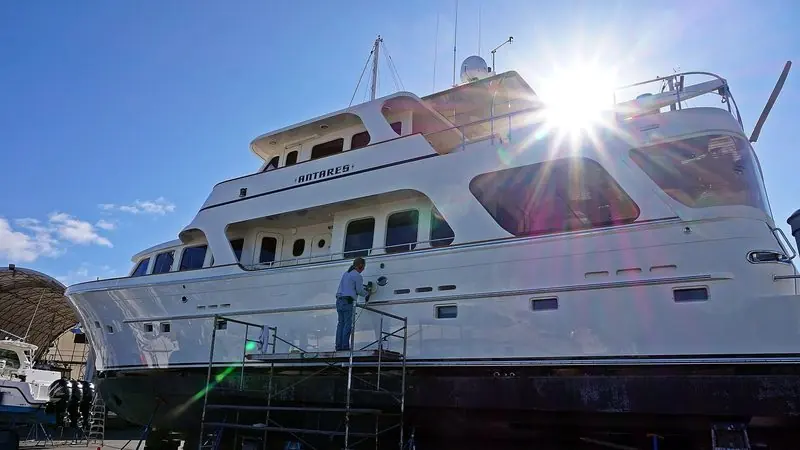
A classification society's five-year survey forces every yacht into drydock for a full structural, machinery and safety inspection, and that mandatory haul-out is the moment most owners actually decide whether to refit or sell.
Y.CO's own guide to the five-year survey lays out what gets opened up: hull plating and structural components checked with ultrasonic thickness testing, main engines, generators, hydraulic and fuel systems inspected for performance and compliance, firefighting systems and life-saving equipment checked against current rules, and fuel, water and ballast tanks opened and inspected for corrosion and coating condition. The yacht has to come out of the water for the external examination regardless of whether the owner wants any of the rest of the work done.
That forced haul-out is why refit and resale decisions cluster around the same window. Once a yacht is already out of the water and opened up for class, the marginal cost of adding discretionary work, new paint, updated electronics, a reworked interior, is lower than booking a second yard period later, and yards price it that way. An owner who was never planning a full refit can find the five-year survey has quietly become one anyway, simply because the boat is already apart.
Which parts of a refit hold their value when the yacht is sold?
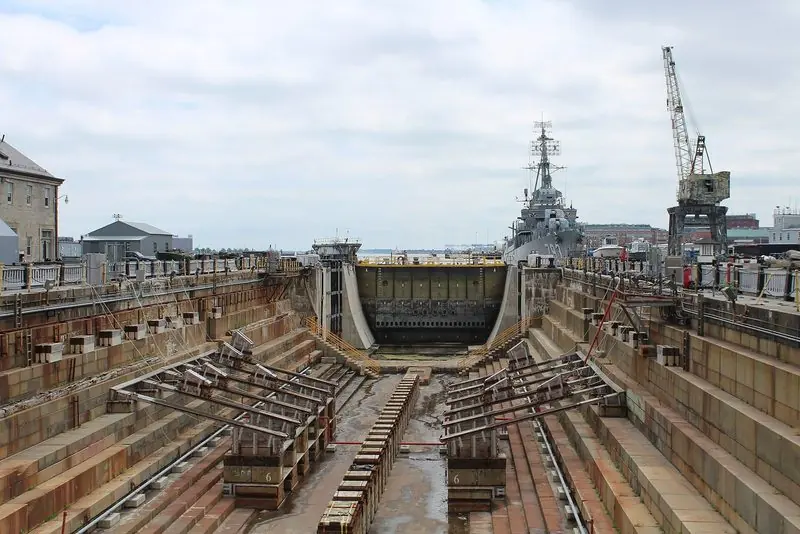
Structural and mechanical work holds its value at resale because it removes a defect a surveyor would otherwise flag, while cosmetic work is judged on taste and rarely adds a matching amount to the price.
Ocean Independence's own valuation guidance is blunt about the ceiling: "the market does not usually attribute full financial recovery to refit expenditure itself," and mechanical upgrades, paintwork and technical improvements are valued differently from purely cosmetic changes, with the commercial return rarely matching the total amount invested. The reverse case makes the same point from the other direction. Dan Bornarth of Bradford Marine warns that neglecting integrity issues, water leaks, tank coatings, exterior paint, left unattended, "will end up being very costly to repair and will ultimately decrease the overall value of the asset." A buyer's surveyor finds deferred structural work either way; refitting it does not create new value so much as it removes a discount.
Even the highest-value single line item on a typical refit invoice is mostly labour, not material. On a 60-metre yacht in fair condition, BOAT International prices a full hull repaint at EUR 300,000 to EUR 1,000,000, LED lighting at EUR 150,000 to EUR 500,000, furniture replacement at EUR 50,000 to EUR 250,000 and a spa pool installation at EUR 50,000 to EUR 150,000. Daan Balk, CEO of Balk Shipyard, explains why the paint number runs so high: "Painting is 70 per cent preparation, fairing, sanding and treating corrosion." A buyer is paying for that prep work being done, not for the colour.

Does refit spending translate directly into a higher asking price?
Spending does not convert to price on a straight line: a broker's own trade-press example puts it as a EUR 5 million refit on a EUR 20 million boat not equating to a EUR 25 million boat, and the market has punished owners who priced as if it did.
SuperyachtNews put the arithmetic in exactly those terms in its own analysis of refit value: a large refit spend does not simply add itself to the pre-refit price. The same piece cites a real case where an owner bought a yacht, refitted her with millions of euros in work, then listed her more than 40 per cent above the purchase price on the strength of that spend, only for the asking price to be cut back to 60 to 70 per cent of that original post-refit figure once the market tested it.
None of which makes a refit pointless before a sale. Ocean Independence's own conclusion is that while significant refit work can improve marketability and reduce time to sale, the market does not usually reward the spend pound for pound. A refit's real return is a faster sale at a defensible price, not a markup that simply passes the invoice on to the next owner.

How much does a typical refit overshoot its budget?
A well-managed refit still typically overruns its budget by 10 to 20 per cent, an average project by 30 to 50 per cent, and a badly scoped one can run 60 to 100 per cent or more over, which eats directly into whatever the refit was supposed to add.
Dockwalk's refit reporting documents the extreme end of that range with a 1967 Camper & Nicholsons yacht that arrived at a South Florida yard for a budgeted six-month, USD 1 million refit and left a year later having cost USD 6 million, a six-fold overrun driven by a work list that kept growing as the yard found more underneath what it had already opened, and by the difficulty of sourcing parts for equipment whose manufacturers no longer exist. James Brewer, formerly of Derecktor Shipyards and now at Roscioli Yachting Center, tells captains to watch for exactly the moment that overrun becomes visible: "80 percent of the money has been expended and the job is only 50 percent done."
The professionals who run these projects give the same two pieces of advice. Daniele Di Giampaolo of Amico & Co. recommends factoring at least 10 per cent of the budget for the unexpected before the yard finds its first surprise, and Marine Group Boat Works pushes owners toward fixed-price contracts specifically so the yard, not the owner, absorbs the risk of a scope that grows once the hull is opened up. An owner who skips both and simply authorises the yard's estimate is the one most likely to still be paying, and losing resale margin, months after the quoted completion date.
Is a real yacht testing this trade-off right now?
Synthesis, a 74-metre Amels 242 delivered in 2021, has just returned from a refit at her own builder and gone on the market at EUR 132 million, a premium of roughly 21 to 47 per cent over two unrefitted sister hulls, and whether that premium survives contact with the market is live data on this exact question.
Synthesis went back to Damen Yachting's Vlissingen yard, the facility that built her, for her first refit since delivery and was redelivered on 30 April 2026. Neither Damen's own announcement nor BOAT International discloses what the refit cost, how long it took beyond the redelivery date, or the detailed scope beyond broad categories: routine maintenance, technical upgrades, layout changes. That gap is itself the pattern this piece has been describing. Two of her Amels 242 Limited Edition sister hulls give a real reference point neither refitted the same way: New Dream asked EUR 109 million in June 2024 and Plvs Vltra was listed at EUR 89.9 million in 2025, both without the refit Synthesis just completed.
Synthesis's EUR 132 million ask is not a number the desk is estimating, it is the price on the market right now, and it sits well above both sister hulls precisely because of a refit whose cost was never published. If she sells near that figure at Monaco or Cannes this season, it will be the clearest evidence yet that a documented refit at a yacht's own builder can move a young hull's price rather than just its time on market. If she sells closer to her sisters, it confirms everything the brokers quoted above already say on the record.
What owners and crew report
Paint cost is mostly preparation, not paint
"Painting is 70 per cent preparation, fairing, sanding and treating corrosion," on why a hull repaint alone can run EUR 300,000 to EUR 1,000,000 on a 60-metre yacht.
Daan Balk, CEO, Balk Shipyard, in BOAT International (Charlotte Hogarth-Jones, 19 November 2020)Track spend against completion, not against the calendar
"80 percent of the money has been expended and the job is only 50 percent done" is the warning sign captains should watch for in regular yard progress meetings.
James Brewer, Roscioli Yachting Center, formerly Derecktor Shipyards, in DockwalkDeferred integrity work costs the owner later, not the yard
Leaving water leaks, tank coatings and exterior paint unattended "will end up being very costly to repair and will ultimately decrease the overall value of the asset."
Dan Bornarth, Bradford Marine, in DockwalkBuild in a contingency before the yard finds the first surprise
Factoring at least 10 percent of the budget for the unexpected, ahead of the discoveries that routinely follow a haul-out.
Daniele Di Giampaolo, Amico & Co., in Dockwalk
What is good, and what to watch
Strong points
- Structural and mechanical work removes a discount rather than just adding a costA surveyor finds deferred integrity issues either way, so paying for them ahead of a sale, rather than letting a buyer's surveyor find them, avoids the price cut Dan Bornarth of Bradford Marine describes.
- A refit reliably shortens time on the marketOcean Independence's own guidance credits refit work with improving marketability and reducing time to sale, even where it does not lift the final price.
- Booking work around the mandatory five-year survey avoids a second haul-outThe yacht is already out of the water and opened up for class, so discretionary work added at the same time costs less than a separate yard period later.
What to watch
- Spend does not convert to price on a straight lineSuperyachtNews's own framing, a EUR 5 million refit on a EUR 20 million boat does not equate to a EUR 25 million boat, and a real case it cites saw an asking price cut to 60-70 percent of its post-refit figure.
- Budgets overrun by a third to a half on a typical projectDockwalk's reporting puts an average refit 30 to 50 percent over its original budget, with a poorly managed one running 60 to 100 percent or more, eating directly into any resale premium.
- Refit cost and scope are almost never disclosed at saleNeither Damen Yachting nor BOAT International will say what Synthesis's refit cost, so a buyer weighing her EUR 132m ask against unrefitted sister hulls cannot verify whether the premium reflects real spend or simply where the seller wants to start.
Practical detail
| Hull repaint, 60m yacht, fair condition | EUR 300,000 to EUR 1,000,000 (BOAT International) |
|---|---|
| LED lighting system | EUR 150,000 to EUR 500,000 (BOAT International) |
| Furniture replacement | EUR 50,000 to EUR 250,000 (BOAT International) |
| Spa pool installation | EUR 50,000 to EUR 150,000 (BOAT International) |
| Typical budget overrun | 10-20 percent well managed, 30-50 percent industry typical, 60-100+ percent poorly scoped (Dockwalk) |
| Documented worst-case overrun | USD 1m budget to USD 6m actual, a 1967 Camper & Nicholsons refit (Dockwalk) |
| Live market test case | Amels 242 Synthesis, refitted at Damen Yachting, asking EUR 132m against sister hulls' EUR 109m (2024) and EUR 89.9m (2025) unrefitted asks |
| What is not published | Refit cost, scope and duration are almost never disclosed at sale; Synthesis's own refit is a current example of a yard and a seller both declining to say what was spent |
Questions this story answers
What happened?
A refit rarely returns what it cost, and the brokers, yards and class societies who work the market say so on the record. For an owner weighing a six or seven figure refit bill against simply listing the yacht as she is, the mechanism behind that gap, and the one current sale testing it in real time, is worth understanding before the yard quote lands.
What is good about it?
Structural and mechanical work removes a discount rather than just adding a cost. A surveyor finds deferred integrity issues either way, so paying for them ahead of a sale, rather than letting a buyer's surveyor find them, avoids the price cut Dan Bornarth of Bradford Marine describes.
What should an owner or buyer watch?
Spend does not convert to price on a straight line. SuperyachtNews's own framing, a EUR 5 million refit on a EUR 20 million boat does not equate to a EUR 25 million boat, and a real case it cites saw an asking price cut to 60-70 percent of its post-refit figure.
What do owners and crew report?
"Painting is 70 per cent preparation, fairing, sanding and treating corrosion," on why a hull repaint alone can run EUR 300,000 to EUR 1,000,000 on a 60-metre yacht. (Daan Balk, CEO, Balk Shipyard, in BOAT International (Charlotte Hogarth-Jones, 19 November 2020))
Who reported this?
BOAT International (Charlotte Hogarth-Jones), Dockwalk, Ocean Independence, SuperyachtNews, Y.CO, Damen Yachting, Superyachts.com.
We do this for everyone who loves this world. The people who have spent their lives in it, and the people just discovering it. Yotters exists so that what we learn belongs to all of them.
Nobody pays us for this. No ads, no sponsors, nothing for sale. We just believe the world is a little better when knowledge is shared instead of kept.
If it gave you something today, tell us to keep going. Follow us, leave a like, or write a positive comment. We read every one, and they are what keeps us going.