A 68m concept hides its masts and claims 33,000 litres saved on an Atlantic run
What has been drawn
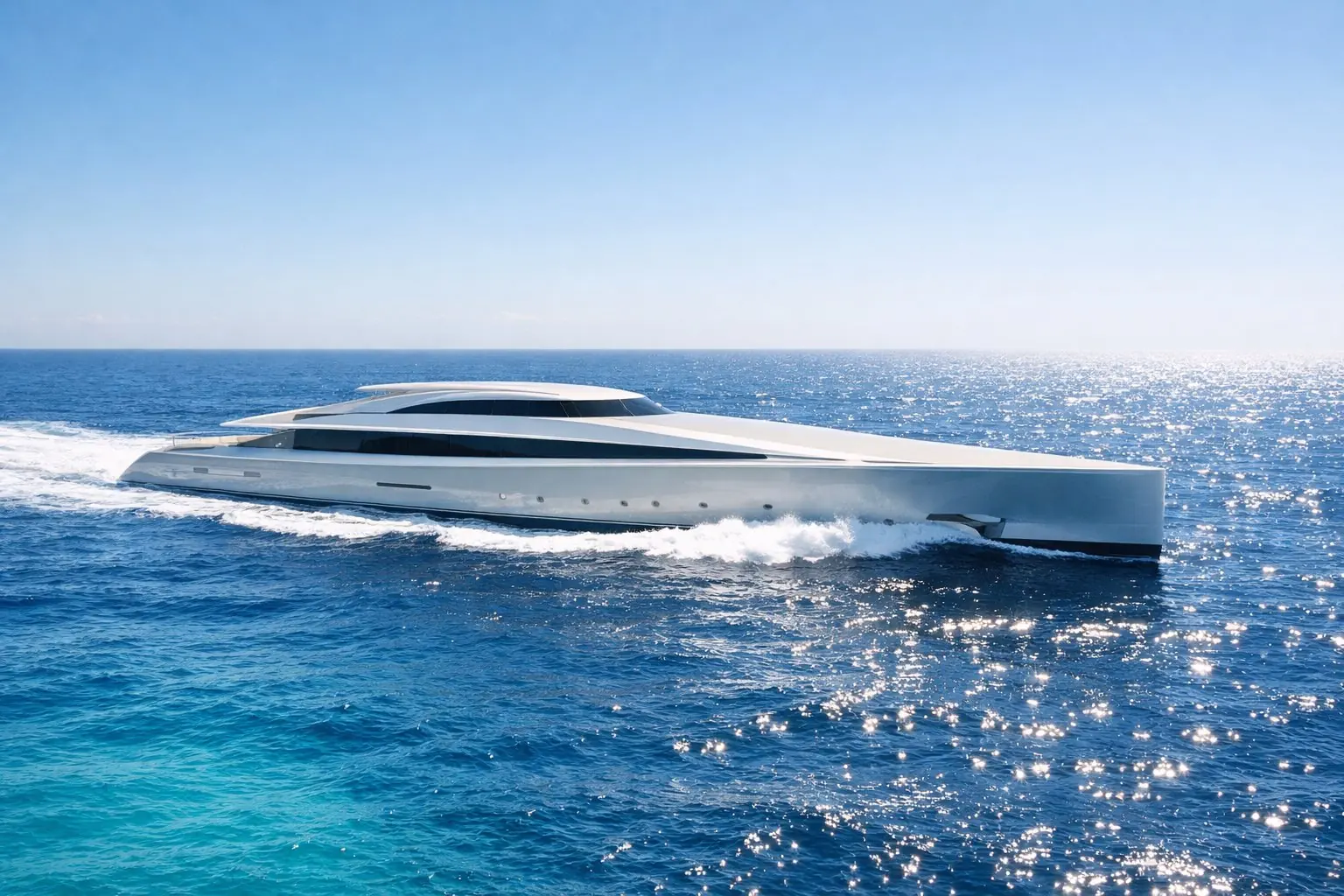
Samy is a 68-metre motor yacht that carries sail assistance without looking like a sailing yacht. The masts retract and the sails are inflatable, and Tony Castro has developed the hull and superstructure so that both disappear into the structure when they are not in use. The stated aims are to keep the exterior lines clean, reduce windage and keep the decks free of the hardware a conventional rig demands.
Alongside the rig, the studio has integrated solar generation and compact wind turbines into the superstructure, presented as a single onboard renewable energy architecture and not as a set of bolted-on additions. The accommodation programme is conventional for the size, with the aft deck built around a swimming pool surrounded by lounge seating and alfresco dining.
The number and what it is worth
The studio's estimate is a saving of roughly 33,000 litres of fuel over a typical round trip between the Mediterranean and the Caribbean, compared with a conventional motor yacht of similar size. At the sort of bunkering price a yacht sees in the Atlantic islands, that is a fuel bill reduction measured in tens of thousands of euros a season. Against the running cost of a 68-metre it is not a material saving.
The saving that matters is in emissions accounting, not in the fuel invoice. With the European Union deciding how yachts sit inside its carbon market and port states adding their own rules, a documented reduction in fuel burned on an ocean passage is becoming a compliance asset. An owner reading this concept should convert the litres into tonnes of carbon dioxide, since that is the unit the regulation uses.
Why sail assistance keeps coming back
Sail-assisted motor yachts have been proposed in every fuel-price cycle since the 1980s and almost none have been built. The reasons are consistent. A rig adds weight aloft and complicates stability, it needs crew who can handle it, it restricts air draught under bridges and in some marinas, and owners have not wanted the look. Castro's answer to the last three of those is to make the rig vanish.
Retractable masts and inflatable sails are not free of consequence though. Anything that retracts is a mechanism, and mechanisms on the exterior of a yacht live in salt water and get used rarely, which is the worst possible duty cycle. The engineering question for a serious buyer is what happens when a mast will not come down, and what class says about the vessel's condition when it will not.
How to treat a concept
No yard has been announced, no owner is behind it and no price has been published. Design studios release concepts to demonstrate capability and to attract exactly the conversation this article is part of, and most never leave the renderings. That does not make them worthless. A concept is the cheapest way to see what a studio believes the next brief looks like.
What Samy says about the current brief is specific. Owners are asking for measurable efficiency, and they are refusing to accept a boat that looks like it is making a point about efficiency. Every visible element of the environmental package here has been engineered out of sight. That is a design constraint, and it tells you what the studio has been hearing from clients. Tony Castro has been drawing sailing and motor yachts for decades, and the studio has a record of taking concepts through to built boats. That does not make Samy a project. It does mean the drawing was done by people who know what a yard will and will not accept.
What owners and crew report
The studio frames this as continuity, not a one-off gimmick
Tony Castro, the studio's founder, said the practice's yachts designed in the 1980s are still sailing, still performing and still owned and loved - using his firm's own track record on longevity to argue Samy's systems are meant to last, not just to generate a launch headline.
Tony Castro, Tony Castro Yacht Design
What is good, and what to watch
Strong points
- Addresses a genuine, growing owner requirementFuel-burn reduction is becoming a compliance asset as the EU's carbon market and port-state rules tighten around yachts, and Samy's studio-estimated saving speaks directly to that shift rather than to styling.
- Solves the image problem that has killed past sail-assist designsEvery visible element of the environmental package is engineered out of sight - retractable masts, inflatable sails - answering the historical objection that owners will not buy a boat that visibly signals it is trying to save fuel.
What to watch
- The engineering risk sail-assist designs always carryA retracting mechanism on the exterior of a yacht lives in salt water and is used rarely, which the article's own reporting flags as the worst possible duty cycle for reliability - the same reason most sail-assisted motor yacht concepts proposed since the 1980s were never built.
- The saving is a design-studio estimate, not a measured resultThe 33,000-litre figure comes from Tony Castro Yacht Design's own modelling. No hull exists to sea-trial the claim against, so it should be read as an engineering estimate rather than a verified number.
Practical detail
| Price | Not published. No yard has been announced and no owner is behind the project, per Superyachts.com's coverage - Samy is a concept, not a commissioned build, so there is no build cost to quote. |
|---|---|
| The claimed saving | Roughly 33,000 litres of fuel on a typical Mediterranean-to-Caribbean round trip, compared with a conventional motor yacht of similar size - Tony Castro Yacht Design's own estimate, confirmed in near-identical terms by both Superyachts.com and a separate BOAT International report on the same reveal, though neither is an independent test of the figure since no hull has been built. |
| What it would take to build | No yard, no owner and no price - the concept exists as a design study only. Design studios routinely release concepts like this to demonstrate capability rather than as a firm commercial offer, and most never leave the renderings, which this article's own reporting makes clear. |
| What is not published | There is no stated build cost, no timeline, no naval architect's structural sign-off on the retractable mast mechanism, and no maintenance-interval figure for the inflatable sail system - all of which would matter to a real buyer before the concept became a contract. |
| Scale and accommodation | 68 metres length overall, 11.9-metre beam, 3-metre draft, about 1,148GT, accommodating 14 guests in 7 cabins with 16 crew plus a captain - figures confirmed by BOAT International's coverage of the reveal. |
Questions this story answers
What happened?
Tony Castro Yacht Design has revealed Samy, a 68-metre sail-assisted motor yacht with inflatable sails on retractable masts, drawn so that neither is visible when stowed. The studio estimates the rig would save around 33,000 litres of fuel on a typical Mediterranean to Caribbean round trip against a conventional motor yacht of the same size. It is a concept, and the interesting part is what it assumes about the owner.
What is good about it?
Addresses a genuine, growing owner requirement. Fuel-burn reduction is becoming a compliance asset as the EU's carbon market and port-state rules tighten around yachts, and Samy's studio-estimated saving speaks directly to that shift rather than to styling.
What should an owner or buyer watch?
The engineering risk sail-assist designs always carry. A retracting mechanism on the exterior of a yacht lives in salt water and is used rarely, which the article's own reporting flags as the worst possible duty cycle for reliability - the same reason most sail-assisted motor yacht concepts proposed since the 1980s were never built.
What do owners and crew report?
Tony Castro, the studio's founder, said the practice's yachts designed in the 1980s are still sailing, still performing and still owned and loved - using his firm's own track record on longevity to argue Samy's systems are meant to last, not just to generate a launch headline. (Tony Castro, Tony Castro Yacht Design)
Who reported this?
BOAT International, Superyachts.com, Tony Castro Yacht Design.
We do this for everyone who loves this world. The people who have spent their lives in it, and the people just discovering it. Yotters exists so that what we learn belongs to all of them.
Nobody pays us for this. No ads, no sponsors, nothing for sale. We just believe the world is a little better when knowledge is shared instead of kept.
If it gave you something today, tell us to keep going. Follow us, leave a like, or write a positive comment. We read every one, and they are what keeps us going.