Azimut Seadeck 9
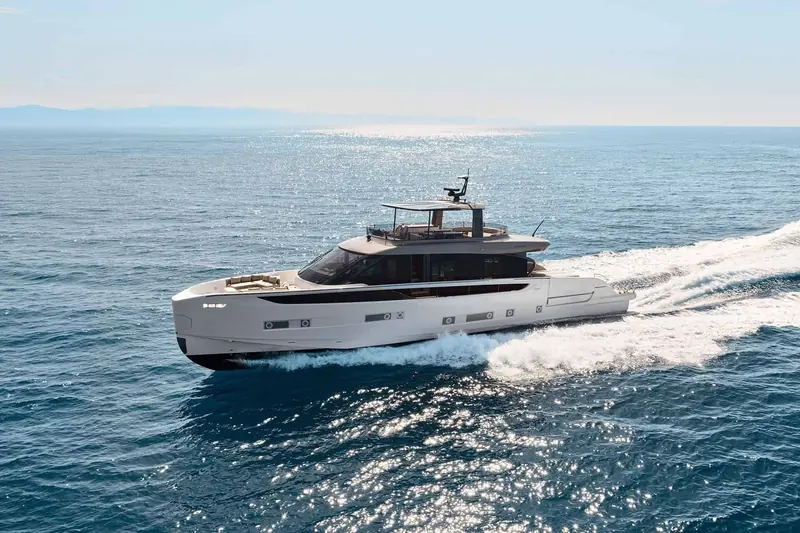
| LOA | 25.60 m |
|---|---|
| Beam | 6.3 m |
| Cabins | 4 to 5 |
| Crew | 3 |
| Engines | 3 x Volvo Penta IPS 1200 or 1350 |
| Top speed | up to 30 knots, cruise up to 24 knots |
| Feature | 60 square-metre Fun Island, plunge pool, 7 square-metre swim platform |
| Efficiency | low-emission yacht, fuel at least 20 per cent below market average, carbon build |
The larger Seadeck
The Seadeck 9 brings the collection's water-focused concept to over 25 metres, with four or five cabins and a crew of three. It carries the family's low-emission character while adding the volume of a larger yacht. It answers owners who want the Seadeck lifestyle at greater scale. The size gives it real presence on the water. For buyers ready to grow, it keeps the water-loving DNA intact.
Alberto Mancini drew the exterior and the studio of Matteo Thun and Antonio Rodriguez shaped the interior. Carbon-fibre superstructures reduce weight by around 30 per cent, opening up interior volume without added displacement. The naval architecture comes from a collaboration with the yard's research team. The 9 is a design-led boat built to sit lightly on the water. It reads as fresh and forward-looking against the fleet.
The Fun Island
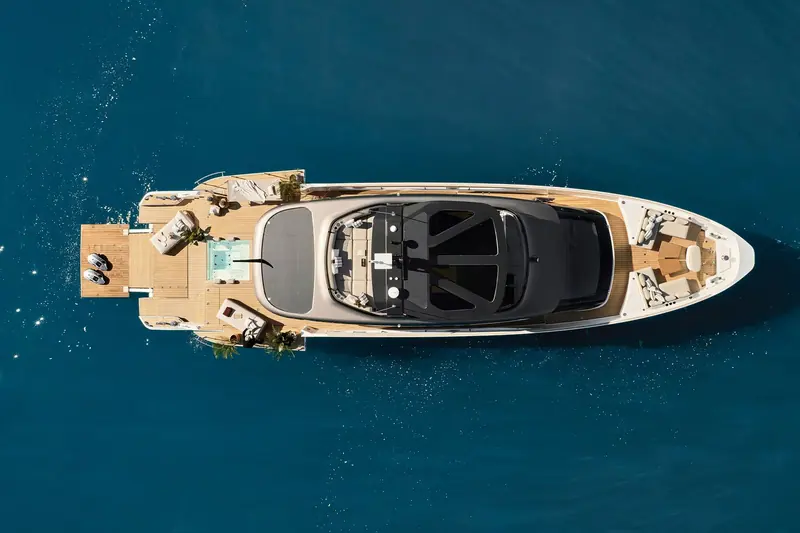
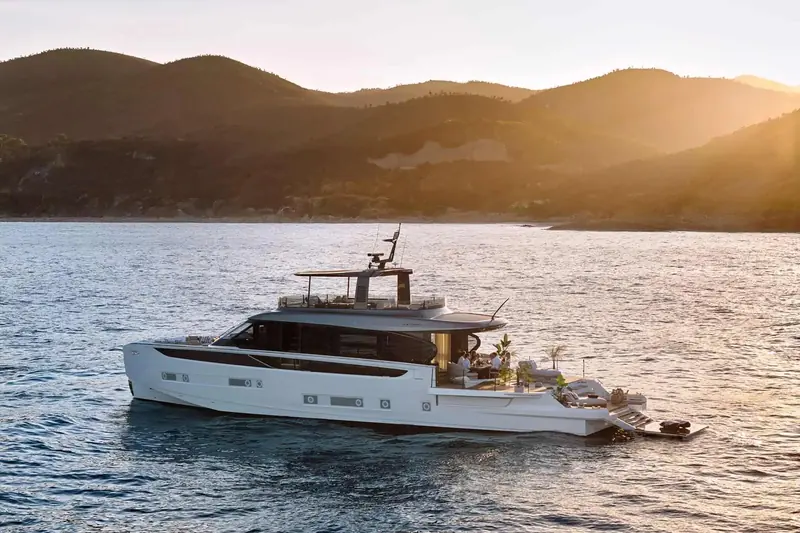
The headline feature is the Fun Island, a run of cascading terraces spanning roughly 60 square metres across three levels at the stern. It incorporates an integrated plunge pool, sliding sundecks and a swim platform of around seven square metres. The effect is a layered beach club that draws guests down towards the sea. Each level serves a different mood at anchor. It is the heart of life aboard on a sunny day.
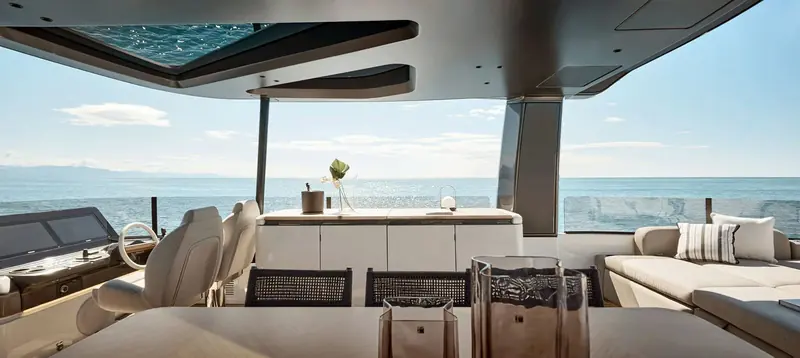
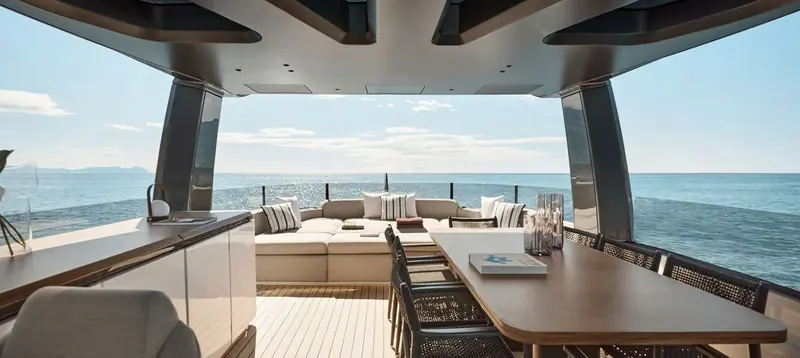
The main deck opens to the cockpit and the terraces for a seamless flow towards the water. The upper deck adds a further social area for sunny days. Wide side decks keep movement safe and easy. Stowage keeps the working gear out of sight. At anchor the 9 is built entirely around time spent in and on the sea.
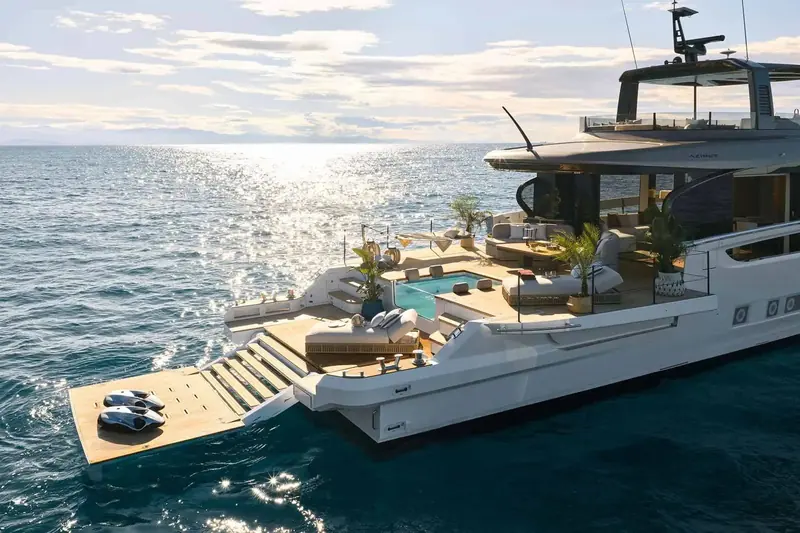
A 60 square-metre Fun Island with a plunge pool and cascading terraces makes the sea the centre of the boat.
Interior and accommodation
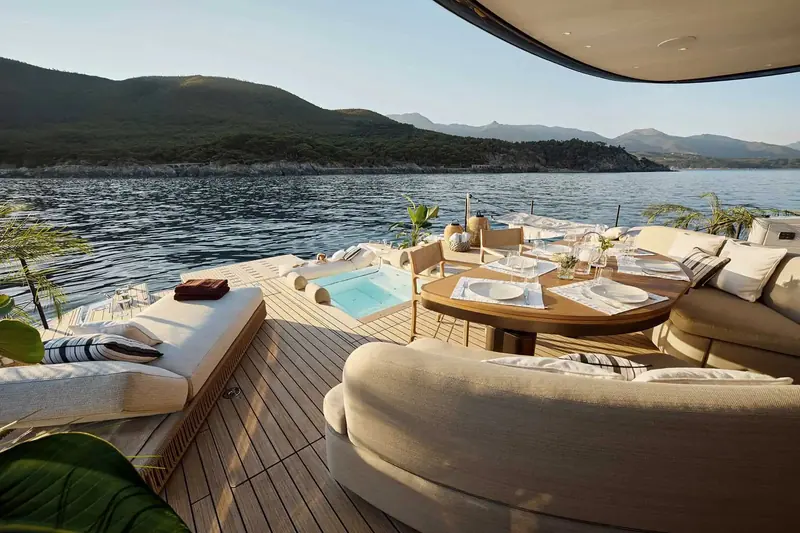
Matteo Thun and Antonio Rodriguez gave the interior a natural, tactile palette in keeping with the boat's environmental brief. Four or five cabins sleep the guests in comfort, and the carbon build frees up genuine volume. Natural light fills the main deck and the cabins below. Hull windows keep the lower deck bright and open. The materials carry the sustainability story into the detailing.
A crew of three is accommodated for longer, crewed programmes. The galley is set up for sociable, extended cruising, and storage suits weeks aboard. The owner's cabin gives a genuine sense of retreat. The layout keeps owner and guest zones distinct for privacy. It pairs a light footprint with real liveable space.
Efficiency and performance
Three Volvo Penta IPS pods, in either 1200 or 1350 form, drive the 9 to a top speed of around 30 knots and a cruise near 24 knots. As a low-emission yacht it targets fuel consumption at least 20 per cent below the market average. The gains come from the hull form and the carbon construction. A 5800-litre fuel supply supports longer cruising between stops. Owners get efficient, quiet running with real capability.
The triple-pod layout brings joystick docking ease to a boat of real size. The hull holds a level, quiet attitude at cruise so guests stay comfortable. Handling stays predictable as conditions build. Close-quarters work stays calm even in a busy harbour. It combines the water-loving concept with sensible running characteristics.
The owner it suits
The Seadeck 9 is for the owner who wants the water-loving Seadeck lifestyle at a larger, more capable scale. Buyers drawn to the Fun Island, the plunge pool and the cascading terraces will find its stern unmatched at the length. It suits families who live around swimming and time at anchor. The size supports a crew and a full guest list. For many buyers it is the flagship expression of the concept, the Seadeck idea grown to full superyacht scale.
It also appeals to owners who want a low-emission story with the volume for longer seasons. The crew of three supports ambitious itineraries. For a summer built around the sea, the 9 is the collection's most complete boat. Its green credentials add resale appeal as the market shifts. Owning one places a buyer at the front of the yard's thinking on efficiency and life at anchor.
Price, tankage and what is not published
Current dealer listings show the Seadeck 9 priced from around EUR 6,400,000 for a 2026 delivery slot up to roughly EUR 7,811,500 depending on configuration. It carries 5,800 litres of fuel and 1,500 litres of water, and is built from carbon fibre and GRP specifically to offset the weight of its triple Volvo Penta IPS installation (1200 or 1350hp pods), which Azimut says cuts fuel burn by at least 20 percent against a similarly sized boat with a traditional hull and shaft propulsion. It is the largest model in the Seadeck range so far, above the smaller Seadeck 6 and Seadeck 7, and the first Seadeck built specifically around a hybrid propulsion system rather than the range's original diesel-only pod layout.
The Seadeck 9 is the flagship of Azimut's first hybrid production series, built around a three-level 'Fun Island' terrace and integrated plunge pool rather than a conventional swim platform. What Azimut has not published is a range figure at any specific cruise speed, and no independent sea trial or owner and charter-guest account was found for this page: a secondary source's reported 27-knot top speed conflicts with the yard's own 30-knot figure, and this page uses the manufacturer's published number because neither could be independently verified. Exterior design is by Alberto Mancini, with the interior by Matteo Thun and Antonio Rodriguez, and the Fun Island terracing itself covers roughly 60 square metres across its three cascading levels, built around an integrated plunge pool rather than a single flat swim platform.
Engines and systems
| Hull | Carbon fibre and GRP composite, deep-V planing hull. |
|---|---|
| Engines | 3 x Volvo Penta IPS 1200 (900hp) or IPS 1350 (1000hp), pod-drive. |
| Fuel tankage | 5,800 litres (1,532 US gallons). |
| Water tankage | 1,500 litres (396 US gallons). |
| Generators, stabilisers, watermaker | Not disclosed in any source found for this page. |
What owners and crew report
Too new for an owner or charter-guest account
Launched in 2025 as the first hull of Azimut's hybrid Seadeck platform, no independent owner or charter-guest testimony was found for this page; press coverage found is exclusively design and launch reporting.
Yotters research desk
What is good, and what to watch
Strong points
- Azimut's first hybrid production series, not a one-off conceptThe carbon-fibre hull is built specifically to offset the weight of a triple-IPS installation and hybrid systems, which Azimut says cuts fuel burn by at least 20 percent versus a similarly sized boat with a traditional hull and shaft propulsion.
- The Fun Island is a genuinely different deck ideaA three-level cascade of terraces built around an integrated plunge pool goes further than a larger swim platform, and is a distinct approach among 25-metre crossovers.
- Triple-pod docking a single pilot can actually useJoystick-controlled triple Volvo Penta IPS pods give docking control that a comparable shaft-drive yacht at this size does not offer.
What to watch
- No independent sea trial has been published for this hullAzimut's own figures (30 knots top speed, 24 knots cruise) are unconfirmed by any independent test found for this page; a secondary source reported a 27-knot top speed that conflicts with the yard's own number, and the two could not be reconciled, so this page uses the manufacturer's published figure and flags the discrepancy.
- No range figure is publishedAzimut states a 5,800-litre fuel tank and a fuel-saving percentage versus the market average, but not a range in nautical miles at any specific speed.
- Too new for an owner or charter-guest accountLaunched in 2025, no independent owner testimony was found for this page; press coverage found is exclusively design and launch reporting, not lived-aboard experience.
Practical detail
| New price | From about EUR 6,400,000 for a 2026 delivery slot to roughly EUR 7,811,500 depending on configuration, per current dealer listings. |
|---|---|
| Launch | 2025, the first hull of Azimut's hybrid Seadeck platform at this 25.6-metre size. |
| What is not published | A range figure at any cruise speed, an independently confirmed sea trial, and any owner or charter-guest account. |
Questions owners ask
How big is the Azimut Azimut Seadeck 9?
LOA: 25.60 m. Beam: 6.3 m.
Who is the Azimut Azimut Seadeck 9 for?
The owner who wants the water-loving Seadeck lifestyle at larger scale, with a plunge pool and cascading terraces at the stern.
What is the Azimut Azimut Seadeck 9 good at?
Azimut's first hybrid production series, not a one-off concept. The carbon-fibre hull is built specifically to offset the weight of a triple-IPS installation and hybrid systems, which Azimut says cuts fuel burn by at least 20 percent versus a similarly sized boat with a traditional hull and shaft propulsion.
What are the drawbacks of the Azimut Azimut Seadeck 9?
No independent sea trial has been published for this hull. Azimut's own figures (30 knots top speed, 24 knots cruise) are unconfirmed by any independent test found for this page; a secondary source reported a 27-knot top speed that conflicts with the yard's own number, and the two could not be reconciled, so this page uses the manufacturer's published figure and flags the discrepancy.
What do owners and crew report about the Azimut Azimut Seadeck 9?
Launched in 2025 as the first hull of Azimut's hybrid Seadeck platform, no independent owner or charter-guest testimony was found for this page; press coverage found is exclusively design and launch reporting. (Yotters research desk)
Who it is for: The owner who wants the water-loving Seadeck lifestyle at larger scale, with a plunge pool and cascading terraces at the stern.