Fly 68
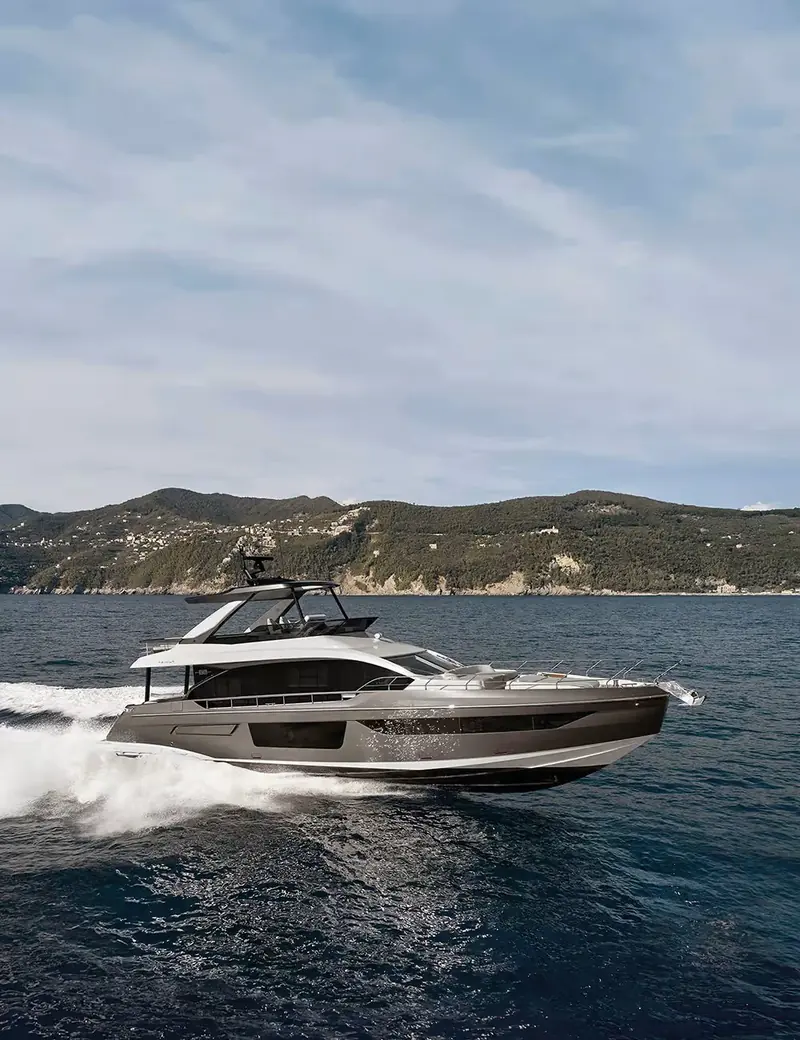
| LOA | 20.98 m (68 ft 10 in) |
|---|---|
| Beam | 5.23 m |
| Draft | 1.60 m |
| Engines | 2 x Volvo Penta IPS 1350, 1,000 hp each |
| Top speed | up to 32 knots, cruise 27 knots |
| Range | 424 nm at 15.2 knots, 336 nm at 27 knots |
| Cabins | 4 guest plus 1 crew, 8 guest berths |
| Design | Alberto Mancini (exterior), Achille Salvagni Architetti (interior) |
A modern take on the flybridge
The Fly 68 belongs to Azimut's Flybridge collection, the family that carries the classic three-level cruiser at the core of the brand's business. At 20.98 metres it sits in a popular size for owners who want a full flybridge without moving into superyacht scale. The layout offers four guest cabins and a crew cabin, enough for family cruising and occasional guests. Since its premiere in 2021 it has been one of the core models keeping the flybridge line current.
The flybridge format is where Azimut sells in the greatest numbers, and the 68 is a mainstream expression of it. It brings the group's carbon construction and modern styling into a size that many step-up owners aspire to. The model shows how the traditional three-deck cruiser has evolved under Azimut, with lower lines and more glass than the type once had. For the brand it is a dependable seller, one of the volume models that keeps the range moving. It carries the current generation of the yard's flybridge design in the popular size just below 70 feet.
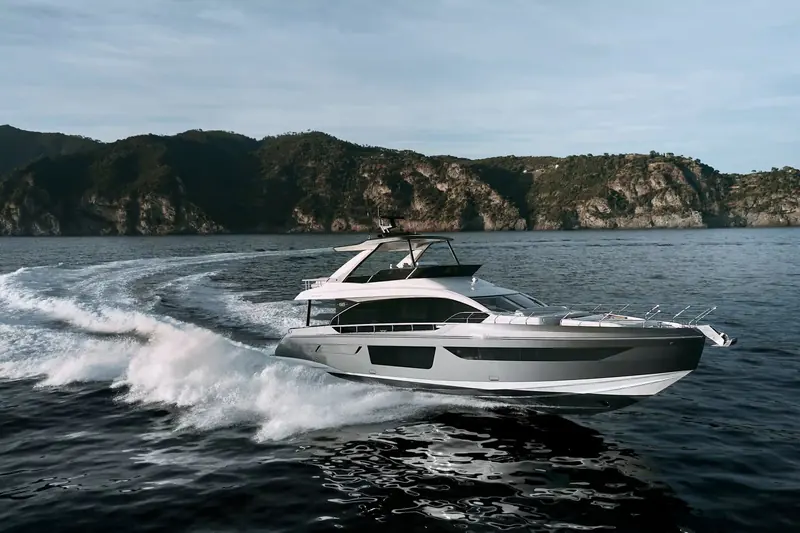
Lower lines and more glass
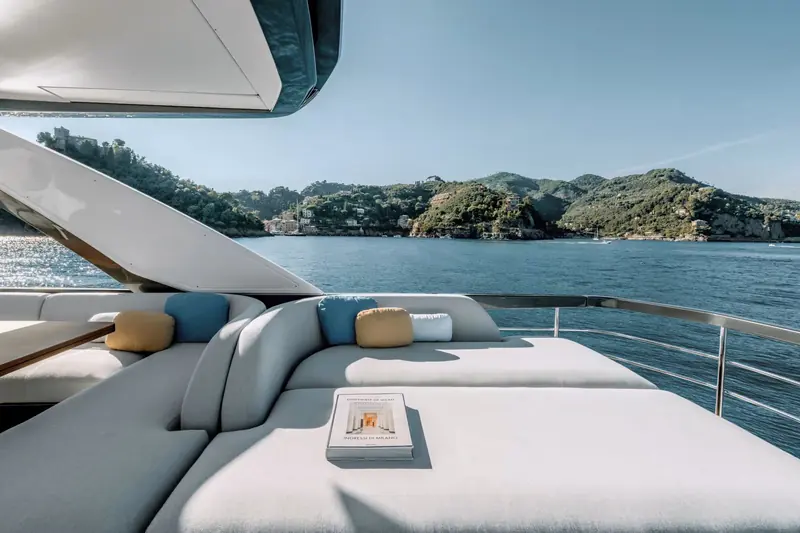
Alberto Mancini shaped the exterior, softening the tall stance that flybridge yachts traditionally carry into something sleeker. Long side windows and a stretched profile give the 68 a more contemporary look than earlier boats of the type. The flybridge itself is a large social deck set above the main level, with a helm, seating and space to sunbathe. Wide side decks keep movement around the boat safe and easy.
Carbon fibre in the superstructure is what lets Mancini lower the roofline while keeping the volume owners expect. Building light up high improves stability and helps the yacht carry its generous glazing. The aft cockpit connects to a bathing platform for swimming and tender handling. The result is a flybridge yacht that looks lower and faster than the boxier cruisers that came before it.
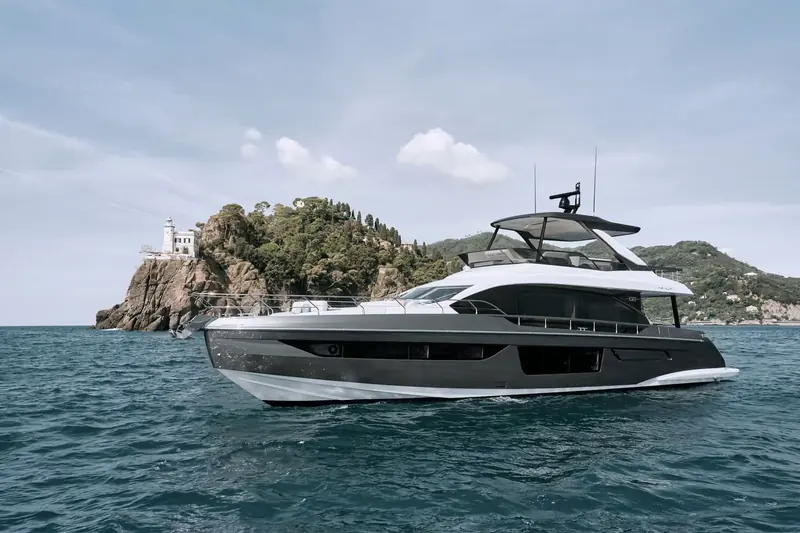
A modern flybridge on Volvo pods, low and quick, with a Salvagni interior over four cabins.
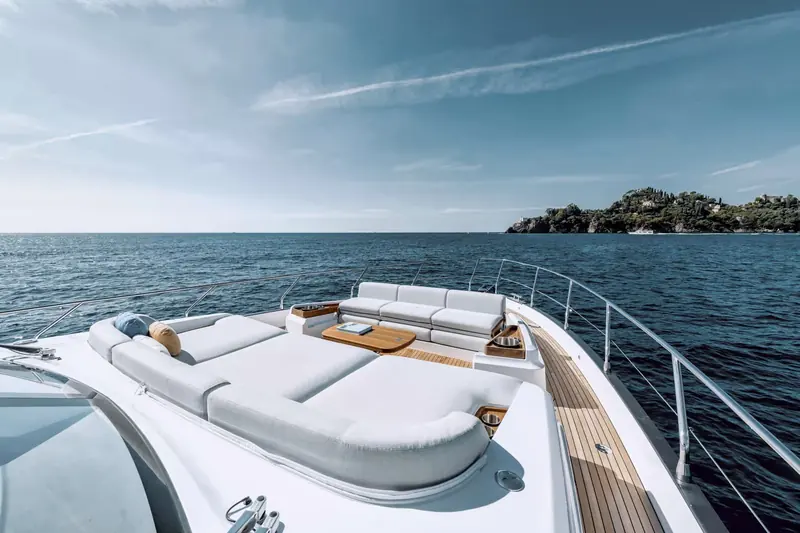
Achille Salvagni below deck
The interior is by Achille Salvagni Architetti, the same Rome studio behind several larger Azimut models, which brings a refined and sculptural feel to a boat of this size. Four guest cabins sit below, including a full-beam master amidships, with a crew cabin aft. Berths run to eight for guests and two for crew, a practical spread for family use with room for friends. Salvagni's materials and forms lift the interior above the standard production feel.
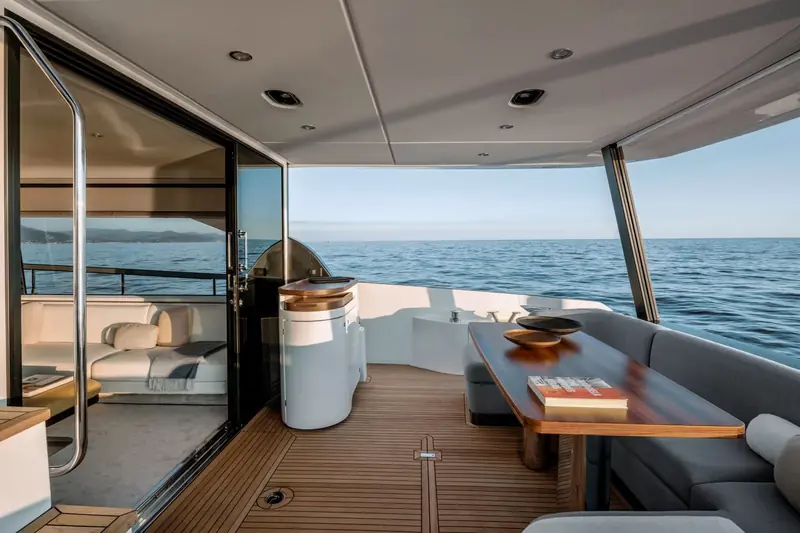
The main deck keeps an open plan between the saloon and the helm, with large windows drawing in light and view. A beam of 5.23 metres gives enough width for comfortable lounging without the bulk of a superyacht. The fit-out balances everyday usability against a sense of quiet luxury. It is an interior that suits both long weekends and extended holidays aboard. The full-beam master amidships takes advantage of the widest part of the hull for a larger owner's suite.
Volvo pods and thirty-two knots
The Fly 68 is driven by twin Volvo Penta IPS 1350 pod units, each rated at 1,000 hp, a package known for efficiency and easy close-quarters handling. Top speed reaches up to 32 knots with a cruise around 27 knots, giving the yacht genuine pace for its class. The IPS pods make docking simpler through joystick control, a real help for owner-operators. The hull was developed by P. Ausonio with the group's research team.
Efficiency comes from the pods working together with the yacht's light composite build. At a relaxed 15.2 knots the 68 can cover about 424 nautical miles, and at a 27 knot cruise it still holds around 336 nautical miles. Carbon in the superstructure keeps weight low and sharpens both ride and stability. For an owner this means a flybridge cruiser that is quick and easy to handle for its size. The pod installation also frees up volume aft that a conventional shaft line would otherwise take.
The step-up owner's flybridge
The Fly 68 is aimed at the experienced owner stepping up towards the 70 foot mark who wants a full flybridge and four cabins. Its IPS pods and joystick docking make it realistic to run with light crew or even short-handed on calm days. The size suits family cruising in the Mediterranean and similar waters with room to host guests. It is a natural progression for someone moving up from a smaller Azimut or a rival cruiser.
The 68 competes in one of the busiest parts of the market, against flybridge yachts from several established builders. Its case rests on the Salvagni interior and the modern Mancini styling, backed by the reach of the Azimut service network. The carbon construction and IPS efficiency give it a technical edge over older designs in the class. For a mainstream luxury buyer it is a safe and stylish choice at this length. For many owners the 68 represents the practical top of the mainstream flybridge market.
What an independent sea trial actually found
Motor Boat & Yachting's Alan Harper drove a UK-spec boat to 31.9 knots and logged 296nm of range at a 23-knot cruise burning 230 litres an hour, close to Azimut's own claim of 27 knots and 336nm on the same tank. He found the hull cornered like a thoroughbred and rode chop with minimal slamming, but rated the lower helm's sightlines only adequate for crowded waters and found the fourth cabin short on stowage. The same reviewer, testing a US-spec boat for Power & Motoryacht, reported a very similar result: just under 32 knots even loaded with fuel and water.
Azimut's own chart also lists a slower cruise of 15.2 knots for 424nm, a genuinely long leg for a 68-footer on 3,700 litres of fuel. What none of the three sources agree on is price: a UK test boat came in at GBP 1,754,349 ex-VAT and a US test boat at USD 2.99 million, prices that reflect two different specifications rather than one fixed cost. Buyers should treat any single headline price for this model as one boat's as-tested figure, not a base rate.
Engines and systems
| Engines | Twin Volvo Penta IPS1350 pod drives, 1,000hp each (Azimut spec, confirmed by both sea trials) |
|---|---|
| Top speed | Up to 32 knots claimed (Azimut); 31.9kt and 'just below 32kt' measured on two independent sea trials |
| Cruise speed / range | 27kt fast cruise / 336nm (Azimut spec); sea trial at 23kt recorded 296nm at 230 l/hr; slow cruise 15.2kt / 424nm (Azimut spec) |
| Hull / superstructure | GRP hull, carbon-fibre superstructure -- Azimut states this cuts superstructure weight by up to 30% versus a conventional build |
| Stabilisation | Seakeeper gyro stabiliser fitted, positioned aft of the jack-shafted IPS drives (Power & Motoryacht sea trial) |
| Not published | Generator make/output and stabiliser model number are not confirmed by the builder or either sea trial |
What owners and crew report
Lower helm visibility is only adequate in crowded waters
After driving the boat, the reviewer wrote that sightlines from the lower helm were "OK on passage but is no better than adequate for crowded waters" -- a firsthand handling note, not a spec-sheet claim.
Alan Harper, Motor Boat & YachtingThe fourth cabin and port twin cabin are tight
The same test found the fourth cabin short on stowage and the port twin cabin "rather crammed in" for floor space, while praising the boat's acceleration and cornering on the same run.
Alan Harper, Motor Boat & YachtingThe hull rides chop with minimal slamming and corners precisely
On a separate US test boat, the reviewer reported the medium-V hull "accelerated with great verve, cornered precisely, rode the minimal chop we encountered with minimal slamming," and stayed close to its rated 32-knot top end even loaded with fuel and water.
Alan Harper, Power & Motoryacht
What is good, and what to watch
Strong points
- Performance holds up under an independent test, not just on paperTwo separate sea trials, on two different boats, both measured within a knot of Azimut's claimed 32-knot top end (31.9kt and 'just below 32kt'), with the tester praising cornering and ride quality rather than just citing the spec sheet.
- Efficient IPS pod propulsion gives real range for a 68-footerAzimut's own chart shows 424nm at a 15.2-knot slow cruise on 3,700 litres of fuel, and the pod drives give the low-speed handling and docking control twin-shaft flybridge boats of this size usually lack.
- An unusually strong design bench for a production flybridgeAlberto Mancini (exterior), Achille Salvagni (interior) and P.L. Ausonio with Azimut's own R&D department (hull) is a stronger, more independently credited design team than most yards attach to a mid-size series boat.
What to watch
- Helm visibility and two cabins drew real criticism from the person who drove itThe same reviewer who praised the boat's handling also found lower-helm sightlines merely adequate in crowded waters, and flagged the fourth cabin's stowage and the port twin cabin's floor space as cramped.
- Published range figures do not agree with each otherAzimut's own chart lists 336nm at a 27-knot fast cruise, while a sea trial at 23 knots recorded 296nm at 230 l/hr -- different speeds and conditions, so neither number should be read as a fixed guarantee of range at any given throttle setting.
- Price as tested varies enormously by market and specA UK-spec test boat priced at GBP 1,754,349 ex-VAT and a US-spec test boat at USD 2.99 million are not directly comparable base prices -- Azimut does not publish a single list price, so any headline figure should be read as one boat's as-tested price, not the model's cost.
Practical detail
| Price as tested (UK, ex-VAT) | GBP 1,754,349 (Motor Boat & Yachting test boat) |
|---|---|
| Price as tested (US) | USD 2.99 million (Power & Motoryacht test boat) |
| Cabins / berths | 4 guest cabins + 1 crew cabin; 8 guest berths + 2 crew berths (Azimut spec) |
| Fuel / water capacity | 3,700 litres fuel, 1,000 litres water (Azimut spec) |
| Noise at cruise | 66 dB(A) recorded on sea trial (Motor Boat & Yachting) |
| What is not published | Azimut does not list a single base price; both figures above are one broker's or one magazine's as-tested price for a specific boat, not a fixed MSRP |
Questions owners ask
How big is the Azimut Fly 68?
LOA: 20.98 m (68 ft 10 in). Beam: 5.23 m.
Who is the Azimut Fly 68 for?
A step-up owner heading towards 70 feet who wants a full flybridge, four cabins and easy IPS handling for family cruising.
What is the Azimut Fly 68 good at?
Performance holds up under an independent test, not just on paper. Two separate sea trials, on two different boats, both measured within a knot of Azimut's claimed 32-knot top end (31.9kt and 'just below 32kt'), with the tester praising cornering and ride quality rather than just citing the spec sheet.
What are the drawbacks of the Azimut Fly 68?
Helm visibility and two cabins drew real criticism from the person who drove it. The same reviewer who praised the boat's handling also found lower-helm sightlines merely adequate in crowded waters, and flagged the fourth cabin's stowage and the port twin cabin's floor space as cramped.
What do owners and crew report about the Azimut Fly 68?
After driving the boat, the reviewer wrote that sightlines from the lower helm were "OK on passage but is no better than adequate for crowded waters" -- a firsthand handling note, not a spec-sheet claim. (Alan Harper, Motor Boat & Yachting)
Design
| Exterior | Alberto Mancini |
|---|---|
| Interior | Achille Salvagni (Salvagni Architetti) |
| Naval architecture | Pierluigi Ausonio Naval Architecture & Azimut Yachts R&D Dept. |
Who it is for: A step-up owner heading towards 70 feet who wants a full flybridge, four cabins and easy IPS handling for family cruising.