Magellano 60
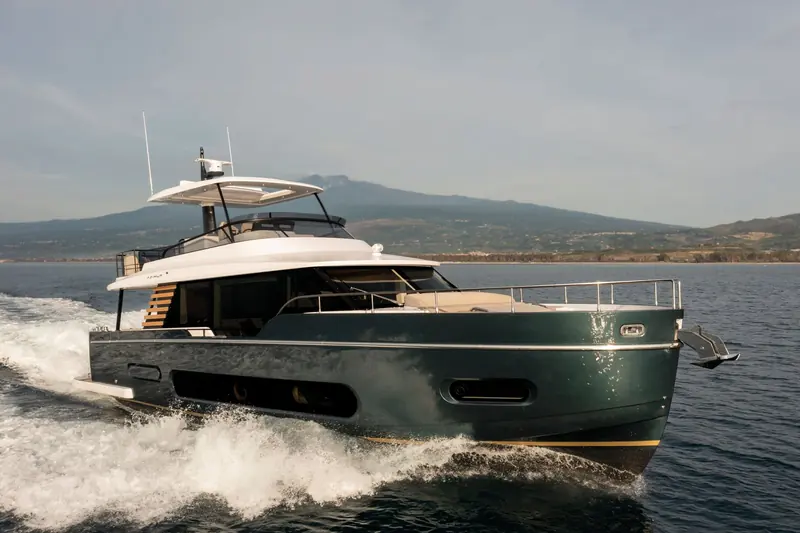
| LOA | 18.47 m (60 ft 7 in) |
|---|---|
| Beam | 5.15 m |
| Draft | 1.37 m |
| Engines | 2 x MAN i6, 730 hp |
| Top speed | 26 knots, cruise 18 knots |
| Range | 464 nm at 11.2 knots, 326 nm at 22 knots |
| Cabins | 3 guest plus 1 crew |
| Design | Ken Freivokh (exterior), Semiplaning Dual Mode Hull |
The compact end of the long-range line
The Magellano 60 is the entry point to Azimut's long-range family, the series that steps away from outright speed in favour of range and comfort in a seaway. At 18.47 metres it brings the Magellano philosophy into a more manageable and affordable size than its larger siblings. The range was conceived to let owners cruise further and in a wider band of weather than a typical planing yacht. The 60 distils that idea into a three-cabin cruiser with a single crew cabin.
Magellano occupies a distinct corner of the Azimut world, one built around passage-making. The line is about the quiet competence of a boat that can keep going when the weather turns. The 60 makes that character reachable for owners who plan longer trips on a more modest budget. It is the model that shows the range does not need great length to deliver on its promise. That mix of reach and comfort has built Magellano a following of its own within the Azimut catalogue.
Ken Freivokh's working-boat cues
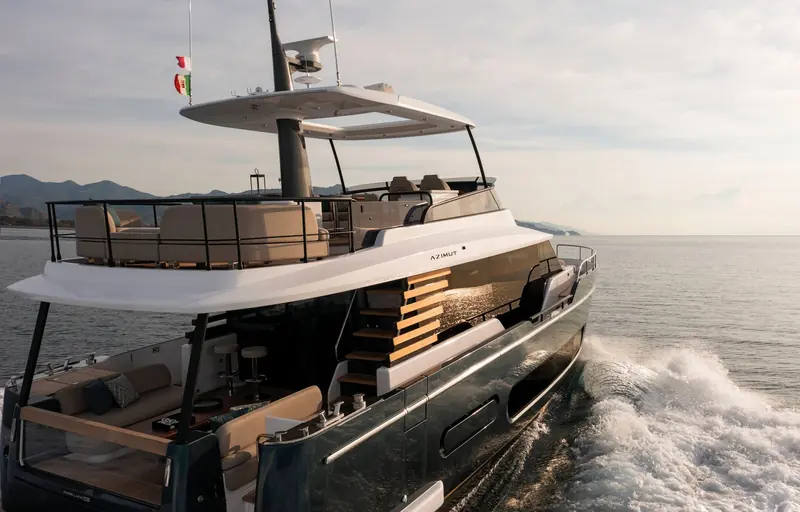
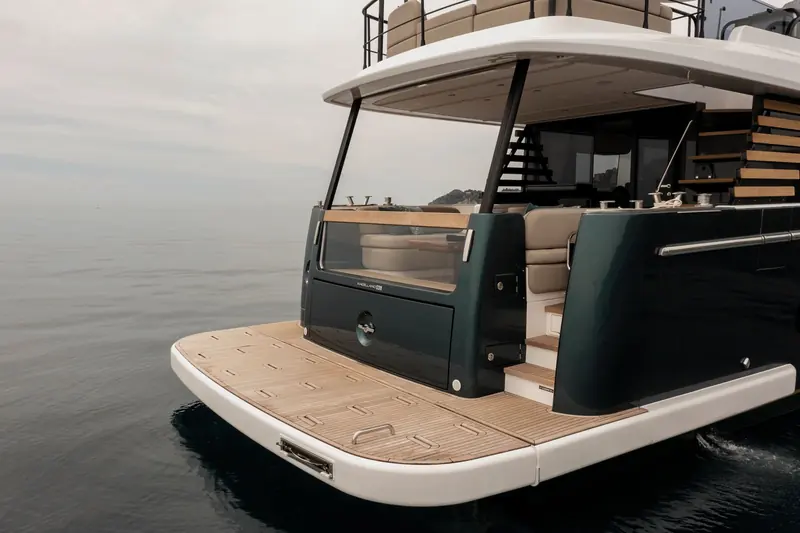
The exterior comes from Ken Freivokh, the British designer long associated with the Magellano concept, and it carries a look closer to a purposeful motor cruiser than a sleek sport yacht. The lines are upright and honest, with generous freeboard and protected deck spaces suited to time spent at sea. A near plumb bow and a substantial hull form give the 60 the stance of a boat built to work in open water. The styling favours function and long-term appeal.
For all that practicality the 60 is far from plain. Freivokh gives it clean modern surfaces and large windows that keep the interior connected to the view. Wide walkaround decks and a sheltered cockpit make it easy to move around safely underway. The design intent throughout is a yacht an owner can use in more months of the year and in rougher water than a fair-weather cruiser. A full-load displacement close to 35 tonnes gives the 60 the heft to stay steady when a sea gets up.
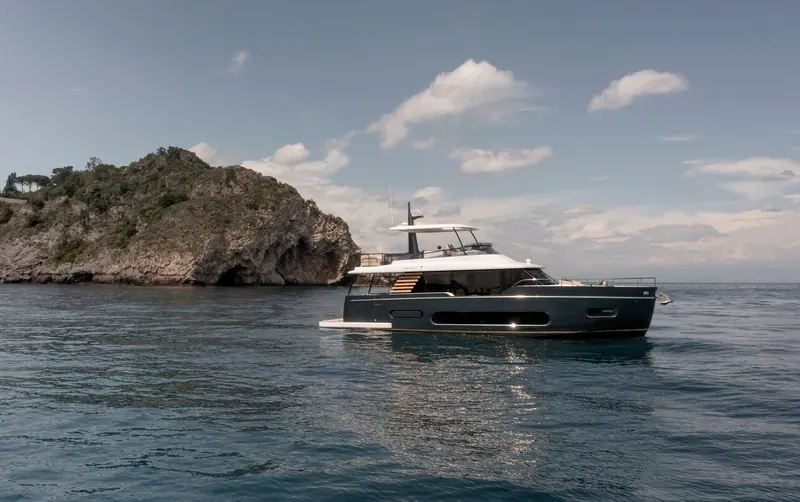
The smallest Magellano, an 18 metre cruiser built for distance rather than the marina.
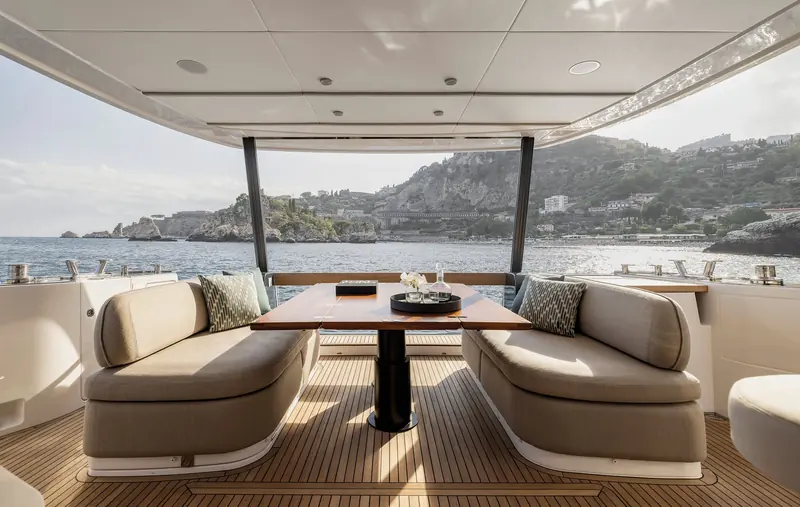
Three cabins built around the view
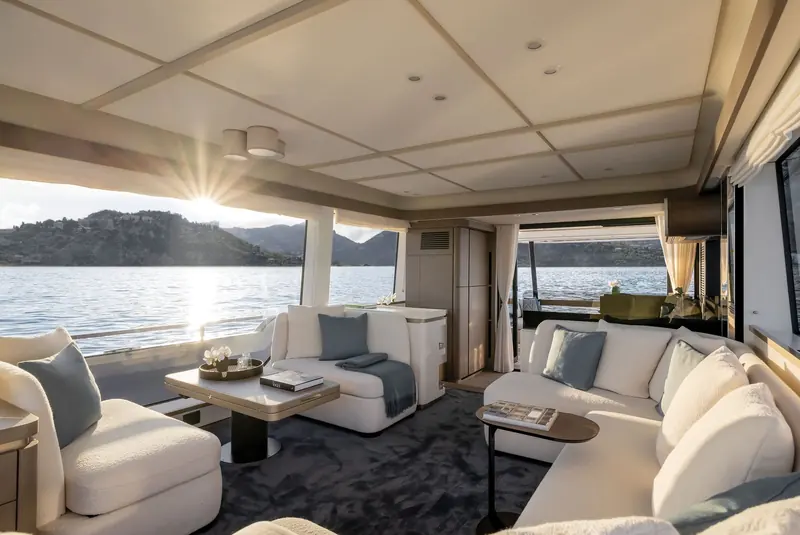
The interior layout puts three guest cabins below along with a single crew cabin, a sensible spread for a couple or a family cruising over distance. Large hull windows bring daylight into the accommodation and reinforce the sense of connection to the sea. The main deck keeps the galley and saloon close to the helm, which helps on longer watches when the owner is running the boat. Azimut handled the interior design of the 60 in house.
Comfort at sea drives the choices below. The three head compartments and generous stowage reflect a boat meant for real trips rather than short hops. Materials are chosen to wear well through years of extended use in a marine environment. The overall feel is practical and warm, an interior that supports long stretches of living aboard. Three separate head compartments serve the accommodation, a level of provision aimed at longer time on the water.
The Dual Mode hull at the core
The core of the Magellano 60 is its Semiplaning Dual Mode Hull, developed with naval architects Profjord and the Azimut research department. The shape is efficient both at slow displacement speeds for long range and up on the plane when the owner wants to press on. Twin MAN i6 engines of 730 hp give a top speed of around 26 knots and an economical cruise near 18 knots. That flexibility is the aim of the whole design.
Range is the clearest benefit of this hull. At a gentle 11.2 knots the 60 can cover about 464 nautical miles, and even at a faster 22 knot clip it holds a useful 326 nautical mile reach. Those figures let an owner plan passages that a pure planing yacht of similar length could not attempt. The engineering is tuned for efficiency and steadiness across long distances.
The owner who wants to go further
The Magellano 60 is for the owner who measures a yacht by where it can take them, not by how fast it gets there. It suits couples and small families who want to explore beyond the usual coastal hops and stay out in a wider range of conditions. Many Magellano owners are experienced hands who value sea-keeping and self-sufficiency. The single crew cabin means the boat can be run with light professional help or by a capable owner.
In the market the 60 sits apart from the fast cruisers that fill most of the segment. Its natural rivals are other long-range and trawler-style yachts rather than planing flybridges. The Azimut name and the Freivokh design give it a strong footing among that smaller field, backed by the group's build quality. For a buyer set on distance and comfort, the 60 is one of the few boats of its length built expressly for the job.
Engines and systems
| Engines | Twin MAN i6 730hp diesels, HVO-renewable-diesel compatible |
|---|---|
| Stabiliser | Seakeeper NG9 gyro as tested; NG13 offered as a larger option |
| Fuel capacity | 3,650 litres |
| Draught | 1.37m (4ft 6in), kept shallow by half-tunnel shafts for Bahamas-style cruising |
| Hull | Semiplaning Dual Mode hull, developed with Pierluigi Ausonio Naval Architecture and Azimut's R&D department |
What owners and crew report
Handling improves sharply once the gyro is engaged
Running in a chop with the Seakeeper gyro on, the boat "suddenly felt as if there were no waves at all" after a course change - the clearest evidence yet that the stabiliser, not the hull alone, is doing the work behind the Magellano range's reputation for comfort.
Shane Scott, Power & MotoryachtThe hull is more nimble than its length suggests
Despite being a semi-displacement cruiser built for range rather than speed, the 60 proved "surprisingly nimble" with responsive steering, and settled onto plane at 20 knots comfortably enough to run there all day.
Phil Draper, Yachting MagazineThe saloon feels larger than her length suggests, at the cost of a lower profile
Azimut's beam management gives the 60's saloon roughly 10 per cent more interior volume than the 60-foot flybridge model in the parallel Azimut range, but the trade is a lower, more traditional profile than buyers used to Azimut's flybridge line might expect.
Alex Smith, Motor Boat & Yachting
What is good, and what to watch
Strong points
- The gyro-plus-hull combination delivers the range's core promiseTwo independent testers reported a composed, near-flat ride in a seaway with the Seakeeper engaged, which is the specific claim the Magellano range is built around - long-distance comfort in weather a planing flybridge would not shrug off as easily.
- She is more capable at speed than her looks suggestTesters ran her comfortably at a 20-knot cruise and briefly saw over 27 knots, well above what the semi-displacement, trawler-influenced styling implies, while a Bahamas-friendly 1.37m draught (thanks to half-tunnel shafts) keeps shallow anchorages open.
What to watch
- The HVO-capable engines don't yet deliver on their own promiseThe 60 can run on HVO renewable diesel for up to a 60-90 per cent emissions cut, but Power & Motoryacht's own tester noted HVO costs roughly 10 per cent more than regular diesel and has no meaningful commercial distribution network yet, so the option is closer to a future-proofing spec line than a usable feature today.
- A single crew cabin caps how the 60 can be run long-termWith three guest cabins and one crew cabin, the 60 suits an owner-operator or a couple running light professional help, but it cannot carry the two or three full-time crew that flybridge and sportfish rivals of the same length routinely accommodate.
Practical detail
| Base price | Around EUR 1.65 million ex VAT; typical on-the-water price with VAT and options runs roughly EUR 2.0-2.5 million |
|---|---|
| Fuel capacity | 3,650 litres |
| Stabiliser | Seakeeper NG9 gyro as tested; the larger NG13 is offered as an option |
| Alternative fuel | HVO renewable diesel compatible (60-90 per cent lower emissions than standard diesel), though HVO runs about 10 per cent more per litre and has little retail distribution today |
| What is not published | Published sea-trial range figures vary widely between outlets, from roughly 330nm at a 20-knot cruise to well over 800nm at a slow cruise, so no single reconciled range table exists - ask the yard for a written fuel-burn curve before planning a specific passage |
Questions owners ask
How big is the Azimut Magellano 60?
LOA: 18.47 m (60 ft 7 in). Beam: 5.15 m.
Who is the Azimut Magellano 60 for?
A couple or small family set on long-range cruising and sea-keeping, happy to run the boat with light crew or on their own.
What is the Azimut Magellano 60 good at?
The gyro-plus-hull combination delivers the range's core promise. Two independent testers reported a composed, near-flat ride in a seaway with the Seakeeper engaged, which is the specific claim the Magellano range is built around - long-distance comfort in weather a planing flybridge would not shrug off as easily.
What are the drawbacks of the Azimut Magellano 60?
The HVO-capable engines don't yet deliver on their own promise. The 60 can run on HVO renewable diesel for up to a 60-90 per cent emissions cut, but Power & Motoryacht's own tester noted HVO costs roughly 10 per cent more than regular diesel and has no meaningful commercial distribution network yet, so the option is closer to a future-proofing spec line than a usable feature today.
What do owners and crew report about the Azimut Magellano 60?
Running in a chop with the Seakeeper gyro on, the boat "suddenly felt as if there were no waves at all" after a course change - the clearest evidence yet that the stabiliser, not the hull alone, is doing the work behind the Magellano range's reputation for comfort. (Shane Scott, Power & Motoryacht)
Design
| Exterior | Ken Freivokh |
|---|---|
| Interior | Azimut Yachts in-house design team |
| Naval architecture | Pierluigi Ausonio Naval Architecture & Azimut Yachts R&D Dept. (Dual Mode displacement/planing hull) |
Who it is for: A couple or small family set on long-range cruising and sea-keeping, happy to run the boat with light crew or on their own.