Polaris
| LOA | 70.2 m |
|---|---|
| Gross tonnage | 1,542 GT |
| Hull | Steel hull, aluminium superstructure |
| Ice class | Finnish-Swedish ice class with twin de-icing systems |
| Naval architecture | Arrabito Naval Architects |
| Design | Enrico Gobbi, Team for Design (exterior and interior) |
| Propulsion | Diesel-electric with Kongsberg Azipull thrusters |
| Range and delivery | Over 6,500 nm at 12 knots, delivered 2021 |
The yard's largest build
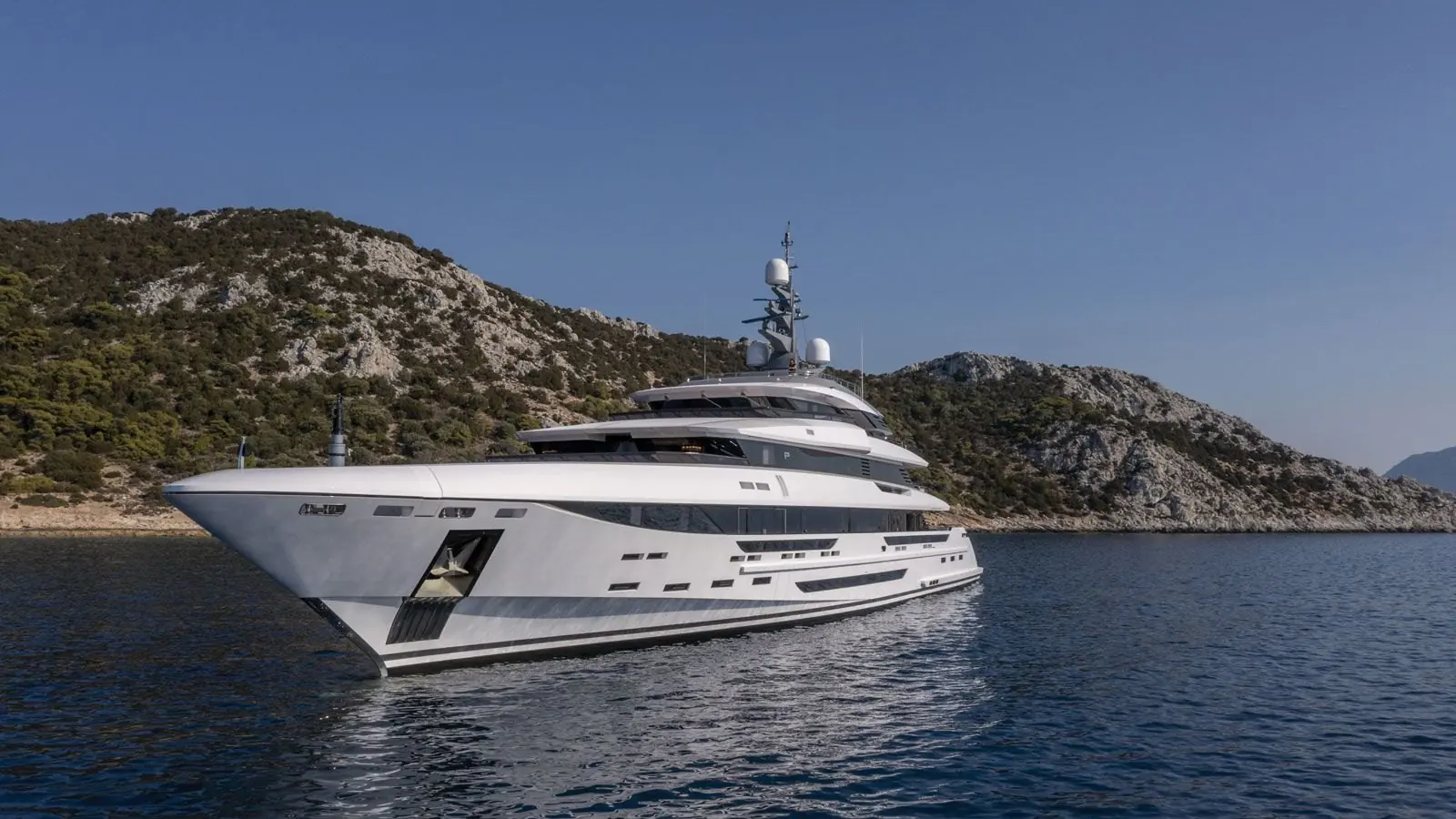
When Polaris slipped out of Viareggio in 2021, she was the largest yacht Rossinavi had ever built, and she still ranks as the flagship of the fleet. At 70.2 metres and 1,542 GT, she gave the family yard a genuine full-size explorer to set against the big Northern European builders. The project ran for years under the codename King Shark before it was revealed, and she has since been renamed Polestar. For a yard that had made its name on displacement cruisers and fast aluminium boats, a vessel of this scale and purpose was a real step up.
What set her apart was the brief. The owner wanted a yacht able to reach the ice and the polar routes, yet still able to sit comfortably off Porto Cervo in August. That meant Rossinavi had to marry a reinforced, ice-rated hull with the finish and layout of a warm-water superyacht, a combination few yards attempt at this length. Pulling that off in Viareggio, far from the cold-water builders of Northern Europe, was itself a statement of intent.
Enrico Gobbi's restrained hand
The exterior and interior both came from Enrico Gobbi of Team for Design, with naval architecture by Arrabito. Gobbi gave Polaris a long, purposeful profile that reads as a serious sea boat with no wasted drama. The steel hull carries an aluminium superstructure, and the ice reinforcement is worked into the structure rather than bolted on afterwards. Almost every line on the boat is there to serve the sea rather than the marina.
Inside, Gobbi leaned on an art deco vocabulary, with custom furniture, crystal chandeliers and a good deal of bespoke joinery. The look stays calm and low on gloss, in keeping with a yacht meant for long passages far from a shipyard. Large glazing keeps the interior connected to the cold, dramatic scenery the boat was designed to reach. It is a warmer, more classical register than the cool minimalism of many modern explorers, and it suits a home built for harsh places.
The flagship that proved a Viareggio family yard could build a true polar explorer.
A boat built to be lived in
The owner's deck is the heart of the layout. It holds a full-beam suite with a forward-facing bedroom that looks straight over the bow, a private balcony, a walk-in wardrobe and twin bathrooms. A dedicated lounge with its own wine store sits alongside, so the owner's party can retreat well away from the guest cabins. The whole deck works as a private apartment, sealed off from the working parts of the yacht.
Wellness was given real space rather than a token gym. Polaris carries a spa with panoramic glazing, a hammam, a massage room and a gym that opens onto a terrace. In a departure from the usual arrangement, the formal dining room was dropped in favour of a cinema, a choice that says a good deal about how the owner planned to use the boat. Owners of long-range yachts tend to value these quiet, restorative spaces far more than another formal saloon.
Rated for ice, tuned for range
Polaris is built to a Finnish-Swedish ice class, with a reinforced hull and two separate de-icing systems. Power comes from a diesel-electric arrangement driving Kongsberg Azipull thrusters, with variable-speed generators that let the yacht trim fuel use to the job in hand. The result is a boat that can push to 18 knots when needed yet settle into a long, economical cruise. For a family yard, mastering this level of integrated systems work was as important as the styling.
Range is where the design pays off, with more than 6,500 nautical miles available at a steady 12 knots. That is enough to reach genuinely remote water without constant fuel stops. For an owner who wants to run to the high latitudes one season and the French Riviera the next, few yachts of this vintage offer the same reach in one hull. Few builders outside the established explorer specialists could have delivered that capability with this level of finish at the time.
Where she sits today
Polaris matters to Rossinavi's story because she proved the yard could deliver a large, technically demanding explorer and finish it to a high standard. That reputation has fed directly into later projects such as Akula. On the water she competes with larger explorer yachts from Northern Europe, though she undercuts many of them on age and on custom detail. That kind of proof point is worth a great deal to a builder still winning recognition against much older names.
As a used purchase, a yacht like Polaris appeals to a specific buyer who values true high-latitude capability over sheer volume. Her renaming to Polestar and continued charter interest suggest she has held her standing well. In a market where explorer yachts keep growing in size and ambition, her blend of real capability and custom detail keeps her relevant. For Rossinavi, she remains the clearest statement of how far a family yard from Viareggio can reach.
Questions owners ask
How big is the Rossinavi Polaris?
LOA: 70.2 m. Gross tonnage: 1,542 GT.
What does the Rossinavi Polaris cost?
Private owner commission. No public asking price. 70.2m/230ft ice-class flagship, delivered 2021 (Rossinavi's largest build. Later renamed).
Who is the Rossinavi Polaris for?
An owner who wants genuine high-latitude range and ice capability in a full-size yacht, without trading away the finish and comfort of a Mediterranean flagship.
Design
| Exterior | Enrico Gobbi - Team for Design |
|---|---|
| Naval architecture | Arrabito Naval Architects (Giuseppe Arrabito) |
Who it is for: An owner who wants genuine high-latitude range and ice capability in a full-size yacht, without trading away the finish and comfort of a Mediterranean flagship.
Guide price: Private owner commission. No public asking price. 70.2m/230ft ice-class flagship, delivered 2021 (Rossinavi's largest build. Later renamed).