Concert loudspeakers go on a 54m Delta, and the deck becomes the venue
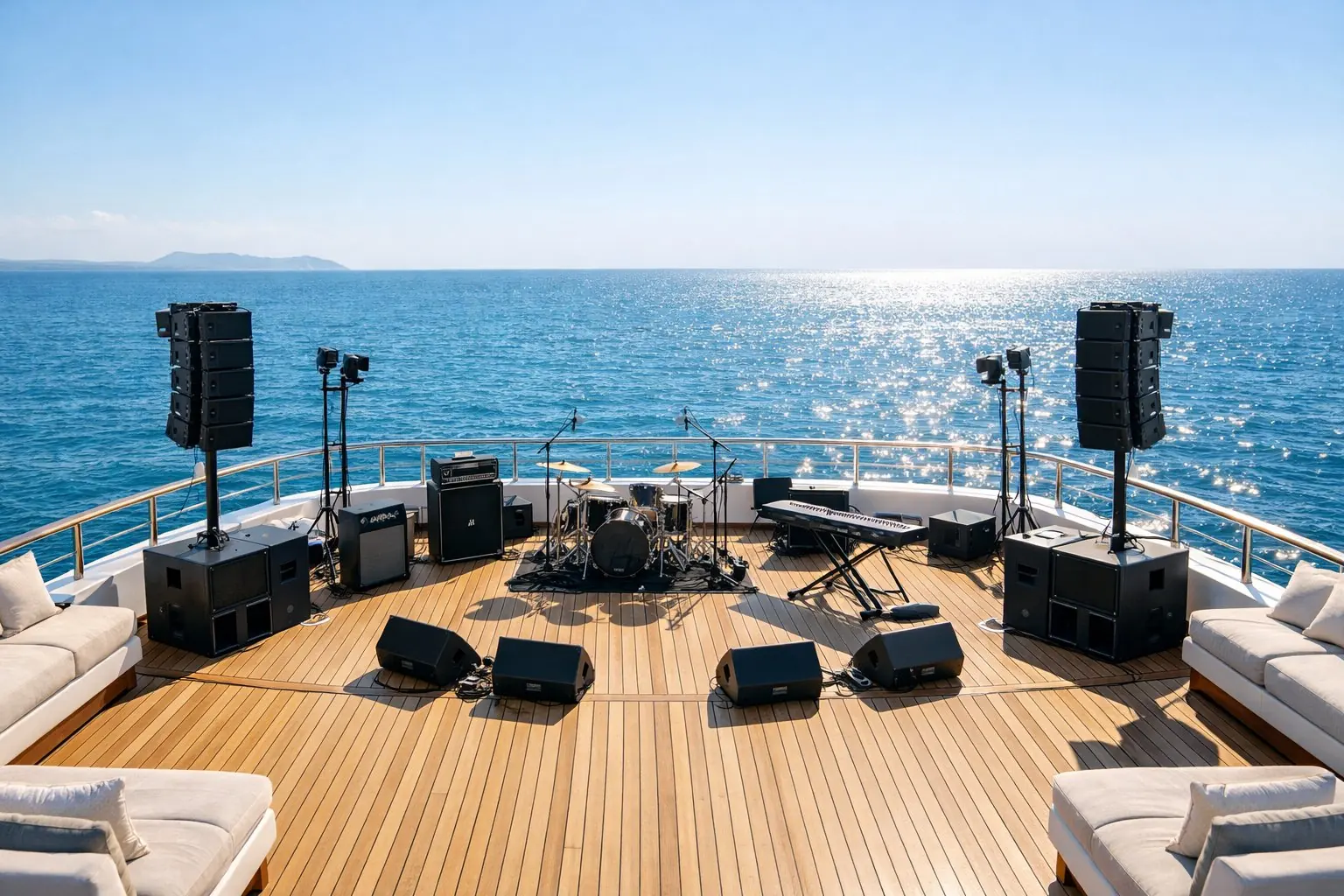
What was installed
The yacht is a 177-foot Delta Marine carrying 16 guests, and the owner is not named. The audio work covers the sundeck, the owner's deck and the main deck, plus the beach club and water toy garage. Montana Pro Audio specified L-Acoustics components, which is professional touring and installed-venue equipment. Marine audio brands are what normally appear on a yacht specification. This is the company's second project for the same owner, the first having been a 114-foot boat.
Aaron Fisher, Montana Pro Audio's director of business development, described the brief as discreet, professional-level products delivering a nightclub-level audio experience throughout the boat. The visible engineering answer to the discretion half of that brief is in the beach club, where speakers sit beneath the overhead garage door and lift into position as it opens. Connection points for a disc jockey are distributed across the decks, so music can be run in one zone or across several at once.
Why professional audio is turning up on yachts
L-Acoustics builds for concert halls and touring rigs, and Fisher makes the point that its equipment is engineered for humidity, salt air and spray as a matter of standard manufacture, not as a marine variant. That removes the historical reason yachts used a separate class of product. It also removes the historical excuse for the sound quality on a large exterior deck, which has usually been poor because the speakers were chosen for size and not for output.
The demand behind it is straightforward. Owners of large yachts increasingly host on board, and a sundeck holding forty people with a live act needs a system that behaves like a venue system. Once you accept that, you are specifying amplifiers, cable runs, power and structural mounting points, and those decisions belong at the build or refit stage.
The cost is not the speakers
A system of this kind is a construction project. Cable routing through fire zones, amplifier racks that need ventilation, power draw that has to be accounted for in the electrical load calculation, and reinforcement where a heavy cabinet hangs off a deckhead. Retrofitting it into a finished boat means lifting linings and headliners, which is where the money goes. Neither the yacht's cost nor the system's has been disclosed.
The sequence used here is the sensible one. Exteriors first, where the acoustic problem is hardest and the disruption to the interior is least, then the saloon, dining room and master suite in a second phase next year. Splitting the work across two yard periods keeps the boat usable and gives the owner a chance to hear the first phase before committing to the second. Neither phase has a published cost, and the yacht's owner is not identified.
What to ask before you specify one
Three questions decide whether an owner is happy with the result. Who owns the acoustic design, as distinct from the equipment supply. Whether the system can be operated by a stewardess with no training, because the alternative is an audio-visual engineer on the payroll. And what the noise breakout is into the cabins below the sundeck, since a system loud enough to work outdoors will be audible in the guest accommodation unless the deck structure is treated.
There is also a practical limit that no equipment solves. Marinas in Monaco, Porto Cervo and Ibiza enforce noise curfews, and a yacht that becomes the reason for a complaint acquires a reputation with berth allocators. Most owners get the use out of a system like this at anchor, where nobody is enforcing a curfew.
What is good, and what to watch
Strong points
- A repeat commission, not a one-off vendor pitchThe owner returned to Montana Pro Audio after a comparable install on their previous 114ft (35m) yacht, a real signal of satisfaction rather than a press-release claim.
- Professional touring gear removes the old case for a separate marine product classFisher's point that L-Acoustics equipment is built for humidity, salt air and spray as standard manufacture rather than a marine variant is a genuine engineering shift, reported independently by Megayacht News and Mix.
What to watch
- No cost figure exists anywhere in the recordNone of Montana Pro Audio, L-Acoustics, Mix, Front of House Magazine or Megayacht News disclose what phase one cost, so there is no way to benchmark this against another yacht's AV budget.
- The harder acoustic problem is still unbuiltPhase two, covering the main salon, dining room, media room, owner's suite, gym and wheelhouse, is not due until 2027, so whether a nightclub-level brief holds up inside finished, furnished rooms is untested.
Practical detail
| LOA / GT | 177ft (54m) / 776 GT |
|---|---|
| Built | Delta Marine, exterior and general arrangement by Delta Design Group |
| Accommodation | 16 guests, 14 crew |
| Audio system | L-Acoustics Soka, Syva and X Series across the sundeck, owner's deck, main deck and beach club garage, installed by Montana Pro Audio; phase two for the interior is planned for 2027 |
| Prior installation | The same owner and integrator previously fitted a comparable system on the owner's 114ft (35m) yacht |
| Installation cost | Not disclosed by the owner, Montana Pro Audio or L-Acoustics |
| What is not published | The yacht's name, the owner's identity and any cost figure for either phase of the installation |
Questions this story answers
What happened?
A 54-metre Delta Marine has been fitted with an L-Acoustics system across its three exterior decks and beach club, installed by Montana Pro Audio for an owner who had already done the same on a 35-metre boat. Some of the speakers are mounted under the beach club garage door and rise into place as it opens. Interior spaces follow next year, in a second phase.
What is good about it?
A repeat commission, not a one-off vendor pitch. The owner returned to Montana Pro Audio after a comparable install on their previous 114ft (35m) yacht, a real signal of satisfaction rather than a press-release claim.
What should an owner or buyer watch?
No cost figure exists anywhere in the record. None of Montana Pro Audio, L-Acoustics, Mix, Front of House Magazine or Megayacht News disclose what phase one cost, so there is no way to benchmark this against another yacht's AV budget.
Who reported this?
Megayacht News, Montana Pro Audio, L-Acoustics, Mix, Front of House Magazine.
We do this for everyone who loves this world. The people who have spent their lives in it, and the people just discovering it. Yotters exists so that what we learn belongs to all of them.
Nobody pays us for this. No ads, no sponsors, nothing for sale. We just believe the world is a little better when knowledge is shared instead of kept.
If it gave you something today, tell us to keep going. Follow us, leave a like, or write a positive comment. We read every one, and they are what keeps us going.