Navetta 30
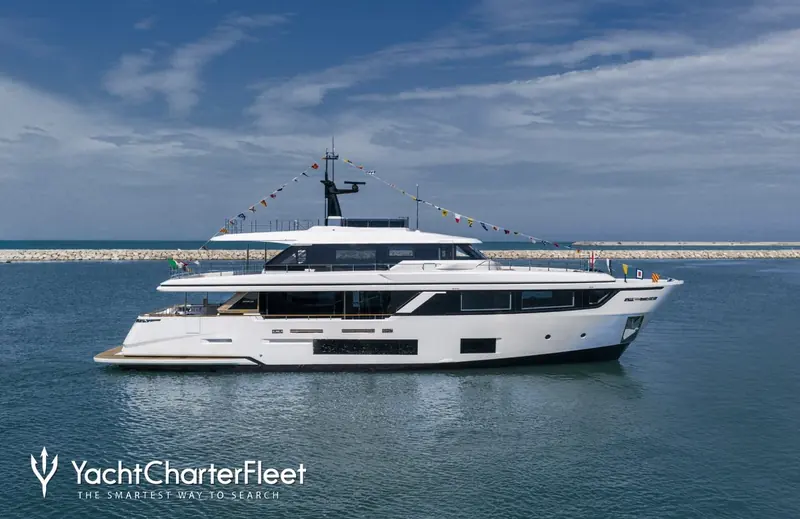
| LOA | 28.43 m (93'3") |
|---|---|
| Beam | 7.31 m (24'0") |
| Draft | 2.2 m (7'3") |
| Displacement | 115,000 kg unladen / 135,000 kg laden (approx 130 tonnes reported at sea-trial load) |
| Engines | twin MAN diesels, 800hp, 1,000hp or 1,200hp options, shaft drive |
| Fuel tank | 14,500 litres |
| Water tank | 2,500 litres |
| Range | approx 2,050 nm at 10 knot economical cruise (1,000hp package) |
| Top speed | 14.5 knots (1,000hp package, per manufacturer spec and independent sea trial) |
| Cruise speed | 13 knots, with a 10 knot economical long-range cruise |
| Construction | GRP hull and superstructure, teak decks |
The smallest Navetta, still a full tri-deck yacht
Custom Line's chief commercial officer Stefano de Vivo previewed the Navetta 30 at the Fort Lauderdale International Boat Show in autumn 2019, describing a 28 metre replacement for the yard's outgoing 28 model that would carry a full third deck rather than the half-raised pilothouse smaller Navettas usually get. The pandemic pushed the actual world premiere back from the planned September 2020 Cannes Yachting Festival slot, and the first hull was instead completed and shown that October, with early examples reaching American owners in late 2020 and early 2021 (Megayacht News, Boat International).
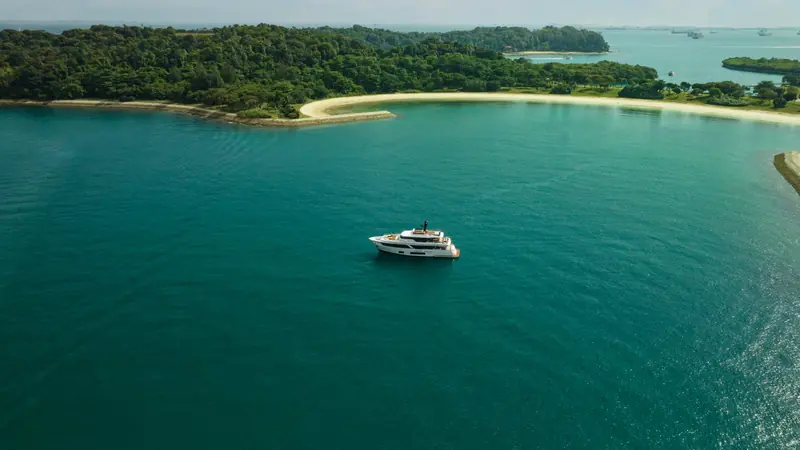
At just 28.4 metres the boat carries a bridge deck, an upper deck with an indoor lounge and shaded alfresco dining for ten, and a resort-style sundeck on top, a configuration Custom Line and Boat International both describe as unusually generous for the length. Salvetti's exterior used a sharp black horizontal deck line and dark glass to draw the eye sideways rather than up, and brought the hull line visually up to the upper deck, tricks aimed specifically at stopping a genuinely tall tri-deck boat from reading as top-heavy on a 28 metre platform (Boat International).
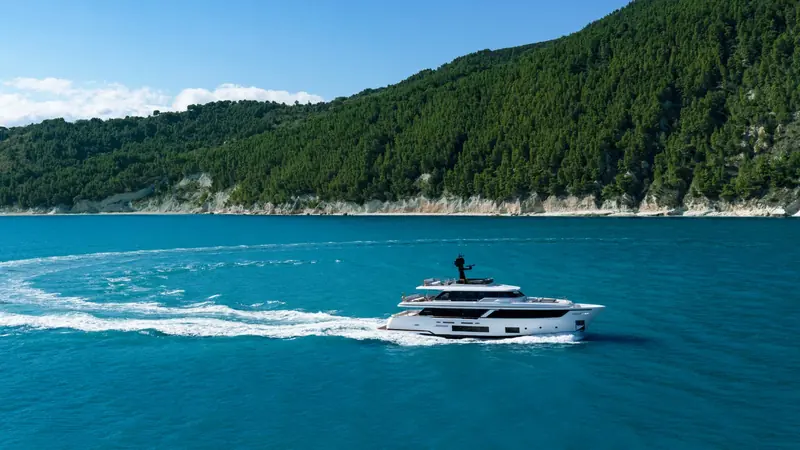
Three engine packages built around range, not top speed
Custom Line offers the Navetta 30 with a choice of twin MAN diesels rated at 800hp, 1,000hp or 1,200hp, all on shaft drives (Megayacht News, Yacht Harbour). The yard's own published specification for the 1,000hp package lists a 14.5 knot top speed, a 13 knot cruise and a 10 knot economical cruise, figures independently repeated after a sea trial of that exact configuration by Yachts Croatia, whose testers recorded the same 14.5 knot maximum. Boat International's feature on the same 1,000hp hull cites a slightly higher 15 knot top speed, the one figure on which sources genuinely disagree; the manufacturer specification and the independent sea trial both agree on 14.5 knots.
What the packages share is a fuel-efficiency target rather than a speed one: Custom Line states the Navetta 30 burns 15 percent less fuel at 13 knots than the outgoing 28 model it replaced (Boat International). On a standard 14,500 litre fuel tank, confirmed independently by Custom Line's own specification and by Yachts Croatia's sea trial figures, the yard quotes roughly 2,050 nautical miles at a 10 knot economical cruise; Megayacht News separately reported 2,150 nautical miles at 10 knots for the standard 800hp package, and Yachts Croatia's own trial logged fuel burn climbing from 70 litres an hour at 10 knots to 415 litres an hour at the 14.5 knot top end.
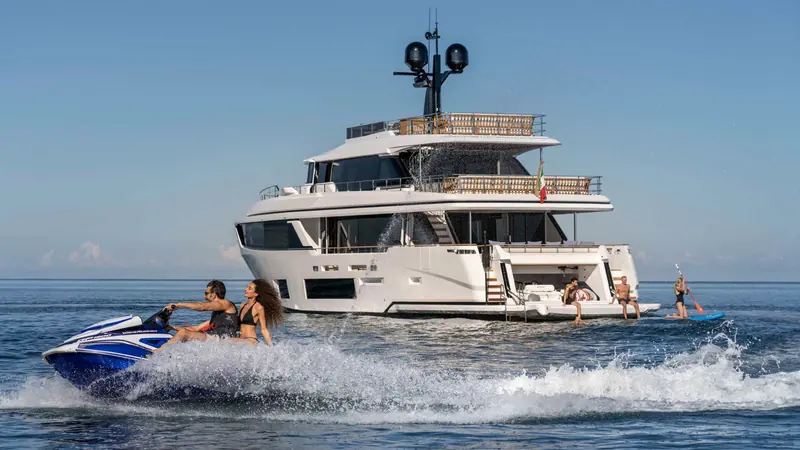
Boat International measured 44 decibels in the owner's cabin underway at 10 knots and 37 at anchor on a 28.4 metre hull, a noise floor the outlet said was comparable to yachts 20 metres longer.
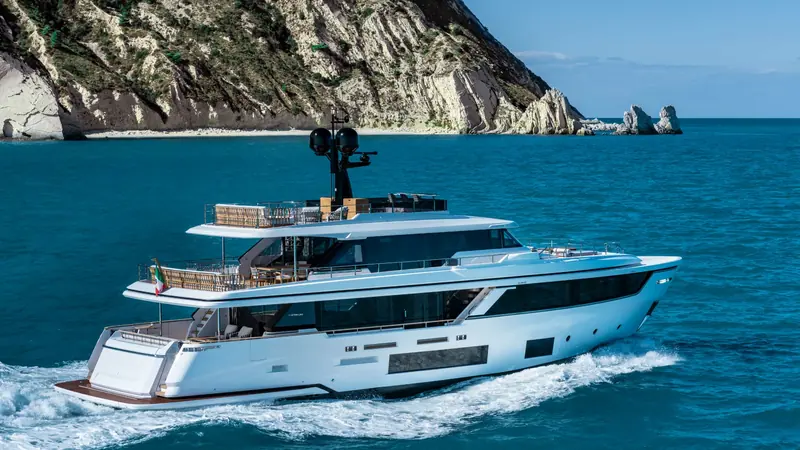
A sea trial that backed up the numbers
Yachts Croatia tested a 1,000hp Navetta 30 fitted with both classic fin stabilizers and an optional Seakeeper gyro running together, and reported the boat as essentially unbothered by hard turns during the trial, crediting the twin-wing bridge design for making the yacht easy to handle in tight marina spaces despite its bulk. The same review logged a 2.2 metre draft, a roughly 130 tonne sea-trial displacement broadly consistent with Custom Line's own published unladen and laden figures of 115 and 135 tonnes, and a CE Category A rating for open-water use.
Boat International's separate feature on the same 1,000hp hull put hard numbers on the comfort claim: 44 decibels in the owner's cabin underway at 10 knots and 37 decibels at anchor, which the outlet noted was comparable to yachts 20 metres longer, and attributed to stabilizer performance the article called incredible when the fins and gyro worked together. De Vivo told the outlet that scaling Custom Line's design language down to 28 metres was, in his words, harder than doing it on a much larger yacht, because the proportions of a person on board never shrink to match the hull.
An interior built by architects, not boat designers
Interior design on the Navetta 30 came from Antonio Citterio Patricia Viel, the Milan architecture firm working on its first Custom Line commission, rather than from a traditional yacht design house. Patricia Viel described the brief to Boat International as deliberately avoiding an overly domestic feel, saying the aim was to keep something that reminds an owner they are on a boat rather than in a villa, while still making the interior reconfigurable to each buyer's own layout choices through Custom Line's semi-custom Atelier process.
The standard layout puts a full-beam owner's suite on the main deck, spanning roughly 35 square metres in Boat International's account, alongside four further VIP cabins for a total of five guest cabins and up to ten guests, with crew quarters for around five. Materials lean on teak decking, leather, solid wood and rope detailing, and the feature article on hull one noted artwork by Alighiero Boetti in the owner's suite, a 3D-printed textured fibreglass wall panel in the main saloon, and custom-configured furniture from Antonio Citterio's own ranges for Flexform and B&B Italia. A patented Dual Mode transom combines a tender-unloading hatch with a submersible swim platform.
A steady seller through the 2020s
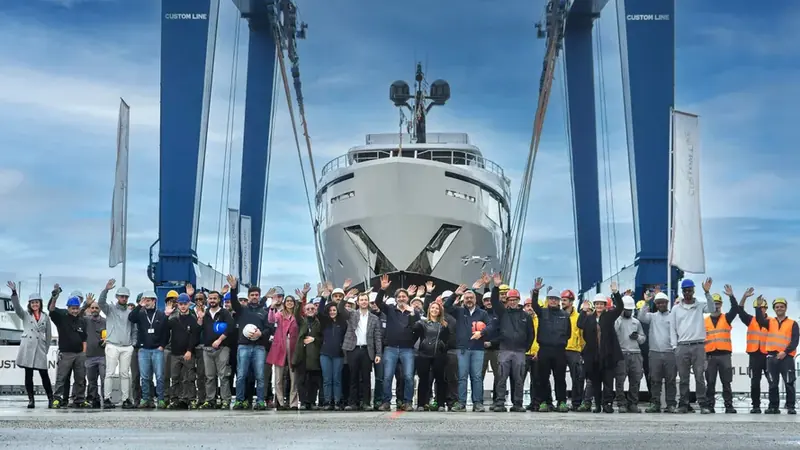
Custom Line's own account of its history describes the Navetta 30 as one of its steadiest sellers, and the delivery record backs that up: the yard's press office marked the twelfth hull's launch, M/Y Belle Ile, in March 2023, roughly two years after the first boat entered the water at Ancona, and brokerage listings for new-build slots since have carried project numbers into the mid-twenties for 2025 and 2026 delivery. That is a materially faster build cadence than Custom Line's larger Navettas, and it has kept the 30 in continuous production for six years without a generation change.
Inside the family it sits below the 41.83 metre Navetta 42, Custom Line's long-running composite flagship in the line since 2018, and well below the 49.9 metre aluminium Navetta 50 the yard added to its range in 2024. All three share the same underlying brief of long-range displacement cruising over planing speed, and all three are built through the same Atelier semi-custom process at the Ferretti Group's Ancona yard, but the Navetta 30 remains the size at which a buyer can get that process, and a proven six-year production run, at the smallest available Navetta footprint.
What it costs, and what isn't published
Neither Custom Line's own model page nor its press materials list a price for the Navetta 30. Independent brokerage sources put a new, standard-specification boat at roughly 8.9 million euros around the time of Yachts Croatia's sea trial, rising to a 10.1 million euro standard list price quoted by itBoat's current pricing data; that gap looks like several years of list-price inflation across the model's production run rather than a genuine disagreement between sources, since the trial predates the later listing by several years. Used hulls from 2021 and 2022 have carried asking prices clustered between roughly 7.95 million and 8.5 million euros across multiple brokerage listings.
What is genuinely thin in the public record is anything below the headline numbers: neither generator output nor bow and stern thruster specification is confirmed by more than a single source, and unlike a production trawler with an active owners' forum, there is no visible body of independent long-term owner commentary on a boat in this price bracket, since most Navetta 30s are run privately or through charter management rather than discussed on public forums. Running costs are not published by the yard or by any source found and should not be assumed from other yachts of similar length.
Motoren und Technik
| Main engines | Twin MAN diesels offered at 800hp, 1,000hp or 1,200hp on shaft drives (Megayacht News, Yacht Harbour); the 1,000hp package is the most widely documented, with a manufacturer-quoted 14.5 knot top speed matched by Yachts Croatia's independent sea trial of the same configuration. |
|---|---|
| Stabilizers | Classic fin stabilizers standard, with an optional Seakeeper zero-speed gyro; Boat International and Yachts Croatia both tested the combination and reported it markedly improved comfort at anchor and underway. |
| Generator | Reported by Yachts Croatia's sea trial as twin 35kW generators; this figure is not independently corroborated elsewhere in the sources found, so it should be treated as single-sourced. |
| Bow/stern thruster | Not specified with a confirmed model or output in any source reviewed; not published by Custom Line's own model page. |
| Fuel tankage | 14,500 litres, confirmed by Custom Line's own specification and by Yachts Croatia's independent sea-trial figures. |
| Fresh water tankage | 2,500 litres, confirmed by Custom Line's own specification and by Yachts Croatia's sea-trial figures. |
| Watermaker | Yachts Croatia's sea trial report notes a fitted watermaker as standard equipment but does not give a capacity figure; no second source with a capacity number was found. |
Was Eigner und Crew berichten
Cabin noise close to that of a much larger yacht
Boat International's reporter measured 44 decibels in the owner's suite underway at 10 knots and 37 decibels at anchor on the tested hull, and described the result as comparable to 50 metre yachts, crediting the fin-and-gyro stabilizer combination.
Boat InternationalStable and easy to handle in tight quarters despite the tri-deck bulk
Yachts Croatia's sea trial reported the hull as essentially unbothered by repeated hard-turn tests with both stabilizer systems running, and praised the twin-wing bridge for making close-quarters marina handling easier than the boat's size would suggest.
Yachts CroatiaNo independent owner-forum discussion exists for this model
Unlike production trawlers or sportfishers with active owner communities, no public forum threads or long-term ownership write-ups for the Navetta 30 were found; coverage is limited to yard press material, brokerage listings and a small number of trade-press sea trials.
Yotters research
Was gut ist und worauf zu achten ist
Stärken
- Big-yacht systems on the smallest Navetta hullA twin-wing bridge, standard fin stabilizers with an optional zero-speed gyro, and cabin noise measured by Boat International at 44 decibels underway give the 28.4 metre Navetta 30 a ride and quietness its size would not predict.
- Real fuel and range gains for the classCustom Line's own claim of 15 percent lower fuel burn at 13 knots than the outgoing 28 model, backed by a roughly 2,050 nautical mile range at 10 knots on a 14,500 litre tank confirmed by two independent sources, gives genuine long-range capability rather than a marketing figure.
- A proven six-year production run with real resale liquidityFrom the first hull in October 2020 to the twelfth (M/Y Belle Ile) in March 2023 and new-build project numbers into the mid-twenties for 2025 to 2026 delivery, the Navetta 30 has stayed in continuous, apparently steady-selling production longer than most yachts at this price point manage.
Worauf zu achten ist
- Genuinely slow for the money next to a planing yacht of similar lengthAt a manufacturer-quoted and sea-trial-confirmed 14.5 knot top speed, the Navetta 30 is meaningfully slower than a flybridge planing yacht of the same length; this is a deliberate trade for range and volume, but a buyer wanting speed should look elsewhere in Custom Line's own Saetta range.
- Pricing and running costs are not transparently publishedCustom Line does not list a price on its own model page, published new-build prices found range from roughly 8.9 to 10.1 million euros across different years, and no running-cost figure specific to this model was found anywhere in the available sources.
- Key equipment specs are thin or single-sourcedGenerator output and thruster specification are each confirmed by only one source at most, a real gap for a buyer trying to compare hulls or engine packages before a purchase.
Praktische Angaben
| New price | Not published by Custom Line directly. Independent sources put a standard new build at roughly EUR 8.9 million around the time of an early sea trial, rising to a EUR 10.1 million standard list price in more recent brokerage pricing data. |
|---|---|
| Used/resale | 2021 to 2022 hulls have carried brokerage asking prices clustered between roughly EUR 7.95 million and EUR 8.5 million. |
| Running costs | Not published by Custom Line or by any source found; should not be assumed from other yachts of similar length. |
| What is not published | An official new-build price from the yard itself, a confirmed generator output beyond a single sea-trial mention, bow/stern thruster specification, and any independent long-term owner review or forum discussion, since this model has no visible owner community comparable to a production trawler or sportfisher. |
Für wen: An owner who wants a genuine tri-deck superyacht with long-range, low-fuel-burn cruising and a semi-custom interior, at the smallest length Custom Line builds that platform on.