Lagoon 46
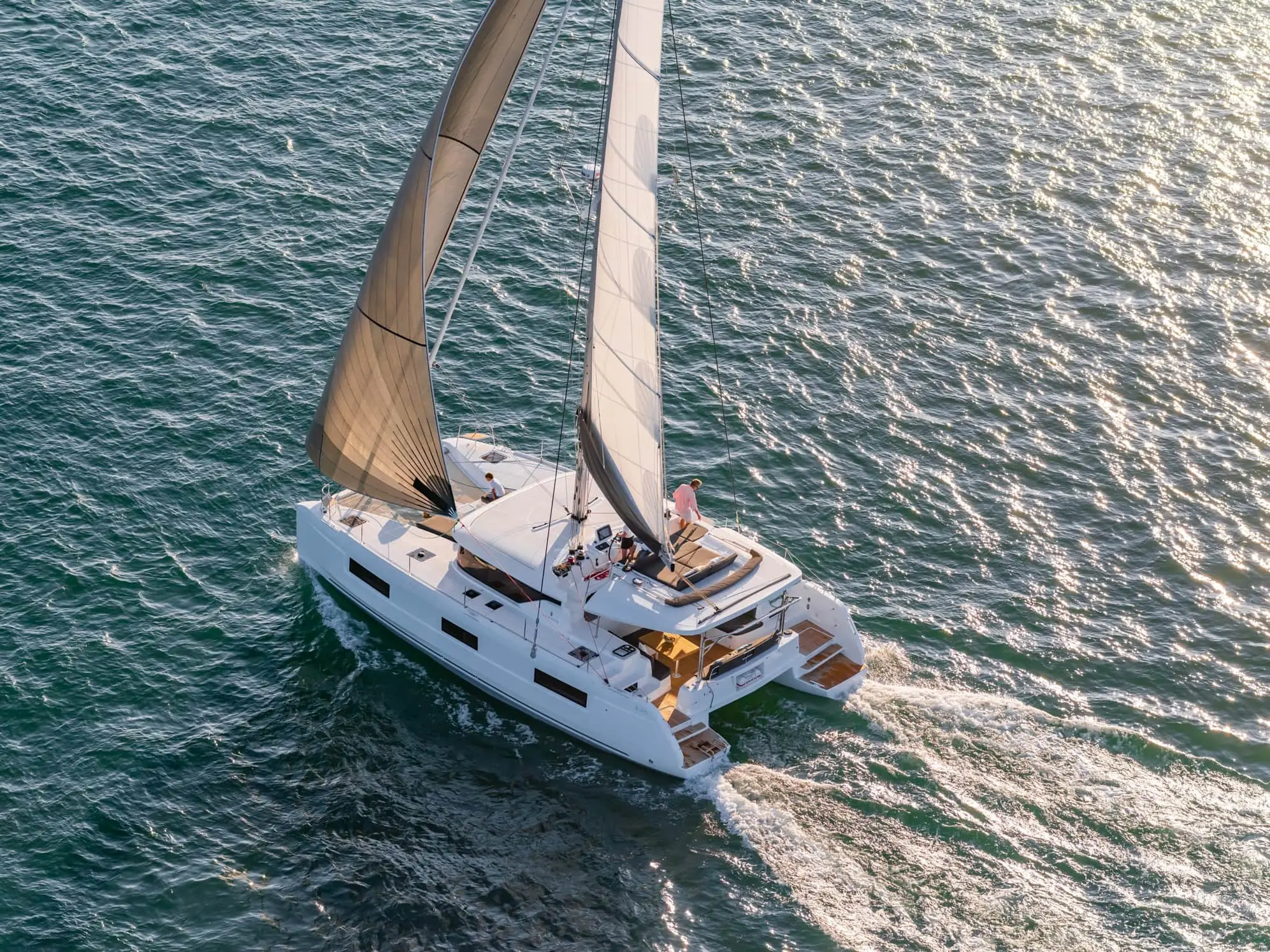
| Hull length 13.99 m (45'11''), length overall 14.5 m including the sugar-scoop extension (Lagoon official spec sheet) | |
| Beam | 7.96 m (26'1'') |
|---|---|
| Draft | 1.35 to 1.37 m depending on source |
| Light displacement | about 15.8 to 16.3 tonnes depending on the measurement standard used |
| Twin Yanmar 4JH-series diesel saildrives, 45 hp standard, 57 hp option | |
| Fuel 1,040 l / 275 US gal, water 600 l / 159 US gal | |
| 3 to 6 cabins, CE category A approval for 12 persons | |
| Launched 2019, succeeded in the catalogue by the 46 Iconic | |
Replacing the best-selling catamaran Lagoon ever built
The Lagoon 46 replaced the Lagoon 450, the boat that turned Lagoon into a charter-fleet fixture with nearly 800 hulls sold since 2010, so the 46 that launched in 2019 carried real expectations rather than a clean slate. Lagoon kept the recipe that worked, a VPLP hull, saildrives, a wide flybridge helm, and addressed the specific complaints owners and charter operators had about the 450. The most visible change is structural: the mast moved further aft on the coachroof, which turns the jib self-tacking and opens a bigger foretriangle for downwind sails, while a shortened boom and higher-aspect mainsail cut the pitching that came with the 450's rig.
The 46 debuted alongside the larger Lagoon 50 and was designed to carry the 50's cues, the flybridge Bimini hardtop, the outdoor galley, the recessed electric mainsheet winch, down into a hull nearly five metres shorter. Reviewers at the time noticed the family resemblance directly: Cruising World called the hull windows even larger than the 450's, and French sailing magazines including Voiles et Voiliers and Multicoques Magazine credited the boat with genuinely more interior volume than its length suggested. It won the Asia Boating Award for Best Multihull Sailing Yacht in 2019, its launch year, and it has stayed in the catalogue since, latterly as the update called the 46 Iconic.
Sailing performance a step ahead of the boat it replaced
Catamaran reviewers are rarely generous about pointing ability, and the Lagoon 46 got more credit than most of its class. Phil Ross's review for TMG Yachts recorded the boat holding four knots of boat speed at 45 degrees off the apparent wind in a light seven-knot breeze, closer to the wind than cruising catamarans usually manage, and Cruising World and SAIL Magazine both logged closehauled speeds around nine knots on their own test sails. Under a Code 0 in a proper breeze, SAIL's testers saw eleven to twelve knots, and Croatia charter operator Yachtaris quotes a realistic seven to nine knots in the moderate winds its guests actually sail in.
None of that makes the 46 a performance cat. Like every Lagoon with fixed keels rather than daggerboards, it will not point as high as a monohull or a true performance multihull, and reviewers converge on 55 to 60 degrees off true wind as the practical optimum for making ground upwind, with real leeway below that angle. The engines earn their keep in exactly that gap: twin Yanmar diesels, 45 hp standard and 57 hp as the common upgrade, push the boat to 8.5 knots wide open and a genuine 7-knot cruise at a modest 2,200 rpm, which is what most charter guests and cruising owners actually run day to day.
Lagoon replaced the best-selling catamaran it had ever built with one that points closer to the wind, then let a decade of charter fleets prove the rest.
Engines, tankage and the systems a used-boat buyer should check
Every 46 left the yard with twin Yanmar 4JH-series diesel saildrives, rated at 45 hp in the standard fit and 57 hp on the option most owners and charter operators actually chose, a distinction worth confirming on any used hull since it changes both the wide-open-throttle speed and the resale conversation. Fuel capacity is 1,040 litres (275 US gallons) and fresh water is 600 litres (159 US gallons) split across two tanks, figures that Wikipedia, Multihulls World and Lagoon's own specification sheet all agree on. Lagoon has never published an official range figure for the 46 at a given rpm, which is worth knowing before assuming transatlantic autonomy from the tankage alone.
The rest of the systems are options rather than standard fit, and it shows on used listings: brokerage specifications for individual hulls describe a roughly 13.5 kVA diesel generator, a 63-litre-an-hour (26 US gallon) watermaker mounted in the port engine room, and an optional bow thruster for tight marina work, none of them guaranteed on every hull built. A charter-configured 46 typically carries all three plus air conditioning and a fuller electronics package, while an owner's-version boat bought lightly specified may have none of them, so a buyer comparing two 46s on paper needs the equipment list, not just the hull number, to know what they are actually pricing.
Life in charter, and what charter does to the boat
The 46 is one of the standard hulls at The Moorings, Sunsail and Dream Yacht Charter, and it anchors Croatia's Adriatic fleets in particular: Yachtaris alone runs 38 examples out of its Croatian bases and prices it as the premium mid-range catamaran in that market, a 15 to 25 per cent premium over the smaller Lagoon 42, with weekly charter rates running roughly 4,000 to 10,000 euro depending on season. Yachtaris reports that charter guests spend most of their time on the flybridge and use the saloon mainly for cooking and sleeping, which matches how Lagoon designed the boat around that upper deck in the first place.
Charter life leaves a mark that a buyer can actually read in a used listing. A 2020-built 46 sold through Moorings Brokerage out of Saint Lucia in 2026 showed 1,499 and 1,687 hours on its two engines after roughly six seasons, a realistic guide to how hard a well-run charter hull gets used, and it asked 404,200 euro against a new price that was well over 600,000 euro when the boat was built. That gap, and the logged hours behind it, are exactly the kind of detail a private owner rarely generates on their own boat but a charter operator publishes as a matter of course.
Where owners and reviewers find fault
The recurring complaint across owner and reviewer accounts is visibility, not performance. Sailing Katamarans' review of the 46 notes poor sightlines to the stern corners from the flybridge helm, meaning a skipper backing into a stern-to berth in the Mediterranean style needs a camera or a second pair of eyes on the sugar scoops rather than a clear view down. The flybridge that makes the 46 such a good charter boat is the same structure that puts the helmsman further from the water and the stern than a monohull skipper is used to, and it is the single most repeated criticism this research found.
A second, smaller thread runs through Cruisers Forum's Lagoon owner community: an extended discussion of whether early-build 46 masts needed reinforcement or replacement, with owners comparing notes on what a revised mast looked like rather than pointing to a single documented recall. Lagoon has not published a formal statement on the subject that this research could independently verify, so it is recorded here as an open owner discussion rather than a confirmed defect, and a buyer looking at an early hull should ask the yard or a surveyor directly rather than rely on forum consensus. Weight is the other honest tradeoff: the 46 carries more displacement than a lightweight performance cat of the same length, which is part of why it needs its engines in light air and why none of its reviewers call it fast, only comfortable and capable.
Motoren und Technik
| Main engines | Twin Yanmar 4JH-series diesel saildrives, 45 hp standard and 57 hp as the common option, 8.5 knots wide open throttle and a 7-knot cruise at 2,200 rpm (Cruising World and SAIL Magazine sea trials agree on both the WOT and cruise figures) |
|---|---|
| Fuel tankage | 1,040 litres / 275 US gallons (Wikipedia, Multihulls World and Lagoon's own specification sheet all agree) |
| Fresh water tankage | 600 litres / 159 US gallons, in two tanks (Wikipedia and Lagoon's own spec sheet agree on the total; Multihulls World's 2 x 300 l figure matches) |
| Generator | Around 13.5 kVA diesel genset on charter-specified hulls, not standard on every boat (YachtWorld brokerage listing detail, single source for the exact kVA rating) |
| Watermaker | Optional, about 63 litres / 26 US gallons per hour, mounted in the port engine compartment on so-equipped hulls (YachtWorld and Multihull Company brokerage listings agree) |
| Bow thruster | Listed as optional equipment rather than standard fit (YachtWorld and Multihull Company listings) |
| Range | No official range figure published by Lagoon at any stated rpm; treat any figure quoted for the 46 as a third-party estimate, not a factory number |
Was Eigner und Crew berichten
Charter guests live on the flybridge
Charter guests on Lagoon 46 bookings spend most of their time on the flybridge and use the saloon mainly for cooking and sleeping, according to the Croatian operator running 38 examples of the boat out of its Adriatic bases.
YachtarisStern visibility is the recurring complaint
Sightlines to the stern corners from the flybridge helm are described as poor, so a skipper backing into a Mediterranean stern-to berth typically needs a camera or a second pair of eyes rather than a clear view down to the sugar scoops.
Sailing Katamarans (katamarans.com)Early-hull mast questions discussed at length
An extended forum thread among Lagoon 46 owners debates whether early-build masts needed reinforcement or replacement, with owners comparing notes on a revised mast rather than citing one documented recall notice.
Cruisers ForumReal charter engine hours on a resold hull
A 2020-built 46 resold in 2026 out of Saint Lucia showed 1,499 and 1,687 hours on its two engines after roughly six seasons of charter and private use, asking 404,200 euro.
Moorings BrokerageNeeds its engines in light air
The 46's displacement is heavier than a lightweight performance catamaran of the same length, and reviewers and the operator running it commercially both note it wants engine assistance rather than pure sail in light conditions.
TMG Yachts (Phil Ross)
Was gut ist und worauf zu achten ist
Stärken
- Genuinely improved sailing manners over the 450The aft-stepped mast, self-tacking jib and higher-aspect mainsail measurably improved pointing and reduced pitching against the 450 it replaced, confirmed independently by Cruising World, SAIL Magazine and TMG Yachts.
- Interior volume unusual for the lengthMultiple independent reviewers, including French titles Voiles et Voiliers and Multicoques Magazine, singled out the cabin and saloon volume as exceptional for a 46-foot catamaran, carrying the larger Lagoon 50's design language down a size class.
- Deep charter fleet means real resale dataLarge standing fleets at The Moorings, Sunsail and Dream Yacht Charter, plus 38 boats in Croatia alone with Yachtaris, mean a buyer can check actual charter returns and resale prices rather than relying on a dealer's projection.
Worauf zu achten ist
- Poor aft visibility from the flybridge helmSightlines to the stern corners are consistently reported as weak, complicating stern-to Mediterranean-style docking without a camera or a second crew member watching the scoops.
- Will not point like a monohull or a performance catFixed keels rather than daggerboards cap upwind ability at roughly 55 to 60 degrees off true wind, and the boat needs engine assistance to hold speed in light air.
- Unresolved mast questions on early hullsOwner forum discussion of early-build mast reinforcement or replacement has never been matched to a public Lagoon statement this research could verify, leaving early hulls a diligence item rather than a closed question.
- No published range figureLagoon has never put an official nautical-mile range on the 46 at a stated rpm, unusual for a boat marketed on long-distance cruising capability.
Praktische Angaben
| New price, current dealer quote | UK dealer Ancasta quotes a base price around 693,700 euro excluding VAT and an as-delivered on the water price around 750,000 euro excluding VAT for the current generation |
|---|---|
| New price, at original launch | Cruising World's tested 2021 boat carried a base price of 620,000 US dollars and a fully equipped price of about 740,000 to 745,000 US dollars, corroborated independently by SAIL Magazine's own test boat at 745,000 US dollars |
| Typical used price | A well-documented 2020-built hull sold through Moorings Brokerage in 2026 asked 404,200 euro with logged engine hours; broader used listings on YachtWorld for later hulls run from roughly 950,000 to just over 1,000,000 US dollars, reflecting configuration and age rather than a single market price |
| Estimated annual running cost | Industry rule of thumb and Lagoon's own published guidance both put annual maintenance at 5 to 10 per cent of purchase price, which on a 750,000 euro boat is roughly 37,500 to 75,000 euro a year including haul-out, servicing and equipment overhaul, not a Lagoon-specific published figure |
| Typical charter rate | Roughly 4,000 to 10,000 euro a week in Croatia depending on season, a 15 to 25 per cent premium over the smaller Lagoon 42, according to the operator running the largest Croatian 46 fleet |
| Not publicly disclosed | An official range figure at any given rpm, total production numbers for the 46 specifically as opposed to the Lagoon range as a whole, and any factory trade-in or resale guarantee value |
Für wen: An owner or charter operator who wants a proven, heavily supported catamaran in the 45-foot class with genuine charter-fleet backing, and who values flybridge living and interior volume over outright sailing performance.