Arrabito Naval Architects
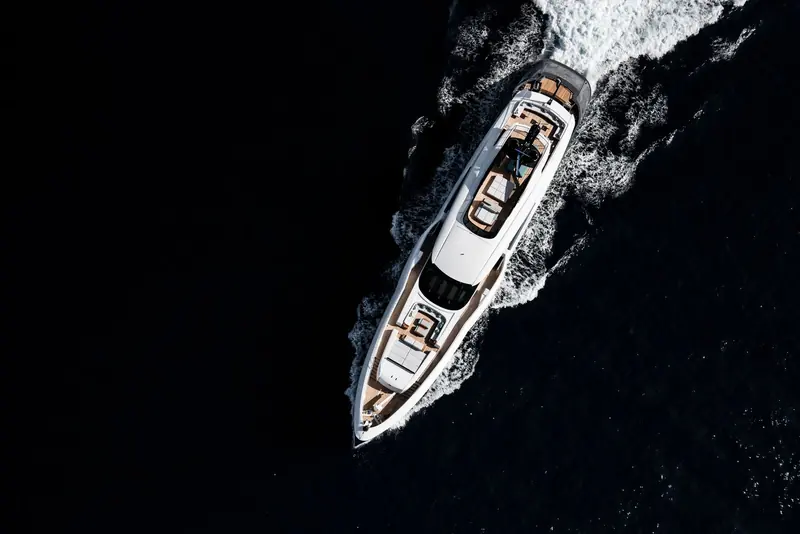
| Founded | 1980 by engineer Giovanni Arrabito as Italtecnica Srl, trading as Arrabito Naval Architects |
|---|---|
| Led by | Giuseppe Arrabito, naval engineering and architecture graduate of the University of Genoa, in the firm since 1996 |
| Based | Livorno, Tuscany, Italy |
| Team | eight people, almost all naval or nautical engineers, split into hydrodynamics, structural engineering and stability and freeboard |
| Output | the studio's own count is nearly 3,000 hulls from 32 to 160 feet sailing worldwide, roughly 10 to 70 metres |
| Services | hull lines and tank testing, structural calculation, stability tests and booklets, CAD-CAM files for composite moulds, technical surveys during new builds and before purchase; exterior styling only as consulting on request |
| Rossinavi | partnership since 2008, 23 custom yachts of 46 to 70 metres by Arrabito's count, six more under way as of January 2026 |
| Polaris, now Polestar | 70.2 m, 1,542 GT, Rossinavi, delivered 2021, diesel-electric with Azipull pods, Finnish-Swedish Ice Class II; Arrabito was naval architect and the owner's surveyor |
| Other delivered Rossinavi hulls | Polaris I 48.2 m (2014), Utopia IV 63 m (2018, 33 knots), LEL 49.7 m (2020), EIV 48.8 m (2020), Akula 59.4 m (2024, ice-class explorer) |
| Heed | 52.7 m all-aluminium Rossinavi under 499 GT, launched January 2026 with Alberto Mancini exterior and Achille Salvagni interior |
| Other yards | Cantieri di Pisa (Akhir series from 2005), Destiny Yachts, Ocean Alexander (Revolution series with Evan K. Marshall), Riva, Baglietto, Mengi Yay, DL Yachts, Canados |
| Design fee | no published scale; for reference the SuperYachtReview 2026 price guide puts a designer at 1 to 5 per cent of build cost, excluded from the yard price |
| Not included | interior design and, on almost every delivered hull, exterior styling; those are separate appointments |
A family engineering office in Livorno
Giovanni Arrabito came to boats from an unusual direction. Barche Magazine's January 2026 profile records that he left the Italian Navy after ten years as director of the nuclear reactor at San Piero a Grado before setting up the technical studio, registered as Italtecnica Srl, in 1980. His son Giuseppe was working on projects while still a student in Genoa and joined full time in 1996. The early 2000s brought nine Destiny Yachts between 90 and 135 feet, and in 2005 Cantieri di Pisa handed the firm its Akhir series, five models from 30 to 42 metres.
The office has stayed small. Arrabito told Barche that there are eight of them, almost all naval or nautical engineers, aged between 28 and 56. The studio's own tally is nearly 3,000 hulls from 32 to 160 feet now at sea, much of it production and semi-custom work that never carried the firm's name on a brochure. That is typical of the trade and it is also a grievance Arrabito raises himself, which is covered further down.
What a naval architect actually does
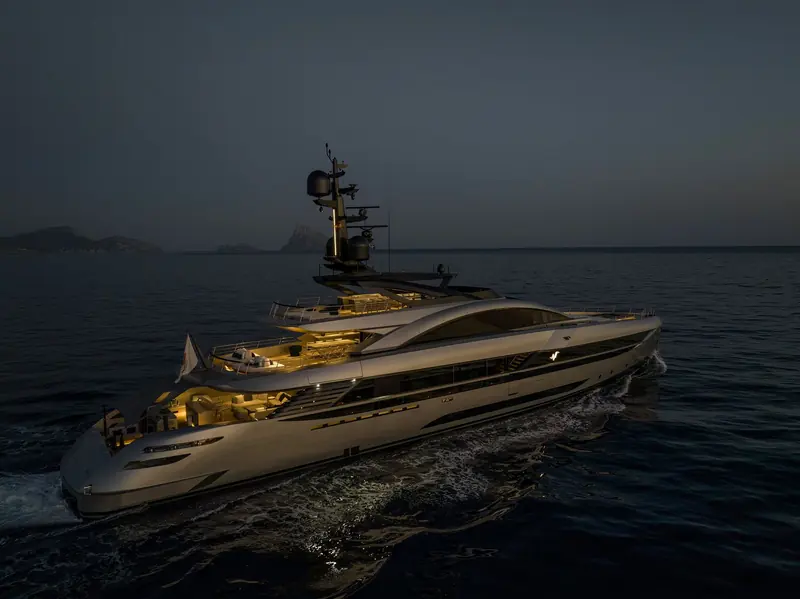
Arrabito's own description of its work is hull lines and tank testing, advanced structural calculation, stability tests and the stability booklet plus CAD-CAM files for composite moulds. In practice that means the naval architect owns the underwater shape, the weight and centre of gravity budget, the scantlings of hull and superstructure, the resistance and propulsion calculations and the paperwork a classification society and a flag state will ask for. None of that is visible in a render and all of it decides whether the render can be built.
Arrabito splits its eight engineers into three specialist groups, hydrodynamics, structural engineering and stability and freeboard, and told Barche that trying to do a bit of everything prevents a studio from becoming a top specialist in any of them. For an owner the relevant point is that speed, fuel burn, motion at anchor, gross tonnage and the ability to add weight later are all set here. A styling change late in a build lands on the naval architect's desk as a weight and stability problem, not as a drawing.
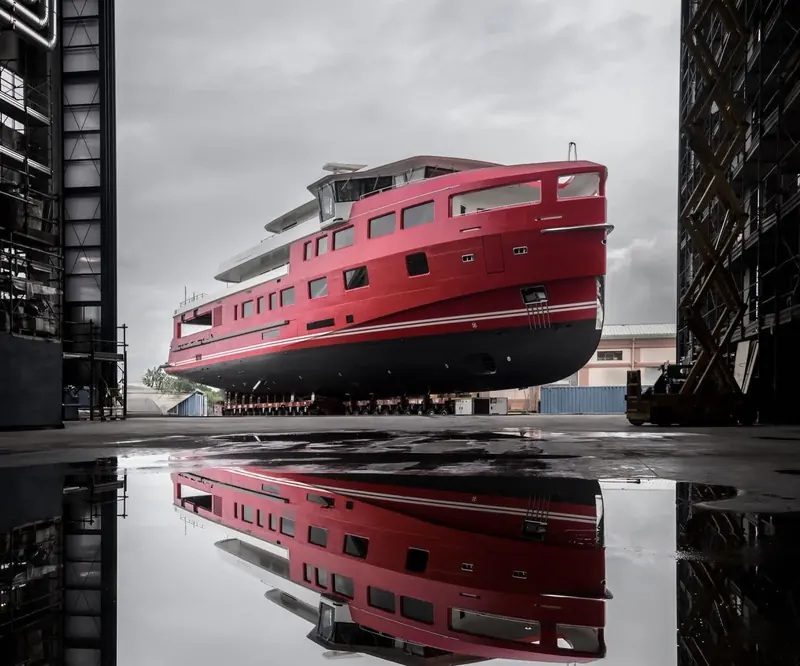
A yard trusted the same eight engineers with 23 custom hulls, and on the flagship it let them work for the owner as well.
Nearly twenty years inside Rossinavi
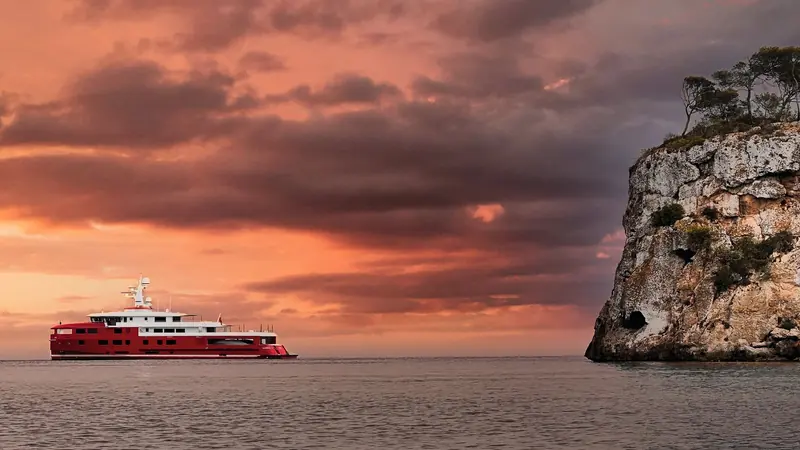
Arrabito credits Claudio, Federico and Claudia Rossi with allowing the studio to restructure itself in 2008, and told Barche that Rossinavi is a yard where the team feels at home. The work runs through the Viareggio and Pisa yard's whole custom range. Polaris I, 48.2 metres and 497 GT, was delivered in July 2014 as the second hull of the Prince Shark series, with styling by Enrico Gobbi's Team for Design. Utopia IV, 63 metres in aluminium with four MTU engines and waterjets, reached 33 knots in 2018. LEL, 49.7 metres with Luca Dini styling, and EIV, 48.8 metres for an American owner with Team for Design again, were both delivered in 2020.
The range is the interesting thing. The same office drew a 33 knot waterjet boat, a pair of sub-500 GT sport yachts and the 59.4 metre Akula, Rossinavi's first explorer, delivered in 2024 with a steel ice-class hull, diesel-electric pods and a stated range of 8,000 nautical miles. Heed, a 52.7 metre aluminium yacht kept under 499 GT, was launched in January 2026. Arrabito said in January 2026 that six more Rossinavi projects are under way.
Polaris, the 70 metre flagship
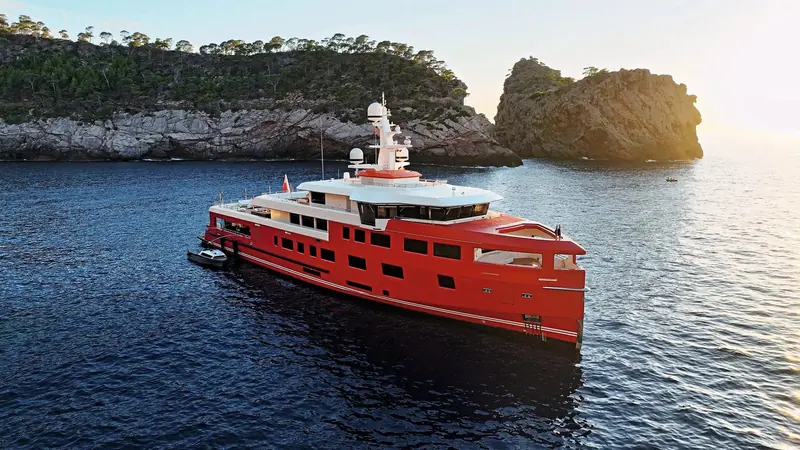
Polaris began as Project King Shark and was launched at Viareggio on 15 January 2021 after four years of work. BOAT International and Barche both give her as 70.2 metres and 1,542 GT, with a steel hull, an aluminium superstructure, full diesel-electric propulsion driving Azipull pods, a top speed of 18 knots and a range of more than 6,000 nautical miles at 12 knots. She is built to Finnish-Swedish Ice Class II. Exterior and interior are by Enrico Gobbi of Team for Design, and SuperyachtNews reported double classification with RINA and Lloyd's Register and compliance with the MCA Large Yacht Code.
Arrabito told SuperyachtNews the project was not born from an existing naval platform but from a completely blank canvas, and told BOAT International that her bulb came out of iterative CFD optimisation aimed at reducing resistance. The less reported detail is in his Barche interview: on Polaris the studio worked as both naval architect and surveyor for the owner, a dual role it also held on Utopia IV. That puts the same office on the design side and on the owner's side of the build at once, which is efficient and worth understanding before signing.
Beyond Rossinavi
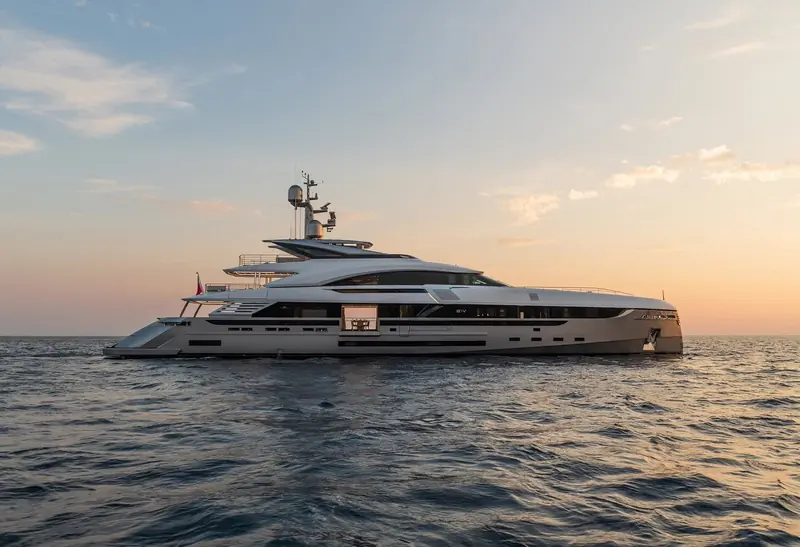
The longest outside thread is with the American designer Evan K. Marshall. When Ocean Alexander announced its 90R in September 2018, the first of the Revolution series, Arrabito said the studio was glad to start a new relationship with the yard and to work again with Marshall, with whom it had then collaborated for more than 25 years. The series ran up to the 35R, which debuted at the Fort Lauderdale show in 2021, with Arrabito responsible for hull form and CFD work. Barche also lists the Posillipo boats built by Rizzardi at 90 to 120 feet, the Riva Opera 24 metre and the Riva Cantata 84 with Mauro Micheli, plus the Dreamline range with Peter Zuber.
BOAT International and SuperYacht Times list further hulls for DL Yachts and Canados, and in January 2026 Arrabito named Riva, Baglietto and the Turkish builder Mengi Yay as current clients. On series work the client is the yard, not the owner, so a buyer of an Ocean Alexander or a Riva has Arrabito lines under him without ever meeting the studio. The practical consequence is that an owner can sea trial Arrabito hulls in several sizes and styles before commissioning one.
What naval architecture costs
The reference numbers that do exist are for design as a whole. The SuperYachtReview guide lists the designer's fee at 1 to 5 per cent of build cost and project management at a further 2 to 4 per cent, both typically excluded from a yard quote. At smaller sizes Kasten Marine Design publishes 10 to 12 per cent of as-built cost for a fixed commission and 6 to 8 per cent on its preferred hourly basis for 40 to 80 foot boats, and notes those figures do not separate engineering from styling. A naval architecture appointment sits inside those envelopes, not on top of them, and is usually the smaller share of the design budget on a styled superyacht.
How the fee reaches the owner depends on who appoints the studio. On a series boat the yard pays and the cost is buried in the price. On custom Rossinavi builds Arrabito has at times worked for the owner directly, and it also sells technical surveys during construction and before a used purchase. Ask for the fee broken out between lines and tank testing, structural and stability work or any survey or supervision role, because those are three different jobs.
Working with a separate stylist
Arrabito's own service list offers exterior styling only as consulting on request, and its credits bear that out. Akula alone had three firms: Gian Paolo Nari for the exterior, Francesca Muzio's FM Architettura for the interior and Arrabito for the hull. Heed paired Alberto Mancini outside with Achille Salvagni inside. That is normal at this size, but it means the owner or his project manager has to hold the interface. A stylist asks for glass and volume; the naval architect has to find the weight, the stiffness and the stability margin to pay for them.
Arrabito is unusually outspoken about where that interface fails. He told Barche that as a naval architect he has a decidedly negative opinion of today's huge glazed surfaces, which make structural design enormously complex and add considerable weight high up, and that regulations should be reviewed to curb the trend. An owner who wants a wall of glass should hear that early, from both firms in the same room, before the general arrangement is frozen rather than after the weight report arrives.
Weight, speed and stability
On Polaris I the owner asked for 23 knots top speed, 16 to 17 knots cruising and good fuel economy for long crossings, on a boat carrying a great deal of weight high up. Arrabito told BOAT International that this made the performance and above all the stability requirements harder to meet and demanded a very refined study of hull and lines, and that the boat beat Param Jamuna IV's performance through weight-saving measures. Federico Rossi described the sea trial turn: at 24 knots and full radius, the heel stayed at about two and a half degrees, which he put down to a bow that is straight and then widens quickly.
The same thread runs through the fleet. Utopia IV reached 33 knots at 63 metres in aluminium. LEL, EIV and Heed packed large volumes and big windows into hulls kept at or below 500 GT, which is where crewing and regulatory costs step up. Polaris and Akula went the other way, into steel, ice class and diesel-electric range. The common factor is weight control, which is exactly the discipline a styling studio cannot supply on its own.
Strengths
Very few naval architecture offices can point to the same yard trusting them with 23 custom hulls across nearly two decades, and the Rossi family's continued use of the studio is the most persuasive reference it has. The spread is genuine: waterjet speed, sub-500 GT volume, steel explorer hulls and a diesel-electric flagship with double classification. Repeat owners reinforce it. Federico Rossi told SuperyachtNews that the King Shark owner simply applied a never change a winning team philosophy when he moved up in size.
The studio also offers something most naval architects do not advertise, which is a survey arm that works during new construction and before a used purchase, covering structure by ultrasonic testing, noise and vibration, hydraulics, mechanical systems, documentation and sea trial assistance. For a buyer looking at a used Rossinavi, the office that calculated the scantlings is available to inspect them. And the collaboration with Evan K. Marshall, running for more than 25 years by Arrabito's account, shows the studio can work inside another designer's language over the long term.
Trade-offs and who it does not suit
Eight people is a small team for a studio carrying six Rossinavi projects at once plus Riva, Baglietto and Mengi Yay work, and Arrabito opened his January 2026 interview by apologising for months of launches, sea trials and deliveries that had delayed it. Capacity should be asked about directly. The Rossinavi concentration cuts both ways: the record is deep but narrow, and at other custom yards the studio has less recent superyacht history to inspect. Above 70 metres there is no delivered hull; the 80 metre platform powered by a micro nuclear reactor that Arrabito mentioned is at an early stage by his own account.
The dual role on Polaris and Utopia IV, designer and owner's surveyor at once, deserves a clear contract. It is convenient, but an owner who wants an independent check on the naval architecture itself needs someone other than the naval architect. Finally, Arrabito's firm views on glazing may suit an owner who values seakeeping and weight margin, and frustrate one whose brief is led by a glass-heavy exterior. Neither is wrong, but the tension should be surfaced before the stylist is appointed.
Practical detail
| Design fee | No published scale for Arrabito or for naval architecture alone; SuperYachtReview's 2026 guide puts a designer at 1 to 5 per cent of build cost and project management at 2 to 4 per cent, both outside the yard price. On series boats the yard pays and the fee is inside the boat's price |
|---|---|
| What is NOT included | Interior design and exterior styling beyond consulting on request; on delivered yachts these came from Team for Design, Luca Dini, Gian Paolo Nari, FM Architettura, Alberto Mancini and Achille Salvagni. Build supervision is a separate survey service that must be contracted explicitly |
| Recent yards worked with | Rossinavi (23 custom hulls, six in progress as of January 2026), Riva, Baglietto, Mengi Yay; earlier Ocean Alexander, Cantieri di Pisa, Destiny, Posillipo, DL Yachts and Canados |
| What to check before commissioning | Team capacity against the current Rossinavi load, how the stylist's glazing and volume brief will be reconciled with the weight and stability budget, and whether an independent surveyor should check the naval architecture if Arrabito also acts for the owner |
| Design process an owner should expect | Hull lines developed by iterative CFD and tank testing, structural calculation, stability tests and booklet for class and flag plus CAD-CAM files for the yard, alongside a separately appointed exterior and interior designer |
What owners and crew report
The first Polaris owner says the performance beat his expectations
The owner of the 48 metre Polaris I, a young entrepreneur not named in the report, said the yacht met all his expectations on exterior and interior design, exceeded them on performance and was delivered on time. Performance was the part Arrabito was responsible for, against a brief of 23 knots top speed and long-range economy.
Polaris I owner, quoted by Roberto Franzoni in BOAT InternationalThe yard's COO describes a stability result he did not expect
On Polaris I's sea trial the yacht had to turn at full radius at 24 knots and stay within a set heel range. Federico Rossi said everyone grabbed on expecting a big heel and the incline was limited to about two and a half degrees, which he credited to a hull that is straight at the bow and widens quickly for lift and stability.
Federico Rossi, COO of Rossinavi, quoted in BOAT InternationalThe 70 metre Polaris captain says the diesel-electric package is powerful and unforgiving
Captain Alessandro Orrao named the ice-class hull, Azipull pods and dynamic positioning as what he liked most, but said the boat is very powerful, needs a gentle hand, takes time to learn and does not allow for mistakes. He added that he would want bigger garages to operate limousine tenders safely at this size, a general arrangement point rather than a hull one.
Captain Alessandro Orrao, M/Y Polaris, interviewed by Claire Griffiths for DockwalkArrabito himself names the design trend that costs his hulls most
Giuseppe Arrabito said he holds a decidedly negative opinion of today's large glazed surfaces, which make structural design enormously complex and add considerable weight high up, and that regulations should be reviewed to curb them. He also said naval architects are often not even credited on the boats they engineer.
Giuseppe Arrabito, interviewed by Olimpia De Casa for Barche Magazine
What is good, and what to watch
Strong points
- A long, verifiable record at one demanding custom yard23 custom Rossinavi yachts of 46 to 70 metres since 2008 by Arrabito's count, including Polaris or Polestar, Utopia IV, LEL, EIV, Akula and Heed, with the Rossi family and repeat owners returning to the same team.
- Range from 33 knot aluminium to ice-class steelUtopia IV made 33 knots at 63 metres, Polaris I held a two and a half degree heel at 24 knots, while Polaris and Akula are ice-class diesel-electric explorers with ranges of 6,000 to 8,000 nautical miles.
- Engineering specialists with a survey armThe eight-person team is split into hydrodynamics, structures and stability, and the studio also surveys new builds and used boats, a service most naval architects do not offer.
What to watch
- Engineering only: the owner must appoint and coordinate the stylistsInteriors are never Arrabito's and exteriors are offered only as consulting, so every delivered superyacht pairs the studio with at least one other design firm and the owner has to manage that interface, including Arrabito's openly stated objection to heavy glazing.
- Small team, one dominant client and nothing delivered above 70 metresEight people carry six Rossinavi projects plus other yard work, most recent superyacht history is at a single yard; the studio's largest delivered hull is the 70.2 metre Polaris.
- Designer and owner's surveyor in one officeOn Polaris and Utopia IV Arrabito acted as both naval architect and surveyor for the owner, which is efficient but means the naval architecture itself was not independently checked by the owner's side.
Who it is for: Owners and yards building a custom motor yacht of 40 to 70 metres, especially at Rossinavi, who want hard engineering on speed, weight, ice class or a sub-500 GT limit and will appoint a separate stylist.