Dykstra Naval Architects
| Founded | 1969 by Gerard Dijkstra |
|---|---|
| Based | Amsterdam, with a second office at Southwest Harbor, Maine |
| Team | around 13 people, including naval architects and engineers |
| Led by | Thys Nikkels as chief executive and Mark Leslie-Miller as partner |
| Disciplines | naval architecture, marine engineering, rig and spar design, CFD and model testing, refit and classic restoration |
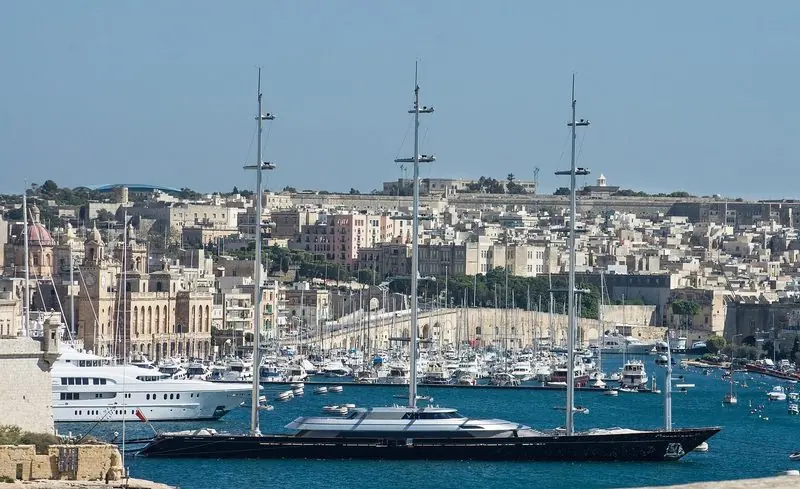
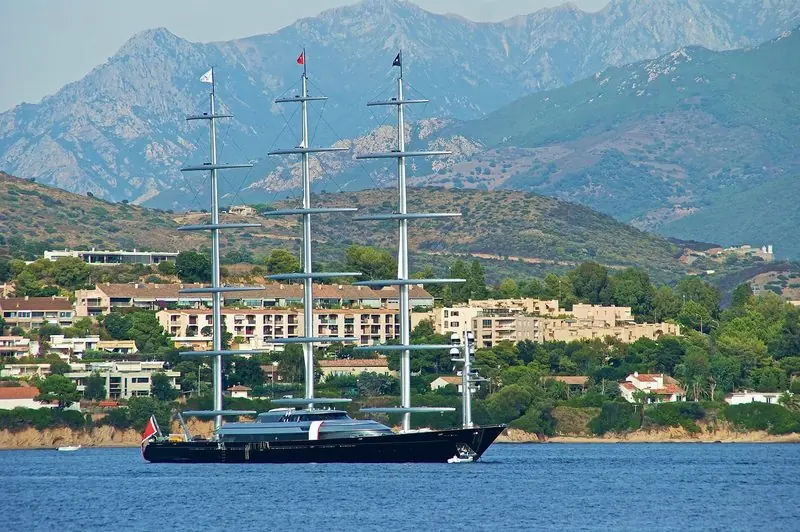
| DynaRig yachts | Maltese Falcon (88.1 m, Perini Navi, 2006) and Black Pearl (106.7 m, Oceanco, 2018) |
| Royal Huisman fleet | Athena (2004, 90 m over all and 79 m on deck), Sea Eagle II (81 m, 2020) and Aquarius (65 m performance ketch, delivered May 2025) |
| J Class work | rebuilds of Endeavour, Velsheda, Shamrock V and Ranger, new builds Hanuman and Rainbow |
| Performance sailing | Hetairos (66.9 m, Baltic Yachts, 2011), with Reichel Pugh |
| Also designed | the clipper Stad Amsterdam and the Bestevaer series of aluminium cruising yachts |
| Recognition | Sailing Yacht of the Year at the 2026 World Superyacht Awards for Aquarius, and a Lifetime Achievement Award for Gerard Dijkstra in 2022 |
| Exteriors and interiors | normally drawn by a separate design house |
| Design fee | not published. Superyacht band 1 to 5 per cent of build cost, plus 2 to 4 per cent project management, both outside the yard price. Naval architecture alone sits at the bottom of that band (SuperYachtReview 2026 price guide, updated March 2026) |
| Rig and spar engineering is commonly quoted separately from hull work, and sea trials attendance is billed on top of the design fee | |
| Copyright default is that the studio owns the design and the owner licenses one hull. Further hulls carry a royalty of roughly 1 to 1.5 per cent under published naval architecture practice | |
An ocean racer who became a naval architect
Gerard Dijkstra founded the practice in Amsterdam in 1969. He was a serious offshore sailor before he was a designer. He crewed on the Van de Stadt designed Second Life in the 1972 singlehanded transatlantic race, and in 1976 he sailed his own aluminium Bestevaer design in the same event, covering around 12,000 miles after turning back to repair damage and still finishing second.
That background shows in the work. The office starts from what a boat has to do at sea and lets the drawing follow. Dijkstra stepped back from day to day running more than a decade ago and still visits the studio. The firm is now led by chief executive Thys Nikkels with Mark Leslie-Miller as partner.
A small office in Amsterdam
Dykstra works from a building on the Kruithuisstraat in Amsterdam, with a second office at Southwest Harbor in Maine that keeps it close to American owners and refit yards. The team is around thirteen people covering naval architecture, engineering, sales and administration. For a practice with this many landmark yachts behind it, that is a very small headcount.
The consequence for an owner is direct access. There is no layer of account handlers between the client and the person drawing the hull. It also means the office takes on a limited number of projects at once and is candid when a slot is not available. Yards and owners generally approach Dykstra for a specific technical problem, not for a full turnkey service.
The office an owner calls when the rig has never been built before and still has to work on the first attempt.
Naval architecture, not styling
The studio sells hull lines, structural engineering, rig and spar design, computational fluid dynamics, tank testing, performance prediction, sail plans and deck layouts. It also does refit engineering and classic restoration. What it does not normally do is the interior or the applied styling, which is where most owners think design begins.
Its range runs well beyond yachts. Dykstra drew the clipper Stad Amsterdam, launched in 2000, and the Greenpeace vessel Rainbow Warrior. The office is also active in wind assisted propulsion for commercial ships. An owner building an 80 metre sailing yacht benefits from that, because the same engineering standards that satisfy a ship classification society are already in the building.
The J Class revival
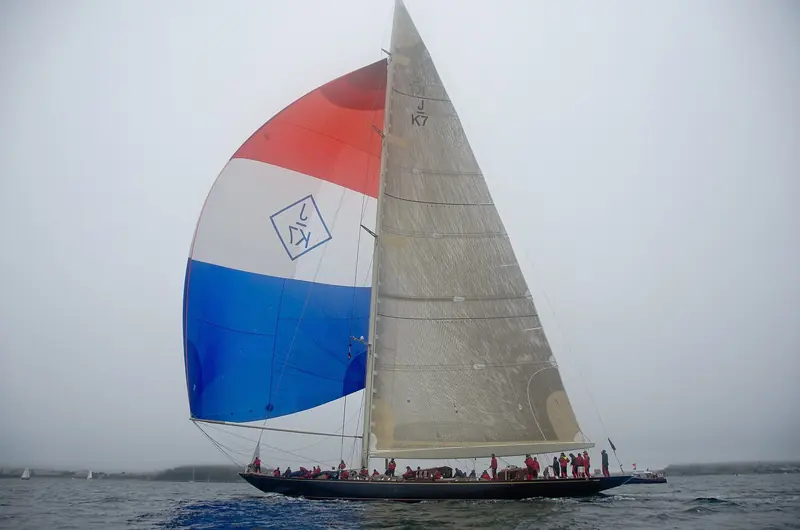
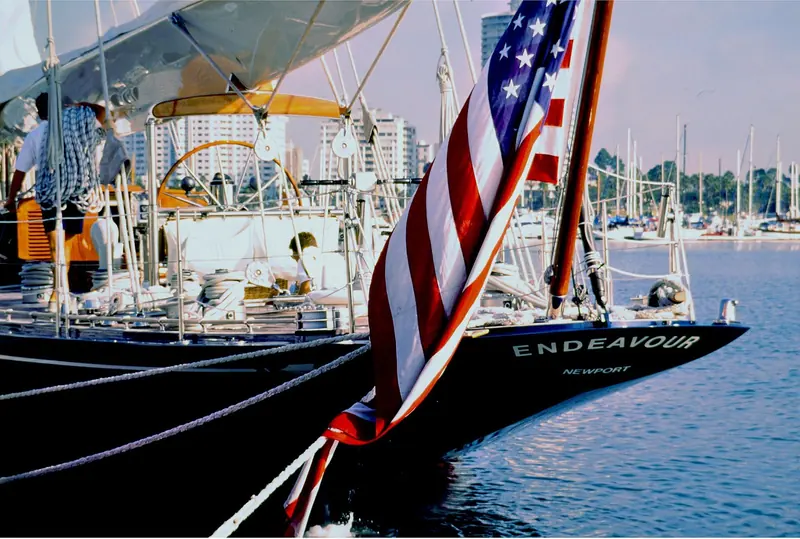
In 1989 the 39.56 metre Endeavour emerged from a five year rebuild that Dykstra had redesigned, and a class that had been dead since the 1930s came back. Velsheda, Shamrock V and Ranger followed. These boats were originally built to an old racing rule with no thought for comfort, safety or modern class requirements.
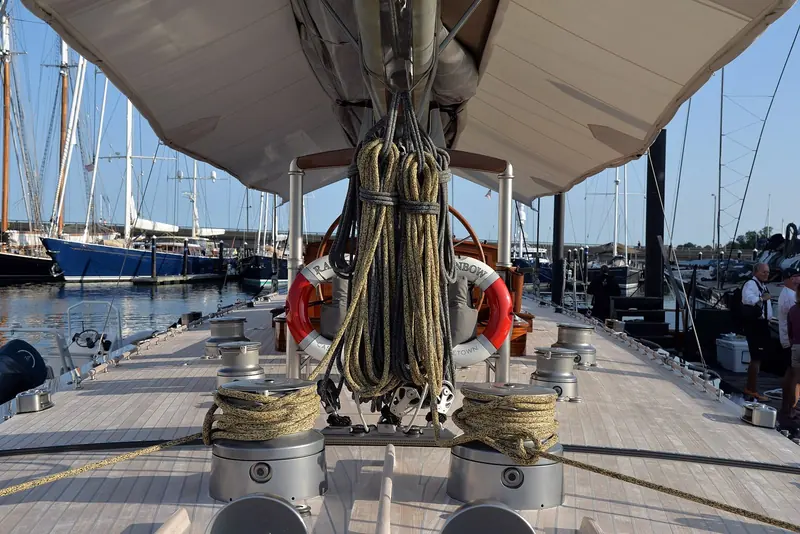
Dykstra then drew two new J Class yachts from original lines, Hanuman at Royal Huisman and Rainbow at Holland Jachtbouw. The technical trick was keeping the period profile above the water while optimising the hull below it and adding systems a modern owner expects. For an owner considering a classic restoration, this is the single deepest body of work in the field. It is also why the J Class fleet races competitively against itself today.
The DynaRig
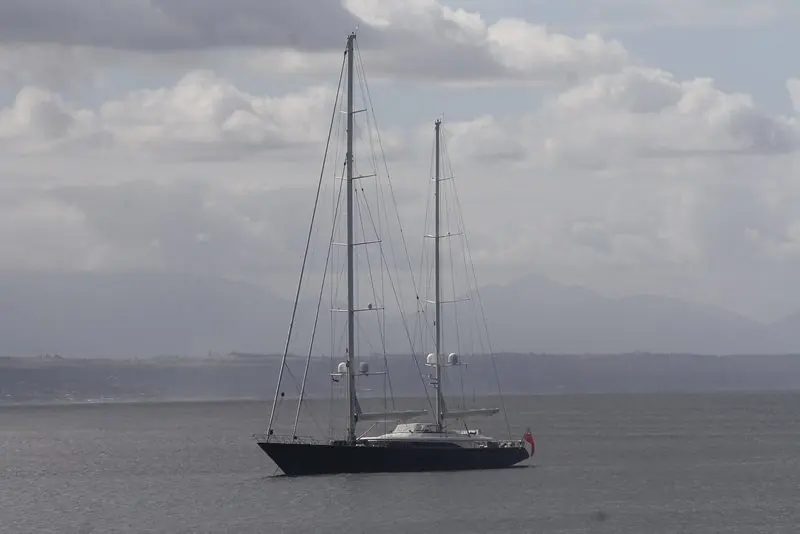
The DynaRig was conceived by the German engineer Wilhelm Prolss in the 1960s for cargo ships and went nowhere for want of light enough materials. Dykstra revived it in carbon. Maltese Falcon, 88.1 metres, was completed by Perini Navi in February 2006 with three unstayed rotating carbon masts carrying fifteen square sails and about 2,396 square metres of sail area. Damon Roberts of Insensys engineered the masts and the interior was by Ken Freivokh.
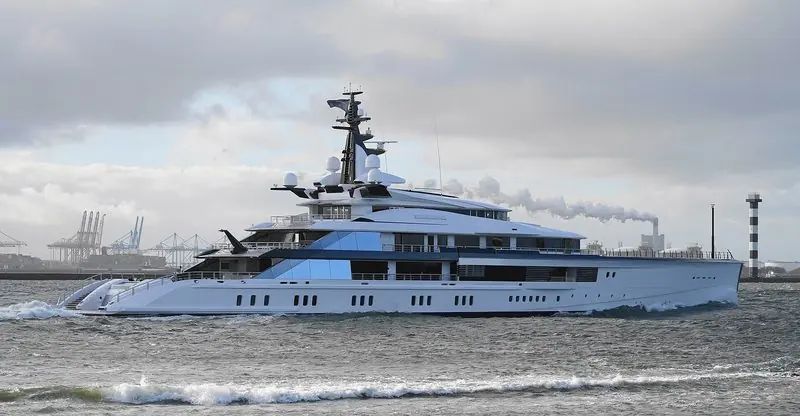
Black Pearl followed from Oceanco in 2018 at 106.7 metres, the largest DynaRig yacht built. Her three carbon masts stand around 70 metres and her 2,900 square metres of sail can be set in roughly seven minutes at the push of a button. The point for an owner is that a very large sailing yacht can be handled without a foredeck crew hauling on anything. Maltese Falcon took seven major awards in 2007, including Sailing Yacht of the Year at the World Superyacht Awards.
The big schooners and the fast ones
Athena, delivered by Royal Huisman in 2004, measures 90 metres over all and 79 metres on deck, and was the largest sailing yacht in the world at the time. Dykstra did the naval architecture and Pieter Beeldsnijder the exterior and interior. Sea Eagle II, 81 metres from the same yard in 2020, is the largest aluminium sailing yacht ever built, drawn by Dykstra with Mark Whiteley Design. She has since completed a non-stop circumnavigation and has more than 45,000 nautical miles behind her.
Aquarius, a 65 metre performance ketch, followed from Royal Huisman on 28 May 2025 with Dykstra naval architecture and an interior by Mark Whiteley Design. She replaced a 56 metre boat of the same name for the same owners and carries about 45 per cent more volume. She was named Sailing Yacht of the Year at the 2026 World Superyacht Awards and took best naval architecture for sailing yachts at the BOAT Design and Innovation Awards in February 2026. Hetairos shows the other side of the office, a 66.9 metre carbon ketch from Baltic Yachts in 2011 with a lifting keel and a lifting rudder, drawn with Reichel Pugh, which averaged 15.12 knots across the Atlantic on an early passage.
The yards behind the work
Royal Huisman is the closest relationship, with Athena, Sea Eagle II, Hanuman and Aquarius all built there. Perini Navi built Maltese Falcon, Oceanco built Black Pearl, Baltic Yachts built Hetairos and Holland Jachtbouw built Rainbow. Vitters and other Dutch aluminium builders appear regularly.
That matters to an owner because a rig this ambitious is only as good as the yard that installs it. Dykstra has already solved carbon mast bearing loads, keel lifting mechanisms and deck structure with each of these builders. A studio that has worked through those problems before will not be learning at the owner's expense. It also gives an owner an honest second view when a yard says something cannot be done.
How an owner engages the studio
Most projects start with a written brief covering size, use, crew numbers, draft limits and how hard the boat is expected to be sailed. Dykstra then produces preliminary lines, a sail plan and a general arrangement, which is the package a yard can price. On a large custom sailing yacht the design and engineering phase runs to many months before construction starts, and total time from concept to delivery of a boat of this scale is commonly three to four years.
The owner deals with the naval architects directly through concept and basic design, then with the yard's project team once building begins, with Dykstra continuing on engineering and sea trials. The studio normally works alongside a separate exterior and interior designer appointed by the owner. Sea Eagle II ran with Mark Whiteley Design, Maltese Falcon with Ken Freivokh, Athena with Pieter Beeldsnijder. Coordination between those two offices is the owner's responsibility to fund and to chase.
Cost, recognition and who it does not suit
Engineering studios at this level charge either against defined design stages or as a share of build cost, and rig work is often quoted separately from hull work. The percentages that are actually in print come from smaller practices: 4 to 7 per cent of the finished cost at Marsh Design, 7 to 10 per cent at Sponberg Yacht Design, 10 to 12 per cent on a fixed commission at Kasten Marine, all read 28 July 2026. At superyacht scale the proportion falls, and the current market band from the SuperYachtReview guide of March 2026 is 1 to 5 per cent for the designer with 2 to 4 per cent more for project management, both outside the yard's price. Naval architecture alone sits at the bottom of that. Sea trials and engineering attendance are billed on top, as they are across the profession.
The recognition is real. Gerard Dijkstra received the Lifetime Achievement Award at the BOAT International Design and Innovation Awards in 2022, and the studio's yachts have taken top honours repeatedly since 1989. This office does not suit an owner who wants one firm to hand over a finished boat including the interior, or an owner buying a motor yacht, which is not the studio's field. It also does not suit anyone who wants a conventional boat delivered quickly, since most of what Dykstra is asked to do has not been done before, and the fee reflects development work rather than the reuse of a known answer.
Who owns a rig nobody else has drawn
The intellectual property question is unusually live at this studio because the work is unusually original. The professional default, in the ITIC standard trading conditions for naval architects dated 8 July 2025, is that the consultant owns everything created under the agreement and the client receives a non-exclusive royalty-free licence for the purposes of that agreement. Superyacht contracts normally improve on that to an exclusive, irrevocable and assignable licence, and published practice prices any further hull to the same design at a royalty of roughly 1 to 1.5 per cent. An owner funding the development of something genuinely new, a rig type or a hull form, is paying for research that will outlive his boat, and the contract should say who gets to use it next.
Continuity is better here than at most of the small studios in this directory, and that is worth stating plainly. The founder handed over, the practice trades under a chief executive and a partner with around thirteen people, and the DynaRig work has been carried across two decades and two yachts by an office rather than by an individual. That structure is the answer to the key-person question a two-person practice cannot give. What still needs writing into the contract is the right to the complete engineering set in native format, because on a one-off rig a refit yard cannot reverse-engineer what it cannot see.
Singular engineering is worth more to keep than to sell
A yacht built to a Dykstra design does not sell faster than a conventional boat and often sells slower, and the reason is the same thing that makes it worth commissioning. A one-off rig or an unrepeated hull form has no comparables, so a valuer has nothing to anchor to and a buyer has to be persuaded from first principles. Sailing yachts already draw a narrower pool of buyers than motor yachts of the same value, and an unconventional sailing yacht narrows it again. Against an average 487 days on market and a median of 277 across the 470 yachts of 24 metres and over sold in 2025, boats of this kind sit at the far end.
The J Class is the counter-case and it is instructive. A class with rules, a circuit and a recognised set of hulls has a market in a way a singular yacht does not, and the restoration work is closer to the classic car market than to yacht brokerage. The lesson for an owner is that liquidity comes from belonging to a set. A boat that belongs to no set is bought for what it does, and its value rests on the engineering being right, which is precisely what this office is for. Anyone commissioning here should assume he is buying a twenty-year asset and not a five-year position.
Practical detail
| Design fee | not published; superyacht market band is 1 to 5 per cent of build cost plus 2 to 4 per cent project management, both outside the yard price, with naval architecture alone at the bottom of that band (SuperYachtReview 2026 price guide, updated March 2026) |
|---|---|
| Rig and sea trials | rig and spar engineering is commonly quoted separately from hull work, and sea trials attendance is billed on top of the design fee |
| How a project starts | a written brief on size, use, crew numbers, draft limits and how hard the boat will be sailed, followed by preliminary lines, a sail plan and a general arrangement, the package a yard prices against |
| Copyright and reuse | ITIC standard trading conditions, 8 July 2025, default to a non-exclusive royalty-free licence for one hull; superyacht contracts normally upgrade this to an exclusive, irrevocable, assignable licence, with a further hull priced at roughly 1 to 1.5 per cent royalty under published practice |
| What still needs asking for | the complete engineering set in native format; on a one-off rig a refit yard cannot reverse-engineer what it has never been shown |
| Yards worked with | Royal Huisman (Athena, Sea Eagle II, Hanuman, Aquarius), Perini Navi (Maltese Falcon), Oceanco (Black Pearl), Baltic Yachts (Hetairos), Holland Jachtbouw (Rainbow) |
What owners and crew report
No independently attributable owner testimony found
Sea Eagle II's owner Dr Samuel Yin and her captain both declined interview requests about the yacht's 45,000 nautical mile voyage, and coverage of Maltese Falcon and Black Pearl draws on the design and build teams rather than on owners or crew; this research found no on-the-record operational quote from anyone who has sailed one of these yachts
Yotters research desk
What is good, and what to watch
Strong points
- The deepest DynaRig experience that existsMaltese Falcon in 2006 and Black Pearl in 2018 are the only two DynaRig superyachts built, and both were engineered by this office, so there is nowhere else to go for a third
- A genuine specialism in rigs and hull forms nobody has built beforethe J Class revival, the carbon DynaRig and Breakthrough's hydrogen fuel-cell integration all required engineering solved from first principles rather than adapted from a known answer
- Continuity beyond the founderGerard Dijkstra stepped back from day to day running more than a decade ago and the practice trades on under chief executive Thys Nikkels and partner Mark Leslie-Miller, which is a stronger answer to the key-person question than most small studios in this field can give
- A direct, small-office relationshiparound thirteen people with no account-handler layer between the client and the person drawing the hull, and the studio is candid when a slot is not available rather than overcommitting
What to watch
- Not a turnkey studiono interior and no applied exterior styling; an owner always coordinates a separate design house and funds two fees
- Not for motor yachtssailing yacht naval architecture is the entire practice, so this office is irrelevant to most of the fleet
- Singular engineering resells slowlya one-off rig or hull form has no comparables, so valuers have nothing to anchor to and boats of this kind sit at the long end of the market's time-on-market range
- Not a quick or cheap routemost commissions involve solving something that has not been done before, which is development work billed accordingly, and total time from concept to delivery commonly runs three to four years
Who it is for: Owners commissioning a large sailing yacht where the engineering is the hard part and the styling can wait.