Malcolm McKeon Yacht Design
| Founder | Malcolm McKeon, naval architect |
|---|---|
| Background | joined Ed Dubois full time in 1981 after studying yacht design at Southampton, and stayed 31 years as lead naval architect |
| Studio founded | end of 2012, after McKeon left Dubois |
| Based | Middle Barn, Efford Park, Lymington, Hampshire |
| Team | a group of naval architects and yacht designers led by McKeon |
| Experience | involved in more than 200 yachts including over 55 superyachts, by the studio's own count |
| Disciplines | naval architecture and full yacht design for monohulls, sailing catamarans, motor yachts, chase boats and tenders |
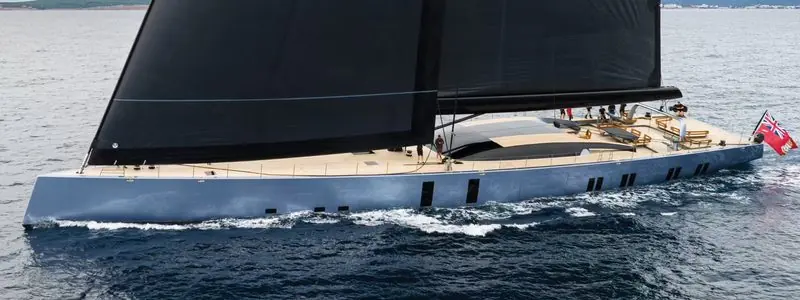
| Flagship | Sarissa, 59.7 m sloop, Royal Huisman, 2023, 499 GT, interior by Liaigre |
| Sarissa awards | ten in total, including Sailing Yacht of the Year at the 2024 World Superyacht Awards and Yacht of the Year from the International Superyacht Society |
| Zemi | a McKeon design that took Best Sailing Yacht 30 m to 39.9 m at the same awards |
| Nautor Swan | a 43.5 metre alloy sloop, design 118, announced in March 2024 to open Swan's 40 metre plus alloy range |
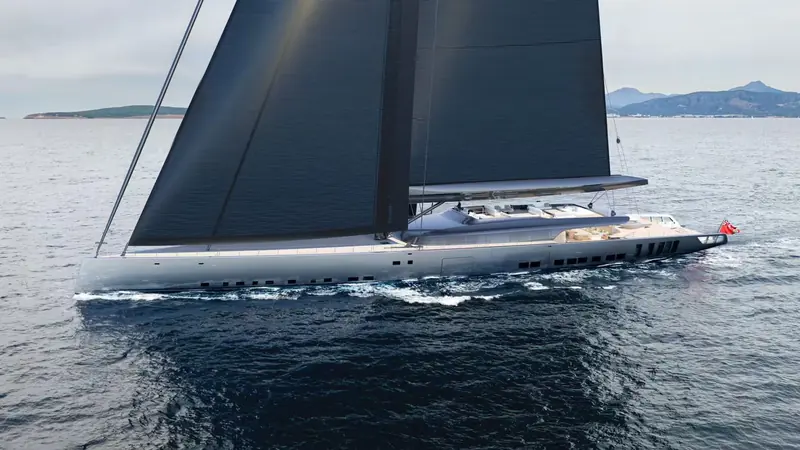
| Sky | an 81 m sloop revealed with Royal Huisman in November 2025, McKeon naval architecture and exterior, Winch interior, with a rig around 93 m that would be the tallest sloop rig in the world |
| Team | Malcolm McKeon and nine other designers in the Lymington studio (ONBOARD Magazine profile, read 28 July 2026) |
| Design fee | not published. Superyacht band 1 to 5 per cent of build cost, plus 2 to 4 per cent project management, both outside the yard price. Naval architecture and exterior without an interior sits in the lower half (SuperYachtReview 2026 price guide, updated March 2026) |
| Engineering attendance and sea trials are billed in addition to the design fee, and the interior is a separate appointment on a separate budget | |
Thirty one years with Ed Dubois
McKeon started working for Ed Dubois while still studying yacht design at Southampton in the late 1970s, delivering boats and sailing regattas during the holidays. He joined full time after graduating in 1981 and stayed for thirty one years as lead naval architect. Dubois was one of the two or three names that defined the large sailing yacht through the 1990s and 2000s.
He has been candid about the ending. The two men had developed different approaches to design and it became impossible to work together. He left around the end of 2012 intending to take time out. Projects already in his hands needed finishing, and the studio started because those owners wanted him and not a replacement.
A studio in Lymington
Malcolm McKeon Yacht Design works from Middle Barn at Efford Park outside Lymington, in the stretch of Hampshire coast that has produced a disproportionate share of British yacht designers. The team is a small group of naval architects and designers led by McKeon. He puts his own involvement across more than two hundred yachts, of which more than fifty five are superyachts.
That number is the point of the studio. An owner hiring McKeon is buying four decades of decisions about keel depth, rig loads and where to put a bulkhead. He is also buying continuity for the Dubois fleet, since a good many of those boats now coming up for refit or replacement were drawn under his hand in the first place.
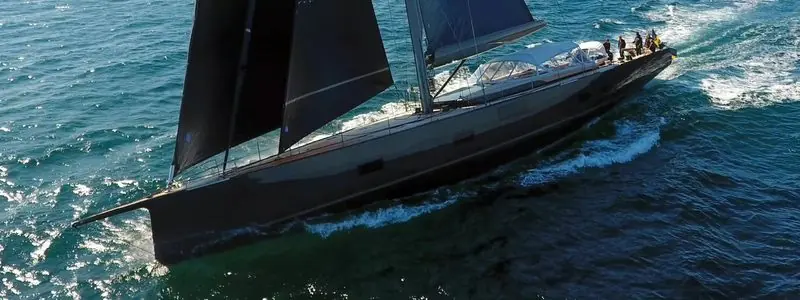
A superstructure pressed as low as the engineering allows, wrapped in glass the rig would rather not have there.
Naval architecture and the whole boat
This is not a styling practice. The studio does the naval architecture, the exterior and the general arrangement, and covers monohull sailing yachts, sailing catamarans, motor yachts, chase boats and tenders. Interiors normally go to a separate house, as they did on Sarissa, where Liaigre took the inside.
Doing the hull and the profile in the same office matters more on a sailing yacht than on a motor yacht. The rig loads, the keel, the deck structure and the shape of the superstructure all argue with each other, and on a sailing boat the argument is settled by physics. A studio that owns both sides of it can decide where to give ground without a negotiation between two firms.
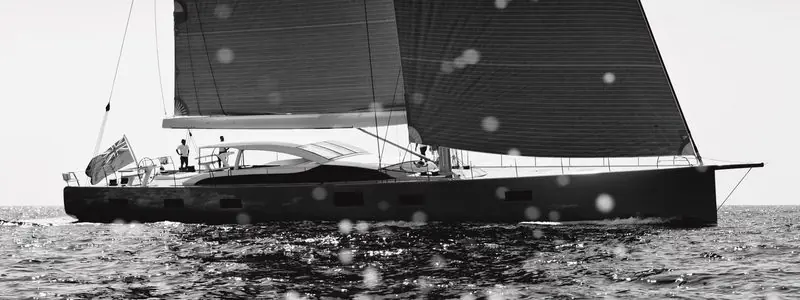
Low superstructure, and a great deal of glass
The recognisable move is a superstructure pressed as low and as long as the engineering allows, with wraparound glazing that runs almost uninterrupted. The sheerline typically shifts from convex forward to concave aft, which is what gives a McKeon boat its slightly predatory look on the water. Rigs are tall and mainsails square topped.
The reason is not only appearance. McKeon designs for connection to the surroundings, which in practice means an owner sitting in the saloon can see the water without standing up. Getting that on a sailing yacht is difficult, because glass is heavy, high up, and structurally awkward exactly where the rig wants to load the deck. This is where the naval architecture in house pays for itself.
Sarissa
Sarissa, 59.7 metres, was delivered by Royal Huisman in 2023 as yard number 404, with the full design by the studio and an interior by Liaigre. She carries an 11 metre beam, 499 GT and a lifting keel that moves her draught between 4.7 and 7.7 metres. The rig is a high performance sloop with a large square topped mainsail.
She won ten awards. Sailing Yacht of the Year at the 2024 World Superyacht Awards, Yacht of the Year and Best in Sail over 40 metres from the International Superyacht Society, Best Interior Sail and a Design and Innovation award for her propulsion. Four of those came at the BOAT design awards alone. Awards do not make a boat sail, and this one does both.

What Sarissa actually solved
Her superstructure is carbon, which let the studio use much slimmer window mullions and gain headroom inside without raising the roof. The saloon opens to the cockpit through a four panel sliding door 3.7 metres wide. The beach club door is carbon and folds out to around 20 square metres of platform. Finite element modelling was used to get the structure around the feature windows right.
She also carries forward facing retractable electric propulsion, which took its own innovation award. The practical list is longer and less glamorous, including retractable bollards, flush fairleads and drums for sail storage. An owner cares about those because they are the difference between a clean deck and a deck covered in hardware. The boat still has a jacuzzi, a sauna and a climbing wall.
Royal Huisman, Nautor Swan and the yards
Royal Huisman is the deepest relationship and the yard that built Sarissa. In March 2024 Nautor Swan announced a 43.5 metre alloy sloop to a McKeon design, listed as design 118, opening the Finnish yard's range above 40 metres and moving it into aluminium construction. The boat is being marketed with Edmiston and is drawn with hydrogeneration and provision for methanol and hydrogen systems.
A yard choosing an outside designer to open a new range is a strong signal. Nautor Swan has its own long design tradition and brought McKeon in specifically for large alloy sailing yachts, which is the part of the market he has spent his career in. For an owner, a designer who is trusted to set a yard's direction is one who will be listened to when the build gets difficult. In November 2025 Royal Huisman revealed Sky, an 81 metre sloop with McKeon naval architecture and exterior styling and an interior by Winch Design, built in aluminium with a lift keel and a carbon Rondal rig standing around 93 metres, which would make her the tallest sloop in the world. She is a design ready to build and was not commissioned when it was announced, with a delivery estimate of 2030.
How a commission runs, and what it costs
McKeon has said he shows a client the boat they asked for and then one or two more radical alternatives alongside it, and that most owners take the conservative option because the money at risk is their own. From there the studio produces the lines, the sail plan, the general arrangement and the exterior, and the package goes to yards to price. That package is what an owner buys at the first gate, and it can be bought and stopped for its own price before any yard is committed. The letter of intent reserves a slot, the yacht building agreement is the commitment, and after engineering starts a change to the rig or the keel is paid for twice.
No studio publishes a scale. The percentages in print come from smaller practices and run from 4 to 7 per cent of finished cost at Marsh Design to 7 to 10 per cent at Sponberg Yacht Design, both read 28 July 2026, and they fall as build cost rises. At this size the SuperYachtReview guide of March 2026 puts a designer at 1 to 5 per cent of build cost with project management a further 2 to 4 per cent, both outside the yard's number, and naval architecture with exterior but no interior sits in the lower half. The interior is a separate appointment and a separate budget. Engineering attendance and sea trials are billed on top.
Recognition, and who it does not suit
The studio is barely a decade old and has already produced a Sailing Yacht of the Year, which is unusual. Zemi, another McKeon design, took Best Sailing Yacht from 30 to 39.9 metres at the same awards. Recognition of that order tells an owner the boat satisfied a panel that had crawled through the engine room, and it helps at resale.
This studio does not suit an owner who wants a traditional or classic sailing yacht, because the work is deliberately modern and McKeon has said he looks forward and not back. It does not suit an owner whose main interest is a very large motor yacht, where deeper portfolios exist elsewhere. Anyone wanting a single office to deliver the interior as well will need a second appointment. The studio also has MMYD 095 in build.
Ten people, one name, and what the contract should say
The studio is McKeon and nine other designers, which is the reason the work is coherent and the reason a four-year build carries a concentrated risk. The standard documents ignore it. The ITIC standard trading conditions for naval architects, in the version dated 8 July 2025, cover intellectual property and cap liability at ten times the consultant's charges or GBP 100,000, whichever is higher, and say nothing about the unavailability of a named principal, and no marine standard form does. Ordinary commercial consultancy treats death or prolonged incapacity of a key person as a termination event and requires a replacement of equal standing subject to the client's approval.
The drawing set is the other half of it. Copyright normally stays with the studio and the owner buys a licence to build one hull, so an owner without a step-in right holds permission and no files. On a sailing yacht that is not an abstraction. A rig of the kind announced with Royal Huisman in November 2025 cannot be re-engineered from photographs, and every future refit, re-rig and class survey will need the original engineering. An escrow or an assignment on insolvency should be in the design agreement, and it will not be offered unless it is asked for.
A narrow market, and a rig that holds its value
A yacht from this studio sells to fewer people than a motor yacht of the same value, and that is a fact about sailing rather than about the design. The pool is specialised, the buyers know what they are looking at, and a boat can sit while the right one is found. Against an average 487 days on market and a median of 277 across the 470 yachts of 24 metres and over sold in 2025, large sailing yachts sit at the long end. The studio is also barely a decade old, so a valuer has few comparables to work from, which cuts both ways and mostly cuts against a seller in a slow market.
What holds value is the engineering. A hull, a keel and a rig that were right on day one are still right in year fifteen, and they are the parts a refit cannot economically change, which is why they are what a serious buyer surveys first. Sarissa took ten awards including Sailing Yacht of the Year at the 2024 World Superyacht Awards, and a panel that has crawled through an engine room is a better signal at resale than a magazine cover. Owners commissioning here should treat the boat as a long hold and should keep the interior appointment calmer than the naval architecture, because the interior is the part that will be judged by somebody else's taste.
Practical detail
| Design fee | not published; market band is 1 to 5 per cent of build cost plus 2 to 4 per cent project management, both outside the yard price (SuperYachtReview 2026 price guide, updated March 2026) |
|---|---|
| What the studio covers | naval architecture and full yacht design for monohulls, sailing catamarans, motor yachts, chase boats and tenders; the interior is always a separate appointment |
| Studio size | Malcolm McKeon plus nine other designers in the Lymington studio, so the practice is small measured against the fleet it has produced |
| Where the work has gone | Royal Huisman built Sarissa and is building the 81 m Sky; Baltic Yachts and Nautor Swan (the 43.5 m design 118) have also built to McKeon drawings |
| What a commission is really buying | a hull, rig and profile settled inside one office rather than negotiated between a separate naval architect and stylist, which is the studio's core pitch to owners who want the boat fast as well as handsome |
What owners and crew report
The owner's reaction to Zemi, relayed by the designer, not independently confirmed
in a Yachting World piece where McKeon sailed the 110 foot Zemi with her owner, McKeon reported the owner was delighted with the boat, chuffed to bits with her, and thrilled with the racing result against two J-Class yachts in the same fleet; this is the designer's own account of a client reaction rather than a quote taken directly from the owner
Malcolm McKeon, quoted in Yachting WorldMcKeon's own assessment of Zemi's race performance
the boat came in behind the two J-Class yachts in her regatta fleet, and McKeon said he did not think they could have done any better against the boats in their class; he also credited a mid-race retrim, moving crew aft and adjusting mainsail set, with improving her pace
Malcolm McKeon, quoted in Yachting World
What is good, and what to watch
Strong points
- Thirty one years at Ed Dubois behind the foundinga naval-architecture pedigree from one of the two or three names that defined the large sailing yacht through the 1990s and 2000s, which is why owners commissioning a big sloop put this studio on the shortlist
- A recognisable, low-superstructure look that also measures wellSarissa took ten awards including Sailing Yacht of the Year at the 2024 World Superyacht Awards, and Zemi took Best Sailing Yacht 30 to 39.9 metres the same year, so the styling signature and the racing numbers are winning at the same time
- Comfortable at both ends of the use caseSarissa was built to compete on the racecourse and also to cross oceans in big seas with manual steering the owners wanted to feel through their fingertips, which shows the office can hold performance and seaworthiness together rather than trading one for the other
- A live pipeline at the very top of the size rangethe 81 metre Sky, revealed with Royal Huisman in November 2025 with a rig that would be the tallest sloop rig in the world, shows the studio is still being trusted with record-scale commissions, not resting on Sarissa
What to watch
- A small studio built around one namenine other designers work alongside McKeon in the Lymington office; an owner is buying access to a single naval architect's judgement, and the practice carries real key-person risk that has to be asked about, not assumed away
- No published fee scalethe only public figures are the market-wide SuperYachtReview band of 1 to 5 per cent of build cost plus 2 to 4 per cent project management, neither specific to this studio
- Sailing yachts only, and large ones at thatthe portfolio runs from big custom sloops to the odd motor yacht and tender; it is not the office for a first boat, a small cruiser, or a motor yacht buyer
- Interior is always a second appointmentSarissa's interior came from Liaigre and Sky's from Winch; an owner has to appoint and coordinate a separate studio on a separate budget alongside McKeon's naval architecture and exterior
Who it is for: Owners commissioning a large modern sailing yacht who want the hull, the rig and the profile settled inside one office.