Nigel Irens
| Designer | Nigel Irens, British, self-taught; trained in boatyard management at Southampton College of Technology |
|---|---|
| Base | Ashburton, Dartmoor, in a former wool-industry building called the Tenter loft |
| Honour | Royal Designer for Industry, 2005 |
| Long-term partner on the maxi trimarans: Benoit Cabaret (French naval architect) | |
| ENZA New Zealand (ex Formule Tag, stretched to 92 ft): 1994 Jules Verne Trophy in 74 days 22 hours | |
| B&Q Castorama, 75 ft trimaran, 2004 | Ellen MacArthur's 2005 solo round-the-world record, 71 days 14 hours |
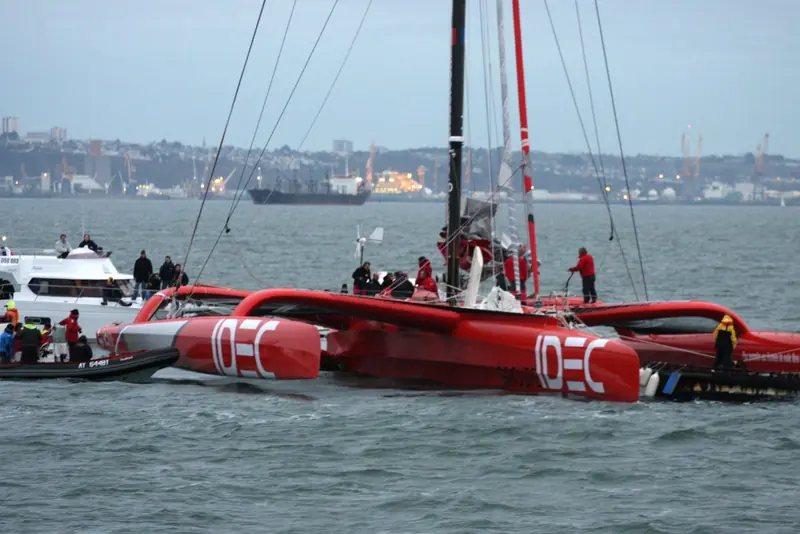
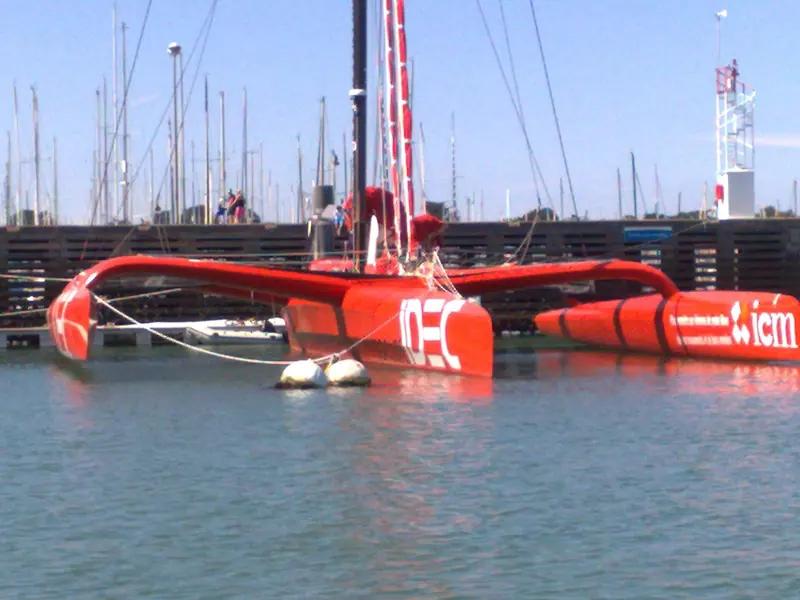
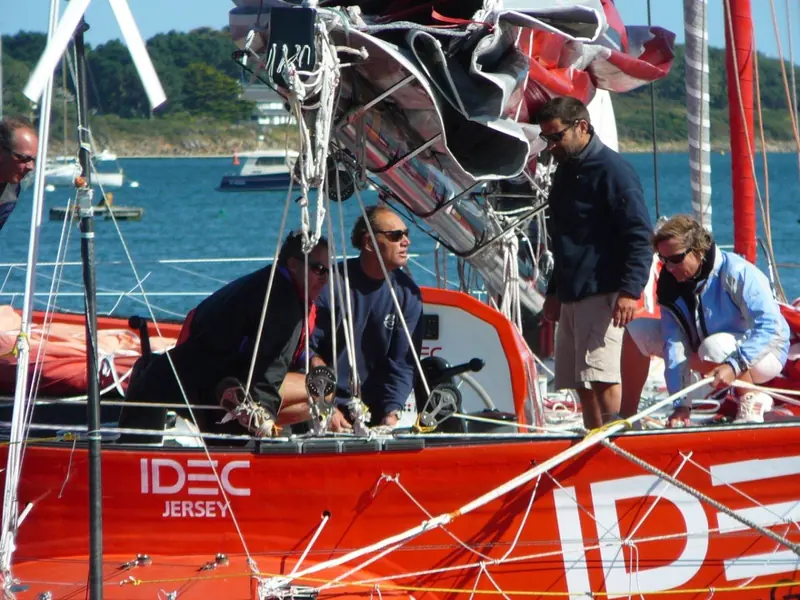
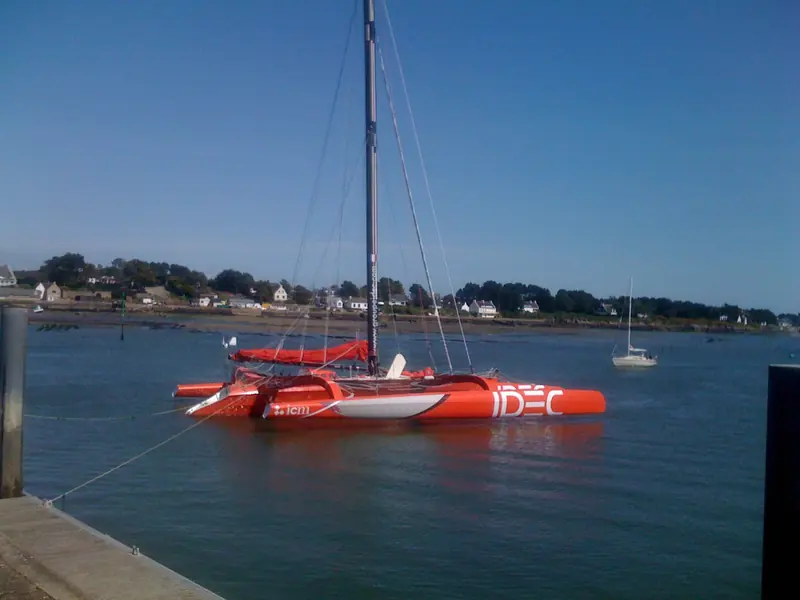
| IDEC 2, 29.7 m trimaran, 2007 | Francis Joyon's 2008 solo round-the-world record, 57 days 13 hours |
| IDEC 2 specification | beam 16.5 m, displacement about 11 tonnes, mast 32 m, carbon and foam sandwich, resin infusion, built by Marsaudon Composites, Lorient |
| Sodebo, 105 ft, 2007 | Thomas Coville, 24 hour record of 620.8 miles and solo west-east Atlantic in 5 days 19 hours |
| Oman Air, 105 ft, 2010 | non-stop solo Round Britain record, 4 days 15 hours |
| Cable and Wireless Adventurer, 35 m power trimaran, launched 16 March 1998; later Sea Shepherd's Brigitte Bardot, retired 2021 | |
| Production work | Gunboat 55 and 60 (from 2013), Gunboat 57, SeaRail 19 trailable trimaran (2012), Paradox 62 ft (2010) |
| Consultant to Alinghi for the 2008 America's Cup | |
| Fee schedule | not published |
A Self-Taught Designer on Dartmoor
Irens learned to sail as a child at Salcombe and trained for a diploma in boatyard management at Southampton College of Technology in the 1960s, not as a naval architect. In the early 1970s he worked on the build of the 52 foot trimaran Tacitimu with the multihull pioneer Paul Weychan at a yard on the River Severn. He has told SAIL magazine that he failed maths at school and designs by intuition, sketching on paper and still building scale models. Multihulls World's 2024 profile says that in twelve years of interviewing multihull figures, no leading architect or skipper has failed to name him among the masters.
The office is small and it stays that way on purpose. The long-term partner on the racing boats is the French naval architect Benoit Cabaret, and the structural and centreboard engineering has leaned on outside specialists, Martyn Smith for composites and Roger Scammell for the boards, according to SAIL. A late colleague, Ed Burnett, started his own career in the office and went on to draw gaff cutters with Irens. So if you hire him, you are hiring one person's judgement and a short list of people he trusts, not a department.
From Round Britain Trimarans to the Jules Verne
The early list is specific. Promenade, a 60 foot cruising trimaran from 1977, was still chartering in the British Virgin Islands when SAIL wrote about him in 2014. He rebuilt the 31 foot trimaran Jan of Santa Cruz and won her class in the 1978 doublehanded Round Britain and Ireland Race with Mark Pridie. Gordano Goose, a 40 footer from 1980, won a 24 hour singlehanded race out of Saint-Malo in 1981 for a 4,000 pound prize. For Tony Bullimore he drew the 40 foot IT82 and then the 60 foot Apricot, which won the 1985 Round Britain Race, and the two men were named Yachtsmen of the Year together.
The step up came with Formule Tag, an 80 foot catamaran launched in Montreal in 1983 for Mike Birch. In 1984 she covered about 512 nautical miles in 24 hours in the Quebec to Saint-Malo race (SAIL gives both 517 and 512.5, so the exact figure is contested). Stretched to 92 feet and renamed ENZA New Zealand, she won the 1994 Jules Verne Trophy with Peter Blake and Robin Knox-Johnston in 74 days 22 hours. Irens credits the stretch with roughly 15 per cent more performance, which fits his stated rule: design the longest boat you can accept, then add a few feet.
Design the longest boat you can possibly accept and then add a few feet.
The Maxi Trimarans: B&Q, IDEC and Sodebo
B&Q Castorama was a 75 foot trimaran built for Ellen MacArthur. She took the solo round-the-world record in 2005 in 71 days 14 hours. Irens said at the time that it was a relief to design a boat that was for once not inside the constraints of a class rule, since the 60 foot ORMA limit did not apply. IDEC 2, drawn for Francis Joyon, is 29.7 metres long with a 16.5 metre beam, a displacement of about 11 tonnes and a 32 metre mast. Marsaudon Composites built her in Lorient in carbon and foam sandwich by resin infusion, and Irens avoids Nomex core because of the punishment these boats take.
The Daily Sail reported that Irens and Cabaret expected IDEC 2 to be two or three days faster than B&Q Castorama and that the real gap was nearer two weeks, with speeds well beyond the performance prediction program. Joyon took the solo round-the-world record in 2008 in 57 days 13 hours and a 616 mile 24 hour run. Sodebo, a 105 foot sister for Thomas Coville, logged a 620.8 mile day and a solo west-east Atlantic crossing in 5 days 19 hours. Oman Air, a 105 foot sister, set a non-stop solo Round Britain record of 4 days 15 hours in 2010. Joyon's own summary of the IDEC 2 was that it doesn't fight the waves, it goes with them.
The Power Trimaran That Became a Protest Ship
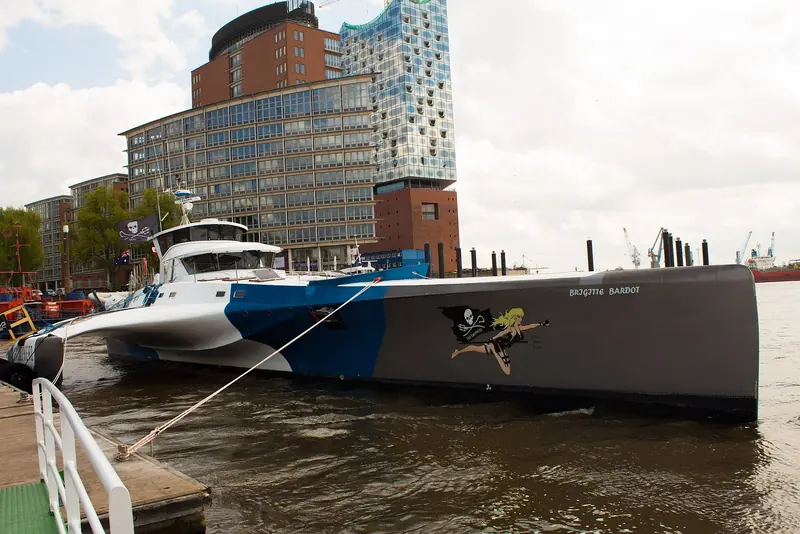
Irens designed the Adventurer as a high-speed twin diesel trimaran, and SAIL records a round-the-world run of 22,600 miles in 74 days in 1998. She carried several later names, among them Ocean 7 Adventurer, Rat Race Media Adventurer, Gojira and finally Brigitte Bardot, the name Sea Shepherd gave her after a legal claim. She was photographed alongside in Hamburg in May 2015, still in Sea Shepherd colours.
Sea Shepherd retired her in 2021 and she was later reported sold, which makes her a useful used-boat data point: a 1998 hull still trading after more than two decades of hard service, which Boat International reported sold. It also shows how far his range runs. The same office drew a 105 foot ocean racer, a 12 metre traditional-looking power launch called Rangeboat, a King Alfred school dinghy that the school itself has built three of, and the gaff cutters Zinnia and Kilrush Nomad II with Ed Burnett.
Production Boats: Gunboat, Paradox and SeaRail
Paradox is a 62 foot carbon racer-cruiser trimaran from 2010, built from the moulds of Loick Peyron's Fujifilm. SeaRail 19 followed in 2012 as a production trailable trimaran built in Vietnam for the American market. In 2013 the Gunboat 55 and 60 became his first work with a production builder, under Peter Johnstone's Gunboat. Gunboat's own run of eight 60 footers in China has ended, so a Gunboat 60 is now a second-hand purchase.
Reviewers are frank about the character. Yachting World's test of the 55 concluded that its speed and power bring added responsibility, that crews need the skill to deal with or avoid heavy weather, and that the open aft areas can feel exposed in a blow. When Gunboat later failed, the owner of the part-built 55 Vaivai took his hull out of the yard and asked Irens to tweak it, which tells you something about who owners turn to in a crisis. Irens has been equally direct about his own limits, saying he is not a natural ocean sailor and prefers to keep land in sight.
How He Works and What He Believes
Irens argues that catamarans have been held back by the weight that comes with space and comfort, and that long slender hulls beat short wide ones. He prefers centreboards to daggerboards for adjustability, lower noise and drag, and more interior room. He sees foil assistance as promising and has said solid wing sails do little to help upwind. Ellen MacArthur's description, in SAIL, is of a purist whose fast boats are fast and whose cruising boats cruise. In March 2019 he gave the Cruising Association's Hanson Lecture, called Slippery Boats, to about sixty people at CA House in London on re-working that technology for other boat types.
He has also acted as a consultant, not only as a designer. SAIL lists him as an adviser to Alinghi for the 2008 America's Cup, and his site shows the secret A65 Middle East project, a 53 foot boat on 65 foot hulls with a rotating wing mast and carbon rigging, as well as the 78 foot APC78 built by Green Marine in the UK. Would he suit every buyer? No, and the verdict below says why.
What Commissioning Irens Costs
Nothing on his site or in the interviews read for this page gives a design fee, a plan price or a percentage. For context only, other small-boat designers quote 10 to 12 per cent of the as-built cost for a fixed commission on a custom yacht, and flat design-only fees of 3,000 to 30,000 dollars for plans, according to Kasten Marine and CADCrowd. Those are market figures for other firms, not Irens's rates, and a carbon racing trimaran with composite engineering will price on a different basis.
Expect the cost to sit with the builder as much as the designer. The big boats here were built at specialist composite yards: Marsaudon in Lorient for IDEC 2, Green Marine for the APC78 and CMM in Cherbourg for the Ocean Eagle 43 patrol trimarans from his concept. The practical route is to approach the office with a clear brief and a named builder, ask for a scope and fee in writing.
Practical detail
| Design fee | not published by Irens; for context only, other small-yacht designers quote 10 to 12 per cent of as-built cost for a fixed commission, or 3,000 to 30,000 dollars for design-only plans (Kasten Marine, CADCrowd); get a written scope and fee from the office |
|---|---|
| Where | Ashburton, Dartmoor, England, in a former wool-industry building; the maxi trimarans were built by Marsaudon Composites in Lorient, the APC78 by Green Marine in the UK, the Ocean Eagle 43 patrol trimarans by CMM in Cherbourg |
| Typical build | carbon and foam sandwich by resin infusion on the racing boats; Irens avoids Nomex core because of the punishment the hulls take (The Daily Sail) |
| Production routes | Gunboat 55, 57 and 60 catamarans; SeaRail 19 trailable trimaran built in Vietnam; Paradox 62 ft from Loick Peyron's Fujifilm moulds |
| Used-market note | the Gunboat 60 run of eight in China has ended, so a 60 means a second-hand purchase; the 1998 Adventurer was reported sold by Boat International after Sea Shepherd retired her in 2021 |
| What is not published | design fees, plan prices, typical lead time for a one-off, and any long-term ownership data on the cruising designs |
| Alternatives | VPLP for French maxi trimarans, Morrelli and Melvin for later Gunboats; the Dykstra and Van Oossanen entries on this site cover other long-hull specialists |
What owners and crew report
IDEC 2 gave a smooth ride in a seaway
Francis Joyon described the trimaran as a boat that does not fight the waves but goes with them, and Irens said her speeds were well beyond what the performance prediction program suggested
The Daily SailGunboat 55: fast, but you need to be able to cope with a blow
the test concluded that the speed and power bring added responsibility and that crews need the skills to deal with or avoid heavy weather, and that the open aft areas can feel exposed
Yachting WorldAn owner went back to Irens after the builder failed
the owner of the part-built Gunboat 55 Vaivai rescued his hull from the Gunboat premises and turned to Irens to tweak it
Yachting WorldA peer's view of how the boats behave
Ellen MacArthur describes him as a purist whose fast boats are fast and whose cruising boats cruise
SAIL
What is good, and what to watch
Strong points
- An unusually long record of boats that finished fasta Jules Verne Trophy in 1994, a solo round-the-world record in 2005 and another in 2008, from three different boats and owners
- He designs to the budget, not only to the ruleB&Q Castorama and IDEC 2 were drawn without a class rule to hold them back, and IDEC 2 ran two weeks faster than the first estimate
- A range from a school dinghy to a 35 m power trimaranthe same hand drew the King Alfred dinghy, gaff cutters, Gunboat catamarans and the Adventurer, so a client with an odd brief is not turned away for fitting no category
What to watch
- No published fee or plan pricenothing found on the office's site or in the press gives a rate, so you only learn the cost by asking
- Almost all independent testimony is about racing boatspublished owner reports on the cruising boats are thin; the one detailed boat test read here is a reviewer, not a long-term owner
- These are demanding boatsYachting World warns the Gunboat 55 needs a crew with heavy-weather skills, and the Gunboat 60 is described as not for novices; the 60 run has ended, so you buy it second hand
- A one-office practicekey-person risk is real and has to be written into a contract, and for a luxury interior or a very large motor yacht you would need other specialists
Who it is for: Owners and campaigns that want a very long, light multihull, from a solo record attempt to a performance cruising catamaran, and are happy to work with a one-person office and a specialist composite builder.