Philippe Briand (Vitruvius Yachts)
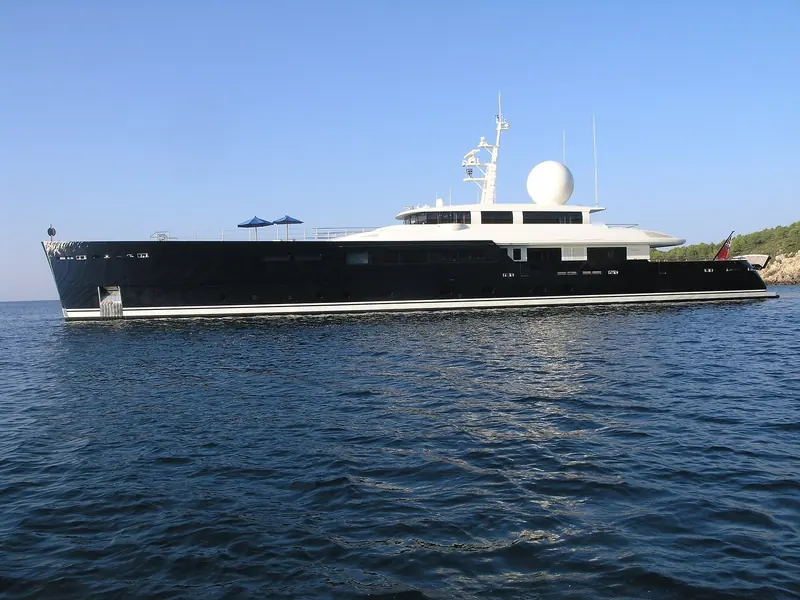
| Founder | Philippe Briand, born in La Rochelle, France |
|---|---|
| Design office founded | 1978, La Rochelle |
| London studio | since 2008, now the group headquarters |
| Motor yacht arm | Vitruvius Yachts, with a Viareggio office opened in 2025 |
| Team | around ten people across the studios |
| Disciplines | naval architecture, exterior design, rig and sail plan |
| Studio's own count | more than 12,000 boats built to its designs, 34 international design awards |
| Signature sailing yachts | Mari-Cha III (44.7 m, 1997), Mari-Cha IV (42 m, 2003), Vertigo (67.2 m, Alloy Yachts, 2011), Sybaris (70 m, Perini Navi, 2016) |
| Signature motor yachts | Exuma (50 m, Picchiotti, 2010), Galileo G (55 m, Picchiotti, 2011), Grace E (73 m, Picchiotti, 2014, since renamed Nautilus), Najiba (58 m, Feadship, 2019), Alchemy (65.7 m, Rossinavi, 2023) |
| Awards | World Superyacht Awards Motor Yacht of the Year 2015 and 2024, Sailing Yacht of the Year 2017 |
| Frequent yards | Perini Navi and its Picchiotti division, Feadship, Rossinavi, Alloy Yachts |
| Interiors | normally handled by a separate studio |
| Design fee | not published by the studio. Superyacht market band 1 to 5 per cent of build cost, plus 2 to 4 per cent project management, both outside the yard price (SuperYachtReview 2026 price guide, updated March 2026) |
| Published naval architecture scales at smaller size run higher: 4 to 7 per cent (Marsh Design), 7 to 10 per cent (Sponberg Yacht Design), 10 to 12 per cent on a fixed commission (Kasten Marine), all read 28 July 2026. The percentage falls as build cost rises | |
| The concept phase is quoted separately, which is the stage at which an owner can test a studio and stop for the price of the concept | |
From La Rochelle to London
Briand was born into a sailing family in La Rochelle. His father Michel was an Olympic Dragon sailor who founded the French sailmaker Tasker Sails. Briand designed his first boat at eleven and had a 25 foot Quarter Tonner built at sixteen, which won races and was repeated eleven times. He learned the trade in practice, including a spell from the age of eighteen with the Swedish designer Pelle Petterson, and holds no formal naval architecture degree.
He opened his own office in La Rochelle in 1978. He took the Half Ton Cup in Norway in 1983 and the One Ton Cup in 1984 with Passion 2, a boat he had drawn and then steered himself. From 1986 to 2000 he drew French America's Cup challengers, among them French Kiss, which reached the challenger semi-finals at Fremantle in 1987. Since 2008 he has worked from a studio in London.
Two names, one practice
The office trades under two names. Sailing work goes out as Philippe Briand, with the naval architects based in La Rochelle. Motor yacht work carries the Vitruvius Yachts name and is run from London, and in 2025 the group opened an office in Viareggio to sit closer to the Italian yards. Around ten people work across the studios, which makes this a small practice measured against the fleet it has produced.
The studio's own count is more than 12,000 boats built to its designs and 34 international design awards. Most of that number is production sailing yachts drawn for Groupe Beneteau, including the CNB 76 and the Jeanneau 64. An owner commissioning a 60 metre motor yacht is therefore hiring a designer whose hull shapes have been tested by thousands of ordinary sailors as well as by a handful of custom launches. Very few studios at the top of the market have that kind of volume behind them.
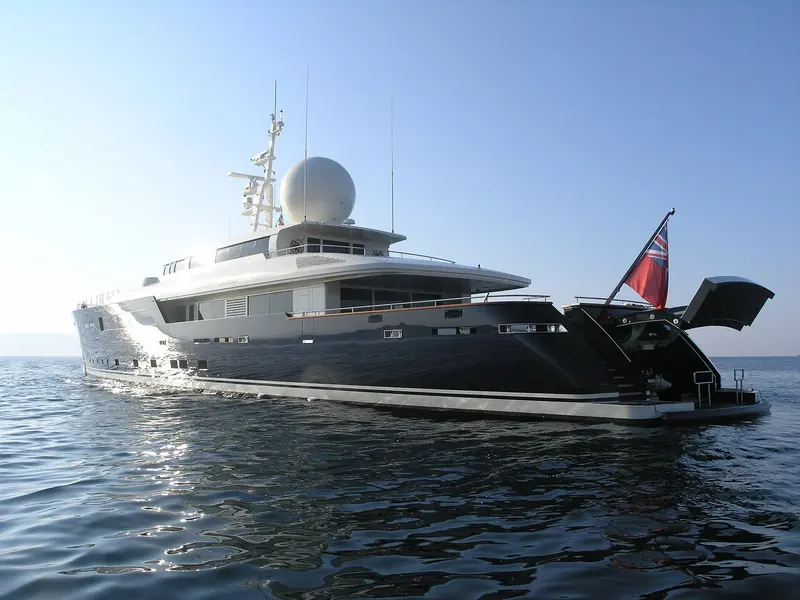
Length used honestly, so the boat is longer in the water than the profile ever suggests.
What a Briand hull looks like
The recognisable move is length used honestly. Briand hulls run a long waterline behind a near vertical bow, with almost no overhang wasted at either end, so the boat is longer in the water than the profile suggests. Superstructures sit low and stretch fore and aft instead of stacking upwards. On the Vitruvius motor yachts the silhouette reads as one long horizontal line broken by glass, with a fine entry that cuts into a head sea.
None of that is only styling. A long, slim hull needs less power for a given speed, which is why the Vitruvius boats are quoted with transatlantic range at economical cruising speeds. The cost is interior volume, because a Briand 60 metre will not carry the gross tonnage of a beamier boat of the same length. The studio is open about that trade and states it early in a project.
The sailing yachts that made the name
Mari-Cha III, launched in 1997 at 44.7 metres, took the west to east Atlantic monohull record in 1998. Mari-Cha IV, a 42 metre twin-masted schooner delivered in 2003, broke the record again and held it for more than a decade. Both were built to be pushed hard offshore. They established Briand as a designer who could make a very large boat genuinely fast.
Vertigo, 67.2 metres from Alloy Yachts in New Zealand in 2011, put a Briand exterior over an interior by Christian Liaigre and became one of the most photographed sailing yachts afloat. Her near vertical bow, long unbroken deck line and short transom set a template that others followed. Sybaris, the 70 metre Perini Navi ketch launched in 2016, used Briand hull lines, appendages, rig and sail plan. She was named Sailing Yacht of the Year at the World Superyacht Awards in 2017.
Vitruvius and the motor yachts
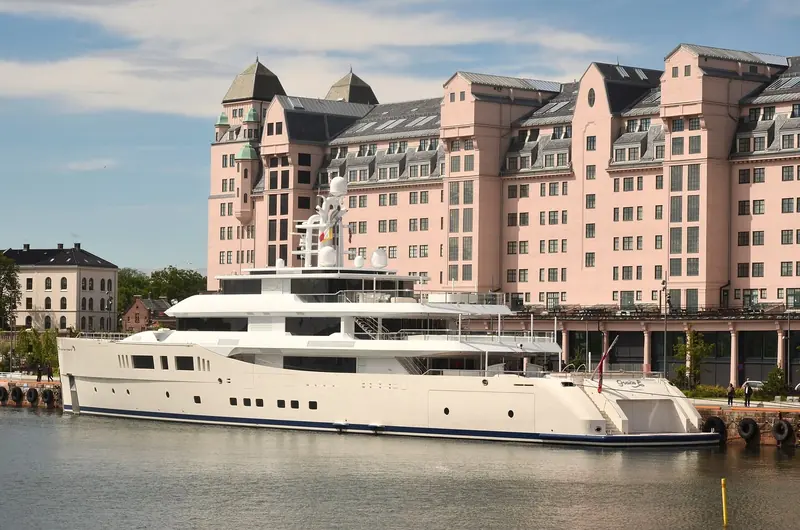
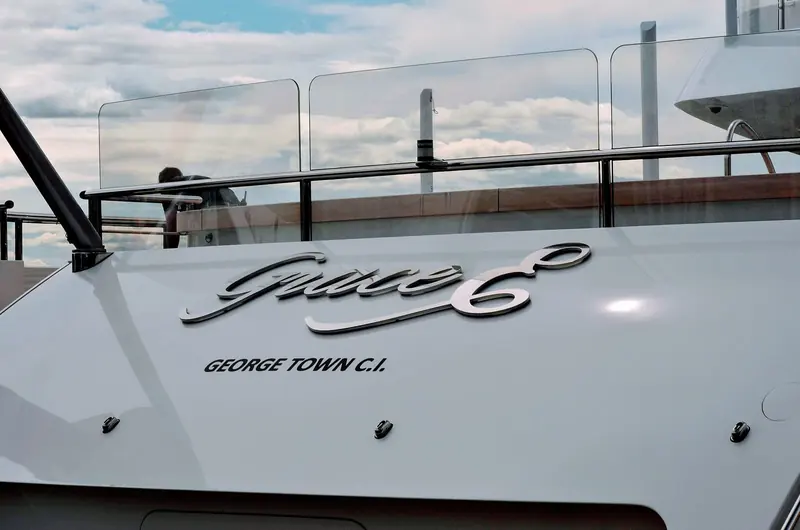
Exuma, 50 metres, launched at La Spezia in 2010 as the first Vitruvius and revived the historic Picchiotti name under Perini Navi. Galileo G followed at 55 metres in 2011 and covered around 85,000 nautical miles in her first three years. Grace E, 73 metres, launched in 2013 and was delivered in 2014 with an interior by Remi Tessier, and she sails now as Nautilus. She took Motor Yacht of the Year at the World Superyacht Awards in 2015, where the judges cited her fuel consumption and range alongside the quality of her joinery.
Najiba, 58 metres, was the first Vitruvius built by Feadship and was delivered in 2019. Alchemy, 65.7 metres from Rossinavi in Viareggio, was handed over in July 2023 and was named Motor Yacht of the Year at the 2024 World Superyacht Awards. Two of those trophies from a fleet this small is rare. The Vitruvius line now runs from lifestyle cruisers to expedition boats built for long passages.
The yards behind the drawings
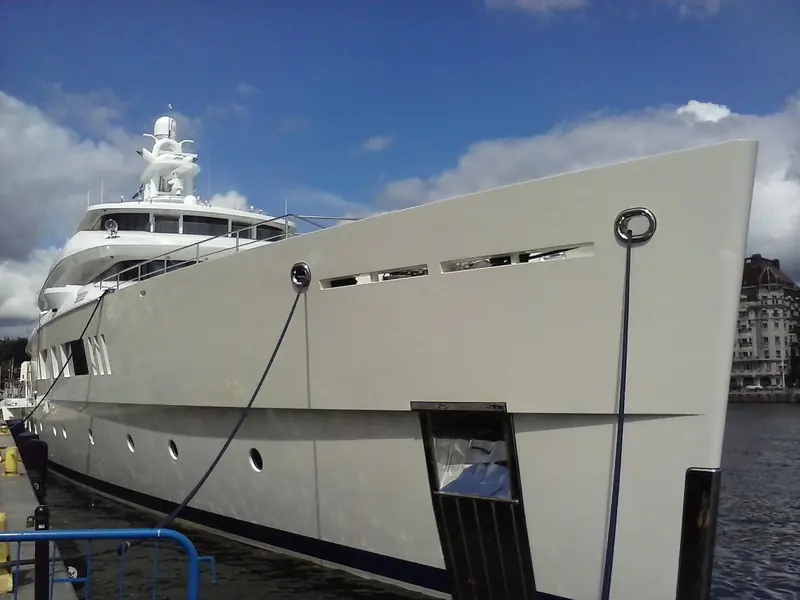
Briand has never tied himself to a single builder. The Vitruvius fleet has come out of Perini Navi and its Picchiotti division, Feadship in the Netherlands and Rossinavi in Viareggio. Sailing work has gone to Alloy Yachts, Perini Navi and others. The studio also lists Lurssen and Sanlorenzo among the builders it works with.
That spread matters to an owner in a practical way. A designer who has delivered at a Dutch yard and at an Italian one knows how differently the two price a compound curve and how each absorbs an engineering change late in a build. It also means the studio can be brought to a yard the owner has already chosen instead of steering him towards one. The Viareggio office, opened in 2025, exists to shorten that distance on Italian projects.
How a commission runs
Work starts with a brief from the owner covering size, use, areas and appearance. The studio's opening deliverables are concept sketches, a general arrangement and preliminary naval architecture, which is the package yards quote against. Briand himself is involved at concept stage, which is one reason the practice has stayed small. Owners who want a famous name on the letterhead and a junior on the phone will not find that here.
On a large custom project the design phase alone can run to nine months, and a yacht of around 90 metres is commonly three to four years from concept to delivery. Once the concept is signed off, basic design turns the drawings into something a yard can engineer and build. The owner deals with the studio directly through those stages, then increasingly with the yard's project team as steel is cut. Briand stays involved on the naval architecture through construction.
Where the studio's responsibility ends
Briand covers naval architecture and exterior design. That means the hull form, the appendages, the rig and sail plan on a sailing yacht, the general arrangement and the profile. It is the part of the boat that decides how it moves and what it costs to run. It is not the part an owner's family will touch every day.
Interiors normally go to a separate house. Grace E was fitted out to a Remi Tessier design and Vertigo to one by Christian Liaigre. An owner hiring Briand should expect to appoint an interior designer as well and should budget time for coordination between two offices working to the same general arrangement. On several projects the yard's own engineering team has taken on parts of the detailed work.
What it costs, and who it does not suit
No studio in this field publishes a fee scale, and the percentages that are in print come from practising naval architects working at smaller scale. Marsh Design puts a full design at 4 to 7 per cent of the finished cost of the boat, Sponberg Yacht Design at 7 to 10 per cent, Kasten Marine at 10 to 12 per cent on a fixed commission, all read on 28 July 2026. Those numbers fall as the build price rises, because the drawing work does not scale with the invoice, which is why the current superyacht market band from the SuperYachtReview guide of March 2026 is 1 to 5 per cent, with project management a separate 2 to 4 per cent. Naval architecture and exterior without an interior sits low in that band. The concept phase is quoted separately, which lets an owner test a studio before committing to a full build.
This studio does not suit an owner whose first priority is maximum volume in a given length, or one who wants a single office to hand over a finished interior. Buyers who want a quick delivery from an existing platform are also better served elsewhere, since most of the fleet has been drawn from a blank sheet. The commissions that come back are from owners who cross oceans. Galileo G logged around 85,000 nautical miles in her first three years of service, which is the kind of use that turns a hull form from an aesthetic choice into an operating cost.
The drawings, and a practice of about ten people
Copyright normally stays with the designer. The ITIC standard trading conditions for naval architects, in the version dated 8 July 2025, give the client only a non-exclusive royalty-free licence for the purposes of the agreement, and superyacht contracts usually improve on that to an exclusive, irrevocable, assignable licence, which is the clause Federico Santini sets out in Barche magazine in August 2018. Where a design is reused, published practice prices further hulls at a royalty of roughly 1 to 1.5 per cent of each boat. A hull form that has been tank-tested and proven over 85,000 miles has value beyond one commission, and an owner who paid for that development should decide deliberately whether he is buying exclusivity or renting a shape.
The practice runs around ten people across its studios and it carries the founder's name, with Briand personally involved at concept stage. That is the reason to hire it and the reason to write a key-person clause. No marine standard form addresses the unavailability of a named designer, and the ITIC conditions do not, capping liability at ten times charges or GBP 100,000, whichever is higher, and stopping there. The ordinary commercial remedies apply: death or prolonged incapacity as a termination event, an obligation to propose a replacement of equal standing for the owner's approval, and a right to the complete drawing set in native format if the office closes. On a boat whose value is in its engineering, the files are the asset.
Efficiency is the part of the design a buyer will underwrite
A Briand hull sells on the one thing a second owner can verify with a fuel log. Range and fuel burn are contractual numbers that live with the naval architecture, and a boat that crosses cheaply costs less to own, which is what a buyer is really pricing when he looks at a ten-year-old yacht. That is a durable advantage and it does not depend on taste. It also survives a refit, because the interior can be replaced while the hull form cannot, and here the hull form is the point of the boat.
The offsetting fact is the size of the market. Sailing yachts attract a narrower and more specialised pool of buyers than motor yachts of the same value, and long-range motor yachts drawn for ocean work attract a narrower pool again, because most owners cruise between marinas that are two days apart. Denison Yachting recorded an average of 487 days on market and a median of 277 across the 470 yachts of 24 metres and over sold in 2025, and boats built for crossings sit at the patient end of that. The buyer who wants one really wants one. There are not many of him at any given moment.
Practical detail
| Design fee | not published; market band is 1 to 5 per cent of build cost plus 2 to 4 per cent project management, both outside the yard price (SuperYachtReview 2026 price guide, updated March 2026) |
|---|---|
| What the studio covers | naval architecture, exterior design, rig and sail plan; interiors are normally a separate studio, coordinated against the same general arrangement |
| Two names, one practice | sailing work goes out as Philippe Briand from La Rochelle; motor yacht work carries the Vitruvius Yachts name from London, with a Viareggio office opened in 2025 to sit closer to the Italian yards |
| Yards that build to Briand drawings | Perini Navi and Picchiotti, Feadship, Rossinavi, Alloy Yachts; the studio also lists Lurssen and Sanlorenzo among builders it has worked with |
| The real lock-in point | concept design is quoted and can be stopped for the price of the concept; once the yard has begun engineering to the preliminary naval architecture, changing studio means paying twice for the same hull form |
What owners and crew report
The Alchemy owner on why he chose Briand's exterior over a conventional motor yacht profile
"Here we found the most beautiful exterior lines combined with sailing yacht efficiency, and we found a new point of view on motor yachts that won us over" - the owner also called the yacht's open, lobby-free central staircase his boldest design choice, expecting it to be a design pivot for the rest of the industry
the Alchemy owner, quoted in BOAT InternationalRossinavi's own account of the collaboration on Alchemy
"The key word for this vessel is balance. With the Vitruvius team, we were able to best express the know-how and skills we have gained through decades of experience; together we were able to work in synergy under the precious guidance and presence of the owner" - a shipyard executive's account, not an independent owner or captain view
Federico Rossi, COO of Rossinavi, quoted in Miami Living Magazine
What is good, and what to watch
Strong points
- A hull form proven at record scaleMari-Cha III took the 1998 west to east Atlantic monohull record and Mari-Cha IV broke it again in 2003 and held it for over a decade; the same length-used-honestly approach now drives the Vitruvius motor yacht hulls
- Efficiency an owner can verify on resalerange and fuel burn are contractual naval-architecture numbers, not styling claims, so a ten-year-old Vitruvius still sells on a fuel log a second owner can check, which is a durable advantage that survives a refit
- Two World Superyacht Awards Motor Yacht of the Year wins, nine years apart2015 and 2024, plus Sailing Yacht of the Year in 2017, showing the practice keeps winning across both the sailing and motor yacht sides of the business rather than trading on one early success
- Not tied to one yardVitruvius hulls have come from Perini Navi and its Picchiotti division, Feadship and Rossinavi, which gives an owner a genuine choice of builder without changing designer
What to watch
- Efficiency costs interior volumethe studio's own framing is that less volume does not have to mean less function, but the trade against a beamier, boxier competitor is real; an owner who wants maximum interior square metreage over range and seakeeping is shopping the wrong hull shape
- A small practice for the fleet it has producedaround ten people work across the La Rochelle, London and Viareggio studios; Briand is involved at concept stage, which is part of the appeal but also means the practice cannot easily scale to many simultaneous large projects
- No published fee scalethe only figures in print are from smaller-scale naval architects (Marsh Design 4 to 7 per cent, Sponberg Yacht Design 7 to 10 per cent, Kasten Marine 10 to 12 per cent) and the market-wide SuperYachtReview band, none specific to this studio
- Interior is always a separate appointmentGrace E's interior came from Remi Tessier and other Vitruvius projects have used different interior studios again, so an owner coordinates two offices against one general arrangement
Who it is for: Owners who intend to cross oceans and will give up some interior volume for a hull that is cheap to move.