Pininfarina Nautical
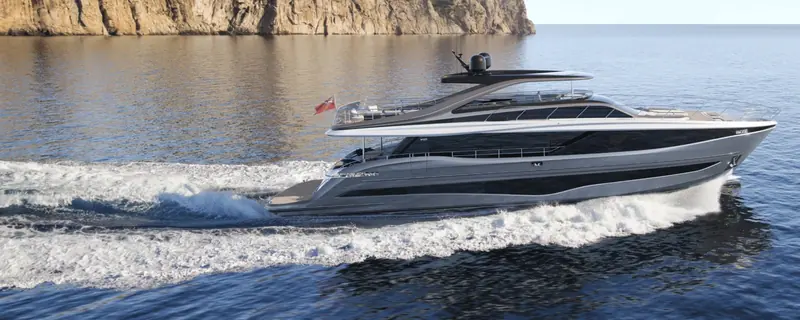
| Parent company Pininfarina founded in Turin in 1930 by Battista Pinin Farina, originally as Carrozzeria Pinin Farina | |
| Yacht connection traces to 1968, when Sergio Pininfarina styled the cockpits of Gianni Agnelli's speedboat G. Cinquanta, built by Sonny Levi | |
| Pininfarina formalized a standalone nautical design practice in the 1980s, working with Beneteau, Primatist and Fincantieri among others | |
| Nautical division led by Kevin Rice, Pininfarina's Chief Creative Officer | |
| Parent company majority owned by India's Mahindra Group since December 2015, which paid about 33 million euros for a 76 percent stake, with Pininfarina remaining separately listed | |
| Delivered Princess Yachts exteriors on the R35 (2018, with BAR Technologies), X95 (first hull 2020), Y95 (first hull 2022) and S80 (announced 2023), each alongside Princess' in-house studio and naval architect Olesinski | |
| Styled the interior of the Wally sailing yacht Tango, a 30 metre WallyCento built by Persico Marine with naval architecture by Mills Design | |
| Concept work with Rossinavi (70 metre Aurea, 2017; and Super Sport 65, 2019) has not yet resulted in a built yacht | |
| Signed a strategic partnership with veteran naval designer Fulvio De Simoni in 2021, opening a joint La Spezia design boutique in 2023 | |
| Princess X95 won Robb Report's Best of the Best yacht award in 2021, with judges crediting Princess' studio together with Pininfarina for the exterior |
From Agnelli's speedboat to a formal nautical studio
Pininfarina itself was founded in Turin in 1930 by Battista Pinin Farina, who built his name over the following decades on coachwork for Lancia, Alfa Romeo and, from 1952, Ferrari. The move onto water came through a personal connection rather than a business plan. Gianni Agnelli, the Fiat patriarch, commissioned boatbuilder Sonny Levi to design a fast 37 foot cruiser and then asked his friend Sergio Pininfarina to finesse the twin cockpits and foredeck cabin. The result, delivered in 1968 and named G. Cinquanta, is documented by RM Sotheby's, Robb Report and Classic Driver in coverage of its later auction, and it predates any formal Pininfarina nautical arm by roughly two decades.
Pininfarina's own account of its nautical sector, and secondary coverage in Yachts Croatia and elsewhere, dates the studio's formal entry into boat design to the 1980s, when it began taking on exterior and interior commissions for production motor and sailing boats and built relationships with builders including Beneteau, Primatist and Fincantieri. Corsara, a runabout built for the Aga Khan in the wake of Agnelli's boat, is cited by Pininfarina alongside G. Cinquanta as part of that early lineage. The Princess Yachts partnership that now dominates the division's public profile did not begin until the R35 in 2018, meaning roughly three quarters of the studio's yacht history predates its most visible client.
A styling house, not a naval architecture practice
According to Pininfarina's own nautical services listing, the division's scope covers UX definition, brand design, sketch-to-production design development, and access to Pininfarina's proprietary automotive wind tunnel for aerodynamic testing, plus bespoke commissions, refit and interior work, and licensing arrangements for smaller builders who want the badge on a production line. The division is led by Kevin Rice, Pininfarina's Chief Creative Officer, who described the logic of its most recent alliance, with veteran Italian naval designer Fulvio De Simoni, as combining complementary skills so the pairing can respond to a shipyard's brief with De Simoni's naval design credentials and Pininfarina's cross sector design experience, in comments reported by Daily Nautica.
On the Princess projects that make up most of the division's visible portfolio, Motor Boat & Yachting's account of the X95 development names a three way structure: Princess' in-house studio, led by Andy Lawrence and Jonny Warden, set direction and interior styling; Cowes based Olesinski, under Jonathan Cantrell and Gerard Grandcourt, ran more than 12,000 hours of exterior styling, hull development and tank testing across three years; and Pininfarina was, in Cantrell's words, a firm brought into the process partway through, with the article giving no specific breakdown of what Pininfarina itself contributed. That pattern, a named engineering or in-house partner doing the structural and technical work while Pininfarina is credited on surfacing and brand, recurs on the Wally Tango, where Mills Design did naval architecture, and on the R35, where BAR Technologies supplied foiling technology.
Pininfarina has never built a hull in its life, and that is exactly the point: it sells the surfacing language of a supercar to shipyards that already know how to make a boat float.
The delivered and undelivered portfolio
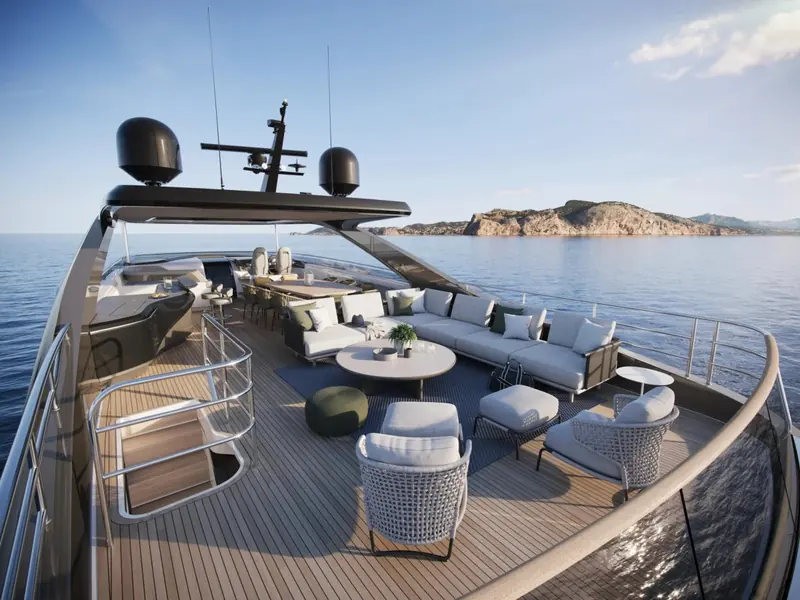
The Princess R35, a 10.89 metre performance day boat unveiled in 2018 with foiling technology from BAR Technologies, was the first Pininfarina collaboration with the Plymouth builder and set the surfacing language, described by Princess executive chairman Antony Sheriff in comments to T3 as making the boat handle literally like a sports car, that Pininfarina carried into the larger X and Y ranges. The 29 metre X95 followed, with its first hull undergoing sea trials in 2020 and roughly 20 further hulls sold by the mid 2020s according to Princess sales figures reported by trade press. The Y95, a more traditionally profiled 29.1 metre flagship in the Y range with a raised wheelhouse, had its first hull delivered in 2022, and the 25 metre S80 flagship of the S range was announced in 2023 with a 2024 launch.
Away from Princess, Pininfarina's interior for the Wally sailing yacht Tango, a 30 metre WallyCento built by Persico Marine to Mills Design naval architecture and launched in 2017, was Wally's first collaboration with the studio and is well documented by Boat International and Yachting World. Two higher profile Rossinavi projects, the 70 metre Aurea concept unveiled in 2017 and the 65.5 metre Super Sport concept shown at the 2019 Fort Lauderdale boat show, generated significant press coverage as design propositions but, as of this research, have not resulted in a built and delivered yacht. Pininfarina has also produced concept work for Oceanco (the 90 metre Kairos), the one design Persico F70 foiler, and, through the newer De Simoni partnership, the Austin Parker CAT56 catamaran and Brazilian builder NX Boats' NX44 and NX62 models.
What a Pininfarina commission costs
None of the trade coverage of the Princess R35, X95, Y95 or S80 projects, nor the Wally Tango or Rossinavi concepts, discloses what Pininfarina was paid, and Pininfarina does not publish a rate card. This is normal for the segment: yacht design fees are almost never made public because they are commercially negotiated per project and often bundled into a shipyard's own pricing rather than itemized to the buyer. Fixed commission structures in the wider custom yacht design market are commonly quoted, per industry commissioning guides, at around 10 to 12 percent of the as built cost of a yacht finished to a turn key stage, phased across concept, development and build oversight stages, though that figure describes the market generally and is not confirmed as Pininfarina's own structure.
On production models like the X95 or S80, the more likely commercial arrangement is a styling and brand licence fee paid by the shipyard, Princess in these cases, rather than a fee charged to individual buyers, since the design cost is amortized across a production run rather than billed per hull. On copyright, general yacht design agreements, as summarized by industry legal commentary, typically leave intellectual property in the designer's hands while granting the commissioning party a royalty free, exclusive licence to build to the design, but no source located here confirms the specific copyright terms of any Pininfarina yacht contract, so that remains a general market description rather than a documented fact about this studio.
Where the automotive crossover actually shows up
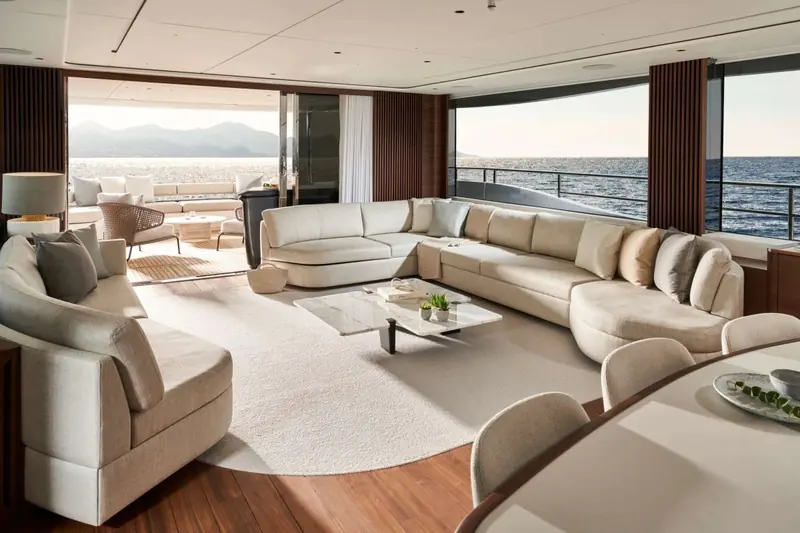
The distinguishing mark across the Princess range is less about hull shape, which Olesinski and BAR Technologies have engineered on the R35, X95 and successors, and more about surface continuity: long, uninterrupted deck lines, glazing treated as a single graphic element, and helm areas styled with the same language Pininfarina uses for a car cabin. Forbes' coverage of the X95 and Motor Boat & Yachting's review both describe the yacht's widebody hull, engineered by Olesinski, dressed in an exterior whose proportions and detailing read as automotive rather than nautical, a combination that earned the X95 Robb Report's Best of the Best yacht award in 2021, with judges specifically crediting the combination of Princess' team and Pininfarina for the exterior treatment.
That division of labour is not unique to Pininfarina. Ferrari's own Hypersail project has paired its design chief Flavio Manzoni with naval designer Guillaume Verdier in a near identical structure, and Robb Report's broader survey of architects and fashion houses moving into yacht design describes a wider trend in which naval architects increasingly execute the technical realization of ideas proposed by stylists from outside yachting, sometimes without a marine engineering background. Where Pininfarina differs from a one off automotive guest credit is repetition and structure: it has returned to Princess for four consecutive model lines since 2018 and has now built a second standing alliance, with Fulvio De Simoni, specifically to formalize the naval architecture side that Pininfarina itself does not supply in house.
The honest criticism: does the badge outweigh the boat expertise
Motor Boat & Yachting's own account of the X95, the most thoroughly reported Pininfarina yacht project found in this research, names Princess' in-house designers and Olesinski's team in detail, including headcounts of design proposals and man hours, but describes Pininfarina only as a firm recently introduced to the collaboration without specifying what it changed or added. That pattern, extensive credit for the yard and the naval architect, a brand name credit for Pininfarina, repeats across the Y95 and S80 coverage, where Pininfarina is consistently named as a collaborator alongside Olesinski but rarely quoted or profiled independently. It is a reasonable basis for the criticism that Pininfarina's marine work trades on automotive brand equity built over nearly a century, rather than on a comparably deep bench of dedicated naval design expertise, since the studio has never, in any project reviewed here, been the party responsible for hull engineering or naval architecture.
Set against that, Pininfarina has not tried to claim naval architecture credit it has not earned. Every delivered or announced project pairs it with a named specialist, Olesinski, BAR Technologies, Mills Design or De Simoni, and the studio's own service description limits its scope to styling, UX and brand rather than engineering. The bigger practical limitation for a prospective client is that two of its highest profile projects with Rossinavi, the Aurea and the Super Sport 65, generated global press coverage as concepts in 2017 and 2019 but have not converted into a delivered yacht years later, a gap between publicity and build that a buyer evaluating the studio's actual completed body of water should weigh against the renderings.
Where the partnership is heading now
Since 2021, Pininfarina's most active new relationship has been with veteran Italian naval designer Fulvio De Simoni, announced as a strategic partnership and formalized at the Monaco Yacht Show in September 2022. The two opened what they describe as the sector's first joint design boutique, in La Spezia's Porto Lotti marina, in 2023, combining De Simoni's naval architecture record with Pininfarina's styling and brand work. Early output from that alliance includes the CAT56 catamaran for Austin Parker and the X2 Explore X Experience project, an experimental yacht built around individual owner experience rather than a conventional category.
Pininfarina has also been licensing its name to smaller production builders outside the superyacht bracket, styling the NX44 and NX62 for Brazilian builder NX Boats and a small F-330 tender for Argos Nautic, extending the brand into a price bracket well below the Princess flagships. On the Princess side, no fifth model line beyond the R, X, Y and S ranges had been announced as of this research, suggesting that the four model Princess relationship, running continuously since 2018, may have reached a natural plateau while Pininfarina's marine growth shifts toward De Simoni backed projects and smaller licensed builders.
Practical detail
| Design fee | Not published for any Pininfarina yacht project found in this research. General custom yacht design commissions in the market are commonly structured around 10 to 12 percent of as built cost per industry commissioning guides, but this is a market wide figure, not a confirmed Pininfarina rate. |
|---|---|
| What the studio covers | Exterior styling, interior concept, UX definition, brand positioning and aerodynamic testing through Pininfarina's own automotive wind tunnel, plus bespoke commissions, refit work and brand licensing for smaller builders, per Pininfarina's own nautical sector description. |
| Studio size and structure | Parent company Pininfarina employed over 700 people as of 2021 across its Cambiano headquarters and other sites, majority owned by India's Mahindra Group since 2015; the nautical division is led by Chief Creative Officer Kevin Rice, but a dedicated nautical headcount is not publicly broken out. |
| Copyright | Not confirmed for any specific Pininfarina yacht contract. General yacht design agreements in the industry typically leave design intellectual property with the designer while granting the commissioning party a royalty free, exclusive licence to build, per industry legal commentary. |
| Where the work has gone | Princess Yachts (R35, X95, Y95, S80, four model lines since 2018), Wally and Persico Marine (Tango WallyCento interior, 2017), Rossinavi (Aurea and Super Sport 65 concepts, unbuilt), Oceanco (Kairos concept), and through the Fulvio De Simoni partnership, Austin Parker (CAT56) and Brazilian builder NX Boats (NX44, NX62). |
What owners and crew report
Shipyard leadership on how the R35 handles
Princess Yachts executive chairman Antony Sheriff told T3 that the Pininfarina styled R35 handles literally like a sports car, contrasting it with the delayed helm response of a typical motor yacht. This is a shipyard executive's characterization rather than an independent owner's, but it is the most specific named comment located connecting the automotive design language to how a Pininfarina yacht actually behaves.
Antony Sheriff, Princess Yachts executive chairman, quoted by T3Award judges on the X95 exterior
Robb Report's judging panel, in naming the Princess X95 a 2021 Best of the Best winner, said it was impressed with the way Princess' team, along with Pininfarina, shaped the exterior and made unique use of the top deck, foredeck and beach club areas.
Robb Report Best of the Best judging panel, as reported by Princess Motor Yacht Sales and YachtBuyerNo independent private owner or broker testimony located
Searches across Boat International, Motor Boat & Yachting, Yachts Croatia, Yacht Style and Power & Motor Yacht reviews of the R35, X95, Y95 and S80 turned up sea trial reports and shipyard or magazine commentary, but no on the record quote from a private owner, captain or brokerage naming Pininfarina's specific contribution rather than Princess Yachts or Olesinski generally. This gap is consistent with the wider finding that Pininfarina's role is credited but rarely detailed even in specialist coverage.
Yotters research desk
What is good, and what to watch
Strong points
- Genuine multi decade yacht historyThe design lineage runs from Sergio Pininfarina's personal work on Gianni Agnelli's 1968 speedboat through a formalized 1980s practice to today, giving the studio a longer marine record than its recent Princess visibility suggests.
- A proven, repeated production partnershipFour consecutive Princess model lines, R35, X95, Y95 and S80, since 2018 is a real, sustained client relationship rather than a one off guest styling credit.
- Automotive surfacing that reads as genuinely differentThe continuous deck lines and cockpit like helm treatment on the X95 and R35 are visually distinct from conventional yacht styling and were specifically cited by Robb Report's judges in a 2021 award.
- Honest about its own boundariesPininfarina has consistently paired with named naval architects, Olesinski, BAR Technologies, Mills Design, De Simoni, rather than claiming engineering credit it has not earned.
What to watch
- Specific creative contribution is rarely detailedEven Motor Boat & Yachting's in depth account of the X95 development names Princess' and Olesinski's teams and hours in detail while describing Pininfarina only in general terms, making it hard for a prospective client to know exactly what Pininfarina itself changes.
- High profile concepts that never got builtThe 2017 Rossinavi Aurea and 2019 Super Sport 65 generated global press coverage as concepts but neither has resulted in a delivered yacht years later, a real gap between publicity and completed work.
- No independent owner testimony foundDespite searching multiple yacht publications' reviews of the four Princess models, no on the record private owner or broker quote crediting Pininfarina specifically, as distinct from Princess or Olesinski, was located.
- No naval architecture capability of its ownOn every project reviewed, hull engineering and structural naval architecture came from a separate named partner, so a client buying pure engineering credibility is not buying it from Pininfarina.
Who it is for: An owner who wants a shipyard's production yacht to read as automotive sculpture on the water, and who is buying the Pininfarina name as much as a specific naval detailing skill.