Sparkman & Stephens
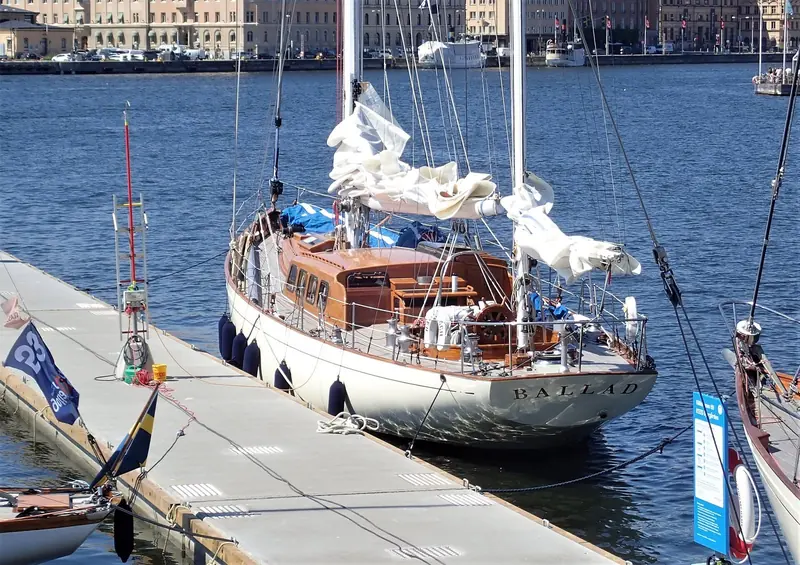
| Founded | 28 October 1929, New York, by Drake Sparkman, James Sparkman, James Murray, Olin Stephens and Rod Stephens |
|---|---|
| Olin Stephens | 1908 to 2008, died aged 100; America's Cup Hall of Fame 1993 |
| Rod Stephens | 1909 to 1995 |
| Owner since August 2018 | Donald Tofias, founder of the W-Class Yacht Company; earlier owners from 2016 a group led by Brooke Parish |
| Offices | Newport, Rhode Island (head office, moved from Greenwich, Connecticut) and Fort Lauderdale |
| Archive | intellectual property for more than 2,600 designs (Boat International, 2018); original drawings at Mystic Seaport Museum from design number 1 |
| Dorade | 52 ft yawl, Minneford Yacht Yard, launched 1930; won the 1931 Transatlantic and Fastnet races and the 2013 Transpac |
| Stormy Weather | design 27, 54 ft yawl, Henry B. Nevins, 1934; won the 1935 Transatlantic and Fastnet races |
| America's Cup | Ranger 1937, Columbia 1958, Constellation 1964, Intrepid 1967 and 1970, Courageous 1974 and 1977, Freedom 1980 |
| Nautor Swan | S&S designed every Swan from 1967 to the late 1980s; Swan 36 run of 90, Swan 65 run of 41 |
| Sayula II, Swan 65 | winner of the first Whitbread Round the World Race, 1973 to 1974 |
| Fee schedule, plan price and lead time | not published |
A Firm Founded by Two Brothers in 1929
Sparkman & Stephens was formed on 28 October 1929 by five partners: Drake Sparkman, his brother James Sparkman, James Murray and the brothers Olin and Rod Stephens, whose father backed them. Olin was 21. The split of work held for decades: Olin drew the hulls, Rod tested the rigs and deck layouts and sailed the boats, and Drake Sparkman ran the brokerage that sold them. Rod died in January 1995 at 85, and Olin died on 13 September 2008 in Hanover, New Hampshire, aged 100, as Soundings and the New York Times both reported.
The firm changed hands twice in quick succession. A group of private investors led by Brooke Parish bought it in 2016, and Donald Tofias, founder of the W-Class Yacht Company, bought 100 per cent of the assets in August 2018 and moved the head office from Greenwich, Connecticut, to Newport. Boat International's interview with him that autumn records that he owns the intellectual property for more than 2,600 designs. Today the business does yacht design, brokerage and performance work on existing boats, with a second office in Fort Lauderdale. It isn't a boatyard, and Tofias said plainly he had no intention of becoming one. So a client buys drawings, engineering and advice; the hull is built somewhere else.
Dorade and Stormy Weather Made the Name
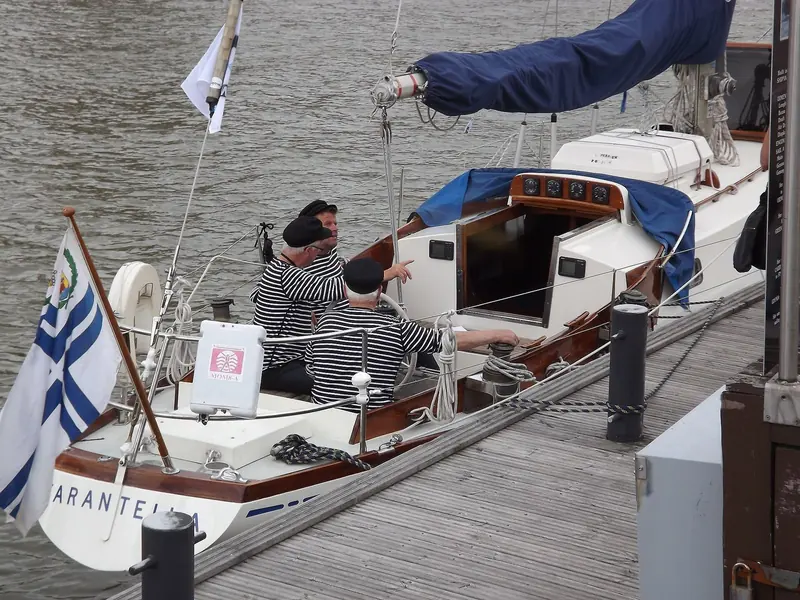
Dorade was built by Minneford Yacht Yard on City Island in New York and launched in 1930. She is 52 ft overall on a 37 ft 3 in waterline, a narrow, deep yawl that looked nothing like the beamy offshore boats of the day. Olin skippered and navigated her in the 1931 Transatlantic Race and she finished first, then won the Fastnet the same summer, a result Britannica records alongside his role as designer, skipper and navigator. She also gave the sailing world the Dorade box, the water-trap ventilator still fitted to boats of every size. In 2010 Matt Brooks and Pam Rorke Levy bought her, spent more than a year on a refit and won the 2013 Transpacific Race on corrected time, 77 years after her first Transpac win in 1936.
Stormy Weather is design number 27, a 54 foot yawl launched by the Henry B. Nevins yard in New York in May 1934. With Rod Stephens as skipper she won the 1935 Transatlantic Race in 19 days 5 hours and then the Fastnet on corrected time, finishing 12 minutes behind Kismet III on the water. She has had two major restorations, the latest at Cantiere Navale dell'Argentario in Porto Santo Stefano in 2000 and 2001, the same yard that restored Dorade in 1997. If you're looking at a classic S&S yawl today, those two boats are the benchmark that every surveyor, judge and buyer will measure it against.
Olin Stephens was 21 when the partnership was formed, and 23 when Dorade won the Transatlantic Race and the Fastnet.
Eight America's Cup Wins in Nine Matches
Ranger, the 1937 J-Class defender, was drawn with Starling Burgess and beat the British challenger in four straight races. After the war the Cup moved into 12 Metres and S&S dominated the class: Columbia won in 1958, Constellation in 1964, Intrepid in 1967 and 1970, Courageous in 1974 and 1977 and Freedom in 1980. The only match in that run the office didn't win was 1962, which went to Weatherly from the Philip Rhodes office. Olin was inducted into the America's Cup Hall of Fame in 1993.
Two of those boats changed yacht design beyond the Cup. Intrepid, built in mahogany on white oak frames by Minneford in 1967, separated the rudder from the keel and added a trim tab, and Olin called her his most innovative twelve. Courageous was the first 12 Metre built in aluminium. Several of these boats still sail and still change hands, so a buyer of a 12 Metre with an S&S sail number is buying a documented hull, and the records are good enough that a false claim of pedigree is easy to catch. Does that history add value in a sale? It does with the regatta circuit and with collectors, though it won't make an old 12 Metre any cheaper to keep.
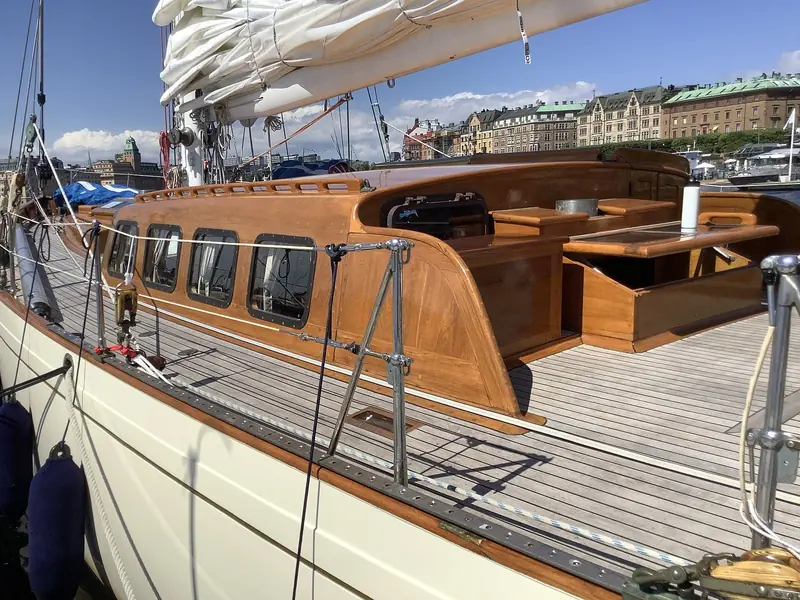
The Swans and the Production Boats
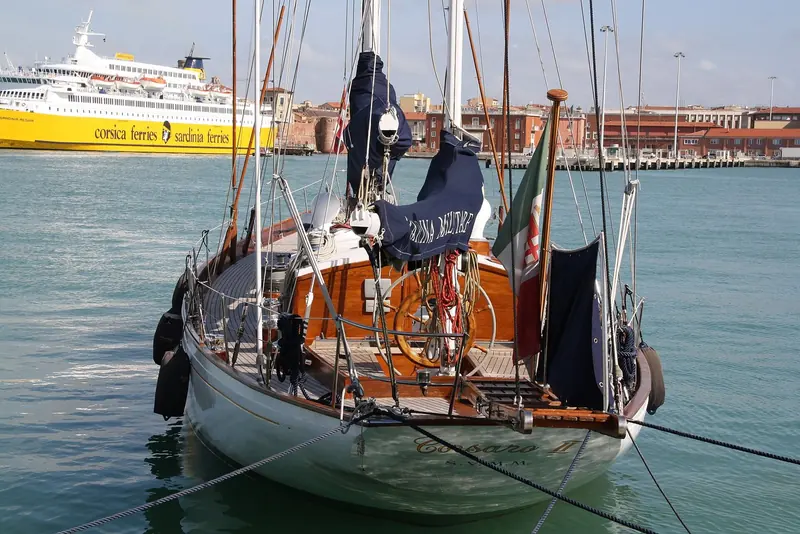
The Finnish founder Pekka Koskenkyla got his first drawings after reaching Rod Stephens by telephone, and the yard in Pietarsaari launched hull number one, Tarantella, on 17 July 1967. Soundings, Classic Sailor and the German magazine Yacht all put the Swan 36 run at 90 boats before the Swan 37 replaced her around 1970. In 1968 the Swan 36 Casse-Tete II won all seven of her races at Cowes Week. The hull carried a separate rudder on a skeg and a fin keel, an arrangement S&S then took to Intrepid. Rod Stephens inspected the boats at the yard himself and wrote defects on yellow slips that the yard had to clear before delivery.
The Swan 65 is the boat most buyers know: 41 hulls were built, the last in 1989, and Sayula II, the yard's first, won the first Whitbread Round the World Race in 1973 and 1974 with Ramon Carlin and an amateur crew. Ron Holland drew five Swans between 1978 and 1981 and German Frers has drawn them since the 1980s, so an S&S Swan is always a pre-1990 boat. How many S&S Swans exist in total isn't settled: published counts run from 775 to about a thousand, which tells you to check each hull's own build record rather than trust a round number. Outside Finland, S&S designs were built in series by Tartan, Hughes, Grand Banks, Morris and others. The S&S 34 became the Australian solo boat: Jessica Watson sailed the 1993 S&S 34 Ella's Pink Lady round the southern hemisphere in 2009 and 2010, as Latitude 38 reported.
Commissioning a Design or a Restoration
What the firm does say it offers is narrower than many owners expect. Tofias told Boat International in 2018 that S&S would advise owners and yards on certified refits and rebuilds of 1930s to 1960s boats rather than build them, and would consider new builds of historic designs such as Stormy Weather or Black Watch, in original or modern materials. Morris Yachts, now part of Hinckley, was named as a building partner. That makes S&S the office that can say whether a rebuild is faithful to the original drawings, which matters when a boat's value rests on its pedigree. The work itself happens at a specialist yard, and Cantiere Navale dell'Argentario's restorations of Dorade and Stormy Weather show where that work has historically gone.
The original drawings are a separate route. Mystic Seaport Museum in Connecticut holds the Sparkman & Stephens collection, catalogued in design order from design number 1 of 1929, and sells copies to owners, restorers and researchers as historical documents that aren't certified for construction. For a restoration that's often the first step: you get the lines and the construction plan for your own design number, then go to a yard and, if you want the pedigree confirmed, to S&S. Budget is the open question. Ask any yard for a written scope that separates structure, rig and systems, because on a wooden classic the hidden frames and floors decide the bill, not the varnish you can see.
What to Check on a Used S&S Yacht
Classic Sailor's guide to the Swan 36 names the two faults owners meet most: deck delamination that lets water into the balsa core, and a galvanised mast foot that corrodes after decades with a through-deck aluminium mast stepped on it. Practical Sailor's used-boat checklists add chainplates, where a deck-penetrating plate that has leaked for years leaves staining, delamination or rot in the bulkhead it's bolted to. Teak decks are the other classic reason an old performance cruiser is priced low, because the teak is usually screwed straight into the deck and the screws let water into the core below. On many bolted-keel boats you can't inspect the keel bolts properly without dropping the keel, so a survey that only looks at the nuts in the bilge isn't the whole answer.
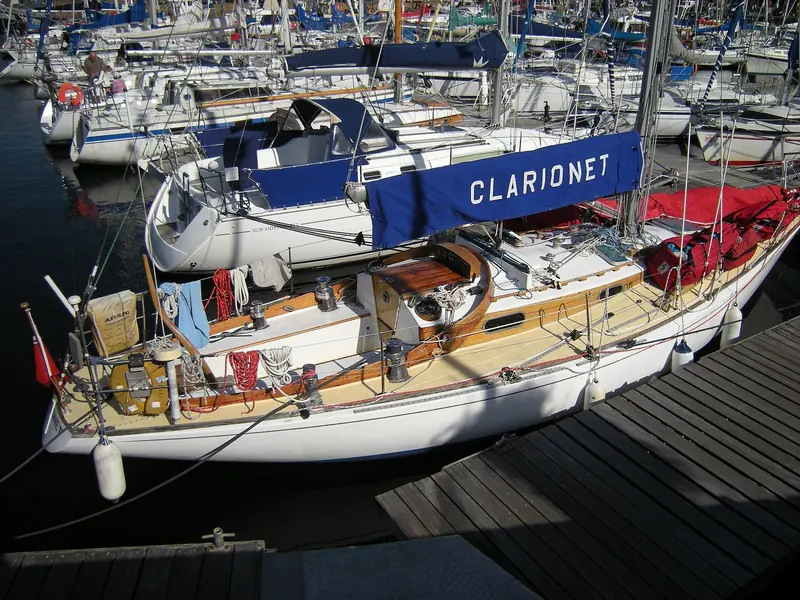
Then check the paperwork. A boat sold as an S&S design should carry a design number you can match to the Mystic Seaport collection, and a Swan should match the yard's own hull records. Owners in the S&S Association are a useful second opinion on a particular boat's history. Watch the rig: many of these boats were optimised for IOR or IRC handicaps over the years and have lost their original sail plan or deck gear, which Practical Boat Owner's report on the 1966 One Tonner Clarionet shows can be reversed. The thick early laminate is a real strength; Swan owners in Yacht describe the boats as virtually indestructible. That isn't a reason to skip a survey by someone who knows boats of that age, and the cost of one is small next to a wet deck.
Who S&S Suits and the Real Alternatives
The firm's strength is its archive and its record. No other office can certify that a rebuilt 1930s yawl or a restored Swan matches the original design, and the brokerage arm knows the existing fleet. The S&S Association, an owners' group chaired by Gavin Howe with Finnish and Dutch regional sites, lists members' boats for sale and runs a global regatta, so an owner joins a working community rather than an archive. What the firm hasn't published is equally clear: no fee schedule, no design team headcount, no recent portfolio of delivered new builds with yard names and dates, and no independent review of its post-2018 design work.
The alternatives depend on the brief. For a modern Swan, the current designer is German Frers, whose office has its own entry on this site, as do Ron Holland, Farr Yacht Design and Judel/Vrolijk for performance boats. For restoration of a classic, the work goes to a specialist yard first, with the original designer's office as an adviser. For a buyer who simply wants an S&S boat to sail, the production fleet is the obvious answer: Swans, S&S 34s and Tartan or Hughes boats appear on the used market far more often than the custom yawls do. Which way you go comes down to one question: do you need the name on the drawings, or a boat that sails the way those drawings did?
Practical detail
| Design fee | not published by Sparkman & Stephens; quotes are by direct enquiry |
|---|---|
| Restoration cost | not published for any S&S classic found, including Dorade and Stormy Weather; get a written scope that separates structure, rig and systems |
| Original drawings | Mystic Seaport Museum, Connecticut, holds the S&S collection from design number 1 (1929) and sells copies as historical documents, not certified for construction |
| Where | Newport, Rhode Island (head office) and Fort Lauderdale, Florida |
| Restoration yards with S&S work | Cantiere Navale dell'Argentario, Porto Santo Stefano: Dorade in 1997, Stormy Weather in 2000 and 2001 |
| Used S&S Swans | every Swan built from 1967 to the late 1980s is an S&S design; later Swans are by Ron Holland or German Frers |
| Owners' group | S&S Association, chaired by Gavin Howe, with Finnish and Dutch regional sites and members' boats for sale |
| What is not published | design fees, lead times, staff size, a list of recent new builds and any restoration budget |
| Alternatives | German Frers, Ron Holland, Farr Yacht Design and Judel/Vrolijk entries on this site; for restorations, a specialist classic yard |
What owners and crew report
The early Swans are built to last
Michael Seiler, who started a Baltic rendezvous open only to S&S-designed Swans, described the boats as virtually indestructible, and a Swan 40 owner said the yard always went for the top shelf
Yacht (Germany)Swan 36: watch the deck and the mast foot
the review names deck delamination that lets water into the balsa core and a corroded galvanised mast foot under the through-deck mast as the faults to check, while calling the boat a pure pleasure to sail
Classic SailorSwan 36 owners rated the boat and the interior
owners praised its performance, its wood-rich interior and its lines, and the magazine calls the design a trendsetter for the performance cruiser
SoundingsA 1929 hull can still win offshore after a careful refit
Dorade's owners spent more than a year on a refit after buying her in 2010, then won the 2013 Transpac overall and took second in class in the 2015 Fastnet
Sailing ScuttlebuttOld racing optimisation can be undone
the 1966 One Tonner Clarionet, previously set up for the IRC handicap, was returned to her original configuration for classic regattas
Practical Boat Owner
What is good, and what to watch
Strong points
- A record nobody else haseight America's Cup wins in nine matches, Dorade and Stormy Weather's Transatlantic and Fastnet doubles and the first Whitbread winner
- The archive and the authoritymore than 2,600 designs and drawings from design number 1, so the office can say whether a restoration or a new classic is faithful
- A large, well-documented used fleetSwans, S&S 34s and other series boats come up for sale often, with design numbers that can be checked
What to watch
- No published fee, plan price or lead timeyou learn the cost of a commission only by asking
- Little visible new workno independent review of post-2018 designs and no published list of recent deliveries with yards and dates was found
- Not a builderS&S advises and draws; the build, the restoration and the cost risk sit with a separate yard
- Old boats, old faultsearly Swans and other S&S boats are now 35 to 60 years old, and deck cores, mast steps and keel bolts need a proper survey
Who it is for: Owners and buyers of classic and production S&S yachts who want the original design behind a restoration or a rebuild, and clients who want a new boat drawn to a historic S&S design with the name and the drawings to prove it.