Tim Heywood Design
| Founder | Tim Heywood, with his wife Vanessa, in 1996 |
|---|---|
| Background | trained at Central School of Art and Design, then around twenty years working for Jon Bannenberg |
| Based | rural England, after Heywood moved the studio out of London |
| Team | effectively a two-person practice, with Heywood doing the drawing |
| Discipline | exterior design only, with interiors always drawn by another studio |
| Signature | a sweeping sheerline falling to the stern, compound curves, vertical bows on the Amels range |
| Largest project | A+ (ex Topaz), 147 m, Lurssen, 2012 |
| Other landmarks | Al Mirqab (133 m, 2008), Symphony (101.5 m, Feadship, 2015), Carinthia VII (97.2 m, Lurssen, 2002), Pelorus (114.5 m, Lurssen, 2003), Ice (90 m, Lurssen, 2005) |
| Series work | exteriors for the Amels Limited Editions range, six sizes from 180 to 272 feet |
| Awards | Al Mirqab took Motor Yacht of the Year at the World Superyacht Awards in 2009 |
| Also | named chairman of the BOAT International Design and Innovation Awards |
| Interiors | usually by another studio, including Andrew Winch Designs and Terence Disdale Design |
| Design fee | not published. Superyacht market band 1 to 5 per cent of build cost, plus 2 to 4 per cent project management, both outside the yard price. An exterior-only appointment sits at the bottom of that band (SuperYachtReview 2026 price guide, updated March 2026) |
| The compound-curve premium is a build cost paid to the yard in fairing hours, not a design cost, and should be priced separately at tender | |
| No marine standard form covers the unavailability of a named designer. The ITIC conditions of 8 July 2025 cap liability at ten times charges or GBP 100,000, whichever is higher, and are silent on key-person cover | |
Twenty years with Bannenberg
Heywood studied at the Central School of Art and Design and then joined Jon Bannenberg, the man credited with inventing modern yacht design. He stayed for around two decades. Andrew Winch and Terence Disdale came through the same office in the same era, which is why three of the most influential exterior studios in yachting share a common grammar.
He set up Tim Heywood Design in 1996 with his wife Vanessa. By then he had already worked on major projects inside someone else's practice and had a reputation among the German yards. The studio took commissions at 90 metres and above almost immediately. That is unusual for a new office and reflects how much of the earlier work was already his.
A studio of two
Heywood does the sketches, the drawings and the follow-through himself. He has said he chose not to build a large office and works with Vanessa alongside him. The studio sits in rural England, and he has said that clients visit more often since he left London.
For an owner this cuts two ways. The person who sells the design is the person who draws it and the person who argues with the yard about it, which is not true at every studio of this reputation. Against that, capacity is limited and a project has to wait its turn. There is also no succession behind the name, which is a fair question to ask before signing a four year build.
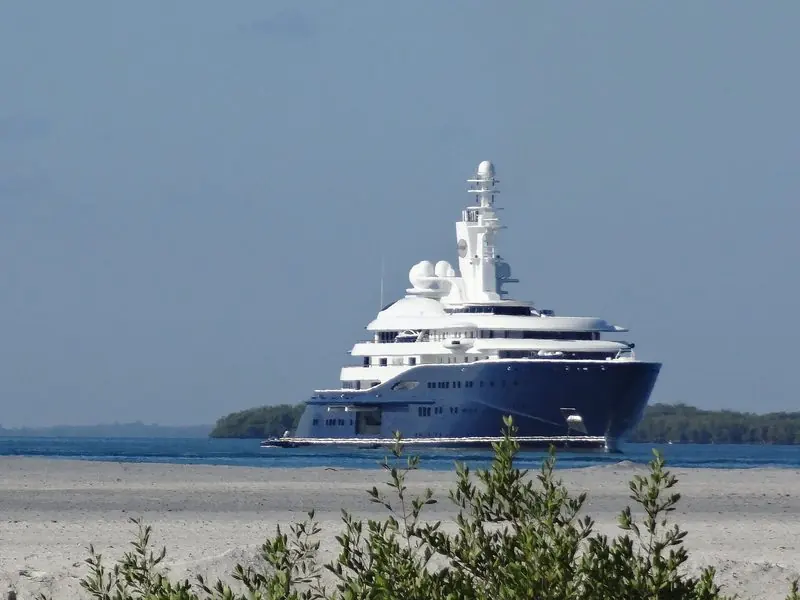
One long curve held the length of a 147 metre hull, which is the hardest thing to draw and the most expensive thing to build.
The sheerline
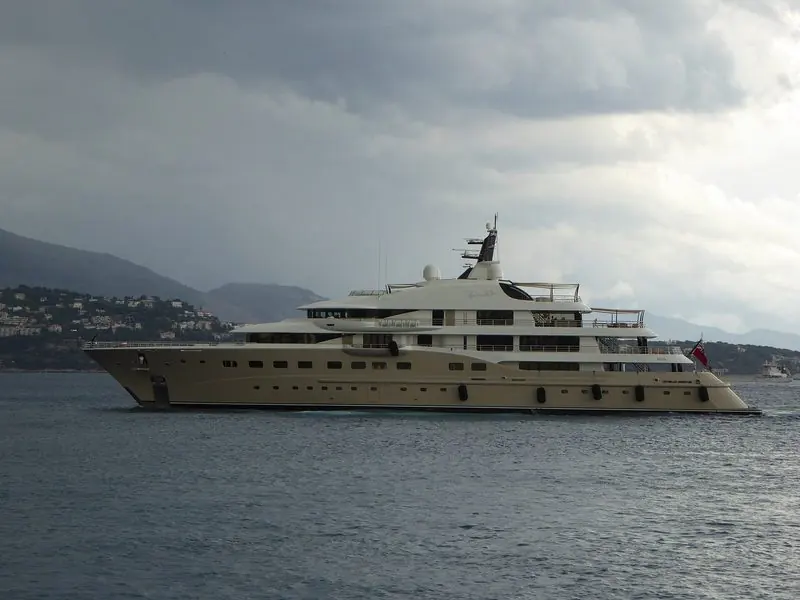
The Heywood signature is a single long curve. His yachts carry a sheerline that gently sweeps down towards the stern, with topsides and superstructure that follow the same movement instead of sitting as separate boxes. The curves are compound, which means the yard has to form them in three dimensions and cannot simply roll a plate. That costs money and is one reason his boats read as expensive from a mile away.
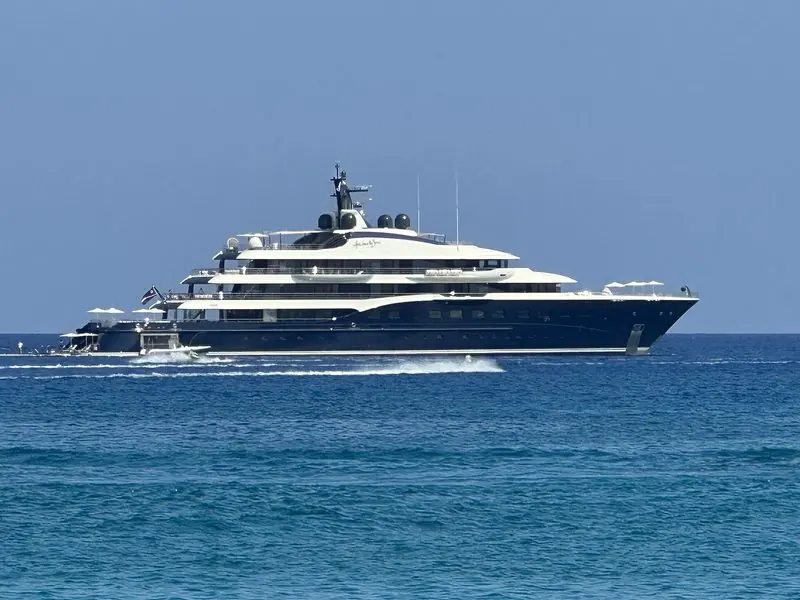
Carinthia VII, 97.2 metres from Lurssen in 2002, is the clearest teaching example. Her hull was painted a bespoke blue mixed for the project and her bulwarks were made from glass in place of conventional stanchions and rails, so nothing interrupts the line. Symphony, delivered by Feadship in 2015 at 101.5 metres, uses a concave clipper bow and a naval blue hull to reach a classical profile, with a sculptural mast Heywood has described as drawn from a dolphin's tail. Both boats look calm from a distance and complicated up close.
The Lurssen years
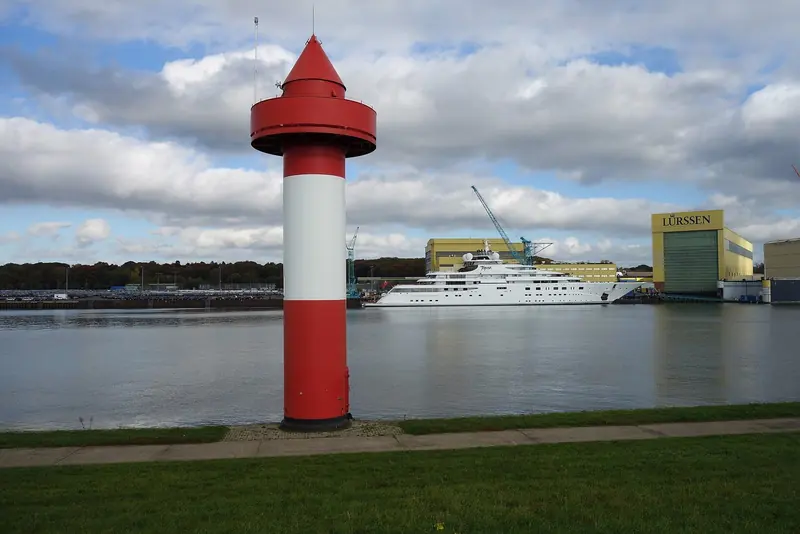
Much of Heywood's reputation was built at Lurssen. Pelorus, 114.5 metres, was delivered in 2003 and set a template for the very large yacht with a low, stretched superstructure. Ice followed in 2005 at around 90 metres and was among the first superyachts to use Azipod propulsion, which put the drives in steerable pods under the hull and freed up the engine room layout. She won at the World Superyacht Awards.
A+, delivered in 2012 at 147 metres and known at launch as Topaz, was the fourth largest yacht in the world when she was handed over. Terence Disdale did the interior. A yacht at that length can easily look like a ferry, and the achievement of the exterior is that it does not. Heywood held a single line the length of a football pitch and a half.
Al Mirqab and the set pieces
Al Mirqab, 133 metres, was built in Germany at Wewelsfleth and delivered in 2008 with a Heywood exterior over an interior by Andrew Winch Designs. She took Motor Yacht of the Year at the World Superyacht Awards in 2009 and her interior took the design prize in the same year. She was the first project on which Heywood and Winch worked together.
Symphony was the longest yacht Feadship had built when she launched in 2015. Aquila, 85.6 metres, came out of Derecktor in the United States in 2010 and was among the largest yachts built in America in modern times. Kogo, 71.7 metres, was delivered by Alstom Marine in 2006. Planet Nine, 73.2 metres from Admiral in 2018, took the same design language into an ice-classed explorer with an owner's suite of around 250 square metres.
Amels and the semi-custom route
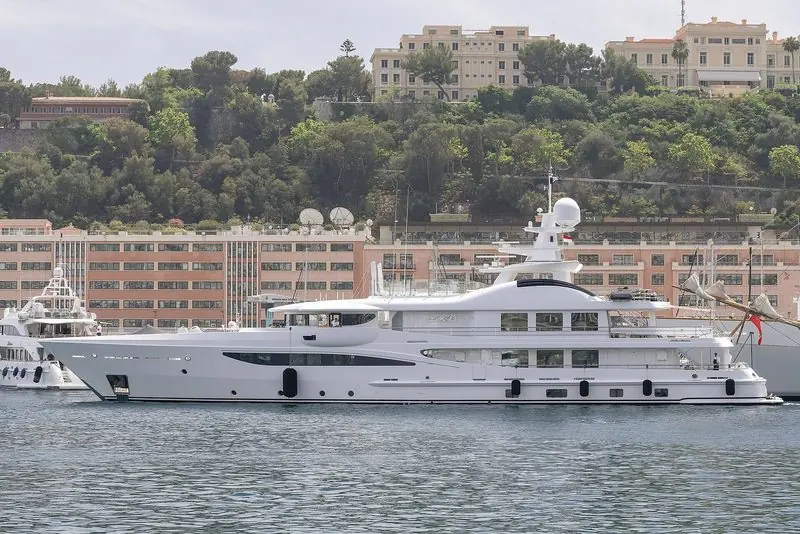
Heywood drew the exteriors for the Amels Limited Editions range from 180 to 272 feet, before Amels handed the newer Amels 60 and Amels 80 to Espen Oeino. That series lets an owner buy a hull already in build at the Dutch yard and take delivery far sooner than a full custom project allows. The naval architecture and the platform are fixed. The layout, the finishes and a good deal of the detail are not.
Plvs Vltra, 74 metres, was the first Amels Limited Editions 242 and was delivered in 2016 in jet black paint with white decks. Here Comes The Sun, 83 metres, arrived in 2017 as the flagship of the range and was later extended by six metres in refit. The recognisable Amels look, a vertical bow with round ports along the hull, is Heywood's. For an owner who wants his lines without a blank sheet build, this is the way in.
Where his responsibility stops
Heywood is an exterior designer. He takes the profile, the deck layout as it affects the outside, the superstructure and the way volume is arranged above the waterline. Naval architecture belongs to the yard or to a separate office. Interiors are normally somebody else's work.
On a few boats he has done more, including interior work on Carinthia VII. The usual pattern is a three-way team of Heywood, an interior house and the yard's engineers. An owner should expect to appoint the interior designer separately and to referee the two studios where the outside and the inside meet at a window line or a deck edge. That boundary is where most build disputes start.
How an owner engages him, and what it costs
The process begins with conversation. Heywood has said his job is to open a client's mind to ideas without pushing him past what he actually wants, and that even a series design gets altered for each buyer. He produces the concept sketches and general arrangement, the owner and yard price it, and the drawings then develop into something a builder can engineer. The commercial gates follow the same order. The concept is bought first and can be stopped for its own price, the letter of intent reserves a yard slot, and the yacht building agreement is the commitment. After the yard begins engineering, an exterior change is no longer a drawing change.
Exterior studios do not publish scales. The superyacht market band is 1 to 5 per cent of build cost for the designer and a further 2 to 4 per cent for project management, both outside the yard's price, per the SuperYachtReview guide updated March 2026, and an exterior-only appointment sits at the bottom of it, with the interior a separate fee on top. The premium that matters is not in the design invoice at all. It is in the compound curves the yard has to build, which is a build cost measured in fairing hours and paid to the builder. An owner who wants a cheap fair hull should be told this at the first meeting.
Recognition, and who it does not suit
The studio has collected World Superyacht Awards, BOAT International Design and Innovation Awards and Monaco Yacht Show honours across three decades, and Heywood has been named chairman of the BOAT International Design and Innovation Awards. Awards at this level are worth something narrow. They tell an owner the boat was finished to a standard a panel of specialists would defend, and they do help resale.
This studio does not suit an owner who wants an interior and an exterior from one office, or one who needs a very large team responding to design changes at speed during a build. It does not suit a first boat under 50 metres. In 2026 the studio worked with Falcon Tenders on an eleven metre superyacht tender, which is about as small as the name goes.
A two-person practice, and the clause nobody offers
The studio is effectively two people, with Heywood doing the drawing. That is the reason to hire him and it is an unhedged risk on a build that runs three to four years. The professional documents do not help. The ITIC standard trading conditions for naval architects, dated 8 July 2025, deal with intellectual property and cap liability at ten times charges or GBP 100,000, whichever is higher, and are silent on what happens if the named designer is unavailable in year three. No marine standard form covers it either, which is why an owner has to raise it himself and will not be offered it.
The clauses are ordinary outside this industry. Death or prolonged incapacity of a named individual as a termination event, an obligation to propose a replacement of equal standing subject to the owner's approval, and a right to the complete drawing set in native format if the practice ceases. That last point is the one that bites here, because copyright normally stays with the designer and the owner buys a licence to build one hull. On an Amels Limited Edition the exposure is different and smaller, since the yard holds a series design and carries the continuity itself, which is a real argument for the series route on a first boat.
A profile that ages slowly is money in the bank
This is the studio in the directory whose work has the best claim to help at resale, and the evidence is the boats themselves. Carinthia VII was delivered in 2002 and Pelorus in 2003, and neither reads as a period piece. A sheerline that falls to the stern is a proportion rather than a fashion, and proportions do not date the way a styling gesture does. That matters more than any award, because the exterior is the part of a yacht a second owner cannot change. An interior can be replaced in a refit season. A superstructure profile is what he owns for as long as he owns the boat.
The Amels Limited Editions add the other half of the argument. A series hull has comparables, a known specification and a yard that still supports it, and Ocean Independence puts exactly those factors, builder pedigree and long-term support, at the top of what holds value in its note of 11 May 2026. An owner buying an exterior from this studio on a full custom project is buying slow ageing. An owner buying one on an Amels is buying slow ageing plus a market. The second is the safer position and the first is the better boat.
Practical detail
| Typical project size | 90 metres and above historically. Recent work has included an 11-metre superyacht tender for Falcon Tenders in 2026, but a first custom boat under about 50 metres is not a good fit |
|---|---|
| Design fee | Not published. Market band is 1 to 5 per cent of build cost for the designer plus 2 to 4 per cent for project management, both outside the yard's price (SuperYachtReview 2026 price guide). An exterior-only appointment sits at the bottom of that band, with the interior a separate fee to a separate studio |
| The real cost of the sheerline | Compound curves are a build cost, not a design cost, paid to the yard in fairing hours at tender, not in the design invoice |
| What is not included | Naval architecture and interior design are both separate appointments. Interiors have gone to Andrew Winch Designs and Terence Disdale Design on Heywood's best-known projects |
| Continuity risk | Effectively a two-person studio, with Heywood doing the drawing himself. The ITIC standard trading conditions of 8 July 2025 are silent on the unavailability of a named designer, so an owner has to negotiate a replacement-designer clause and a rights-to-drawings clause directly |
| The faster route | The Amels Limited Editions range, 180 to 272 feet, carries a Heywood exterior on a semi-custom platform already in build at the yard, faster to deliver and lower continuity risk than a full custom commission |
| Based | Rural England, having moved the studio out of London; clients travel to him |
What owners and crew report
The owner brought her back rather than replacing her
After two decades in service, Carinthia VII's owner sent her back to Lurssen for a full refit rather than commissioning a new yacht. It was a practical vote of confidence in the original design, though this account comes from Lurssen's own refit team, not the owner directly.
Lurssen (Alberto Perrone da Zara, refit sales director)
What is good, and what to watch
Strong points
- A profile that ages slowlyCarinthia VII (2002) and Pelorus (2003) still don't read as period pieces two decades on. A sheerline is a proportion, not a styling trend, and proportions don't date.
- The person who draws it argues for itHeywood does the sketches and drawings himself and stays on to argue the design with the yard, which is not true at every studio of this reputation.
- A semi-custom route existsThe Amels Limited Editions range puts his exterior language on a platform the yard already knows how to build, cutting both delivery time and continuity risk.
- A resale logic that checks out independentlyOcean Independence's 11 May 2026 note names builder pedigree and long-term support as top value factors, which is exactly what a Heywood exterior on an established series hull offers.
What to watch
- A studio of two, with no named successorCapacity is limited and a project waits its turn, and there is no second designer behind Heywood. That is a fair question to weigh before a three-to-four-year build.
- No contractual cover for key-person riskThe standard ITIC trading conditions are silent on what happens if the named designer becomes unavailable mid-build; an owner has to ask for that clause, it will not be offered.
- Compound curves cost money the design invoice doesn't showThe sheerline's premium shows up as fairing hours in the yard's build price, which an owner focused only on the design fee can miss at tender.
- Exterior onlyAn owner wanting one contract covering the whole visible boat has to look at a studio like Sinot instead; Heywood always needs a second interior appointment.
Who it is for: Owners commissioning a large custom motor yacht who want a profile that ages slowly and will pay the yard to build compound curves.