Tangier & the Strait of Gibraltar
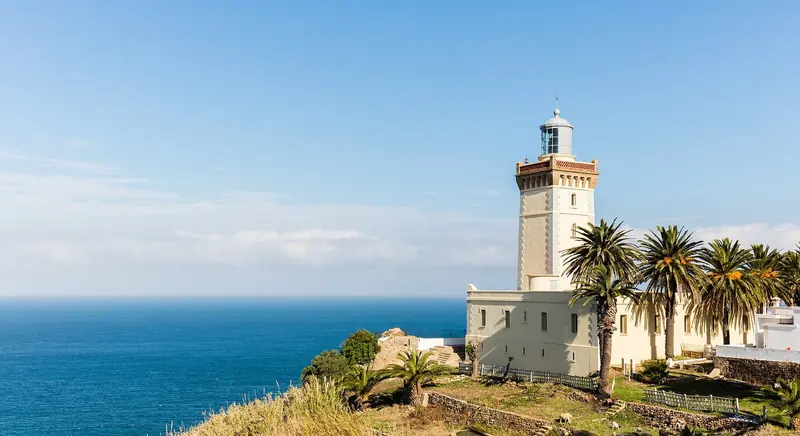
| Location | Morocco's northern tip, on the Strait of Gibraltar, the traditional crossing point between Europe and Africa and between the Atlantic and the Mediterranean |
|---|---|
| Strait width at the narrowest point, Punta Marroqui to Punta Cires: 7.7 nautical miles (14.2 km). Shallowest cross-section, the Camarinal Sill: about 280 metres | |
| Cape Spartel, 14 km west of Tangier, carries the lighthouse built in 1864 and its longitude, 5 55 W, is the internationally recognised western limit of the Mediterranean Sea | |
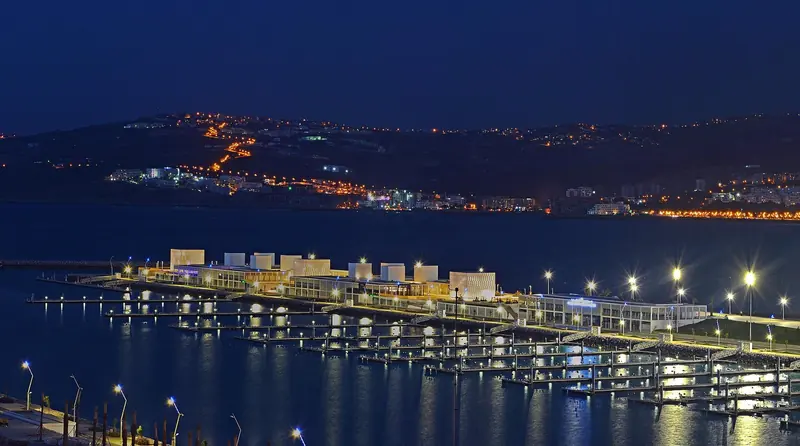
| Tanja Marina Bay | two basins, Basin 1 for 800 berths from 7 to 90 metres, Basin 2 for 600 berths from 7 to 30 metres, per the port authority's own figures. Opened summer 2018 as Morocco's first urban marina |
| A one hectare shipyard at the marina carries a haul-out dock rated at approximately 400 tonnes for vessels to 40 metres, and a 200 cubic metre fuel station | |
| Home to the Tangier Royal Yacht Club, founded 1925, Morocco's oldest, now relocated onto the marina peninsula | |
| Strait traffic | more than 100,000 vessels a year, around 300 commercial ships a day, split by a formal traffic separation scheme, eastbound in a 2 mile northern lane, westbound in a 2 mile southern lane, with a half mile buffer between them |
| Current | net eastward flow of roughly 1 million cubic metres a second, producing up to a 4 knot west-to-east stream through the Strait, tidal cycle roughly every 6 hours 20 minutes |
| Winds | the Levante (easterly, May to September, to 40 knots) favours a westbound passage; the Poniente (westerly, October to April) favours eastbound. Both accelerate hard through the gap and reliably run stronger than forecast |
| Orca incidents in the Strait/Gulf of Cadiz corridor: Alboran Cognac holed and sunk 12 May 2024, Bonhomie William attacked and sunk 26 July 2024, both crews rescued, no injuries in either case. Nearly 700 recorded interactions since 2020 with no person harmed | |
| Orca risk season runs April to August, tracking the bluefin tuna migration through the Strait; a Cruising Association and GTOA reporting portal has run since June 2022, apps GT Orcas and Orcinus give real-time reports, monitor VHF Channel 16 | |
| Morocco temporary admission for a foreign pleasure boat: Noonsite's own reference page states up to 6 months duty-free a calendar year with report-in within 24 hours of arrival, but cruiser reports describe customs in practice enforcing far shorter, sometimes 45 days, sometimes three months. No single figure is safe to plan against without confirming locally first | |
| Tanger Med, the region's large container port, sits about 45 km north-east of Tangier city near Ksar Sghir. It handled 101 million tonnes of cargo in 2021 and offers commercial bunkering through the Horizon Tangiers Terminal, a separate facility from the yacht marina's own small fuel pontoon | |
| No current published tariff was found for Tanja Marina Bay's own berths | |
The City the Strait Made
Cape Spartel, 14 km west of the city, is the accepted answer to where the Atlantic ends and the Mediterranean begins, a status fixed by its longitude of 5 degrees 55 minutes west and marked since 1864 by a lighthouse Sultan Mohammed III ordered built there, one of the largest in Africa, standing about 300 metres above the Atlantic. From that headland the Strait narrows to 7.7 nautical miles between Punta Marroqui on the Spanish side and Punta Cires on the Moroccan, with a shallowest cross-section at the Camarinal Sill of only about 280 metres against a general depth of 300 to 900 metres, the pinch point that drives everything else on this page, the currents, the traffic scheme and the weather.
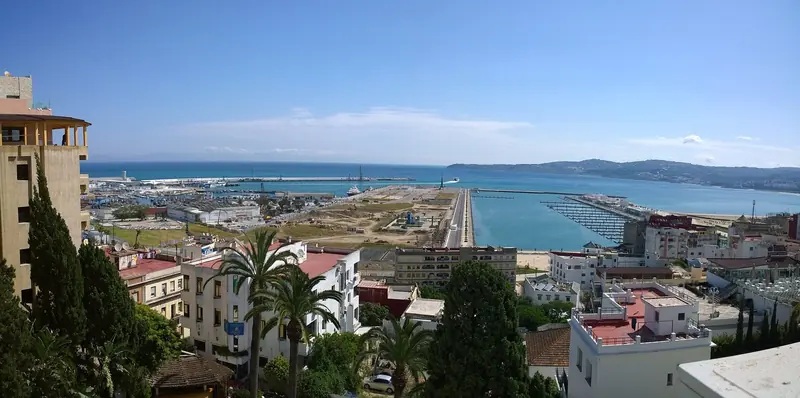
The city's own history reads as a direct consequence of sitting on that pinch point. From 1923 to 1956 to 1960 Tangier ran as an internationally administered zone under France, Spain, Britain, Italy, Portugal, Belgium, the Netherlands and later the United States, a status created specifically because no single power was willing to let another hold the Europe-Africa, Atlantic-Mediterranean crossing alone. That era ended with Moroccan independence, but the geography that caused it did not, and it is the same geography that makes Tangier a genuine waypoint today rather than a detour: a yacht crossing from Gibraltar or from the wider Mediterranean into the Atlantic, or the reverse, passes within sight of this coast whether it stops or not.
Tanja Marina Bay: the New Harbour in the Old Port
The port authority's own figures split the marina into two basins: Basin 1 holds 800 berths for vessels from 7 to 90 metres, Basin 2 a further 600 for 7 to 30 metre boats, opened in the summer of 2018 as what the port itself calls the kingdom's first urban marina, built directly against the old medina rather than on reclaimed land outside it. A one hectare shipyard alongside carries a haul-out dock rated at roughly 400 tonnes for vessels to 40 metres, and a 200 cubic metre fuel station serves the basins, with berth prices reported to include water and three-phase electricity. The marina has also picked up the Blue Flag environmental accreditation and is now home to the Tangier Royal Yacht Club, founded in 1925 and Morocco's oldest, relocated onto the marina peninsula itself.
First-hand cruiser accounts read as genuinely mixed rather than glowing. A Noonsite report from around the marina's opening describes a warm welcome from three linesmen and a marina running at a fraction of capacity, with only about nine yachts and a few powerboats occupying more than 200 available berths, and fuel cheap but not as cheap as Gibraltar's. A more recent account, the Graptolite sailing log from June 2023, describes a frustrating wait at the reception pontoon overnight with no proper berth assigned and no WiFi reaching that far from the main basin. No current tariff sheet for either basin was found published anywhere, so an owner is quoting from an agent, not from the marina's own rate card.
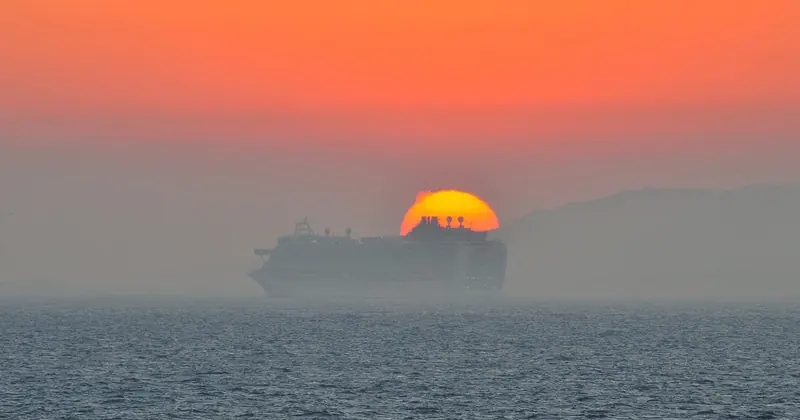
Roughly one million cubic metres of Atlantic water pour into the Mediterranean through the Strait every second, fast enough to run a 4 knot current through a channel only 7.7 nautical miles wide at its narrowest.
Clearing Into Morocco: What the Rules Actually Say
The clearance process itself is consistently described as straightforward. Morocco's customs border control issues an internal cruising permit and immigration issues visas on arrival, officials board for a brief inspection, and Noonsite's general Atlantic Morocco report states plainly that there are no fees, only passports, ship's papers, an insurance certificate and patience. Tangier specifically draws praise in that report for well organised, multilingual staff, with check-in taking around ninety minutes and check-out about an hour, and a Cruisers Forum-derived account puts a Tangier in-clearance at as little as thirty minutes with only a token inspection.
Where the rules genuinely conflict is duration. Noonsite's own dedicated customs page states the temporary admission regime allows a foreign pleasure boat to stay duty-free for up to six months, continuous or in instalments, within a calendar year, reported within 24 hours of arrival. But the same page, read alongside cruiser accounts, also describes the system in practice as far less flexible, with figures as low as 45 days appearing alongside a separately cited three month limit before duty becomes an issue. No yacht-specific circular from Morocco's customs authority, the ADII, was found to settle which figure actually governs. The honest position for an owner planning more than a short stay is to confirm the current practice directly with the ADII or a Tangier agent before committing to it, not to plan against any single number in this paragraph or any other source.

Threading the Traffic Separation Scheme
The Strait's shipping lanes are split into a two mile wide eastbound lane on the Spanish and Gibraltar side, a two mile wide westbound lane on the Moroccan side, and a half mile separation zone between them, charted on Admiralty plans and covered by Admiralty Sailing Directions NP45. COLREGS Rule 10 sets the standard every cruising-safety source repeats for a vessel obliged to cross the scheme rather than follow it: cross on a heading as close as practicable to a right angle to the general flow of traffic, which minimises the time spent inside the lane of 300-a-day commercial shipping rather than threading along it.
Two independent firsthand crossings describe exactly this in practice. The Graptolite sailing log, June 2023, shaped a course straight across the scheme toward the Moroccan side while working around charted turbulent water, and separately reported a tidal race off the Moroccan headland at Belyounach so strong that at engine settings normally good for 6 to 7 knots the boat made only 2. The Shamballa Cruising Yacht Club's account from October 2019 describes the same perpendicular crossing and timed its departure from Gibraltar three hours after high water specifically to ride a favourable current, a timing strategy the reference site NoForeignLand sets out in more general terms: eastbound, leave close to slack water at high water Gibraltar; westbound, aim to be off Tarifa around six hours after it.
Currents, Winds and the Orca Question
Beneath the surface the Strait runs two ways at once: a comparatively fresh Atlantic layer flows east into the Mediterranean at the surface while a saltier, denser Mediterranean layer flows west underneath it, and the net surface effect, reported consistently at around 1 million cubic metres of Atlantic water a second, is a current that can run up to 4 knots west to east through a channel only 7.7 nautical miles wide, cycling roughly every six hours twenty minutes with the tide. On top of it, the Levante blows hard from the east from May to September, gusting to 40 knots and favouring a westbound passage, while the Poniente blows from the west from October to April and favours the opposite direction. Every source consulted repeats the same warning regardless of which wind is blowing: the Strait is reliably windier than its own forecast, funnelled by the land either side, and a boat should reef before reaching Tarifa or Gibraltar Bay, not after.
The newer hazard is orcas. Since 2020 nearly 700 recorded interactions between orcas and yachts have occurred across the wider Strait of Gibraltar and Gulf of Cadiz corridor, and two have ended with a yacht sunk in the last two seasons alone: Alboran Cognac, holed and lost on 12 May 2024, and Bonhomie William, attacked and sunk on 26 July 2024, both crews rescued with no one hurt in either case. The risk tracks the bluefin tuna the orcas are following, and runs heaviest from April to August, exactly the window a Levante-driven westbound passage is most likely to be planned in. A Cruising Association and GTOA reporting portal has operated since June 2022 in four languages, with the apps GT Orcas and Orcinus recommended for real-time alerts and VHF Channel 16 the channel to monitor, though Spanish and Portuguese authorities currently give conflicting advice on what to do if orcas approach, one recommending stopping and dropping sail, the other recommending motoring away toward shallow water.
The Medina and the Kasbah, and Tanger Med Next Door
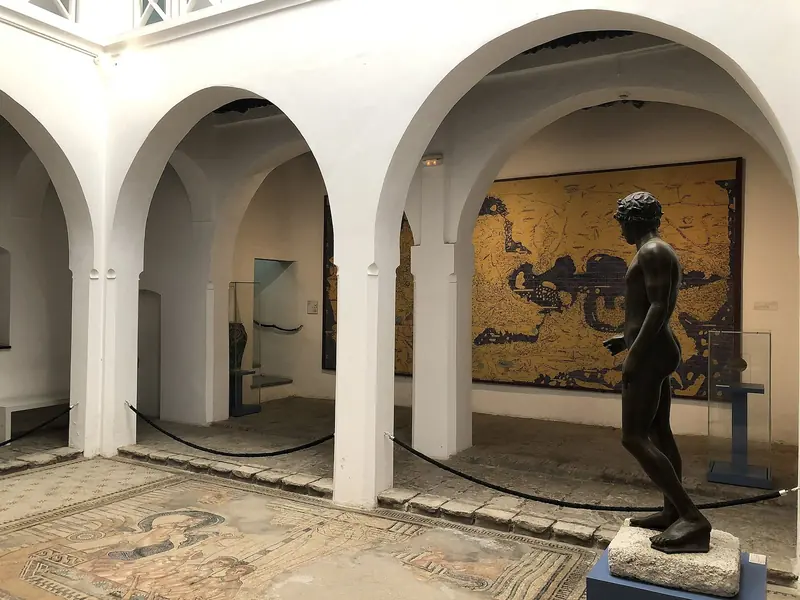
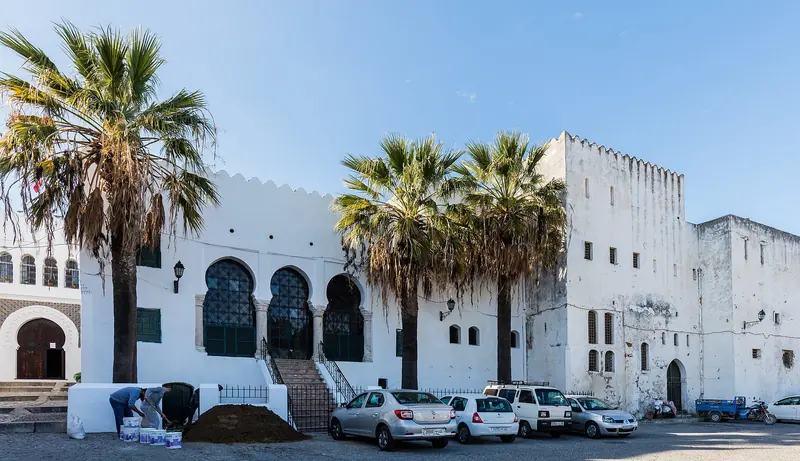
The Kasbah stands at the summit of the medina, the historic residence of the sultan and today one of the city's most fashionable quarters, with the Kasbah Museum of Mediterranean Cultures occupying the former palace and its Andalusian garden. The medina below it retains a working souk of spice, leather and textile stalls alongside its tourist trade, still trading in a way several travel sources specifically contrast with medinas elsewhere in Morocco that have been given over entirely to tourist shops, and its viewpoints look directly across the Strait to Spain, a detail with real resonance for anyone who has just crossed it or is about to.
Tanger Med is a different port doing a different job, and worth naming precisely so it is never confused with the yacht marina. It sits roughly 45 km north-east of Tangier city near Ksar Sghir, close to Tarifa on the Spanish side, and handled 101 million tonnes of cargo in 2021 across container terminals with 11 million TEU of capacity connecting to more than 180 ports in 70 countries, making it one of the largest ports on the Mediterranean and in Africa by some measures. It offers commercial bunkering through the Horizon Tangiers Terminal, a 530,000 cubic metre facility, entirely separate from Tanja Marina Bay's own small 200 cubic metre yacht fuel pontoon. A yacht clears in and berths at the city marina; Tanger Med is a container port an owner will see on the chart and nowhere else.
Ashore, access and booking
| Getting there | Ibn Batouta Airport serves Tangier directly with strong seasonal links to France and Spain. By sea, Gibraltar is the standard departure point, roughly 20 nautical miles across the Strait depending on the exact track chosen to cross the shipping lanes safely. |
|---|---|
| Berthing | Tanja Marina Bay: Basin 1, 800 berths, 7 to 90 metres; Basin 2, 600 berths, 7 to 30 metres. A one hectare yard with an approximately 400 tonne haul-out lift for vessels to 40 metres. No current published tariff for either basin. |
| Fuel | A 200 cubic metre fuel station at Tanja Marina Bay. Reported cheap relative to Europe but not as cheap as Gibraltar's duty-free bunkering. Tanger Med, 45 km away, runs a much larger commercial bunkering terminal not aimed at yachts. |
| Clearance | Customs and immigration process on arrival, no fee, roughly 90 minutes in and 60 minutes out per Noonsite's general account. Duration allowed without duty is genuinely disputed across sources, from 45 days to six months; confirm current practice with the ADII or a local agent before planning a long stay. |
| The crossing | 7.7 nautical miles at the narrowest point. Cross the shipping lanes close to a right angle under COLREGS Rule 10. Current up to 4 knots, timed against high water Gibraltar; Levante winds May to September favour westbound, Poniente October to April favours eastbound. Orca risk April to August, monitor VHF 16 and the GTOA reporting apps. |
| What is not published | No current marina tariff, no single reliable admission-duration figure, and no yacht-specific customs circular from Morocco's ADII was found anywhere in this research. |
What owners and crew report
The marina's own figures put it at 1,400 berths across two basins
Tanja Marina Bay's port authority describes Basin 1 as 800 berths for vessels of 7 to 90 metres and Basin 2 as 600 berths for 7 to 30 metres, opened in the summer of 2018 as Morocco's first urban marina, with a one hectare shipyard and an approximately 400 tonne haul-out dock alongside it.
Tangier port authority (tangerport.com)A cruiser's overnight at the reception pontoon went badly in June 2023
After crossing from Gibraltar and refuelling, the yacht waited at the reception pontoon through the night without being moved to a proper berth, reporting oversized electrical connections and no WiFi signal reaching that far from the main basin.
Graptolite's Sailing Log, 18 June 2023Two yachts have been sunk by orcas in the Strait corridor since May 2024
Alboran Cognac was holed and lost on 12 May 2024 and Bonhomie William was attacked and sunk on 26 July 2024, both in the Strait of Gibraltar, with all aboard rescued and nobody hurt in either incident, part of a pattern of nearly 700 recorded orca interactions with vessels since 2020 in the wider corridor.
Wikipedia's Iberian orca attacks record, compiling contemporary press reportingMorocco's own duration rule and its enforcement in practice do not match
The stated temporary admission regime allows a foreign pleasure boat up to six months duty-free a calendar year, reported within 24 hours of arrival, but cruiser accounts describe customs in practice being markedly less flexible, with figures as low as 45 days appearing alongside a separately cited three month limit. No single number should be relied on without confirming current practice locally.
Noonsite, Morocco customs reference page, cross-read against cruiser reportsThe Strait's shipping lanes move roughly 300 vessels a day
More than 100,000 vessels a year transit the Strait of Gibraltar on a formal traffic separation scheme, a two mile eastbound lane and a two mile westbound lane split by a half mile buffer, and COLREGS Rule 10 requires a yacht obliged to cross it to do so as close to a right angle to the traffic flow as practicable.
Admiralty Sailing Directions NP45 and standard COLREGS guidance cited across cruising-safety sources
What is good, and what to watch
Strong points
- A real crossing point, not a manufactured one7.7 nautical miles separate two continents and two seas here, a genuine geographic fact the marina and the city are both built around rather than a marketing frame.
- Tanja Marina Bay takes real size in a real medina setting1,400 berths to 90 metres, built into the old port at the foot of the Kasbah, not on a reclaimed strip outside the old city.
- The Kasbah and medina are still a working townSouks trading spice, leather and textiles alongside the tourist trade, and a clifftop view straight across the Strait to Spain.
- Clearance itself is genuinely easyNo fee, multilingual staff, roughly ninety minutes in and an hour out by Noonsite's own account, among the more straightforward check-ins reported anywhere on this coast.
- A distinct facility from Tanger MedThe giant container port 45 km away never enters a cruising yacht's plan at all; the city marina is the whole story for a yacht.
What to watch
- How long you may actually stay is not settledOfficial guidance says six months a year; cruiser reports describe customs enforcing as little as 45 days. Nobody has resolved the gap in public, so plan a long stay only after confirming it locally.
- No current marina tariff anywhereBerth pricing at Tanja Marina Bay is not published; an owner works from an agent's number, not the marina's own rate card.
- The crossing itself carries real, current hazardsA shipping lane moving 300 vessels a day, a current that can run 4 knots, wind that habitually beats the forecast, and since 2020 a real pattern of orcas damaging and sinking yachts in the same water.
- One firsthand account describes a genuinely poor arrivalA June 2023 log records a full night on the reception pontoon with no proper berth and no WiFi, against an earlier report of an easy welcome, so consistency of service is itself in question.
- Fuel is cheap here, not freeReported cheaper than mainland Europe but explicitly not as cheap as Gibraltar's duty-free bunkering a short distance away, so it is not the fuel stop some owners assume it to be.
Who it is for: A captain planning a Mediterranean to Atlantic delivery or an owner who wants Morocco as a genuine stop rather than a name on a chart, with a crew willing to read a traffic separation scheme and a current table before making the crossing and to watch for orcas the same way they would watch for weather.