The Greek Cyclades
| Region | central and southern Aegean, Greece, roughly 30 inhabited islands |
|---|---|
| Scale | Athens to Mykonos about 90 nautical miles, Mykonos to Paros about 25, Mykonos to Santorini about 70 |
| Season | May to October, with the Meltemi at its strongest in July and August |
| Defining wind | the Meltemi, a northerly that regularly runs force 6 to 7 for three to five days at a time |
| Berthing | Tourlos marina on Mykonos has 222 berths but caps at 25 m and 3 m draft, so large yachts lie off |
| Mykonos port rule | yacht movements in and out are prohibited between 09:30 and 10:30 for ferry traffic |
| Santorini | no marina for a large yacht, caldera depths run from 50 m to several hundred, so moorings or a lunch stop only |
| Mainland base | Flisvos Marina in Athens, 310 berths with more than half sized for yachts over 35 m |
| Cruising tax | TEPAI, charged monthly, EUR 8 per metre per calendar month at superyacht sizes (rate current July 2026) |
| New protection | a South Cyclades national marine park was announced in 2025 with environmental studies approved in December 2025, centred on trawling bans and no-fishing zones |
| Jurisdiction | Greece, EU and Schengen, with separate charter licensing requirements |
| Getting there | Mykonos and Santorini both have airports, Athens is the reliable one |
| TEPAI cost in practice | EUR 400 a month for a 50 m yacht, or EUR 2,000 for a five month June to October season, on the rate current in July 2026 |
| TEPAI reductions, per the tax authority guidance dated 23 January 2026: 10 per cent for annual prepayment, 20 per cent for staying in Greek territory all year, 25 per cent for exclusive professional use, applied cumulatively | |
| No Greek marina published a superyacht berthing tariff in July 2026, including Flisvos and Zea | |
| Charter by a third-country flag is permitted above 35 m LOA and for non-wooden hulls, under a Greek charter licence | |
| The Greek charter licence runs three years and renewal requires at least 75 charter days in three years, or 105 days where bareboat chartering is allowed | |
| Charter VAT | 24 per cent standing rate, 13 per cent for a professional crewed charter of more than 48 hours, 24 per cent for short, static and bareboat charters |
| Temporary admission | the ordinary EU 18 month clock for private use, and it cannot run alongside commercial charter |
| Nearest lift | Neorion at Syros, a 2,500 tonne synchrolift taking vessels to 100 m |
Real distances, for once
This is the one Aegean ground where passage planning is a real exercise. Athens to Mykonos is about 90 nautical miles, or 70 from Lavrio, which is the sensible departure port. Mykonos to Paros is 25 miles, Paros to Santorini about 60, and Milos sits 60 miles west of Santorini across open water. The islands look close together on the chart and they are separated by channels where the wind accelerates.
A week from Athens is tight but workable. Lavrio to Kythnos or Syros on the first day, then Mykonos and Delos, Paros and Naxos, and back. Two weeks is where the Cyclades come alive, because the second week reaches Santorini, Folegandros, Sifnos and Milos, which is the western chain and the prettiest of the group. Owners who want to see Santorini and Mykonos in the same week should expect to spend two whole days on passage and should build in a spare day for the wind.
Milos, and the islands people skip
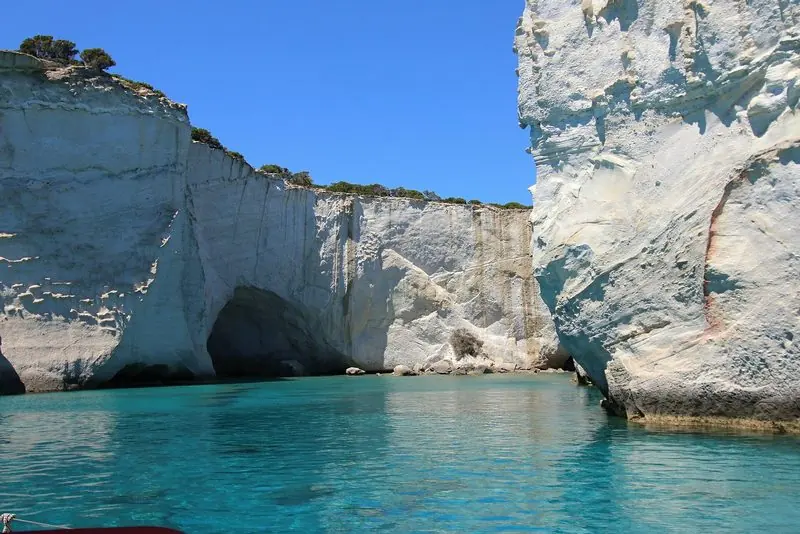
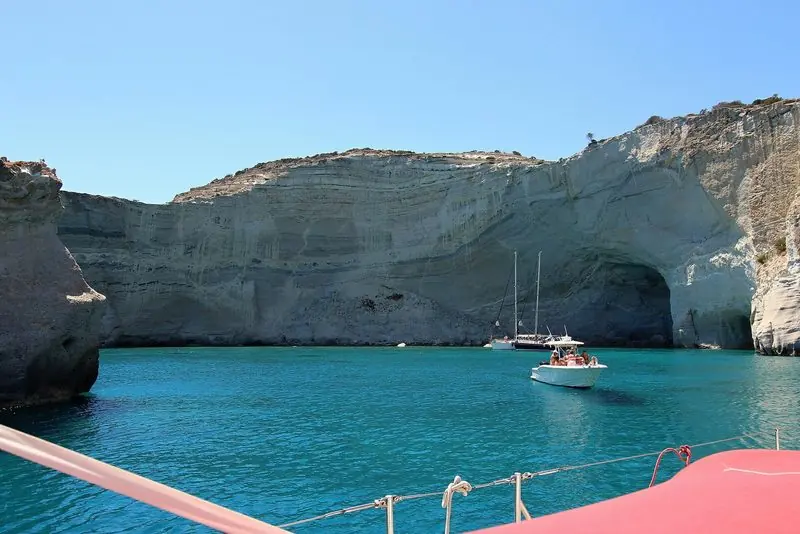
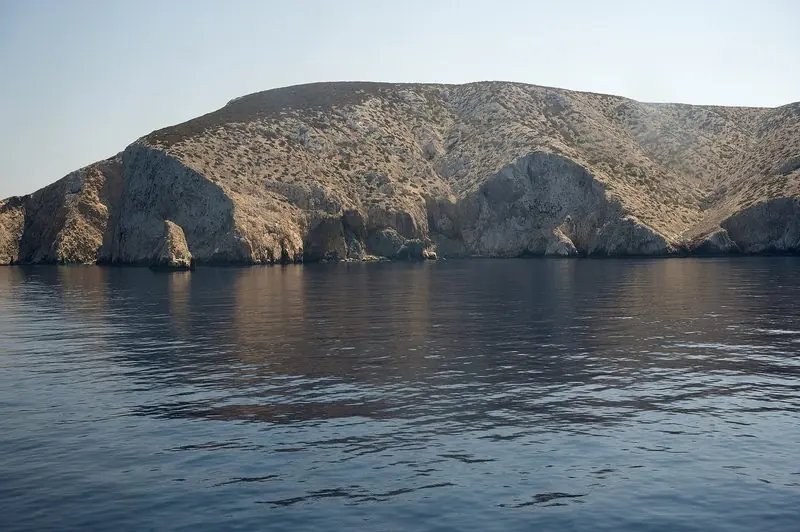
Milos is the best cruising island in the Cyclades and most itineraries underrate it. Kleftiko on the southwest corner is a set of white rock arches and caves in clear water and it is worth a full day, with Sikia cave and Gerakas nearby. Sarakiniko on the north coast looks like a moonscape and works in southerly conditions. On Polyaigos, the empty island east of Milos, there is a run of pale bays with nobody in them.
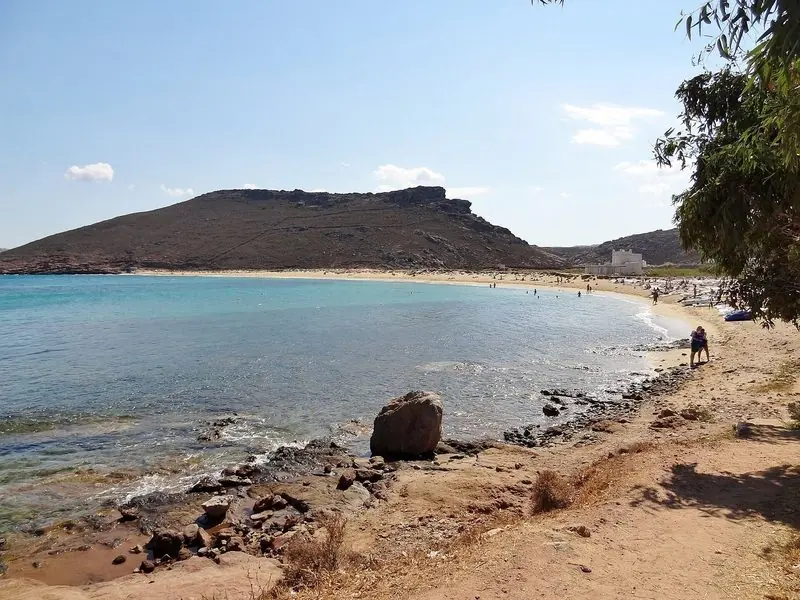
Elsewhere the pattern is one or two good bays per island. Off Mykonos the southern beaches, Psarou, Ornos and Super Paradise, are the social anchorages and they are exposed to the swell that the Meltemi pushes round the island. Naxos has long sandy bays on the west coast, Paros has Naoussa in the north and the channel to Antiparos, and Ios has the deep sheltered bay at Ormos. Rinia, the uninhabited island beside Delos, holds several quiet anchorages within tender range of the ruins.
The Meltemi decides where the boat sleeps, and no amount of money changes that.
Berthing, of which there is almost none
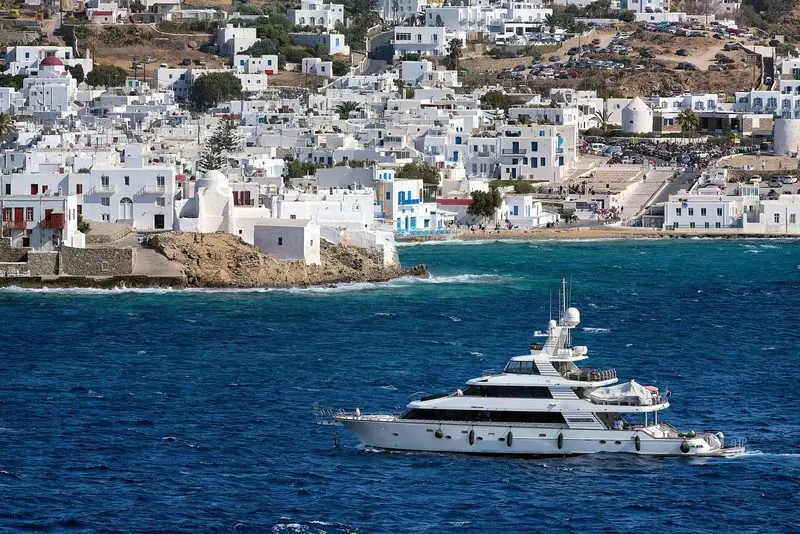
Almost nowhere alongside. Tourlos marina on Mykonos has 222 berths but a maximum of 25 metres and 3 metres of draft, so a large yacht either arranges space on the commercial quay at the new port or lies at anchor and tenders in. The port authority prohibits yacht movements in and out between 09:30 and 10:30 every day to clear the ferry traffic, which is the kind of detail that ruins a guest departure if nobody checked. Paros, Naxos and Syros have working harbours with limited alongside space and constant ferry movement.
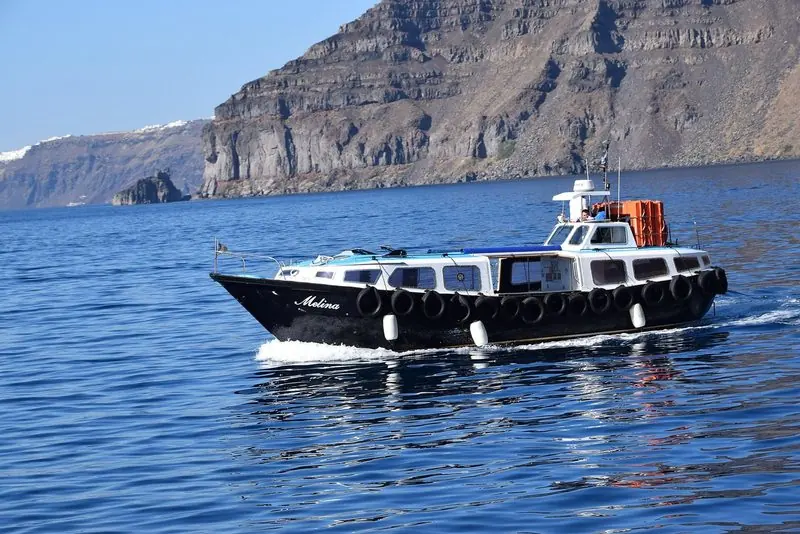
Santorini has no answer at all for a large yacht. The caldera is a drowned volcano and the water goes from 50 metres to several hundred within a boat length of the cliff, so anchoring is not practical and yachts use laid moorings or simply stop for lunch and run the tender to Ammoudi. Vlychada on the south coast is a small harbour and not a superyacht berth. The practical structure for the whole region is a contract berth at Flisvos in Athens, which has 310 berths with more than half sized for yachts over 35 metres, and a cruise that runs out and back.
The Meltemi, and the months
May is beautiful and cool, with the sea still cold for swimming and the islands half open. June warms up and is the best all-round month. July and August are hot, dry and busy, and they are also when the Meltemi is at its most reliable. September is the crew's answer, with warm water, thinning crowds and lighter winds, and the first half of October is often the calmest fortnight of the year.
The Meltemi is a northerly that sets up when a high sits over the Balkans and a low over Turkey, and it runs force 6 to 7 for three to five days at a stretch, gusting harder through the channels and off the high islands. It does not build a long swell in the way an Atlantic wind does, but it produces a short steep sea that is genuinely unpleasant on the beam. The shelter is on the southern and western sides of each island. Crews plan the whole route so that the wind is behind them, which is why itineraries here tend to run north to south and then reposition.
When it fills, and what has changed
The fleet arrives in June, the charter season peaks from mid July to the third week of August, and it drops away sharply after the first week of September. Mykonos runs its own calendar, with the beach clubs opening in late May and the season built around DJ residencies and a nightlife economy that prices in August at Riviera levels. Santorini's peak is driven by cruise ship calls and day visitors, and the island is at its worst between eleven and six.
Two recent things are worth knowing. Santorini had an intense seismic swarm from late January 2025, with more than 12,000 tremors recorded and a state of emergency declared, and the island was declared safe for visitors again in March 2025, with a quieter 2025 season as a result. Separately, Greece has been pushing back on overtourism at both Santorini and Mykonos with cruise levies and access measures. Both mean the shore experience at the two famous islands is more managed than it was.
Athens is the airport that works
Athens is the airport that works. It has full long-haul and European connectivity, a proper general aviation operation, and Flisvos and Alimos marinas are half an hour away by road. Mykonos and Santorini both have airports that take business jets and both are congested and slot-limited in August, with short runways that restrict aircraft type. Paros has a small airport with domestic service.
The practical model most owners settle on is that guests fly to Athens, join the boat at Flisvos, and the yacht does the passage overnight. Direct joins at Mykonos work in June and September and are a gamble in August. Helicopter transfers between the islands are available and expensive, and they are the usual fix when a guest has to leave from Santorini in a hurry.
Mykonos, Delos and the tavernas
Mykonos is the money island and it is unapologetic. Nammos at Psarou beach is the name everyone knows and the bill matches, Scorpios at Paraga is the sunset venue, and Principote on the northern side at Panormos catches the other wind. The old town around Matoyianni and Little Venice is genuinely pretty at seven in the morning and unmanageable at seven in the evening. The nightlife is the best in the Aegean and it is also the most expensive thing on this coast.
Everywhere else is quieter and better value. Delos is a guided archaeological visit reached by tender, one of the most important sites in Greece, and it closes in the early afternoon. Santorini is about the caldera view, the Assyrtiko vineyards at Santo Wines and the fish tavernas at Ammoudi below Oia. Naoussa on Paros has a small fishing harbour ringed with restaurants and is the most pleasant evening in the group. Sifnos has a serious reputation for its island cooking.
TEPAI, fuel and the thin support
TEPAI, the Greek cruising tax, applies to all leisure vessels over seven metres in Greek waters whatever their flag, and at superyacht sizes it works out at EUR 8 per metre per calendar month, so a 50 metre boat pays EUR 400 a month, on the rate current in July 2026. It is paid online in advance and is checked. Chartering from Greek ports carries its own licensing regime, which has been reworked repeatedly and treats non-EU flagged yachts differently, and no owner should assume last season's structure still holds. A Greek agent is not optional here.
The support picture is thin away from the mainland. Syros has the Neorion yard and is the only meaningful technical capability in the Cyclades. Fuel at superyacht quantities is a genuine constraint, delivered by truck in limited volumes on most islands, so boats bunker at Piraeus, Lavrio or Syros and plan the cruise around tank capacity. Provisioning at the standard a large yacht expects is an Athens exercise, with stores sent out by ferry or carried aboard.
The honest downside
The wind is not a detail here, it is the whole planning problem. A Meltemi that sets in on the Tuesday of a one week charter will pin the boat on the southern side of two islands for the rest of the trip, and there is no version of the Cyclades where that does not happen sometimes. Guests who expect to step off in a marina every evening will be disappointed, because the boat is at anchor most nights and the tender ride can be wet.
The other honest point is the split between the famous islands and the rest. Mykonos and Santorini are expensive, crowded and heavily commercialised, and they are also the two islands most guests ask for. The islands that make the Cyclades worth a fortnight, Milos, Sifnos, Folegandros and Amorgos, have almost nothing ashore beyond a village and a taverna. An owner who wants both the nightlife and the emptiness will spend a lot of the cruise on passage between them.
What a Greek season costs when there is no berth to buy
This is the cheapest ground in the Mediterranean to lie in and one of the most expensive to service, because there is almost nothing to buy. TEPAI, the cruising tax, is EUR 8 per metre per calendar month for any vessel over 12 m whatever its flag, so a 50 m yacht pays EUR 400 a month and EUR 2,000 for a five month June to October season on the rate current in July 2026. The tax authority's eTEPAI guidance dated 23 January 2026 sets out reductions that stack: 10 per cent for paying the whole year in advance in the preceding December, 20 per cent where the vessel stays in Greek territory for the full year, and 25 per cent for exclusive professional use. No Greek marina publishes a superyacht tariff. Flisvos in Athens, which is the practical home berth for a Cyclades programme, quotes on application, and neither it nor Zea had a public rate card in July 2026, so no berth figure is given here rather than an invented one.
Put that next to the marinas that do publish and the scale of the difference is the point. The berth line of a Cyclades fortnight is a couple of hundred euros of cruising tax, against EUR 108,740 for twenty August nights at Porto Cervo on its 2026 card. What replaces the berth invoice is logistics. Fuel at superyacht volumes is trucked in limited quantities on most islands, so the boat bunkers at Piraeus, Lavrio or Syros and plans the route around tank capacity, and a mid-cruise uplift at Mykonos is an arranged event rather than a fuel dock. Provisioning to the standard a large yacht expects is an Athens exercise with stores sent out by ferry. An agent is not optional, because the port police, the charter paperwork and the berth on the commercial quay all run through one. The money does not disappear in Greece, it moves off the marina invoice and onto the delivery van.
Whether a foreign flag may charter in Greek waters
Greece gives the clearest answer in the EU to the question that matters most, and it is a yes with conditions rather than a referral to a lawyer. A yacht on a third-country flag may charter in Greek waters, which is not available on the same terms in France, Italy or Spain, but only above 35 m LOA and only if she is not of wooden construction. She must hold a Greek charter licence, obtained through a registered Greek agency acting under a management and handling agreement, and be recorded in the online Registry of Touristic Yachts and Small Vessels. The licence runs three years, and renewal requires documentary evidence of at least 75 charter days within a three year period, or 105 days where bareboat chartering is permitted. That day count is the condition owners fail, because a yacht used mainly privately with two or three charters a season will not reach it and will lose the licence at renewal.
Charter VAT is 24 per cent as the standing rate, reduced to 13 per cent for a professional crewed charter running more than 48 hours under a proper charter contract with a yacht that meets the Greek charter rules. Charters of 48 hours or less, static charters and bareboat stay at 24 per cent. The effective rates of around 6 per cent that still circulate in older material belong to a regime abolished after 2020 and should not be relied on for a 2026 quotation. Privately, a non-EU flagged yacht runs the same 18 month EU temporary admission clock as everywhere else under Article 217(e) of Delegated Regulation (EU) 2015/2446, and temporary admission and commercial charter cannot run at the same time, so the licence route means the yacht is imported. Greek enforcement runs through the port authority, which handles the charter paperwork before departure, so a licence problem surfaces as a boat that is not cleared to sail rather than as an assessment months later. TEPAI is paid in advance and it is checked. The only real technical capability in the islands is Neorion at Syros, which operates a 2,500 tonne synchrolift for vessels to 100 m alongside its commercial docks.
Ashore, access and booking
| Getting there | Athens is the airport that works: full long-haul and European connectivity, a proper general aviation operation, and Flisvos and Alimos marinas half an hour away by road. Mykonos and Santorini both take business jets but both are congested and slot-limited in August, with short runways that restrict aircraft type. Paros has a small airport with domestic service only. |
|---|---|
| How you actually reserve | Tourlos marina on Mykonos has 222 berths but caps at 25 m and 3 m of draft, so a large yacht either arranges space on the commercial quay at the new port or lies off and tenders in. Santorini has no marina answer at all: the caldera runs from 50 m to several hundred within a boat length of the cliff, so yachts use laid moorings or simply stop for lunch and tender to Ammoudi. The practical structure most owners settle on is a contract berth at Flisvos in Athens, which has 310 berths with more than half sized for yachts over 35 m, and a cruise that runs out and back from there. |
| What a berth costs | No Greek marina, including Flisvos and Zea, published a superyacht berthing tariff as of July 2026 - both quote on application. What replaces the berth invoice is the cruising tax: TEPAI runs EUR 8 per metre per calendar month for any vessel over 12 m regardless of flag, so a 50 m yacht pays EUR 400 a month, or EUR 2,000 for a five month June to October season, on the rate current in July 2026. The tax authority's eTEPAI guidance dated 23 January 2026 stacks reductions of 10 per cent for prepaying the year in the preceding December, 20 per cent for staying in Greek waters all year, and 25 per cent for exclusive professional use. |
| What the fluids and provisioning cost | Fuel at superyacht volumes is trucked in limited quantities on most islands, so boats bunker at Piraeus, Lavrio or Syros and plan the route around tank capacity rather than topping up mid-cruise. Provisioning to the standard a large yacht expects is an Athens exercise, with stores sent out by ferry or carried aboard before departure. |
| Where to eat within walking distance | On Mykonos, Nammos at Psarou is the name everyone knows and the bill matches it, Scorpios at Paraga is the sunset venue and Principote at Panormos catches the other wind; the old town around Matoyianni and Little Venice is pleasant at seven in the morning and unmanageable at seven in the evening. Naoussa's small fishing harbour on Paros, ringed with restaurants, is the most pleasant evening in the group. On Santorini the fish tavernas at Ammoudi below Oia and the Assyrtiko vineyards at Santo Wines are the destination; Sifnos has a serious reputation for its island cooking. |
| Fixed dates to plan around | The charter season peaks from mid July to the third week of August and drops away sharply after the first week of September. Mykonos runs its own calendar, with beach clubs opening in late May and August priced at Riviera levels around DJ residencies. Santorini's worst hours are eleven to six, driven by cruise ship day visitors rather than the charter fleet. |
| What is NOT published | No Greek marina publishes a superyacht rate card, Flisvos and Zea included, checked July 2026. Santorini has no berthing infrastructure for a large yacht at any price - there is genuinely nothing to buy there, only a mooring or a lunch stop. And the charter licensing structure has been reworked repeatedly, so no owner should assume last season's rules still hold without checking with a Greek agent first. |
What owners and crew report
Charter brokers reported no drop in Santorini bookings through the 2025 seismic swarm
During the earthquake swarm that began in late January 2025, Kensington Tours said consumer confidence on the charter side stayed high and that the company was working directly with yacht captains and owners so that any disrupted trip could be postponed or rescheduled rather than cancelled outright.
Edita Sgovio, vice-president of yachts and villas, Kensington Tours (CNN, March 2025)A new marine park sits over part of the cruising ground, though it targets fishing, not anchoring
Greece's Prime Minister announced the South Aegean National Marine Park 1 - South Cyclades in July 2025, covering 18 existing Natura 2000 sites and banning bottom trawling within its boundaries. As announced, the restriction is on commercial fishing methods rather than yacht anchoring, but it is a live change in a cruising ground that previously had no such protected status.
Office of the Prime Minister of the Hellenic Republic, 21 July 2025The TEPAI receipt is checked by more than one authority, not just on departure
Greece's tax authority guidance states that the Coast Guard, port authorities, marina staff and customs officers can all ask to see proof of TEPAI payment, so a lapsed or unpaid receipt can surface as a stop at any point in the cruise rather than only at the port of entry.
Independent Authority for Public Revenue (AADE), eTEPAI guidance
What is good, and what to watch
Strong points
- The best water and the emptiest islands in the eastern MediterraneanMilos alone - Kleftiko's white rock arches, Sarakiniko's moonscape, the uninhabited bays of Polyaigos next door - rewards owners who accept that the boat lives at anchor rather than alongside a quay.
- Athens is a real long-haul hub, not a resort airstripFull international connectivity and a genuine business aviation operation half an hour from Flisvos, against Mykonos and Santorini's short, slot-limited runways in August.
- The cheapest ground in the Mediterranean to lie inTEPAI runs EUR 400 a month for a 50 m yacht, or EUR 2,000 for a five month season, against EUR 108,740 for twenty August nights at Porto Cervo. The tax authority's own eTEPAI guidance stacks further discounts for staying the whole year.
- Greece gives the clearest yes in the EU on foreign-flag charteringA third-country flag may charter here above 35 m LOA on a non-wood hull under a Greek licence - a straight answer France, Italy and Spain do not give on the same terms.
- Real technical capability exists, even out in the islandsNeorion at Syros runs a 2,500 tonne synchrolift for vessels to 100 m alongside its commercial docks, so a problem in the Cyclades is not automatically a passage back to the mainland.
What to watch
- The Meltemi is the whole planning problem, not a detailA northerly that sets in for three to five days at force 6 to 7 can pin the boat on the southern side of two islands for the rest of a one week charter, and there is no version of the Cyclades where that never happens.
- Almost nowhere to lie alongsideTourlos caps at 25 m and 3 m draft, and Santorini has no marina answer at all - the caldera goes from 50 m to several hundred within a boat length of the cliff.
- The charter licence punishes a mostly-private boatRenewal needs at least 75 charter days in three years, or 105 where bareboat is allowed. A yacht used privately with two or three charters a season will not reach that and loses the licence.
- The famous islands and the good islands are not the same islandsMykonos and Santorini are expensive, crowded and heavily commercialised, and they are what most guests ask for. Milos, Sifnos, Folegandros and Amorgos are what make a fortnight worth it and have almost nothing ashore beyond a village and a taverna.
- Fuel and provisioning are logistics problems, not marina line itemsTrucked fuel in limited volumes and ferry-borne provisioning mean a Greek agent is not optional here, even though there is barely a berth invoice to justify one.
Who it is for: An owner who is happy to live at anchor for a fortnight, wants real distances and empty islands, and has a captain who can read a northerly three days out.