Ferrari's First Boat Runs on Supercar Motors, Chasing a World Record
A 30-Metre Foiler With No Engine and No Price
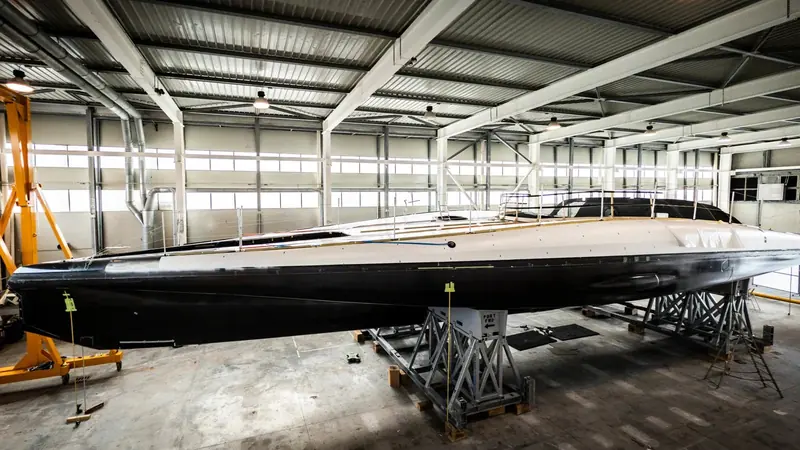
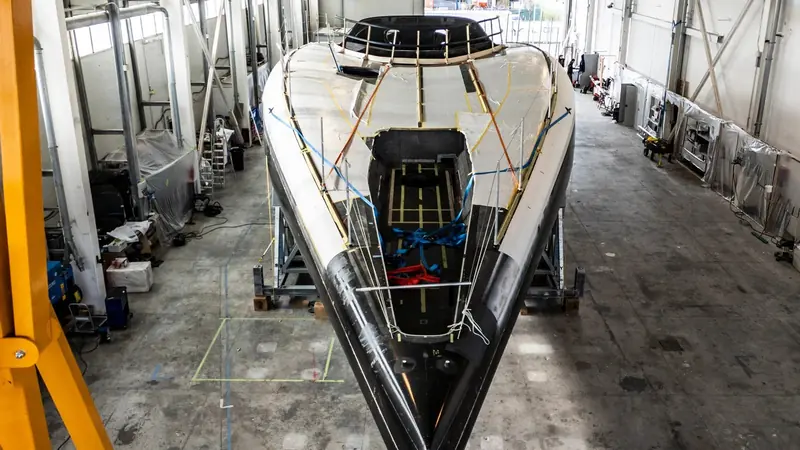
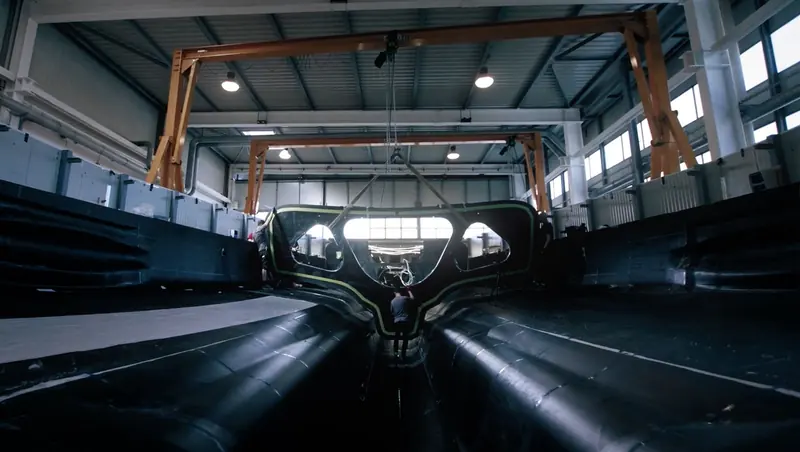
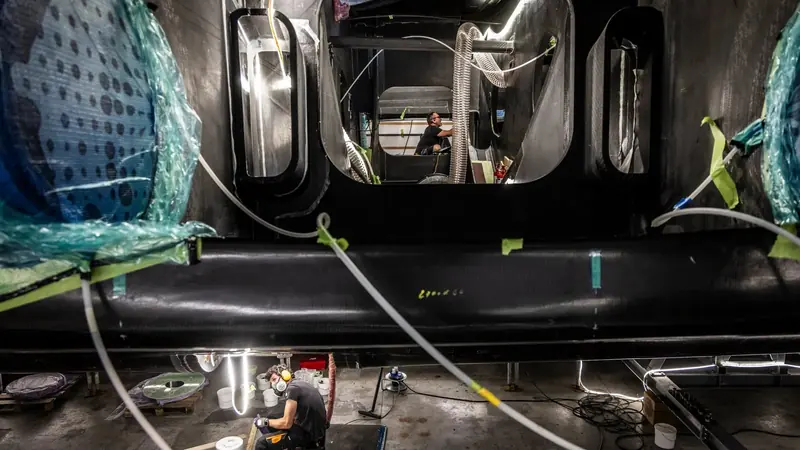
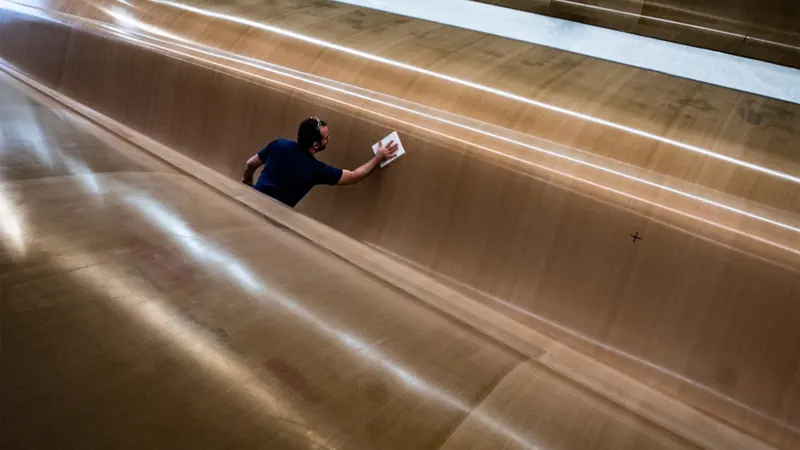
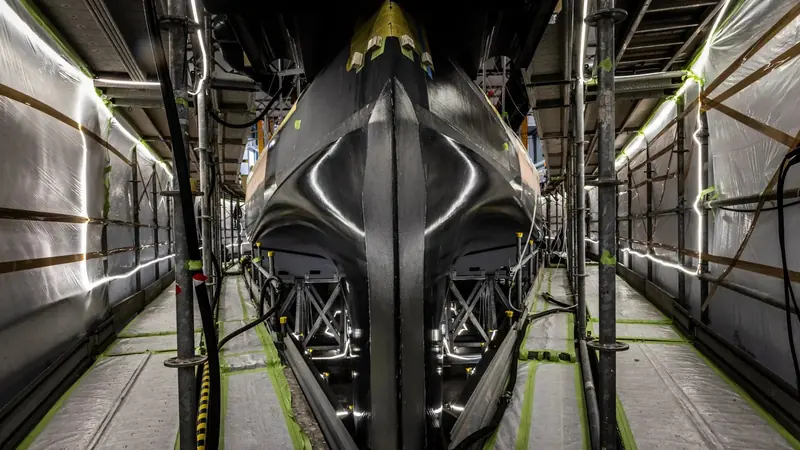
Hypersail is Ferrari's first sailing boat in the marque's 79-year history, and it is not remotely a leisure build. The 30-metre fully foiling monohull is under construction at a composite yard in Pisa, designed by the French naval architect Guillaume Verdier, with Ferrari's own Design Studio, led by Flavio Manzoni, responsible for the styling. The hull came out of its mould in May 2026 after more than a year of curing and lamination, and Ferrari has said the boat is now going through mechanical, hydraulic and electrical installation ahead of a planned late-2026 launch and 2027 sea trials and delivery. There is no combustion engine anywhere aboard: propulsion, hydraulics and every onboard system run on electricity generated from solar, wind and the crew itself.
The stated target is a genuine outlier for a boat this size: the Jules Verne Trophy, awarded for the fastest non-stop crewed circumnavigation under sail, a record that has only ever belonged to giant multihulls. The current holder, the French sailor Thomas Coville and his crew aboard the trimaran Sodebo Ultim 3, set the mark in January 2026 at 40 days, 10 hours and 45 minutes, covering 28,315 nautical miles at an average of 27.17 knots. Ferrari's own performance targets for Hypersail describe take-off on the foils in 10 to 12 knots of wind, sustained averages in the high 30s to 40 knots, a top end near 50 knots, and a goal of covering 1,000 nautical miles in a single day - figures that would be extraordinary for any monohull, let alone one roughly a third the length of the trimarans that currently dominate the record.
The Motors Come Straight Off the Production Line
What makes Hypersail a Ferrari story rather than just another foiler is where its hardware comes from. The foil and keel actuation are driven by an 800-volt rear e-axle lifted directly from the Ferrari Luce, the brand's electric road car, with a separate 48-volt motor driving the flap adjustments. The same e-axle architecture that pushes a Ferrari off a stoplight is here repurposed to trim a foil rake mid-ocean, and Ferrari's technical team - led by Matteo Lanzavecchia and Marco Guglielmo Ribigini - has built the boat's entire power electronics around automotive parts rather than bespoke marine units wearing a Ferrari badge.
Onboard energy comes from two identical 800-volt battery packs, charged by roughly 100 square metres of solar panelling built into the deck and hull sides plus removable wind turbines mounted on the stern for use at anchor or in port. Ferrari has said around 90 percent of the boat's carbon fiber is drawn from the same production lines that build its Scuderia Ferrari Formula 1 chassis. Asked what the project costs, Ferrari's chief financial officer, Antonio Picca Piccon, told investors only that the investment was planned and would not materially affect the group's capital expenditure - the only cost figure Ferrari has offered publicly to date.
Winch-by-Wire: The Crew Becomes a Generator
The most novel single system aboard is what Ferrari calls Winch-by-Wire. Five grinding pedestals on deck have no physical, mechanical connection to any winch. Instead, electric motors - the same units used in the active suspension of Ferrari's Purosangue SUV and F80 hypercar - convert the crew's muscular effort into electricity in real time, which is fed into the boat's onboard grid and distributed to power winches and hydraulic pumps wherever they are needed. Ferrari's figures put a single crew member, grinding at a steady rate of around 100 revolutions per minute, able to move loads of up to nine tonnes - work that would otherwise take several hands on a conventional winch.
That is a meaningfully different idea from what is already sold to owners. Harken's belowdeck captive-reel electric winches already bring what the company calls megayacht-grade remote line handling down to boats as small as 14 to 18 metres, and its push-button Radial range serves cruising sailors directly; Karver's KSW and KPW ranges do the same job at the top of the superyacht sailing market. All of those systems replace muscle power outright, drawing on a battery bank charged conventionally. Winch-by-Wire does the opposite: it treats the crew as a generator, converting effort that would otherwise be wasted heat and fatigue into grid power the instant it is produced - a genuinely regenerative system that, as of today, nobody sells.
A Design Team Mid-Change
The build itself carries Ferrari's usual attention to finish: the hull is painted in a grey the company calls Grigio Hypersail, with a bespoke yellow, Nuovo Giallo Fly, applied by the Italian marine coatings specialist Boero Yacht Coatings along the hull lines, foils and cabin edges to visually exaggerate the boat's speed and proportions even at rest. Verdier's design brief and Manzoni's styling direction have stayed constant through the build, but the sailing programme around the boat has not.
When Ferrari first announced the project in 2025, it named the veteran offshore sailor Giovanni Soldini - who had raced and chased records for Maserati aboard a VO70 and later a MOD70 from 2012 to 2024 - as the sailor leading the campaign. Soldini has since been released from the project, with Enrico Voltolini now named as project leader. Soldini himself was notably non-committal about the boat's eventual purpose even before his departure: asked directly about a round-the-world record attempt, his answer was simply "Maybe... it's something so new that we haven't set any sporting objectives for the moment." Months into construction, Hypersail's actual sporting target remains Ferrari's stated ambition rather than a confirmed campaign.
What This Means for an Owner's Next Build
Hypersail will not be sold. Ferrari has described it explicitly as a one-off, open-innovation prototype rather than the first hull of a production run, and there is no price, no build slot and no order book for a reader to consider. That puts it outside the normal logic of a Yotters story about a boat you could actually buy, charter or specify - but the engineering behind it is not hypothetical, and production superyacht builders and their electrical subcontractors are watching an automotive giant solve, in public, exactly the problems - energy density, regenerative power capture, high-voltage safety at sea - that any owner electrifying a refit will eventually run into.
None of that should be mistaken for proof the boat works yet. Hypersail has not launched, has produced no independent sea-trial data of any kind, and the record class it is aimed at has, without exception, gone to giant trimarans and maxi-multihulls built around far more sail area and righting moment than a 30-metre monohull can carry. Ferrari's own numbers - the 50-knot top end, the 1,000-mile day - are targets set by the builder, not measurements taken at sea. An owner reading this for signal rather than spectacle should treat Hypersail as a genuine, well-funded electrification test bed with an unresolved sporting mission, not as evidence that any of it is ready to be specified on a new build today.
What is good, and what to watch
Strong points
- Genuine tech transfer, not badge engineeringThe e-axle and motors are lifted directly from the Luce, Purosangue and F80 production lines rather than built as bespoke marine units wearing a Ferrari badge, and about 90 percent of the carbon fiber comes off the same lines that build Ferrari's Formula 1 chassis.
- A genuinely regenerative system, not just an electric oneWinch-by-Wire converts crew effort into grid power in real time rather than simply swapping muscle for a battery motor, letting one grinder move up to nine tonnes of load - a system nobody currently sells.
What to watch
- Not for sale, and the sailing programme is mid-changeFerrari has ruled out commercialising Hypersail, and the project lost its originally announced skipper, Giovanni Soldini, during the build, with Enrico Voltolini now leading a programme whose sporting target was still unconfirmed as of this writing.
- No cost, no sea trial, and a mismatched record classBuild cost is undisclosed beyond a CFO's reassurance to investors, the boat has not yet sailed, and the Jules Verne Trophy it is aimed at has only ever fallen to giant multihulls with far more sail area and righting moment than a 30-metre monohull carries.
Practical detail
| Builder and designer | Ferrari Style Centre (Flavio Manzoni) with naval architect Guillaume Verdier; built at a composite yard in Pisa, Italy |
|---|---|
| Size and construction | 30 metres (98ft), fully foiling monohull, carbon fiber hull, foils and rig; hull demoulded May 2026 |
| Timeline | Launch targeted late 2026; sea trials and delivery in 2027 |
| Power | Two 800V battery packs, an 800V rear e-axle from the Ferrari Luce, a 48V flap motor, about 100 square metres of integrated solar, removable stern wind turbines; no fossil fuel aboard |
| Cost | Not published. Ferrari CFO Antonio Picca Piccon has said only that the investment is planned and will not materially affect group capital expenditure |
| Commercial availability | Not for sale. Ferrari describes Hypersail as a one-off, open-innovation prototype, not a production model |
| What is not published | A firm race calendar or record attempt, the total build cost, and any independent sea-trial data - none exist yet |
Questions this story answers
What happened?
Ferrari has built its first sailing yacht, and it carries no engine, no price tag and no buyer - only a 30-metre carbon foiler powered by the same electric motors as its road cars, aimed at the fastest crewed lap of the planet. For an owner weighing a hybrid or electric refit, Hypersail is the clearest public look yet at where marine electrification is actually headed, and at what a single crew member can now do without touching a winch handle.
What is good about it?
Genuine tech transfer, not badge engineering. The e-axle and motors are lifted directly from the Luce, Purosangue and F80 production lines rather than built as bespoke marine units wearing a Ferrari badge, and about 90 percent of the carbon fiber comes off the same lines that build Ferrari's Formula 1 chassis.
What should an owner or buyer watch?
Not for sale, and the sailing programme is mid-change. Ferrari has ruled out commercialising Hypersail, and the project lost its originally announced skipper, Giovanni Soldini, during the build, with Enrico Voltolini now leading a programme whose sporting target was still unconfirmed as of this writing.
Who reported this?
Boat International, Yachting World, Robb Report, ReadMotorsport.
We do this for everyone who loves this world. The people who have spent their lives in it, and the people just discovering it. Yotters exists so that what we learn belongs to all of them.
Nobody pays us for this. No ads, no sponsors, nothing for sale. We just believe the world is a little better when knowledge is shared instead of kept.
If it gave you something today, tell us to keep going. Follow us, leave a like, or write a positive comment. We read every one, and they are what keeps us going.