Zero's Sea Trials Show a Four-Hour Sail Banks Two Days of Power
How does a 69-metre sailing yacht replace its generators?
Sailing Yacht Zero makes its own power by sailing: two azimuthing hydrogeneration pods, built into the same units used for propulsion, convert the yacht's forward motion into electricity, and Foundation Zero's own trial data puts a four-hour sail at roughly 1 MWh, enough to run the yacht's hotel loads at anchor for two full days.
The pods carry variable-pitch propellers that adjust blade angle and position to optimise how much kinetic energy they pull from the water as the yacht sails, rated at up to 250kW. Dockside testing through August checked the propulsion control system that manages propulsion, manoeuvring and regeneration together, before the team moved to open-water testing in early September. Foundation Zero has said plainly that computer simulations of the pods met different conditions once real wind speed and wave motion were involved, and that the control system has to continuously adapt blade positioning to hit its energy targets rather than follow a fixed model. The pods can also be feathered to reduce drag when the yacht is under power alone, and the propulsion control system that ties them to the batteries is the same one that will eventually manage docking and close-quarters manoeuvring, so getting it right at the dockside stage before ever putting it in open water was treated as the higher priority of the two test phases.
Because the yacht depends on sailing itself for power, the trials have also reshaped how the crew works. A dedicated onboard "mission room" lets crew monitor energy systems, read weather and plan each day's sailing around power generation rather than treat it as incidental to the passage. A custom sea-fastening system, with hidden magnets and spring-loaded clips for securing interior fittings, lets Zero get underway quickly rather than lose hours to conventional stowing - because on this yacht, a missed sailing window is a missed charging window. Foundation Zero has been candid that this makes Zero a genuinely different yacht to operate than a conventional motor yacht, where fuel is simply loaded before departure and the question of when to run the generators barely enters a captain's planning. On Zero, the sailing plan and the power plan are the same document.
What happens to the heat a diesel-generator yacht just dumps into the sea?
A conventional yacht pumps seawater through its cooling systems and discards the heat it picks up; Zero instead captures that heat, along with the thermal output of its photovoltaic-thermal panels, and routes it through a 2,000-point network into air conditioning, general cooling and water heating.
The panels are photovoltaic-thermal, meaning they harvest both electricity and heat from the same sunlight rather than treating heat as a byproduct to shed, and Vripack and Foundation Zero have described the combined electrical and thermal capture efficiency at around 60 percent. Commissioning the network behind this has been the slower, less visible half of the trials: the system runs to roughly 2,000 inputs and outputs across precision sensors, pumps and control valves, and each one had to be checked individually before open-water testing of the full loop could begin. The absorption chiller feeding off this recovered heat, rated at 17kW, was one of the first pieces of the network to be commissioned, because it depends on a steady thermal supply from systems that themselves were still being tuned.
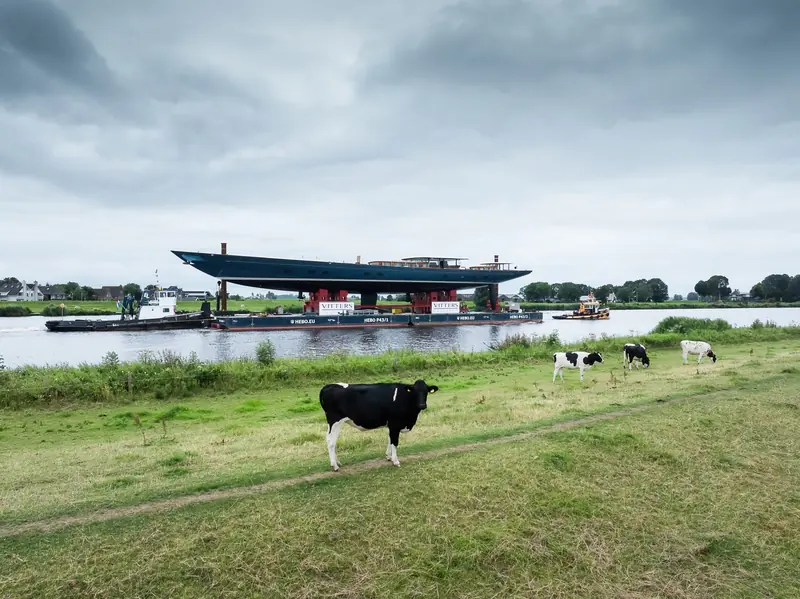
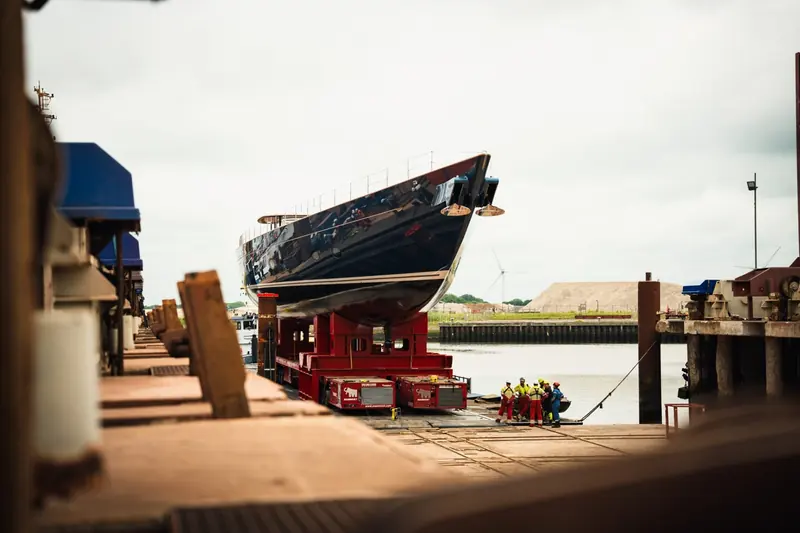
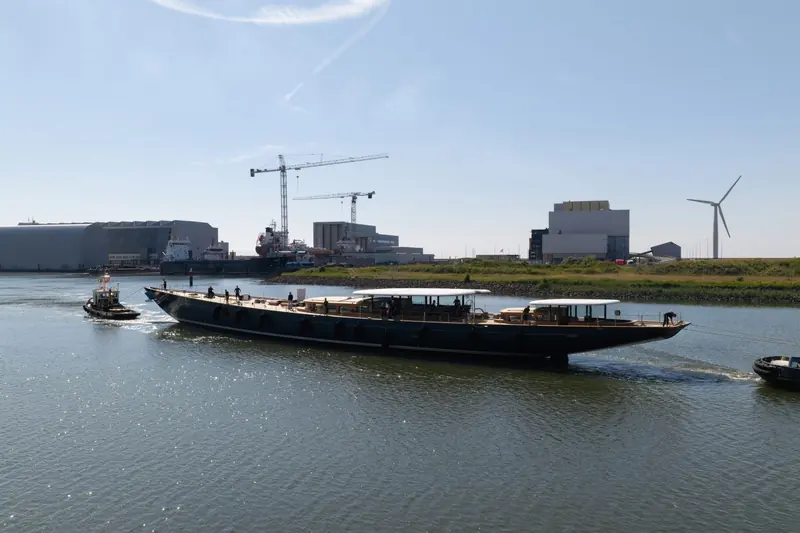
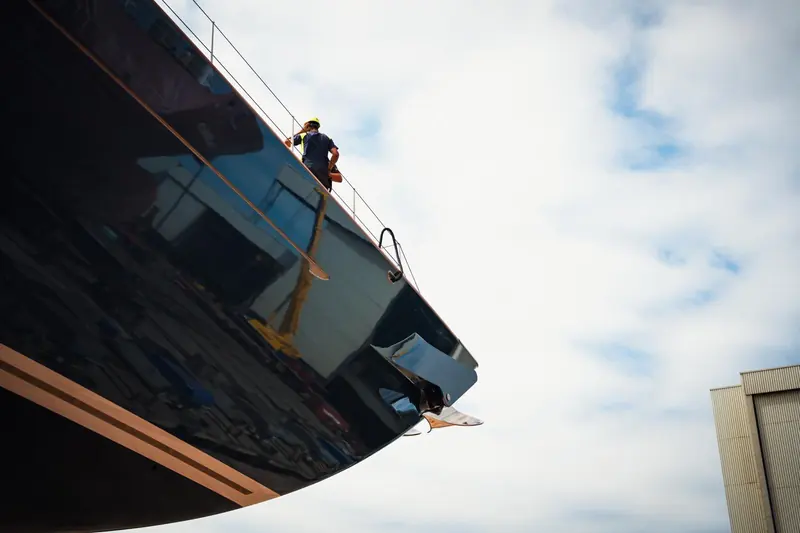
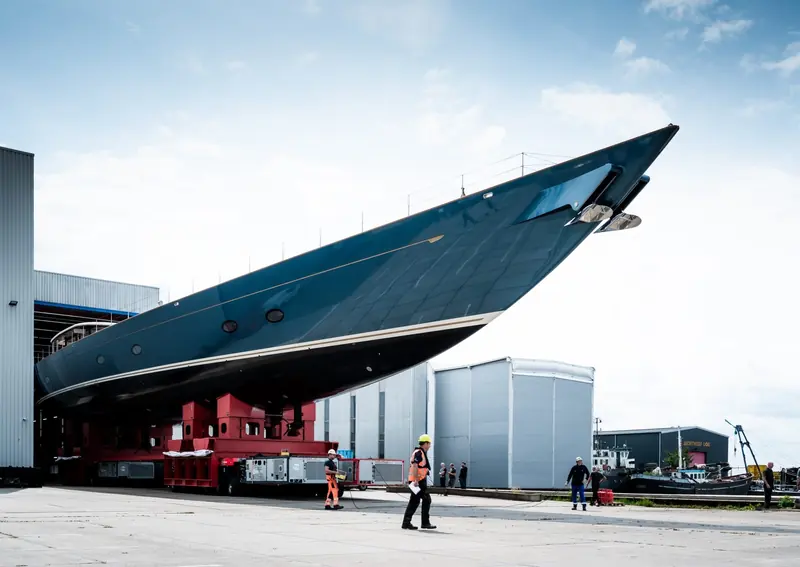
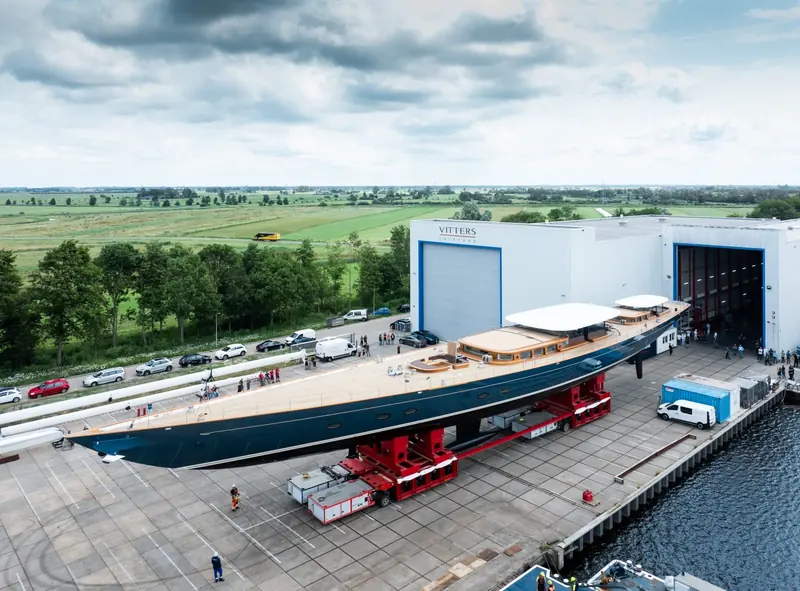
Foundation Zero has framed the results so far as good enough to suggest the approach could set a new maritime standard for thermal management rather than remain a one-off. That claim is easier to credit given who built the system: Vitters Shipyard constructed the yacht, with the hull built at Jacht- en Scheepswerf Gouwerok, and Vripack led exterior and interior design while Dykstra Naval Architects handled the naval architecture, sailplan and the hydrogeneration pods - three established names in serious sailing-yacht construction, not a single unproven startup. It also helps that Zero was never a rushed project: Vitters took on a build that ran seven years from contract to launch, longer than any other yacht currently in the yard's shed, and the hull that emerged in July carries a metallic dark-blue finish and a reverse stem drawn from J-Class racing lines rather than a stock explorer profile. A yard willing to commit that much time to one hull is also, implicitly, one willing to let the engineering take as long as it needs.
How do you meet strict air-quality rules without the power budget for standard air conditioning?
Maritime Labour Convention rules require indoor carbon dioxide levels to stay within 400 to 1,000 parts per million, which the industry standardly meets with six full air changes per cabin every hour; Zero's team instead built dynamic, room-by-room CO2 monitoring that ventilates only as much as actual occupancy demands.
Six air changes an hour, repeated in every room regardless of whether anyone is in it, means constantly pulling in warm outside air and cooling it from scratch - a large, continuous power draw on a yacht that has no generator to absorb it. Zero's engineers treated that as one more system to redesign rather than a fixed cost of compliance, in keeping with the project's wider approach: nothing about how a normal yacht handles power gets assumed as a given. Six air changes an hour is not an arbitrary number picked by regulators to be difficult; it is the simplest way to guarantee compliance across every cabin configuration without measuring anything, which is exactly why almost no yacht builder has bothered to do better. Treating it as a floor to engineer around, rather than a number to simply hit, is where Zero's approach diverges from standard practice.
The system measures CO2 levels room by room and adjusts airflow to match, so a cabin with nobody in it is not ventilated as if it were full of guests. Foundation Zero published the result on 2 September, the most recent entry in its sea trials series, and framed it as proof that meeting a fixed regulatory floor and minimising energy use are not actually in conflict - the industry has just defaulted to the expensive way of doing both at once. The obvious question a dynamic system invites is what happens when a cabin goes from empty to occupied quickly - a guest returning from a tender ride, say. Foundation Zero has not yet published data on response time between a jump in occupancy and the system reaching compliant CO2 levels, which is the kind of detail a class society or a fit-out contractor evaluating the approach for another yacht would want before specifying it themselves.
Does any of this help someone deciding whether to commission a zero-emission superyacht?
Zero is a foundation-funded demonstrator, not a production model or a private owner's commission, so its numbers are real but its build cost, its reliability across a full season and its resale value all remain unpublished and untested by any actual buyer.
Foundation Zero is a nonprofit, and the project is explicitly open-source: the data from these trials is being published to help the wider industry build on it, not held back as one yard's competitive advantage. That is unusual in a business where builders normally treat performance data as proprietary, and it means an owner's naval architect can, in principle, check these numbers rather than take a sales brochure's word for them. That openness extends to the failures as much as the successes: Foundation Zero's public log format, dated and numbered through the sea trials series, includes the moments where simulation and reality diverged rather than only the ones where the system performed as planned, which is not the normal tone of a builder's own marketing material.
What it does not yet answer is what any of this costs, in money or in risk. Neither Vitters nor Foundation Zero has released a build price, a projected maintenance bill for a 2,000-sensor thermal network and a hydrogeneration control system, or any data on how the systems hold up over a full season of guest use rather than a summer of trials. No class society or third-party surveyor has published a verification of the figures, and because Zero has no private owner, none of this has yet been tested against an actual owner's warranty claim, charter schedule or resale expectations. The honest trade for now is real, measured efficiency against a genuinely unproven track record. A prospective owner's naval architect would still need answers Foundation Zero has not been set up to give: how the 2,000-sensor network is serviced in a yard without Vitters' own commissioning team on hand, what a warranty on a hydrogeneration pod actually covers, and whether insurers price a boat with no generator differently. None of that makes the trial data less real. It just means the data answers an engineering question, not yet a buying one.
What is good, and what to watch
Strong points
- The numbers are measured, not modelledFoundation Zero's own account of the trials says computer simulations of the hydrogeneration pods met different conditions once real wind and wave loads hit them; the 1 MWh-per-four-hours figure and the 250kW pod rating come from dockside and open-water testing, not a spreadsheet.
- It solves the harder problem, not just the obvious oneRouting waste heat from propulsion and hydrogeneration into HVAC and water heating through a 2,000-point thermal network, rather than just adding solar panels, is the unglamorous engineering that decides whether a zero-emission yacht is livable, not just theoretically possible.
- A recognised yard built it, not a startupVitters, Vripack and Dykstra Naval Architects are established names in serious sailing-yacht construction, which lends the trial data more weight than a one-off prototype from an unknown builder would carry.
What to watch
- No independent verification exists yetEvery figure published so far comes from Foundation Zero's own account of its own project; no class society, charter guest or third-party sea-trial report has been published to check it against.
- Cost and long-term reliability are both unpublishedNeither Vitters nor Foundation Zero has released a build cost, a maintenance burden, or how the 2,000-sensor thermal network and dynamic CO2 system perform over a full season rather than a single summer of trials.
- It has no ownerZero is a foundation-funded demonstrator built to publish open-source data, not a yacht commissioned and paid for by a private owner, so it answers what is technically possible, not what a real owner's build, warranty and running-cost experience would look like.
Practical detail
| Builder / hull | Vitters Shipyard, Zwartsluis, Netherlands (hull built at Jacht- en Scheepswerf Gouwerok) |
|---|---|
| Designers | Vripack (exterior and interior), Dykstra Naval Architects (naval architecture, sailplan, hydrogeneration pods) |
| Length / rig | 68.9m ketch |
| Launched | 10 July 2026, Harlingen, Netherlands |
| Battery storage | 5 MWh |
| Hydrogeneration | up to 250kW via two azimuthing pods |
| Power from sailing | about 1 MWh per four-hour sail, roughly two days of hotel load at anchor |
| Solar/thermal capture | PVT panels, about 60pc combined electrical and thermal efficiency |
| Thermal network scale | about 2,000 sensors, pumps and control valves |
| Latest published trial (2 September 2026) | dynamic, room-by-room CO2 monitoring replacing fixed six-air-changes-an-hour ventilation |
| What is not published | build cost, projected maintenance burden, full-season reliability data, any class-society or third-party verification, and any named private owner |
Questions this story answers
What happened?
Sea trials through the summer have produced the first hard, measured numbers for Sailing Yacht Zero, the 69-metre ketch built to run without a generator or a drop of diesel: a four-hour sail banks roughly 1 MWh, enough to cover hotel loads at anchor for two full days, and a 2,000-point network now recycles heat a normal yacht would simply dump overboard. For any owner weighing an all-electric or hybrid build, these are the first real figures rather than simulations, and they show what the trade actually costs in complexity, unproven reliability and an unpublished bill.
What is good about it?
The numbers are measured, not modelled. Foundation Zero's own account of the trials says computer simulations of the hydrogeneration pods met different conditions once real wind and wave loads hit them; the 1 MWh-per-four-hours figure and the 250kW pod rating come from dockside and open-water testing, not a spreadsheet.
What should an owner or buyer watch?
No independent verification exists yet. Every figure published so far comes from Foundation Zero's own account of its own project; no class society, charter guest or third-party sea-trial report has been published to check it against.
Who reported this?
Foundation Zero, SuperyachtNews, Marine Industry News.
We do this for everyone who loves this world. The people who have spent their lives in it, and the people just discovering it. Yotters exists so that what we learn belongs to all of them.
Nobody pays us for this. No ads, no sponsors, nothing for sale. We just believe the world is a little better when knowledge is shared instead of kept.
If it gave you something today, tell us to keep going. Follow us, leave a like, or write a positive comment. We read every one, and they are what keeps us going.