Vitters Launches Zero, a 69m Sailing Yacht With No Engine
Zero Rolls Out With Nothing to Burn
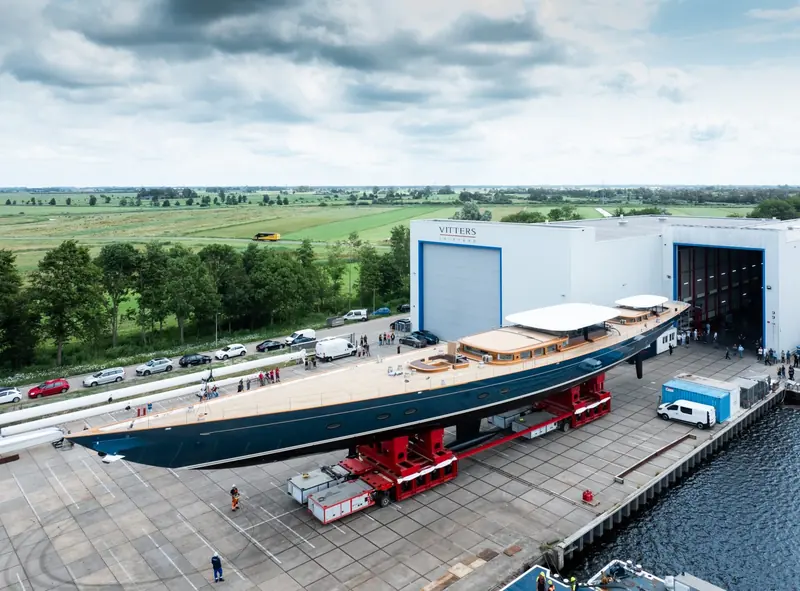
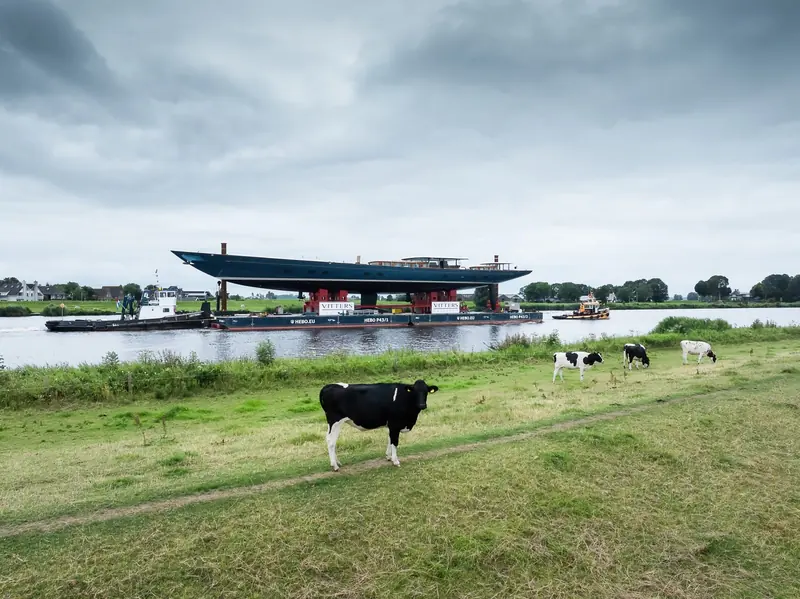
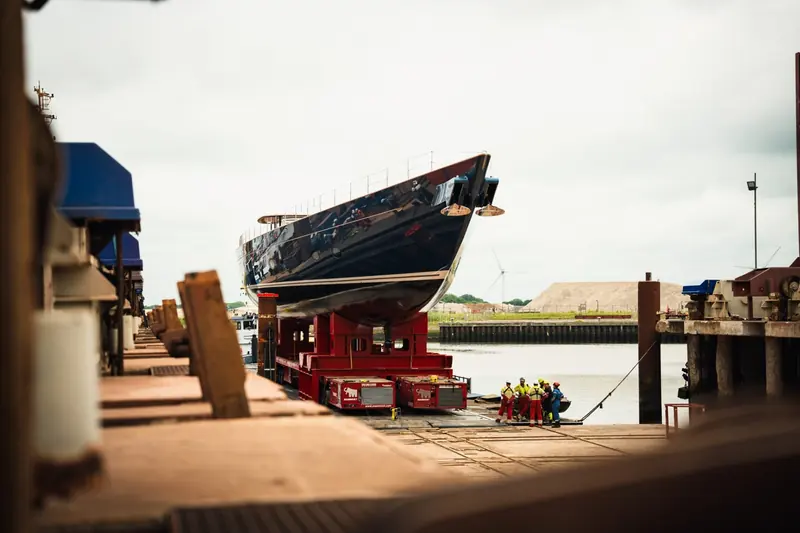
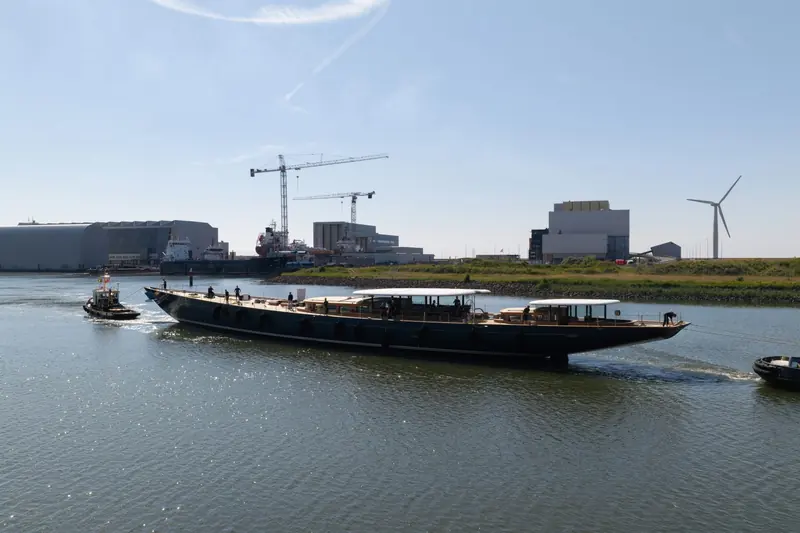
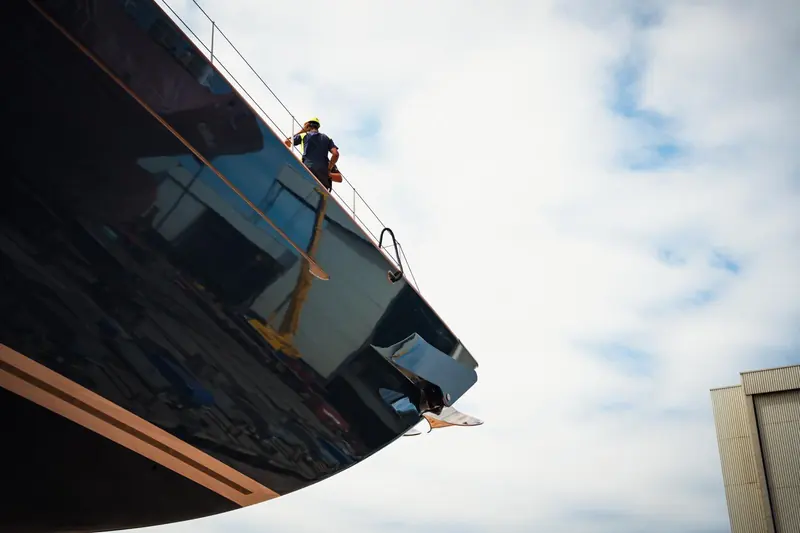
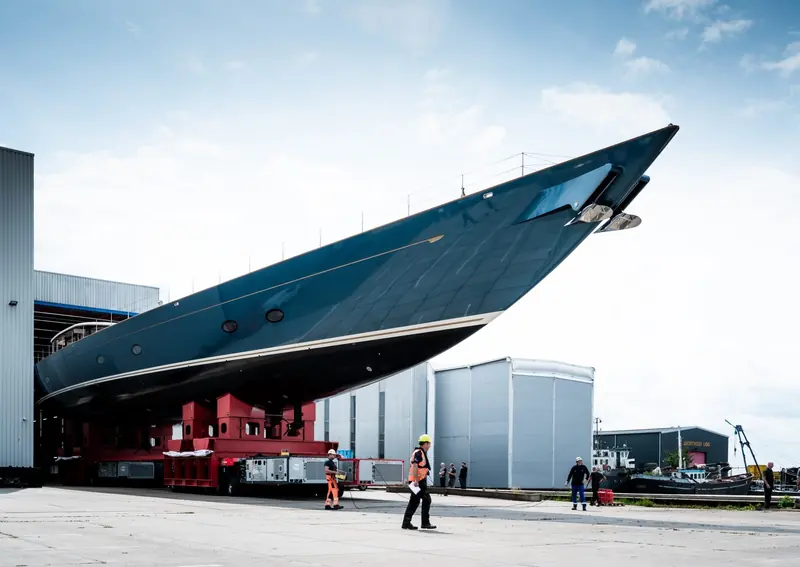
Vitters Shipyard floated Zero at Harlingen in the Netherlands on 10 July 2026, after rolling the hull out of its Zwartsluis construction hall earlier that week on a self-propelled modular transporter. She measures 68.9 metres with an 11.11-metre beam and displaces 456 tonnes at 494 GT, carried on a lifting keel that draws between 4.22 and 8.4 metres. There is no diesel engine for propulsion, no generator for hotel loads, and no fuel of any kind stored on board. Bas Peute, Vitters' sales and marketing manager, put it plainly to the trade press covering the tow-out: no generator, no fuel.
That single fact reorders everything else about the boat. A conventional 69-metre sailing yacht carries diesel tankage as a matter of course, both for the engine that gets her out of a marina on a windless morning and for the generator that runs air-conditioning at anchor. Zero has neither, so the entire design brief - hull shape, sail plan, energy systems, even the layout of the deck furniture - had to be built around generating and storing enough power to do both jobs without them.
How She Makes Her Own Power
Propulsion assistance and battery charging both come from two azimuthing hydrogeneration pods with a combined 2.9 square metres of disk area, rated up to 250 kW when the boat is sailing fast enough to spin them. A 700-volt DC grid distributes that power to a battery bank of a little over five megawatt-hours, weighing around 28 tonnes - roughly the weight of two loaded articulated trucks, permanently on board in place of fuel. Solar contributes through 100 square metres of hybrid photovoltaic-thermal panels laid across the biminis, which generate electricity and also capture heat at 80 to 85 degrees Celsius, fed into a 17 kW absorption chiller that does the work a diesel-run air-conditioning compressor would otherwise do.
Cooling belowdecks is handled partly without machinery at all: the 62.5-metre masts are built as 'breathing masts', with internal ventilation channels that draw air through the yacht rather than relying solely on powered air-conditioning. Vitters says the combined systems let Zero cruise in comfort for up to two weeks on harvested renewable energy alone before she would need open water and usable wind or sun to recharge. Nobody outside the yard has yet tested that figure at sea; sea trials, delayed until her masts were stepped, were only getting underway as this was written.
Seven Years, One Impossible Brief
The concept dates to 2019, when Vripack and Dykstra Naval Architects agreed to try to build a superyacht that generated more energy than it consumed rather than simply consuming less of it. Marnix Hoekstra, Vripack's co-creative director, has called Zero the studio's 'Perfect Storm': a boat where, in his words, 'it all began with the technology, but we knew she also had to be beautiful.' The owners, who remain unnamed, reportedly insisted on classically handsome, uncluttered lines that hide the technology rather than showcase it, which Vitters has said complicated the build - the hull was refined for pure sailing performance too, with input from an Emirates Team New Zealand America's Cup design team whose CFD testing produced a hull curvature the yard says delivers a 2.5 percent gain in boat speed and an 8 percent increase in electric power generation over the earlier hull form.
Bart Bouwhuis, Vripack's other co-creative director, has been candid about how the project was received elsewhere in the industry before Vitters agreed to build it: most naval architects and yards said no, on the view that the technology was not ready and the compromises would be too great. 'It wasn't just seen as unrealistic,' he has said, 'it was largely dismissed outright, without serious investigation.' Even inside the winning design, there were real tradeoffs to accept: Dykstra naval architect Mark Leslie-Miller has said the forward hydrogeneration propeller was tuned for low drag rather than maximum output, costing Zero about one knot of boat speed under sail whenever it is turning, in exchange for a propeller that does not meaningfully slow her down the rest of the time.
The Bet Without a Backup
Most yachts marketed as hybrid or low-emission still carry a generator or a combustion engine as an insurance policy against a becalmed passage or an overcast week at anchor. Zero has deliberately given that insurance up. In place of it, Dykstra's team analysed thirty years of historical wind data on the routes Zero is expected to sail and built her sailing plan and rig around keeping the batteries charged on likely weather rather than around a mechanical fallback. Naval architect Mark Leslie-Miller has framed the resulting seamanship as a genuine constraint, not a marketing line: on a yacht with a diesel engine, a crew that meets bad weather can lower the sails and motor through it, and Zero's crew cannot.
The same all-or-nothing brief made the build itself unusually hard to plan. Bas Peute has acknowledged that Vitters started construction without the finalised specification a yard normally insists on: the battery chemistry, by his account, was still undecided well into the build, and each innovation that got resolved along the way pushed the schedule rather than shortening it, which is why Zero carried no firm delivery date for most of her seven years in build. An owner weighing a similarly ambitious one-off elsewhere in the fleet should read that as the real cost of being first: not a published premium over a conventional yacht, because none exists, but an open-ended build clock while the yard solves problems nobody has solved before.
What the Rest of the Fleet Gets From This
Unusually for a private one-off, Zero's underlying research is not staying private. Vitters, Vripack and Dykstra publish the technical solutions, sea-trial data, software code and design schematics behind the boat through Foundation0, a nonprofit platform at foundationzero.org that frames the project as one entry in a wider push to prove renewable energy at sea, on land and in cities. That is a deliberate choice by the owners to let a single very expensive experiment inform yards and owners who will never come near a boat this size, and it is the strongest reason to watch what the coming sea trials actually report, good or bad.
For now the record is a launch, not a verdict. Zero has floated, and the systems that matter - the hydrogeneration pods, the battery bank, the breathing masts, the two-week autonomy claim - have not yet been tested on an ocean passage by anyone outside the companies that built them. Vitters has four other superyachts under construction alongside her, none attempting anything like this brief, which is itself a fair measure of how singular Zero is inside its own yard, let alone the wider fleet.
What owners and crew report
No independent report exists yet - she has only just floated
Zero left the construction hall in early July 2026 and was waterborne on 10 July. Sea trials, which will be the first test of the hydrogeneration, battery and two-week autonomy figures away from the yard's own numbers, were only beginning as this was written. There is no owner interview, no independent sea trial and no crew or charter feedback in circulation, so every performance figure on this page traces back to Vitters, Vripack or Dykstra. We will add real reports here once she has actually been sailed and someone outside the build team has published on it.
Yotters desk, checked 13 August 2026The owners drove the one requirement that made the build harder
Vitters and Vripack have both said the unnamed owners insisted on classic, uncluttered lines that conceal rather than display the technology aboard, a condition the yard has said complicated construction. It is the only documented preference from the people actually paying for the boat, and it points to buyers who wanted the engineering to be real rather than decorative.
YACHT (yacht.de), reporting Vitters
What is good, and what to watch
Strong points
- Genuinely fuel-free at 69 metresNo other yacht this size has launched with no combustion engine, no generator and no fuel tank of any kind - this is a real engineering claim, not a hybrid label.
- The naval architecture is independently testedCFD work with an America's Cup design team produced a measured 2.5 percent speed gain and 8 percent more power generation, not just a marketing claim about the hull.
- The research is being given awayPublishing the systems, data and code free through Foundation0 means this one very expensive boat can improve efficiency across yachts that will never approach her size or budget.
- The performance cost of the hydrogeneration gear is small and disclosedAbout one knot of boat speed lost to the forward propeller, a specific, named tradeoff rather than a vague efficiency promise.
What to watch
- There is no mechanical backup at allNo engine and no generator means a genuinely becalmed, sunless stretch has no fallback beyond the batteries already on board and route planning built on historical wind data.
- The build had no firm delivery date for most of seven yearsBattery chemistry was reportedly still undecided well into construction, and each unresolved innovation added time rather than being designed out early.
- Price, ownership and even her own accommodation count are undisclosedNo published price exists to weigh against a conventional 69-metre ketch, and trade reports cannot even agree on whether she sleeps eight or ten guests.
- Nothing aboard has been proven at sea by anyone outside the build teamThe two-week autonomy figure, the 250 kW hydrogeneration rating and the breathing-mast cooling are all the yard's own numbers until independent sea trials say otherwise.
Practical detail
| Dimensions | 68.9 m LOA, 11.11 m beam, lifting keel drawing 4.22 to 8.4 m. Displacement 456 tonnes at 494 GT. Ketch rig, 62.5 m air draught (Panamax-compliant), 1,912 sq m of sail close-hauled. |
|---|---|
| Energy system | 250 kW hydrogeneration from twin azimuthing pods, a battery bank of just over 5 MWh (about 28 tonnes), 100 sq m of hybrid photovoltaic-thermal panels, a 700-volt DC grid and a 17 kW absorption chiller run off recovered solar heat. 'Breathing masts' ventilate the interior without relying solely on powered air-conditioning. |
| Autonomy | Up to two weeks of cruising on harvested renewable energy alone, by the yard's own figures. No combustion engine, generator or fuel tank is fitted as a backup. |
| Who built her | Vitters Shipyard (Zwartsluis and Harlingen, Netherlands), hull constructed by subcontractor Jacht- en Scheepswerf Gouwerok before outfitting at Vitters. Naval architecture by Dykstra Naval Architects with hull-performance input from an Emirates Team New Zealand America's Cup design team. Exterior and interior by Vripack. |
| Timeline | Concept work began in 2019. Seven years to launch: floated at Harlingen 10 July 2026. Sea trials began only after her masts were stepped, later in July. |
| Open data | All technical solutions, sea-trial data, software code and design schematics are published free through the nonprofit platform Foundation0 at foundationzero.org. |
| What is not published | Price, and the owners' identity. Guest cabin count is reported inconsistently across the trade press - some accounts say four themed cabins, others five staterooms for ten guests - and Vitters has not issued a single definitive deck plan or guest and crew count. |
Questions this story answers
What happened?
Vitters floated Zero at Harlingen on 10 July 2026: a 68.9-metre ketch with no combustion engine, no generator and no fuel tank of any kind aboard, built to cruise for up to two weeks on nothing but wind, sun and her own hydrogeneration. For an owner weighing what a pioneering, unrepeatable build actually costs against what it buys, this is the clearest current test case - seven years, one brief nobody else would take, and no independent report yet on whether it works underway.
What is good about it?
Genuinely fuel-free at 69 metres. No other yacht this size has launched with no combustion engine, no generator and no fuel tank of any kind - this is a real engineering claim, not a hybrid label.
What should an owner or buyer watch?
There is no mechanical backup at all. No engine and no generator means a genuinely becalmed, sunless stretch has no fallback beyond the batteries already on board and route planning built on historical wind data.
What do owners and crew report?
Zero left the construction hall in early July 2026 and was waterborne on 10 July. Sea trials, which will be the first test of the hydrogeneration, battery and two-week autonomy figures away from the yard's own numbers, were only beginning as this was written. There is no owner interview, no independent sea trial and no crew or charter feedback in circulation, so every performance figure on this page traces back to Vitters, Vripack or Dykstra. We will add real reports here once she has actually been sailed and someone outside the build team has published on it. (Yotters desk, checked 13 August 2026)
Who reported this?
SuperyachtNews, BOAT International, Vripack, Vitters Shipyard, Robb Report, YACHT (yacht.de), Foundation0 (foundationzero.org).
We do this for everyone who loves this world. The people who have spent their lives in it, and the people just discovering it. Yotters exists so that what we learn belongs to all of them.
Nobody pays us for this. No ads, no sponsors, nothing for sale. We just believe the world is a little better when knowledge is shared instead of kept.
If it gave you something today, tell us to keep going. Follow us, leave a like, or write a positive comment. We read every one, and they are what keeps us going.