Flyde's drone delivers to Riviera yachts for $57 in 15 minutes
The tender run gets a drone instead
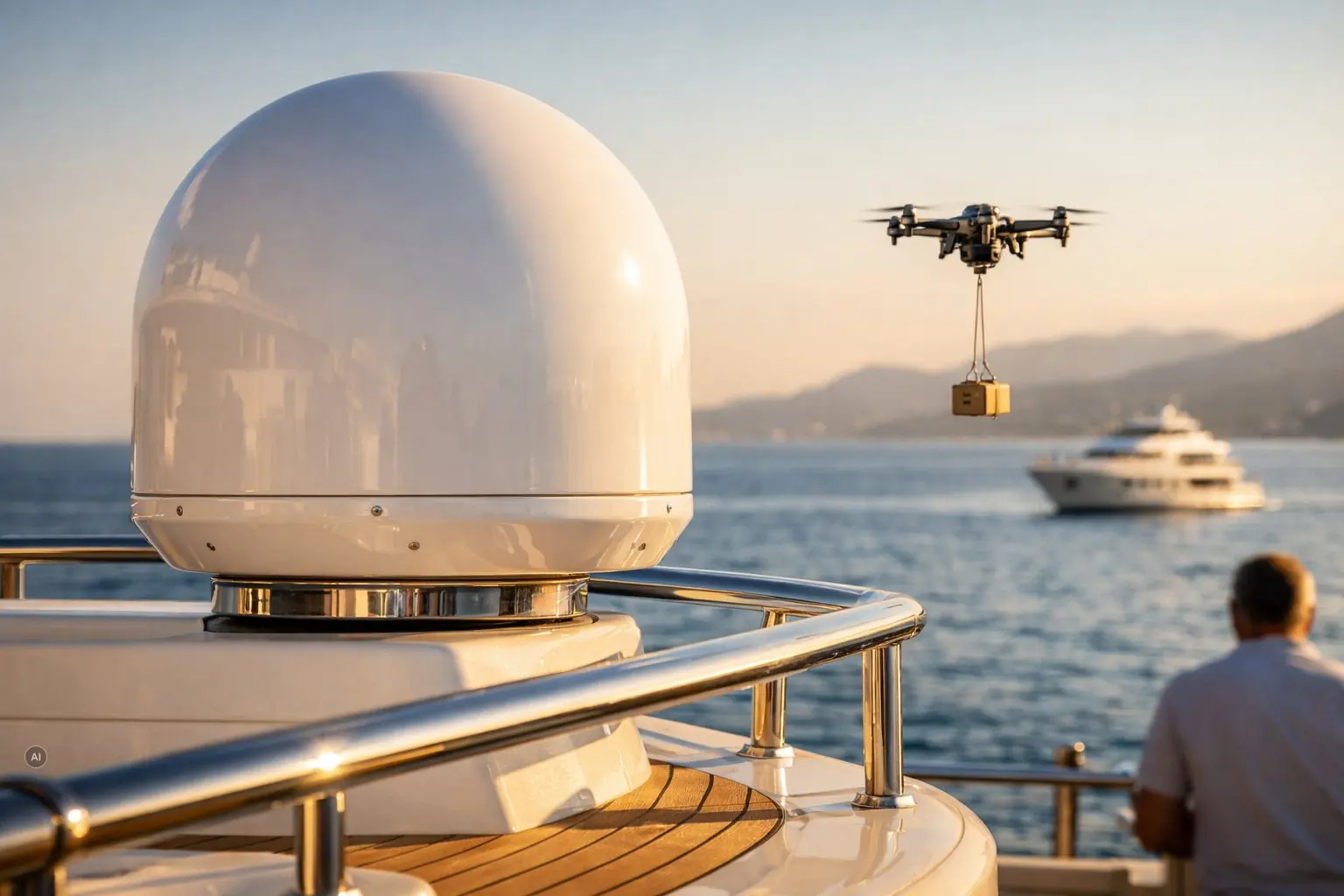
Flyde began commercial flights on 1 August 2026 from Port Gallice in Antibes, carrying parcels out to yachts anchored off Juan-les-Pins and, as the base expands, toward the Lerins Islands and Cannes. The aircraft is a custom electric fixed-wing called the Beluga, built with French aerospace firm CAVOK Engineering after several years of testing other platforms. It does not land on deck. Instead it holds position above the yacht and a motorised winch lowers the package on a line, so there is no need to clear railings, tenders or crew from a landing spot and no rotor working anywhere near passengers.
A local pilot handles the low-altitude departure from the harbour before the flight is taken over by remote operators based in Lyon, flying a corridor pre-cleared with French aviation and maritime authorities. Deliveries take under 15 minutes and the aircraft cruises at roughly 60 km/h (37 mph), covering a radius of about 10 kilometres (6.2 miles) offshore. The initial schedule runs Thursday to Saturday, the busiest anchor days of a Riviera week, with the company planning to add days through the summer as it beds the route in. The model is closer to a courier than a chandler: Flyde does not stock or sell provisions itself, it moves a parcel someone else has already bought or packed, so an owner or chief stew still does the ordering and Flyde only replaces the boat trip to collect it.
Three years to get a drone over open water legally
Flyde was founded in 2022 and has raised only EUR 300,000 from business angels, financing three years of testing and demonstration flights rather than a single big funding round. That patience went on the paperwork: the company holds authorisation from the DSAC, France's civil aviation safety authority, and separate sign-off from the maritime prefecture to fly a delivery corridor over open water and hand a parcel to a private vessel at anchor - a combination Deyris has called the hardest part of the whole project, harder than building the aircraft itself. Trial flights ran first from the breakwater at Port Hercule in Monaco before the company judged the route safe enough to sell as a commercial service from Antibes.
The team is six people. That is a genuinely small operation to be running licensed autonomous flights over a crowded summer anchorage, and it is worth an owner or a captain checking the operational limits directly with Flyde before assuming a delivery slot is always available - neither Flyde nor the trade press covering the launch has published a stated wind or sea-state ceiling for flights, which a mistral day on the Riviera makes a live question rather than a formality. The EUR 300,000 raised is angel money, not venture capital, and it shows in the rollout: one base, three days a week, rather than a simultaneous launch across the whole coast. That sequencing reads as prudent for a business whose entire product depends on a regulator's continued comfort with autonomous flight over paying passengers' heads, and it leaves Flyde with little room to absorb a bad early incident before it has proven the model anywhere else.
What it carries, and what it costs
A flight carries up to 8 kilograms (about 18 pounds) - Le Journal des Entreprises, reporting locally, puts Flyde's own stated ceiling at 10 kilograms - and the fare has come down from an early advertised price above $450 per trip to about $57, with Le Journal quoting a EUR 40 to EUR 100 range depending on distance and weight. Set against chartering a launch or pulling a crew member off other duties to run a tender across a anchorage, Flyde is pitching itself as materially cheaper for a single forgotten item, not as a replacement for a full provisioning run.
Bookings go through a mobile app: a captain, chief stew or owner schedules a slot, a logistics partner drops the parcel at a port hub where it is scanned and loaded, and the customer gets live tracking through the flight. Deliveries so far reported in the press include phone chargers, medicine, groceries, spare parts and luxury provisions such as caviar - the everyday-forgotten-item category a boat at anchor cannot easily solve itself, rather than a full owner's shop.
From one base to twenty
Flyde's stated target is 20 delivery zones by the end of 2027, expanding from Antibes to Cannes, Monaco and Saint-Tropez-Ramatuelle on the Riviera before moving to Sardinia, Capri, Corsica, the Balearic Islands and the Greek islands - all markets with the same summer anchorage crowding that makes a 15-minute drone trip attractive against a tender queue. The company has set itself revenue targets of EUR 80,000 for 2026 and EUR 500,000 for 2027, modest figures that read as a company still proving the model rather than one already scaled to fleet demand. It is also exploring medical-sample transport and delivery to mountain villages, applications that would use the same regulatory approval outside the yachting season.
None of that expansion is live yet. Today the service covers a single base, a three-day week and one stretch of water between Antibes and the Lerins Islands - useful to know before an owner mentions it to a captain expecting Monaco or Saint-Tropez coverage this season. The Cool Down, covering the launch from an environmental angle, noted the drone itself cuts fuel burn against a petrol tender run while the yachts it serves remain, in the outlet's words, generators of significant pollution in their own right - a fair point for an owner weighing the service as a sustainability line rather than simply a convenience.
What is good, and what to watch
Strong points
- No tender, no crew pulled off other workA single forgotten item no longer needs a launch crossing a crowded anchorage or a deckhand's afternoon
- Regulatory work already doneDSAC and maritime prefecture approval, after three years of trials, is the hard part most drone-delivery pitches never clear - Flyde already has
- Deck stays clearThe winch-and-hover method needs no landing pad and keeps rotors away from railings, rigging and guests
- Priced for a single item, not a shopAt $57 it undercuts mobilising a tender for one parcel, which is the gap it is built to fill
What to watch
- One base, three days a weekCoverage is Antibes only and Thursday to Saturday at launch - not yet a season-long, fleet-wide service
- Six-person companyA small team is running licensed autonomous flights over a summer anchorage; worth confirming operational limits directly rather than assuming availability
- 8-10kg payload capFine for a charger or a jar of caviar, no use for restocking wine or heavy provisions
- No published weather ceilingNeither Flyde nor the press coverage states a wind or sea-state limit, which matters on a mistral day
Practical detail
| Price | About $57 (EUR 40-100 depending on distance/weight) per delivery; down from an early advertised price above $450 |
|---|---|
| Payload | Up to 8kg / 18lb per Flyde's international coverage; Le Journal des Entreprises cites a 10kg ceiling |
| Range and speed | About 10km / 6.2 miles offshore, cruising at roughly 60km/h / 37mph |
| Delivery time | Under 15 minutes from port hub to deck |
| Current coverage | Port Gallice, Antibes, serving yachts off Juan-les-Pins toward the Lerins Islands; Thursday-Saturday only at launch |
| How to book | Flyde's mobile app (iOS and Android); a logistics partner loads the parcel at a port hub before flight |
| Regulatory basis | DSAC (French civil aviation authority) flight authorisation plus maritime prefecture sign-off, after roughly three years of trials from Port Hercule, Monaco |
| Company scale | Founded 2022, six employees, EUR 300,000 raised from business angels; 2026 revenue target EUR 80,000 |
| Not published | No stated wind or sea-state limit for flights, and no independent guest or crew reviews yet - the service is under two weeks old |
Questions this story answers
What happened?
A six-person startup from Roquebrune-Cap-Martin has opened Europe's first sea-based drone delivery base, winching forgotten chargers, medicine and caviar down to anchored yachts off Antibes without a tender leaving the swim platform. For an owner who has waited an hour for a chandler's launch to cross a crowded bay, that is the whole pitch.
What is good about it?
No tender, no crew pulled off other work. A single forgotten item no longer needs a launch crossing a crowded anchorage or a deckhand's afternoon
What should an owner or buyer watch?
One base, three days a week. Coverage is Antibes only and Thursday to Saturday at launch - not yet a season-long, fleet-wide service
Who reported this?
DroneXL, The Cool Down, Le Journal des Entreprises, Flyde (company statements).
We do this for everyone who loves this world. The people who have spent their lives in it, and the people just discovering it. Yotters exists so that what we learn belongs to all of them.
Nobody pays us for this. No ads, no sponsors, nothing for sale. We just believe the world is a little better when knowledge is shared instead of kept.
If it gave you something today, tell us to keep going. Follow us, leave a like, or write a positive comment. We read every one, and they are what keeps us going.