Sea Fend's Airbags Aim to Buy a Holed Hull 25 Minutes
How does the Sea Fend anti-sinking system work?
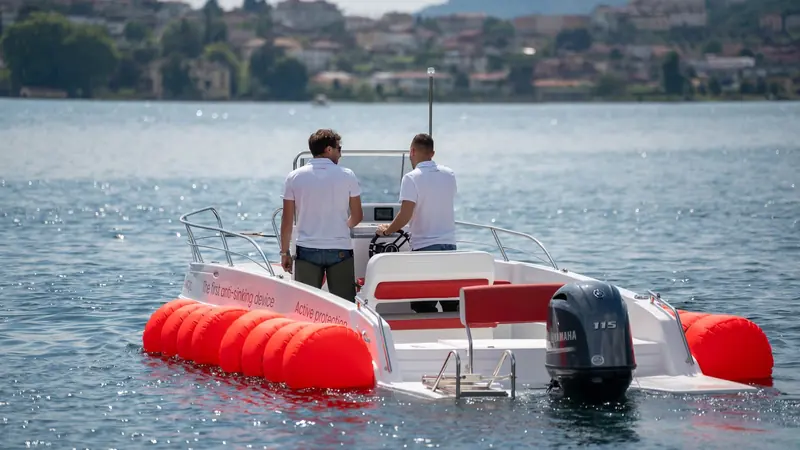
Sea Fend inflates a row of airbags along a boat's hull topsides to generate enough buoyancy to keep it afloat after a breach, triggered by hand at the helm or remotely through an app.
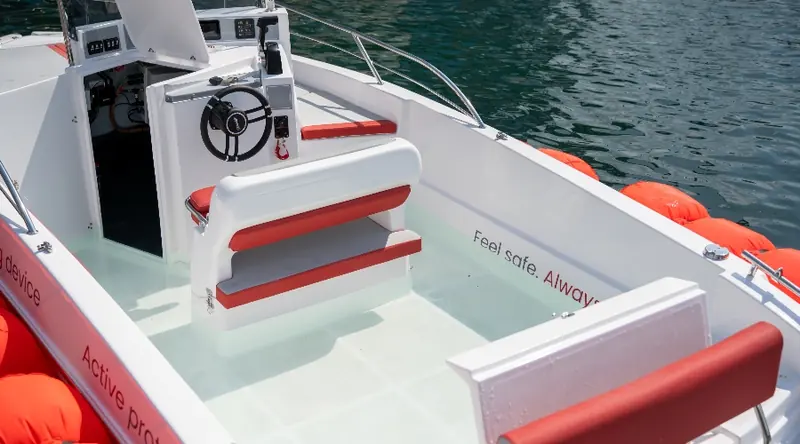
The system is built around inflatable modules fitted into the hull sides, either moulded into recesses behind flush panels on a new build or mounted externally in low-drag torpedo-shaped tubes on an existing boat. Sea Fend, made by the Italian firm Save Our Ship S.r.l, describes the trigger events as a hull breach, a collision with a submerged object, or a failed seacock or through-hull fitting - the ordinary ways a boat actually goes down, rather than a single catastrophic event. Activation is manual, from a switch at the helm, or remote, through a dedicated phone app that can also be used to check the system's status when nothing is wrong.
Once triggered, an electromagnetic release opens the panels on a new-build installation and the airbags deploy and inflate, a process Motor Boat & Yachting reports takes five to 25 minutes depending on the size of the boat and the kit fitted. The company is explicit that this does not stop water coming in - it counters the loss of buoyancy with enough hydrostatic lift to keep the hull up regardless, buying time to reach port or wait for rescue rather than promising to fix the leak itself. Every account of activation, including the company's own, describes a manual switch at the helm or a trigger pulled through the app - there is no mention anywhere in Sea Fend's own material of an automatic, sensor-driven release that fires with nobody aboard.
What size boats does Sea Fend's system fit?
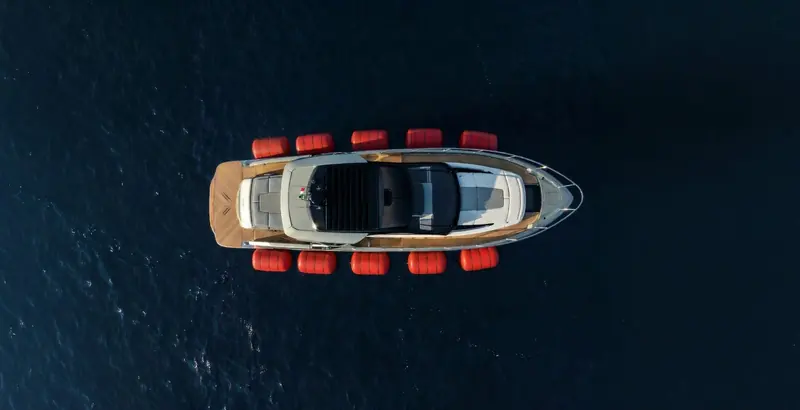
Sea Fend sells three modular kits sized primarily by displacement: Kit 2.0 for boats of 30 to 42 feet up to 16 tonnes, Kit 2.7 for 43 to 52 feet up to 25 tonnes, and Kit 3.4 for 53 to 65 feet up to 40 tonnes.
Buoyancy is a function of weight, not just hull length, so Sea Fend's range is built around displacement bands rather than a single length chart. The company's own site puts the overall ceiling at 45 tonnes, which in practice covers most planing motoryachts and large RIBs up to around 65 feet, but stops short of the flybridge and displacement yachts above that where Yotters readers more often shop. Motor Boat & Yachting and the Italian outlet Barche a Motore both confirm the same three-tier structure independently of the company's own material.
That ceiling is not necessarily fixed. Motor Boat & Yachting reported the company itself saying there is no technical reason the range could not be extended up or down, which reads as an admission that today's top kit reflects where Sea Fend has tooled and tested so far, not a hard engineering limit. For now, an owner of anything larger than a 65-footer has no version of this product to buy.
Can Sea Fend's system be retrofitted to a boat already in the water?
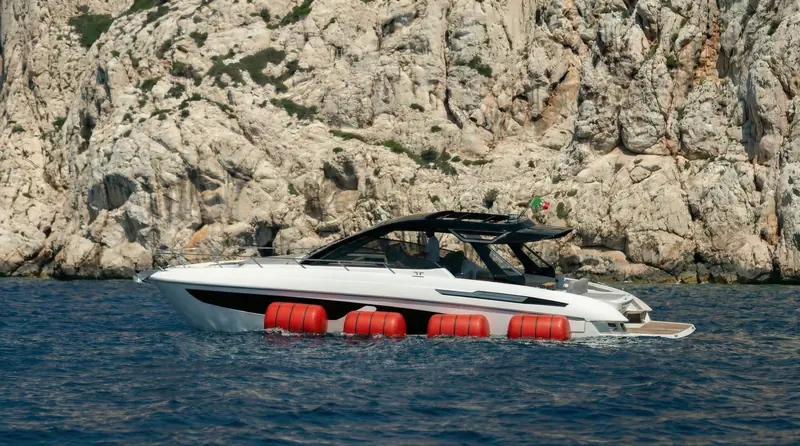
Yes: Sea Fend's kits are moulded into the hull at the build stage on a new boat, or bolted on externally in low-drag tubes on an existing one, typically during a routine haul-out.
On a new build, the yard factors the airbag recesses into the hull moulding, so the compressed bags sit behind flush panels that Sea Fend says are all but invisible until the electromagnetic release pops them open. On a boat already afloat, the same modules are housed in external, torpedo-shaped tubes designed to add minimal drag and visual clutter, fitted alongside the hull during ordinary maintenance rather than requiring a dedicated yard period of their own.
The companion app is the same across both installations. It reports battery charge, tube pressure, internal and external temperature and solenoid-valve status in real time, and on activation it sends the boat's GPS position by automatic alert to pre-set emergency contacts. That is a meaningful difference from a passive bilge alarm: it is designed to get a position to someone on shore at the moment the crew may be too busy, or too far offshore, to make the call themselves.
Has Sea Fend's system been independently certified or tested?
No: as of September 2026, neither Sea Fend nor the trade press covering it has published independent certification, a classification-society approval, third-party test data, or a price.
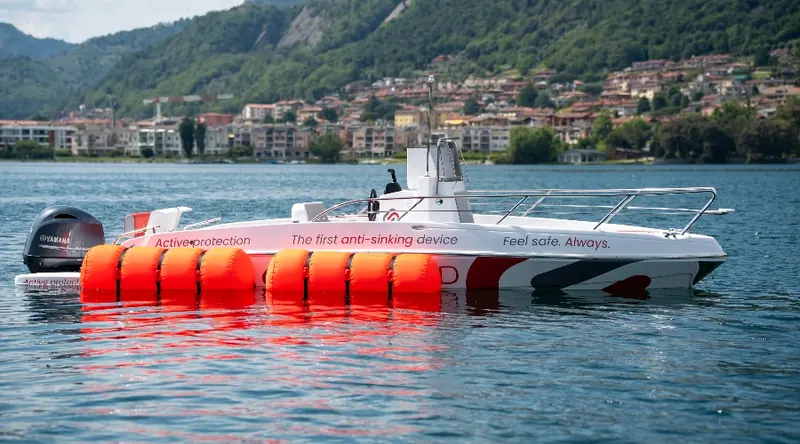
Every technical claim so far traces back to the company's own demonstrations - a lake trial that produced the widely-used press photography of a RIB running with its airbags inflated, and a separate showing at Marina di Varazze reported by Barche a Motore. That is normal for a young marine safety product finding its way into trade coverage, but it means every number in this story - the five-to-25-minute inflation window, the 45-tonne ceiling, the drag claims for the retrofit tubes - is Sea Fend's own figure, not an independently verified one.
Save Our Ship S.r.l is based in Italy, with a registered address in Cividate al Piano near Bergamo and, per Marine Industry News, roots in Modena; the company says its team comes from people who have spent their careers designing and building boats rather than from a pure tech background. Barche a Motore's coverage places the product's origin around 2023, which means it has been on the market for roughly two years without, on the public record, a single reported real-world deployment outside a company demonstration. Broader English-language trade attention only arrived in 2026, so its track record is still short by any measure.
Why would a yacht owner care about an anti-sinking system beyond crew safety?
A hull that stays afloat after a breach is a repair bill; one that sinks is almost always a total loss, so a system that credibly buys time to reach port changes the economics of an incident as much as the safety of it.
Hull insurers already price flood and sinking risk into every premium, and a device that measurably cuts the odds of a total loss is, in principle, exactly the kind of thing an underwriter rewards - the same logic that already gets a discount for an AIS tracker or an approved fire-suppression system. Nothing in Sea Fend's own material or in the trade coverage claims an insurer has recognised the system that way yet, so that link is a plausible next step rather than a fact on the ground today. Sea Fend itself makes a second, non-insurance case for the same economics: the company argues that every boat that sinks releases fuel, oil and plastic into the water, so a system that prevents a sinking is also preventing that pollution - a genuine point, though one that so far rests on the company's own framing rather than any outside body's endorsement.
The honest sale, for now, is narrower and still useful: a way to buy five to 25 minutes after the worst has already happened, on boats between 30 and 65 feet, fitted either at the build stage or during a normal haul-out, at a price the company has not yet told anyone. It is also worth weighing against how most boats actually go down. BoatUS's own claims data puts the majority of sinkings - about 69 per cent by its count - at the dock, unattended, usually after a small below-the-waterline fitting fails quietly overnight. A system that needs someone at the helm or on the app to trigger it does nothing for that boat unless an owner or marina staff happens to notice in time, which is precisely the scenario dockside sinkings show they usually do not.
What is good, and what to watch
Strong points
- Retrofit needs no dedicated yard periodThe external tubes are designed to go on during a boat's normal haul-out or winter maintenance rather than requiring its own booking.
- Kits scale to weight, not just lengthSizing by displacement band means a heavy-built 40-footer and a light one are not sold the same undersized kit.
- The app does more than alarmAutomatic GPS position sent to emergency contacts on activation gives rescuers a starting point immediately, rather than after a mayday call gets made.
What to watch
- No independent certification is publishedEvery performance figure in this story, including inflation time and displacement ceiling, comes from Sea Fend's own material or its own demonstrations.
- No price is publishedAn owner cannot yet weigh the system against the cost of better bilge pumps, a higher premium, or simply carrying more insurance.
- No reported real-world deploymentRoughly two years after the product's origin around 2023, the public record shows company demonstrations but no account of the system saving an actual boat.
- Activation needs a person, and most sinkings happen when nobody is aboardSea Fend's own materials describe only a helm switch or an app trigger, with no automatic, sensor-driven release - yet BoatUS puts about 69 per cent of sinking claims at the dock with the boat unattended.
Practical detail
| Kit 2.0 fits | 30-42ft boats, 5-16 tonnes displacement |
|---|---|
| Kit 2.7 fits | 43-52ft boats, 16-25 tonnes displacement |
| Kit 3.4 fits | 53-65ft boats, 25-40 tonnes displacement |
| Maximum displacement | 45 tonnes |
| Inflation time | 5 to 25 minutes, depending on kit and boat size |
| Activation | Manual switch at the helm, or remote trigger via the Sea Fend app |
| New-build fitting | Moulded recesses behind flush hull panels, opened by an electromagnetic release |
| Retrofit fitting | External low-drag tubes, fitted during a routine haul-out |
| App monitoring | Battery charge, tube pressure, internal/external temperature, valve status, GPS position |
| Price | Not published by Sea Fend as of September 2026 |
| Independent certification | Not published; no classification society or insurer approval named by the company or in trade coverage |
Questions this story answers
What happened?
An Italian startup has built a modular airbag system that inflates along a hull's topsides to keep a holed or flooding boat afloat rather than let it go down. For an owner, the pitch is not just safety: a hull that stays up is a repair bill, and one that sinks is almost always a total loss.
What is good about it?
Retrofit needs no dedicated yard period. The external tubes are designed to go on during a boat's normal haul-out or winter maintenance rather than requiring its own booking.
What should an owner or buyer watch?
No independent certification is published. Every performance figure in this story, including inflation time and displacement ceiling, comes from Sea Fend's own material or its own demonstrations.
Who reported this?
Marine Industry News, Motor Boat & Yachting, Barche a Motore, Sea Fend (Save Our Ship S.r.l), BoatUS.
We do this for everyone who loves this world. The people who have spent their lives in it, and the people just discovering it. Yotters exists so that what we learn belongs to all of them.
Nobody pays us for this. No ads, no sponsors, nothing for sale. We just believe the world is a little better when knowledge is shared instead of kept.
If it gave you something today, tell us to keep going. Follow us, leave a like, or write a positive comment. We read every one, and they are what keeps us going.