54 Convertible
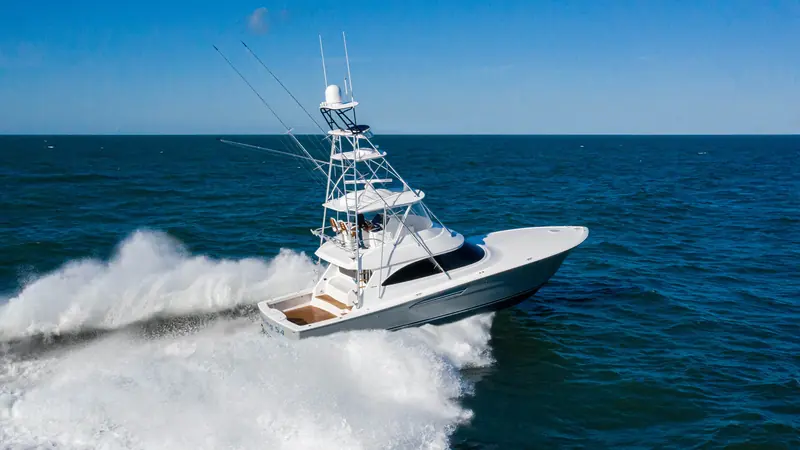
| LOA | 54 ft 6 in (16.61 m), beam 17 ft 8 in |
|---|---|
| Standard engines | twin MAN V12 1400CRM diesels, 1,400 mhp each |
| Optional engines | twin MAN V12 1550CRM diesels, 1,550 mhp each |
| 42 knots top speed with the 1550CRM engines, low-to-mid 30s cruise | |
| Fuel | 1,403 US gal standard, 1,535 US gal optional; water: 198 US gal |
| 3 staterooms, 2 heads, 6 to 8 guests | |
| 154 sq ft cockpit with dual-use livewell/kill box | |
| Seakeeper SK18 gyro stabilizer offered as an option, not standard | |
The Boat Viking Built to Own the 50-to-60-Foot Bracket
Viking's own count of the bracket explains why the 54C exists at all. President and CEO Pat Healey told dealers at the model's release that the yard had designed more boats from 50 to 60 feet than any other manufacturer in the industry over the prior two decades, calling the size range the company's sweet spot. The 54C replaced two prior nameplates at once, the 50 and 52 Convertible, rather than sitting alongside them, and Viking's hull and running-surface work stayed in-house, engineered with the yard's own computational fluid dynamics programs to run virtual sea trials before a single hull was laid up.
The 54C did not stay the flagship of its own size class for long. Viking used the same platform as the starting point for the larger 64 Convertible that followed a year later, an enlarged and reworked version of the 54's hull rather than a clean-sheet design, which is Viking's own account of how it moves a proven hull upmarket. Closer to home, the very first 54C built was not kept as a static show boat. HMY Yacht Sales ran Hull No. 1 through a full winter of South Florida sailfishing tournaments as a demo boat, with company captain and sales associate Trey Claus at the helm, putting the boat to work before most buyers had even stepped aboard one.
Three Staterooms, Two Heads, and a Cockpit Built to Fish
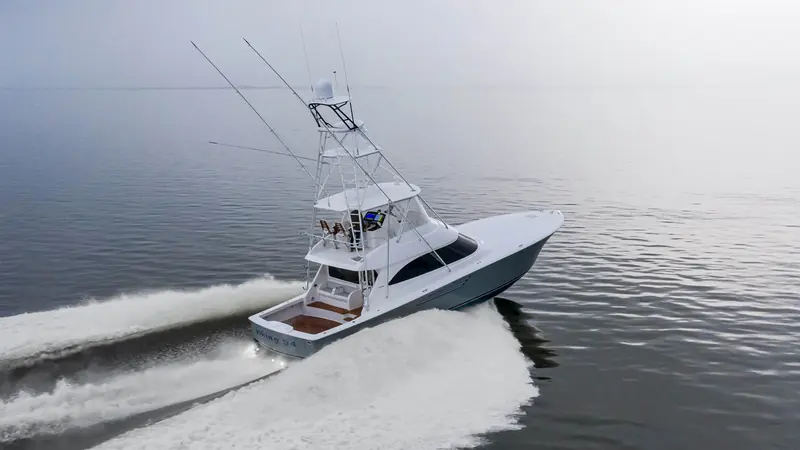
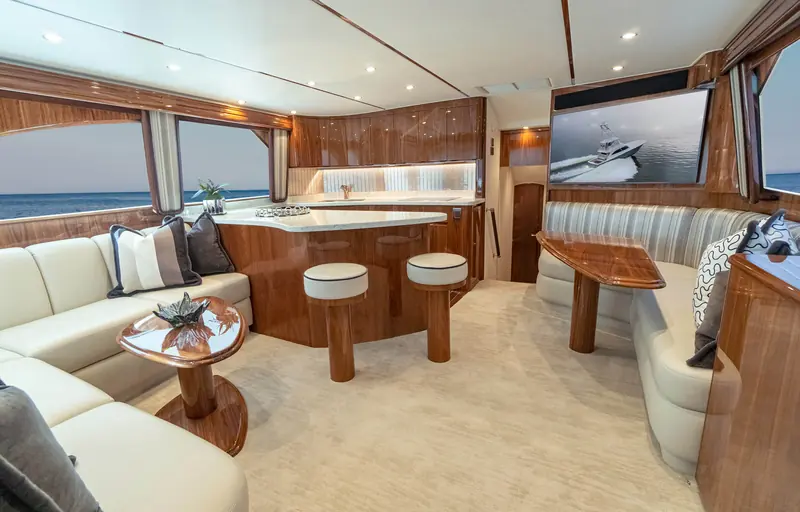
The layout puts the master amidships to port with a walk-around queen berth and its own en suite head, a forward stateroom with a choice of a centerline queen or crossover berths, and a starboard stateroom with upper and lower bunks that shares the second head with the forward cabin. The galley runs portside as a peninsula rather than a straight run, finished in one of four wood options Viking offers buyers, and the companionway carries straight through the cabin rather than jogging around furniture, a small detail that matters when moving gear or a hooked angler through the boat in a seaway.
The cockpit is 154 square feet, built around a dual-use livewell and kill box in the transom, an in-deck fishbox in the cockpit sole, and a second in-deck box plumbed for an additional livewell. A mezzanine module hides a bait freezer, coolers and tackle storage rather than eating cockpit floor space, and rigging runs to as many as six flush-mounted rod holders in the gunwales, six rocket launchers on the Palm Beach Towers tuna tower, and eight more across the bridgedeck. The engine room, reached from the cockpit through a center hatch and from the mezzanine, is painted Snow White Awlgrip for visibility, a Viking production detail meant to make it easier to spot a leak or a loose fitting before it becomes a problem offshore.
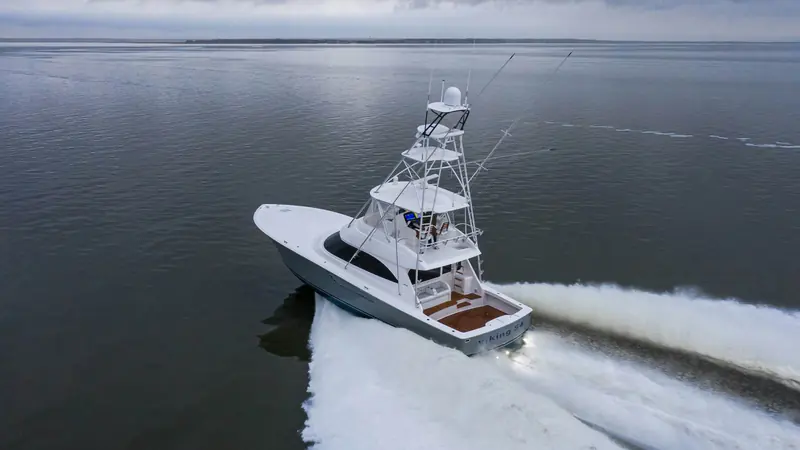
HMY put Hull No. 1 of the new 54 Convertible to work fishing South Florida's winter sailfish tournaments as a demo boat, with company captain Trey Claus at the helm, before most buyers had even stepped aboard one.
Two Engine Choices and a Genuine 40-Knot-Plus Top End
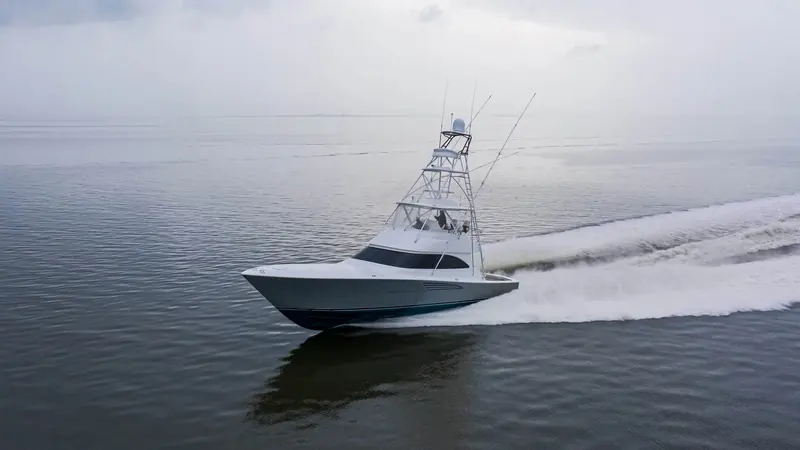
Viking builds the 54C standard with twin MAN V12 1400CRM diesels at 1,400 mhp each, stepping up to twin MAN V12 1550CRM diesels at 1,550 mhp each as the sole factory option, a narrower spread than the four-engine menu Viking now offers on the larger 64 Convertible. With the 1550CRM pair fitted, Marlin's sea trial recorded 42 knots at wide-open throttle, 2,330 rpm, while Yachting Magazine's independent test of the same configuration measured 41 knots, the two publications agreeing closely enough to trust the number. Cruise settles in the low-to-mid 30s, Marlin logging 31.5 knots at 1,830 rpm and a separate pass at 32.6 knots at 1,880 rpm, turning through a ZF gearbox at a 2.250:1 ratio onto Veem five-blade Interceptor propellers.
None of that speed is free. Marlin's wide-open-throttle run burned 160 gallons an hour with the 1550CRM engines, and Viking's own published fuel capacity for the 54C is 1,403 gallons standard or 1,535 gallons with the optional third tank, figures Marlin's test and HMY's own feature list both cite. Viking's current online specification page lists a lower 1,357 gallons for the same boat, a discrepancy this page could not reconcile against two agreeing magazine sources, so the 1,403/1,535 figures are used here. Range is the softest number on the boat: secondary sources repeat a rough estimate of about 400 nautical miles at a mid-30s cruise, but unlike the fuel-flow tables magazine testers have published for other Viking models, no independent sea trial found here backs that figure with its own measured burn, so it should be treated as an estimate rather than a tested range.
Stabilizer, Watermaker and Thruster Are Options, Not Standard Kit
Hotel power comes from a single 21.5-kW Onan E-QD generator, a spec confirmed on both Viking's own factory page and HMY's published feature list. Stability at anchor is a different story: Viking lists the Seakeeper as available rather than standard, and brokerage listings for delivered hulls consistently show a Seakeeper SK18 fitted, which suggests most buyers order it even though it is not baked into the base boat. A Side-Power bow thruster with joystick-integrated controls at the helm is common across Viking's convertible line, but the 54C's own factory specification page does not publish a thrust rating for it, and no independent test found here names the exact unit fitted either, a gap worth asking a selling dealer to close in writing before survey.
Fresh water runs to 198 gallons, a figure Marlin, Yachting Magazine and a third aggregated feature summary all agree on, and a Spot Zero reverse-osmosis watermaker, typically specified around 700 gallons a day with an auto-backflush cycle, is offered as an option rather than standard equipment, the same pattern as the Seakeeper. For a boat built around multi-day tournament trips well offshore, that means two of the systems owners rely on most, stabilization and fresh water, both add real dollars to whatever price a dealer first quotes, and a buyer comparing two 54Cs should confirm exactly which of these boxes are ticked before comparing their asking prices.
Straight to Work: Tournaments, Demo Duty and Owner Word
Hull No. 1 of the new 54C did not spend its first season on a dock. HMY Yacht Sales put it to work as a demo boat through South Florida's winter sailfishing tournaments, with company captain and sales associate Trey Claus running the boat through local events rather than reserving it for boat-show walkthroughs, giving the yard and prospective buyers real fishing time on the hull within months of its debut. Marlin's own test, run by longtime editor Peter Frederiksen alongside Viking's demo-program crew, praised the hull's sloping sheerline for keeping the cockpit safe and dry during an endgame release or gaff shot, and its wake for cutting clean water suited to natural or dead-bait presentation at trolling speed.
Owner opinion on forums is more mixed, which is worth reporting honestly rather than smoothing over. On The Hull Truth, one poster described the 54C as not regarded as one of Viking's stronger models, while a 54 owner elsewhere in the same thread said they liked their boat overall but found the laundry center's placement in the layout a little odd. A third poster, describing a friend's ownership of a 1550CRM-powered 54C, put realistic self-run annual costs at roughly $50,000 for fuel, dockage, insurance and winterization, and separately noted that same boat needed a cracked cylinder head repaired along with both turbochargers, a reminder that a 1,550-horsepower diesel run hard on tournament schedules needs real mechanical upkeep, not just fuel and dockage money.
What It Costs to Buy, and What It Costs to Run
Viking does not publish a fixed base price for the 54C, and dealers quote against whichever engine and equipment package a buyer chooses. Galati Yacht Sales has cited a starting cost of around $3.4 million, and HMY listed a 2027-model-year 54C starting at $3,755,000, a range that likely reflects standard-engine, lighter-option boats before a buyer adds the Seakeeper, extra fuel tank or electronics package. In-stock, tournament-rigged new hulls run well above that starting figure: current 2026-model listings in Osterville, Massachusetts and Cape May Point, New Jersey ask $4.1 million and $4.2 million respectively. Because the model only entered production in 2020, there is not yet a real gap between new and used pricing: a 2021 hull has been listed at $3,195,000, a 2023 example named Olde Floridian at $3,799,000, and at least one heavily equipped recent hull as high as $4,399,000, prices that sit close to what a new boat costs once comparably optioned.
Running costs are the part no dealer puts on a spec sheet. A single Hull Truth estimate, sourced to an owner describing a friend's self-run 54C rather than a crewed operation, puts annual costs at roughly $50,000 for fuel, dockage, insurance and winterization, a figure well below the $350,000 to $550,000 a year a fully crewed larger Viking convertible can run, since it assumes an owner-operator rather than a paid captain and mate. That single-sourced estimate should be treated as a rough floor rather than an audited number. What Viking does not publish, and what a buyer has to ask a dealer for directly, is the boat's true base price before any options, the bow thruster's make and thrust rating, and any independent, magazine-measured fuel-burn or range table for this specific hull and engine combination.
Motorisation et systèmes
| Main engines | Standard twin MAN V12 1400CRM diesels, 1,400 mhp each; optional twin MAN V12 1550CRM diesels, 1,550 mhp each, giving a 42-knot top speed (Marlin and Yachting Magazine sea trials agree closely on both the engine line-up and the top speed) |
|---|---|
| Gearbox | ZF gearbox at a 2.250:1 ratio, turning Veem five-blade Interceptor propellers (Marlin sea trial, the only source found with the exact ratio) |
| Generator | One 21.5 kW Onan E-QD diesel genset (Viking's factory specification page and HMY's published feature list agree) |
| Stabilizer | Seakeeper SK18 gyroscopic stabilizer, listed by Viking as available rather than standard; brokerage listings for delivered hulls consistently show it fitted |
| Bow thruster | A Side-Power bow thruster with joystick-integrated helm controls is common across Viking's convertible line, but the 54C's factory specification page does not publish a thrust rating, and no independent test found here names the exact unit |
| Watermaker | Spot Zero reverse-osmosis watermaker, typically specified around 700 gallons per day with auto-backflush, offered as an option rather than standard equipment |
| Fuel tankage | 1,403 US gallons standard, 1,535 US gallons optional (Marlin's sea trial and HMY's published feature list agree exactly). Viking's own current specification page lists a lower 1,357 gallons, a figure this page could not reconcile against the two agreeing magazine sources |
| Fresh water tankage | 198 US gallons (Marlin, Yachting Magazine and an aggregated HMY/FishTalk feature summary all agree) |
Ce que rapportent propriétaires et équipages
Hull No. 1 went straight to work fishing, not onto a show dock
HMY Yacht Sales ran the very first 54 Convertible built through a full winter of South Florida sailfishing tournaments as a demo boat, with company captain and sales associate Trey Claus at the helm, putting the boat to work before most buyers had even stepped aboard one.
HMY YachtsA hull designed to keep the cockpit dry and the wake clean for bait
Marlin editor Peter Frederiksen sea-trialed the 54C alongside Viking's own demo-program crew and praised the sloping sheerline for making an endgame release or gaff shot safe on the crew, and the wake for cutting clean water suited to bait presentation at trolling speed.
Marlin (Peter Frederiksen)Not one of Viking's best, one owner says; another calls the layout odd but likable
On The Hull Truth, one poster described the 54 as not regarded as one of Viking's stronger models, while a 54 owner elsewhere in the same thread said they liked their boat overall but found the laundry center's placement in the layout a little odd.
The Hull Truth (owner forum thread)Real running costs are closer to $50,000 a year, and the 1550 MANs need real upkeep
A Hull Truth poster with a friend who owns a 1550CRM-powered 54C put self-run annual costs, fuel, dockage, insurance and winterization, at roughly $50,000 a year, and separately noted the same boat needed a cracked cylinder head and both turbochargers replaced.
The Hull Truth (owner forum thread)
Les points forts et les points de vigilance
Points forts
- A bigger fighting cockpit than at least one size-up rivalAt 154 square feet the 54C's cockpit is larger than the 135 square feet most commonly cited for the Hatteras GT54, a genuine size-up competitor, giving the smaller Viking more usable fishing deck than a boat nearly the same length from its closest rival.
- Proven enough to become the seed hull for Viking's next flagshipViking used the 54 Convertible's own hull as the starting point for the larger 64 Convertible that followed a year later, an enlarged and reworked version rather than a clean-sheet design, the yard's own way of saying which platform it trusted enough to scale up.
Points de vigilance
- Stabilizer, watermaker and thruster spec are all extras, not standardUnlike some rivals that build stabilization and watermaking into the base price, Viking lists the Seakeeper and Spot Zero watermaker as options on the 54C, and its own factory specification page does not publish a thrust rating for the bow thruster at all.
- Heavy fuel burn undercuts the 40-knot-plus top end for everyday useMarlin's wide-open-throttle run with the optional 1550CRM engines burned 160 gallons an hour, a real cost against a fuel capacity of 1,403 to 1,535 gallons that makes the top speed better suited to a tournament sprint than routine cruising.
- Owner sentiment is genuinely mixed, not uniformly positiveThe Hull Truth carries a post describing the 54C as not one of Viking's stronger models alongside a satisfied owner's complaint about an oddly placed laundry center, and a separate report of a cracked cylinder head and turbocharger replacement on a 1550CRM-powered example.
- No independent, magazine-measured range or fuel-burn table existsThe commonly repeated 400-nautical-mile range figure traces back to secondary summaries rather than a magazine's own fuel-flow test, unlike the multiple independently measured range figures available for some other Viking models, so it should be treated as an estimate rather than a tested number.
Informations pratiques
| New price | Viking does not publish a fixed base price; dealers quote per configuration. Galati Yacht Sales has cited a starting cost of around $3.4 million, HMY listed a 2027-model 54C starting at $3,755,000, and loaded, tournament-rigged in-stock 2026 hulls list at $4.1 million to $4.2 million |
|---|---|
| Used price | A 2021 hull has been listed at $3,195,000, a 2023 example named Olde Floridian at $3,799,000, and at least one heavily equipped recent hull as high as $4,399,000; because the model only entered production in 2020, there is not yet a real gap between new and used pricing |
| Annual running cost | A single Hull Truth estimate, describing a self-run rather than crewed 54C, puts annual costs at roughly $50,000 for fuel, dockage, insurance and winterization; this is one owner-sourced figure, not a Viking-published or magazine-audited number |
| Not publicly disclosed | Viking's true factory base price before options, the bow thruster's make and thrust rating, and any independent magazine-measured fuel-burn or range table for this hull and engine combination |
Pour qui: An owner-operator or tournament team who wants Viking's 50-to-60-foot sweet spot in a boat that fits a standard-width slip, values speed and cockpit fishability over the four-stateroom family space of Viking's larger convertibles, and is prepared to order the Seakeeper, watermaker and bow thruster as extras rather than expect them built in.