Turkey & the Dodecanese
| Regione | Turchia sudoccidentale (coste dell'Egeo e della Licia) più il Dodecaneso greco |
|---|---|
| Stagione | da maggio a ottobre, con il picco da metà luglio a fine agosto |
| Vento dominante | il meltemi, da nordovest, da forza 5 a forza 6 a luglio e agosto, fino a forza 7 o 8 |
| Porti principali | Yalikavak, Bodrum, Gocek, Marmaris, Kos, Symi, Rodi |
| Ormeggio più grande | Yalikavak Marina, circa 620 posti barca, yacht fino a circa 140 metri |
| Ancoraggi simbolo | Skopea Limani e le isole di Gocek, Kekova, la penisola di Bozburun |
| Ancoraggio | le baie di Skopea Limani hanno da 15 a 20 metri di fondale vicino a riva, le cime a terra sono la norma |
| Ingresso in Turchia | e-Transitlog al primo porto, valido un anno, più una Blue Card che registra gli scarichi |
| Charter | la legge turca sul cabotaggio limita il charter commerciale di bandiera estera, serve una licenza turca o un permesso di navigazione del ministero |
| Carburante | bunkeraggio senza dazio per gli yacht di bandiera estera nelle marine e nei cantieri turchi autorizzati |
| Lato greco | tassa di navigazione TEPAI, riportata a EUR 8 al metro al mese per yacht oltre i 12 metri nel 2026 |
| Aeroporti | Milas-Bodrum a circa 45 minuti da Yalikavak, Dalaman a circa 30 minuti da Gocek, Rodi e Kos sul lato greco |
| Charter from 19 June 2026 | a foreign-flagged commercial yacht under 39 m may not embark charter guests in Turkey and pays EUR 40 per metre of LOA at each clearance |
| Charter licence for 39 m and above | one-off and banded, EUR 74,423.36 for 39 to 59 m, EUR 108,135.03 for 60 to 79 m, EUR 168,846.72 above 80 m, valid to 31 December 2026 |
| Private yachts | a foreign-flagged private yacht may not charter in Turkey and may cruise only with the ultimate beneficial owner or a first-degree family member aboard, with no licence and no VAT |
| Licence process | notarised translations and about ten working days, with no amendments and no refunds after payment |
| Berthing | no Turkish marina publishes a superyacht tariff, checked 28 July 2026, and Netsel publishes its formula without the unit price |
| Third-party berth figure | EUR 12,000 to 25,000 a year for a 12 m yacht in the Bodrum, Marmaris and Gocek marinas on a 2026 market guide |
| Greek cost | TEPAI at EUR 8 per metre per month is EUR 400 a month for a 50 m yacht |
| Discharge | marine pollution fines under Article 20 of Environmental Law 2872 rose 25.5 per cent for 2026, and eleven vessels were fined a combined TRY 18,038,414 in the first quarter of 2026 |
| Duty-free fuel | open to foreign-flagged yachts private and commercial, ordered a working day ahead, with no published price differential |
Due coste, una sola area di crociera
La metà turca corre dalla penisola di Bodrum verso sud oltre Datca e Marmaris fino a Gocek e Fethiye, poi a est lungo la costa licia attraverso Kas fino a Kekova. La metà greca sta a poche miglia al largo e appartiene a un altro Stato: Kos, Symi, Rodi, Patmos, Leros e gli scogli più piccoli in mezzo. Da Bodrum a Kos ci sono circa 12 miglia nautiche. Da Marmaris a Rodi circa 35. Da Datca a Symi circa 12. Uno yacht può cambiare giurisdizione in una mattinata ed essere all'ancora in un posto completamente diverso nel pomeriggio.
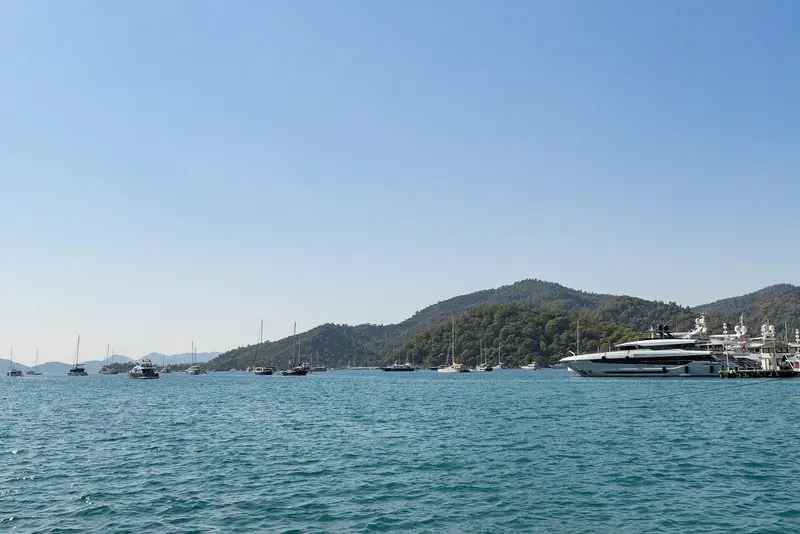
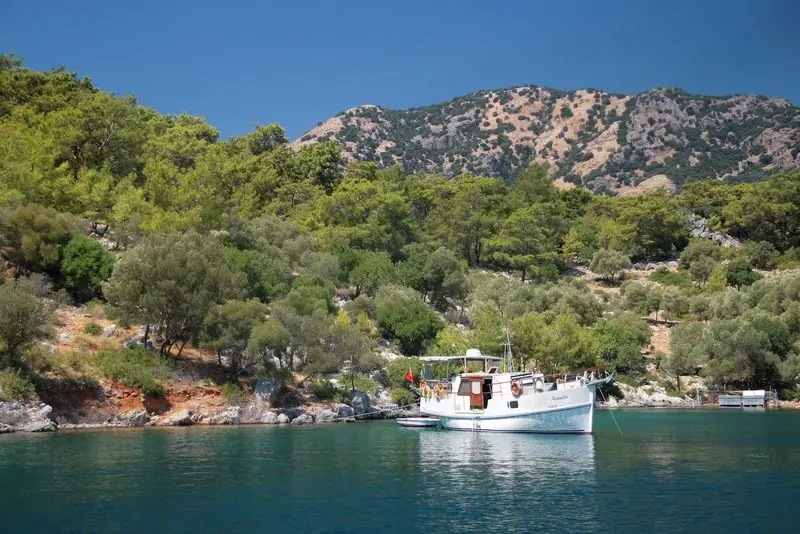
A vendere la costa turca è la sua forma. Ripida, coperta di pini e profondamente frastagliata, con le montagne dietro Skopea Limani che salgono verso i 2.000 metri. L'acqua profonda arriva vicino a riva, quindi le navigazioni sono brevi e il riparo è immediato. La maggior parte delle giornate di crociera qui è di due o quattro ore di moto. L'armatore che detesta le lunghe tratte in mare aperto ottiene un'enorme quantità di costa per pochissimo tempo in navigazione.
Una settimana, e due settimane
La settimana classica parte da Gocek. Fuori in Skopea Limani per due notti tra le isole di Gocek, poi attraverso il golfo di Fethiye, quindi a est verso Kalkan e Kekova per la città licia sommersa, e ritorno con una notte a Ekincik. Su quel percorso niente dista più di quattro ore dall'ancoraggio precedente. La settimana alternativa è la penisola di Bodrum e il golfo di Gokova, più ampio, più ventoso e più aperto, con la penisola di Datca e Knidos alla sua estremità occidentale.
Due settimane permettono di unire le due metà e di aggiungere la Grecia. Da Bodrum giù fino a Gocek con Kos, Symi e Rodi in mezzo è la quindicina onesta. L'attrito sono le formalità. Ogni salto oltre confine significa una pratica completa di dogana, immigrazione e sanità in entrambe le direzioni, e in un porto affollato come Kos Town o Rodi vuol dire in genere due o quattro ore della giornata. Metti in conto un attraversamento in due settimane, non quattro.
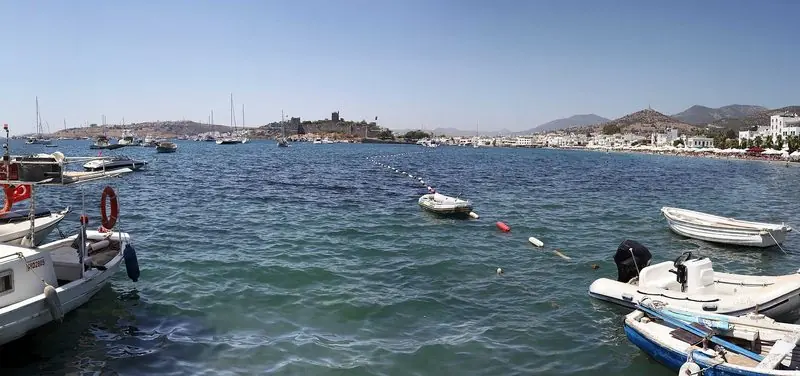
Qui uno yacht può cambiare giurisdizione nel tempo di un pranzo, e lo paga con una pratica di sdoganamento a ciascun capo.
Gli ancoraggi che valgono il viaggio
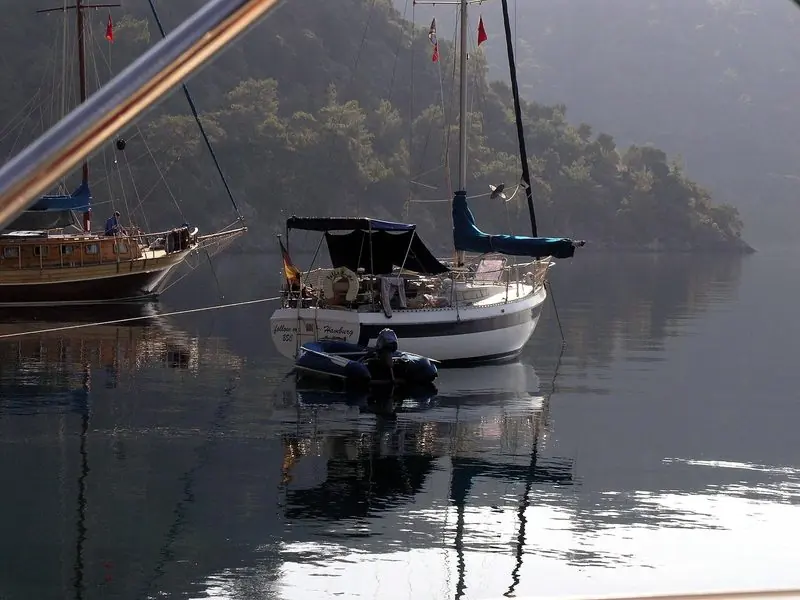
Skopea Limani, il golfo chiuso a sudovest di Gocek, tiene i migliori. La baia di Bedri Rahmi porta il nome del pittore turco il cui motivo a pesce è ancora sulla parete di roccia. Tomb Bay ha tombe rupestri licie scavate nella falesia proprio sopra l'acqua. L'isola di Tersane ha un cantiere in rovina e un insediamento abbandonato. Diverse baie hanno pontili di ristoranti dove il personale esce a remi a prendere le cime, cosa che funziona benissimo per una barca di 25 metri e per niente per una di 50.
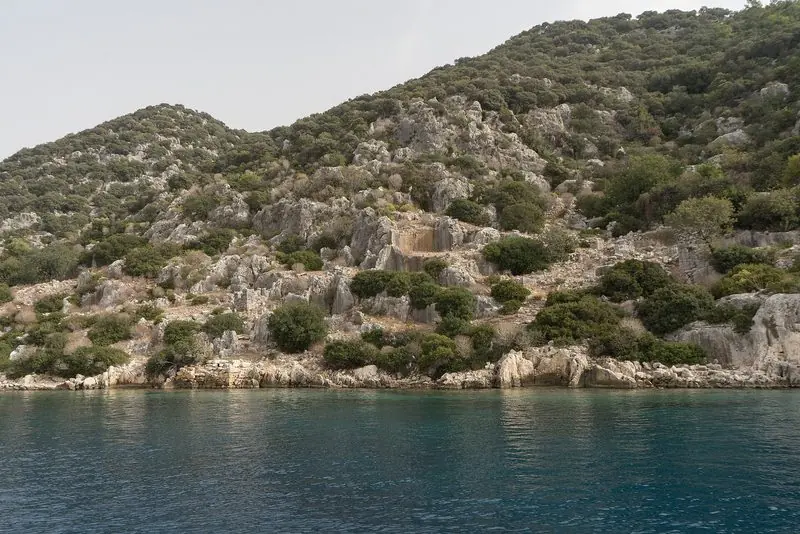
A est di Fethiye l'interesse diventa archeologico. Kekova ha una città licia semisommersa lungo la riva, che si vede meglio in tender a bassa velocità, con Ucagiz e Kalekoy alle due estremità. A ovest di Marmaris le penisole di Bozburun e Datca sono più tranquille, con Knidos sulla punta dove si incontrano due mari. Sul lato greco il porto di Symi a Gialos è l'arrivo più fotografato del Dodecaneso, tutto facciate neoclassiche impilate su una conca di roccia, e Patmos porta il monastero di San Giovanni e la grotta dell'Apocalisse sopra il porto di Skala.
Dove ci sta una barca di 50 metri, e dove no
Yalikavak Marina, sulla punta nordoccidentale della penisola di Bodrum, è il perno di tutta la regione, con circa 620 posti barca e capacità per yacht fino a circa 140 metri. È stata votata più di una volta migliore marina per superyacht del mondo nei premi di settore. Gocek ha diverse marine stipate in una sola piccola baia, di cui D-Marin Gocek è la più grande, che prende yacht fino a circa 70 metri dietro una diga galleggiante. Netsel Marmaris e le marine di Bodrum completano il quadro. Rodi ha una banchina superyacht nel porto commerciale, e Rodi Marina a est della città.
I limiti si vedono all'ancora. Le baie di Skopea Limani sono profonde fino a ridosso della riva, quindi la tecnica standard è dare fondo su 15 o 20 metri e portare lunghe cime a rocce o alberi, il che richiede da 50 a 60 metri di catena filata e una squadra a terra. È routine per una barca di 50 metri con un buon equipaggio ed è impossibile nelle insenature più piccole. La banchina cittadina di Symi è corta e affollata. In pratica qui uno yacht di 50 metri ancora al largo nella parte esterna della baia e lavora la costa in tender, che è quello che fa la flotta residente.
Il meltemi e lo stato del mare
Il vento che definisce tutto è il meltemi, da nordovest attraverso il Dodecaneso, al suo più duro e più insistente a luglio e agosto. In quei mesi soffia in genere da forza 5 a forza 6 e può crescere fino a forza 7 o 8. Lo schema quotidiano conta più della media: leggero fino a metà mattina, più duro nel pomeriggio, in calo nella notte. È quel ritmo prevedibile la ragione per cui gli equipaggi locali si muovono all'ora di colazione. Tra le Cicladi e il Dodecaneso il vento ha circa 100 miglia nautiche di fetch libero, quindi è nelle traversate aperte che il mare si alza, non sotto costa.
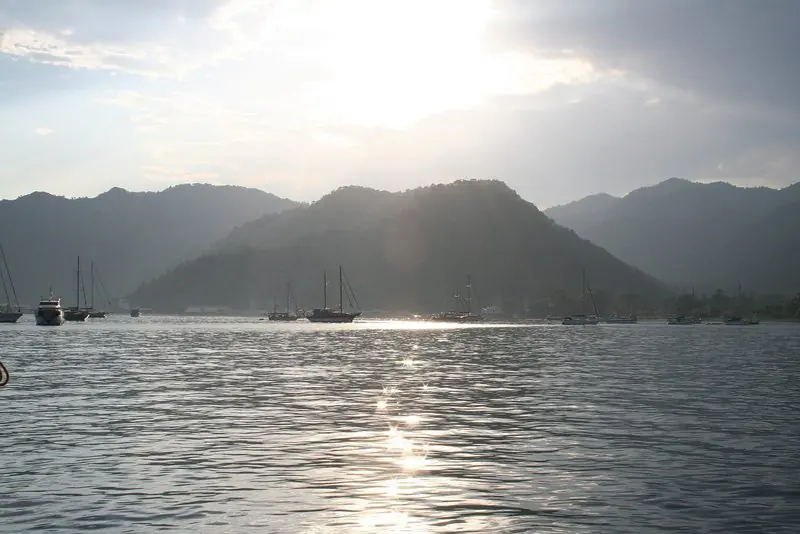
A sud e a est della penisola di Datca la costa turca è molto più riparata e il meltemi arriva smorzato. Skopea Limani in particolare è una sacca di aria leggera. L'acqua è calda da giugno e resta balneabile fino a ottobre. Primavera e autunno portano il mare più calmo e le colline più verdi, con qualche temporale nel caldo di fine agosto. Da novembre a marzo qui non c'è stagione di crociera in nessun senso concreto: pioggia, vento, e la maggior parte dei ristoranti sulla costa chiusi.
La stagione e le settimane già prenotate
La stagione utilizzabile va da maggio a ottobre. Da metà luglio a fine agosto la penisola di Bodrum è al volume massimo, con il traffico vacanziero turco e regionale sopra alla flotta internazionale. Gocek ad agosto è davvero pieno, e le baie buone sono occupate entro metà pomeriggio. Fine maggio, inizio giugno e le prime tre settimane di settembre sono le finestre che chi conosce questa costa sceglie davvero, con acqua calda, vento più morbido e spazio per ancorare.
I posti barca estivi migliori a Yalikavak sono di fatto già assegnati alle barche che li tengono con contratti annuali, e ad agosto la disponibilità per chi si presenta è sottile a qualunque lunghezza. A ottobre arriva la Bodrum Cup, una regata di gulet che si corre dal 1989 nella terza settimana del mese e che riempie Bodrum di 150 o più yacht tradizionali in legno, chiudendo la stagione con una settimana di feste. Quella settimana va o cercata o evitata, a seconda dell'armatore.
Portare gli ospiti a bordo
Milas-Bodrum è la porta d'accesso per la metà nord, circa 45 minuti di strada da Yalikavak e meno da Bodrum città, ed è il principale punto di gestione dei jet privati della regione. Dalaman serve il sud, a circa 30 minuti dalle marine di Gocek e a meno di un'ora da Fethiye. Entrambi prendono jet d'affari ed entrambi hanno orari estivi da gran parte dell'Europa. Istanbul è a un breve volo interno per chi arriva da lontano.
Il lato greco è servito da Rodi Diagoras e Kos, entrambi con un pesante traffico charter estivo e una gestione dell'aviazione privata più sottile rispetto agli aeroporti turchi. Agli ospiti che si imbarcano in Grecia e sbarcano in Turchia va detto del confine. Gli obblighi di visto turco variano per nazionalità e il sistema elettronico è lineare, ma va fatto prima della partenza. I cambi equipaggio oltre confine costano una pratica di sdoganamento ogni volta.
A terra, e com'è davvero
Bodrum ha il castello dei Cavalieri di San Giovanni, che ospita il Museo di archeologia subacquea, e i resti del Mausoleo di Alicarnasso. Il centro storico di Rodi è una città medievale murata e patrimonio dell'umanità, ed è l'unica tappa in cui gli ospiti passeranno volentieri una giornata intera. Dalyan, raggiungibile in tender risalendo il fiume da Ekincik, ha le tombe rupestri di Kaunos scavate nella parete di roccia.
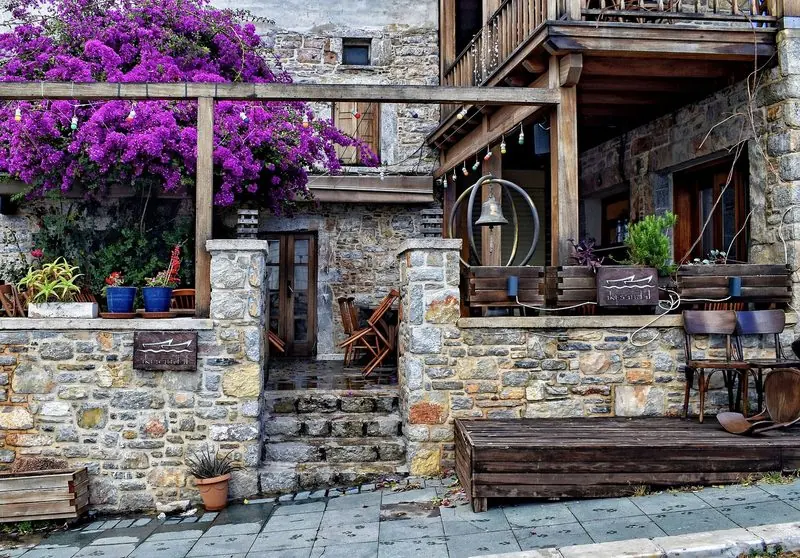
Il cibo è schietto e regionale. Meze, pesce alla griglia venduto a peso e ristoranti sulla costa che mandano un tender a prenderti. Turkbuku sul lato nord della penisola di Bodrum e la passeggiata di Yalikavak Marina portano la scena estiva, con i nomi della ristorazione internazionale e il pubblico della notte. Le isole greche sono più tranquille, con Symi e Patmos in particolare che chiudono presto. Su questa costa nessuno viene per la vita notturna della Costa Azzurra, e chi ci prova resta deluso.
Carte, carburante e il difetto da dire
Ogni yacht di bandiera estera che entra in Turchia prende un e-Transitlog al primo porto, valido un anno, più una Blue Card che registra gli scarichi. Gli agenti gestiscono entrambi di routine e non è una cosa pesante. Il vantaggio commerciale è reale. Gli yacht di bandiera estera fanno bunkeraggio senza dazio nelle marine e nei cantieri turchi autorizzati, che su una barca di 50 metri è una cifra concreta nell'arco di una stagione. La Turchia sta anche fuori dal territorio doganale dell'Unione, ed è per questo che tanti yacht la usano per interrompere il conto dei 18 mesi di ammissione temporanea, e su questo punto gli armatori dovrebbero farsi consigliare in proprio.
Il difetto è il regime del charter. La legge turca sul cabotaggio riserva il commercio marittimo interno alle unità di bandiera turca, e uno yacht commerciale di bandiera estera non può semplicemente imbarcare ospiti in Turchia. Le vie per aggirare il problema, una licenza di charter turca o un permesso di navigazione al metro pagato al ministero, sono cambiate più di una volta e vanno verificate nell'anno di utilizzo. Oltre a questo: l'affollamento di agosto a Gocek, il meltemi sul versante di Bodrum, e un'industria del refit seria la cui capacità di sollevamento più pesante sta a Tuzla, vicino a Istanbul, a diverse centinaia di miglia dalle baie che poi si navigano.
What it costs, and where the saving actually is
Turkish marinas do not publish superyacht tariffs. Netsel Marmaris publishes the formula, LOA multiplied by beam multiplied by days multiplied by a unit price, and not the unit price. Yalikavak lists 620 berths and a 60 m maximum on the booking platforms with no rate table behind it, checked on 28 July 2026. The best-sourced third-party figures are small-boat ones: a 2026 Turkish market guide puts an annual berth for a 12 m yacht at EUR 12,000 to 25,000 in the Mugla marinas, meaning Bodrum, Marmaris and Gocek, against EUR 8,000 to 15,000 around Izmir and Didim. That is not obviously cheap. Marina di Porto Cervo's published 2026 tariff charges EUR 17,952 for a 1 May to 31 October contract in the same 12 m band and EUR 2,328 for the winter, so at small lengths the Costa Smeralda and the Turkish coast are within sight of each other. The gap opens at the top, where Porto Cervo charges EUR 3,698 a day in the band to 40 m between 1 and 20 August and EUR 5,437 in the band to 55 m, and no Turkish marina will state its equivalent in public.
The saving on this coast is fuel and customs, not berthing. Duty-free bunkering is open to foreign-flagged yachts, private and commercially registered alike, at licensed Turkish marinas and yards, with orders placed a working day ahead and 48 hours ahead over a weekend. No Turkish supplier publishes the duty-free against duty-paid differential, so the number is a quotation on the day and worth getting in writing before the boat commits to a fuelling port. The second saving is jurisdictional and costs nothing at all: Turkey sits outside the EU customs territory, which is why so many yachts use a Turkish call to interrupt the EU's 18-month temporary admission clock. On the Greek side the cost is explicit and small. TEPAI runs at EUR 8 per metre per month for yachts over 12 m in 2026, which is EUR 400 a month for a 50 m boat, and it is payable whether she moves or not.
The charter rule changed on 19 June 2026
Turkey has replaced the arrangement that most owners still believe is in force, and the new position is the plainest in the eastern Mediterranean. From 19 June 2026, a foreign-flagged commercial yacht under 39 m LOA may cruise Turkish waters with charter guests already aboard on entry and may not embark new guests in a Turkish port, and she pays a cruising permit charged at EUR 40 for each metre of LOA at every clearance, up from EUR 36. A foreign-flagged commercial yacht of 39 m and above may now embark and disembark in Turkey, but only under a Turkish charter licence obtained before arrival, with the yacht held alongside until it is approved. The fee is one-off, banded on length and valid to 31 December 2026: EUR 74,423.36 for 39 to 59 m, EUR 108,135.03 for 60 to 79 m and EUR 168,846.72 above 80 m. Papers must be translated and notarised and the process runs to about ten working days, with no amendments and no refunds once it is paid.
A foreign-flagged private yacht may not charter in Turkey at all. She may cruise, and the condition attached is that the ultimate beneficial owner or a first-degree family member is aboard, under which no licence and no VAT arise. The purpose of the whole structure is protection of the Turkish-flagged commercial fleet, which sits overwhelmingly below 39 m, and that tells an owner how it will be enforced. Cabotage remains the underlying rule: domestic maritime commerce is reserved to Turkish-flagged vessels, and a charter that embarks and lands guests in Turkey without the licence is trading illegally rather than merely misfiled. An owner who intends to earn in these waters should treat the licence fee as the price of the ground and compare it with Greece before committing, because a 45 m boat is being asked for EUR 74,423.36 before she takes a single booking.
Discharge, the Blue Card and the fines
The Blue Card is not a formality. Every foreign yacht in Turkish waters carries one and it records waste discharges to shore reception, which means the state holds a running account of what a boat has landed and can read the gaps. Discharge offences are administered under Article 20 of Environmental Law 2872, and the tariff is revalued every year. Marine pollution penalties for 2026 were raised 25.5 per cent over 2025, and in the first three months of 2026 the authorities fined eleven ships and boats a combined TRY 18,038,414. That is an average approaching TRY 1.7 million a vessel in a quarter, on a coast where the offence is usually a tank emptied in a bay that looked empty.
The practical rule is that black and grey water go ashore, at the marina or to a pump-out boat, and the Blue Card entry is made. The enclosed bays are the exposure: Skopea Limani and the Gocek gulf hold water for days in a light-air summer, which is exactly why the enforcement is concentrated there. On the Greek side the yacht is inside a MARPOL Annex V Special Area for the Mediterranean, in force since 1 May 2009, under which effectively nothing but ground food waste may go over the side and only well offshore.
A terra, accessi e prenotazioni
| Getting there | Milas-Bodrum is about 45 minutes to Yalikavak and is the region's main private jet handling point. Dalaman serves the south, around 30 minutes to the Gocek marinas. Rhodes and Kos serve the Greek side with heavier charter traffic and thinner private aviation handling. |
|---|---|
| By sea | Every crossing between Turkey and Greece needs a full customs, immigration and health clearance both ways, typically two to four hours at a busy port such as Kos Town or Rhodes. Build one crossing into a fortnight, not four. |
| Reserving a berth | No Turkish marina publishes a superyacht tariff. Yalikavak's prime summer berths are effectively spoken for by boats on annual contracts, and walk-up availability in August is thin at any length; book well ahead of the July to August peak. |
| What it costs | Turkish marina berthing is a quotation, not a published rate. Greece is explicit: TEPAI cruising tax runs EUR 8 per metre per month for yachts over 12 m in 2026, about EUR 400 a month for a 50 m yacht, payable whether she moves or not. |
| Charter licensing | From 19 June 2026 a foreign-flagged commercial yacht of 39 m or more needs a Turkish charter licence before embarking guests: EUR 74,423.36 for 39 to 59 m, EUR 108,135.03 for 60 to 79 m, EUR 168,846.72 above 80 m, valid to 31 December 2026. Under 39 m, guests must already be aboard on entry and each clearance costs EUR 40 per metre of LOA. |
| Fuel | Duty-free bunkering for foreign-flagged yachts, private and commercial, at licensed Turkish marinas and yards. Orders go in a working day ahead, or 48 hours over a weekend. No supplier publishes the duty-free differential; get the number in writing before committing to a fuelling port. |
| Where to eat | Turkbuku on the Bodrum peninsula and the Yalikavak Marina promenade carry the international restaurant names and the late crowd. Several Skopea Limani bays run restaurant pontoons where staff row out to take lines, which suits a 25 m boat far better than a 50. |
| After dark | Bodrum and Yalikavak have a real summer scene; the Greek islands, especially Symi and Patmos, close down early. Nobody comes to this coast for Riviera-style nightlife. |
| Fixed dates | Season runs May to October. Mid-July to late August is full volume on the Bodrum peninsula and in Gocek. The Bodrum Cup gulet regatta fills the third week of October with 150-plus traditional yachts and a week of parties. |
Cosa riferiscono armatori ed equipaggi
Captains who use a Turkish agent describe the paperwork as routine rather than a real obstacle
Several captains published in 360 Yachting's own client testimonials, writing under their yacht's name rather than their own, describe repeat use of a Turkish agent across multiple seasons and say they return every time they are back in Turkish waters. It is the agency's own published feedback rather than an independent survey, so it speaks to how manageable the clearance and licensing process feels with the right agent, not to the cost of the licence itself.
Captain, M/Y I Dynasty (via 360 Yachting)
Cosa convince e cosa va valutato
Punti di forza
- An enormous amount of coastline for very little time at seaSteep, pine-covered, deeply indented shore with deep water close in. Most cruising days are two to four hours of running, so an owner who dislikes long open legs still sees a great deal.
- A serious marina, not a makeshift oneYalikavak Marina takes yachts to roughly 140 m across around 620 berths and has been rated the best superyacht marina in the world by the Yacht Harbour Association.
- Real fuel and tax savingsDuty-free bunkering for foreign-flagged yachts at licensed Turkish marinas, plus a Turkish call that interrupts the EU's 18-month temporary admission clock, both save genuine money at no cost beyond the paperwork.
- Two countries in one cruising groundBodrum to Kos is about 12 nautical miles and Datca to Symi about the same, so an owner can add the medieval towns and monasteries of the Dodecanese to a Turkish itinerary without a long passage.
Da valutare
- The charter rule changed again on 19 June 2026A 45 m commercial yacht is now asked for a one-off Turkish charter licence fee of EUR 74,423.36 before she takes a single booking, and the fee is non-refundable once paid even if the licence process, which runs about ten working days, throws up a problem.
- No marina will tell an owner what a berth actually costsNetsel Marmaris publishes its pricing formula without the unit price, and Yalikavak lists berth counts and a length ceiling with no rate table behind them, checked 28 July 2026.
- Discharge enforcement is real money, not a warningMarine pollution fines rose 25.5 per cent for 2026, and eleven vessels were fined a combined TRY 18,038,414 in the first quarter of the year alone, concentrated on enclosed bays such as Skopea Limani that hold water for days in a light-air summer.
- August crowding is genuineGocek in August is full and the good bays are taken by mid-afternoon; the refit industry's heaviest lifting capacity sits at Tuzla near Istanbul, several hundred miles from the cruising ground itself.
A chi si rivolge: L'armatore che vuole navigazioni brevi, baie profonde e riservate e una marina seria, e che naviga in privato senza bisogno che la barca guadagni in acque locali.