Italy will now take AIS as proof your yacht left the EU
The seizure that was overturned
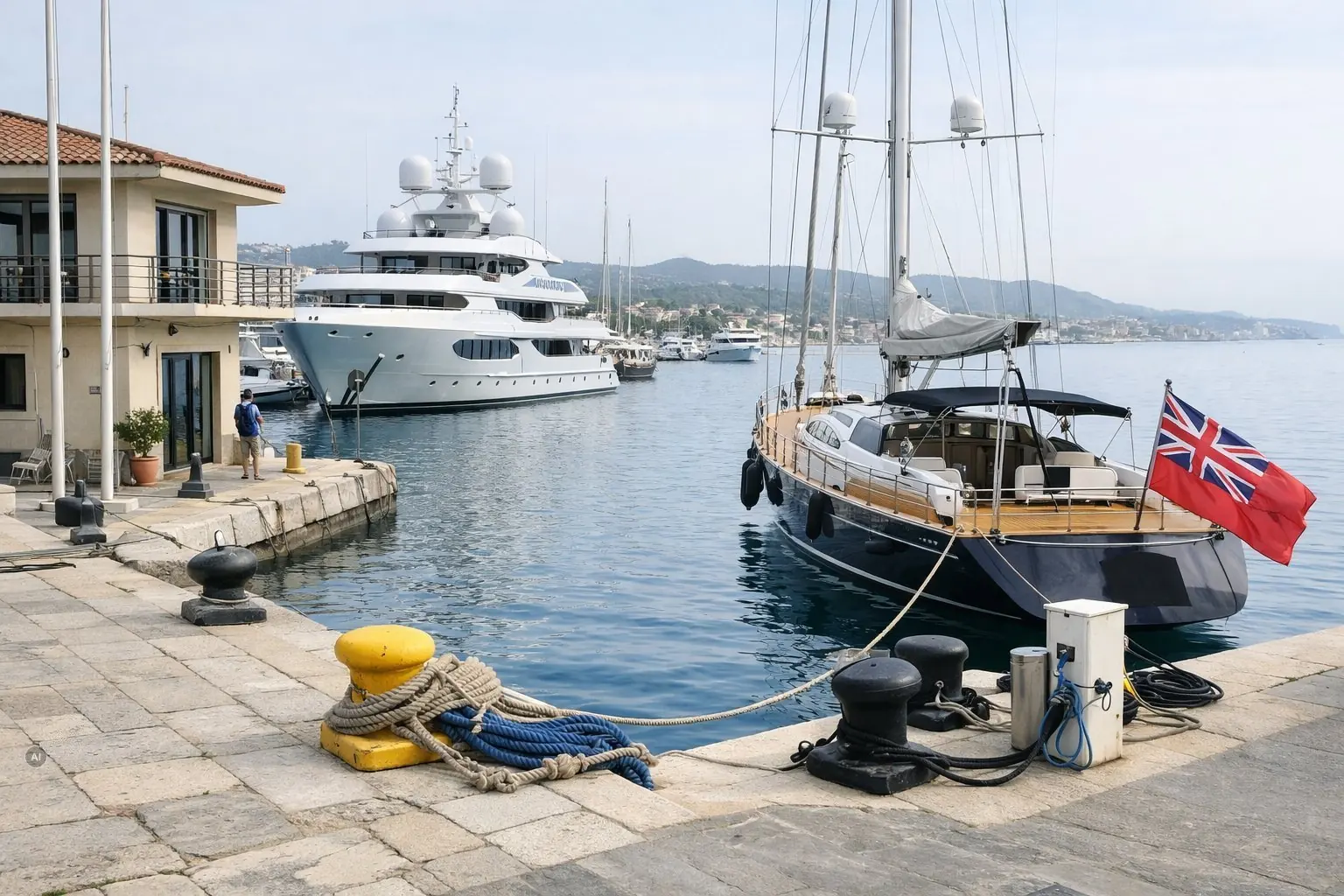
A UK-flagged yacht was seized in May 2026 at an Italian shipyard. Italian customs took the view that she had exceeded the 18 months allowed under the temporary admission regime, the arrangement that lets a non-EU owned, non-EU registered yacht cruise Union waters without paying import VAT on the hull. The yacht had been exported from France in the summer of 2024 and had reached Italy by way of Spain. On review, the Ligurian tax judges released her.
The reasoning reported by SuperYacht24 is the part worth reading twice. The judges held that leaving the customs territory of the European Union is what ends the regime, and that no call at a non-EU port is needed to make that exit real. Satellite AIS data showing the yacht in international waters was accepted as proof. The defence was run by Gianfranco Puopolo of PG Legal alongside advisers from Moores Rowland Partners. The ruling is numbered 200/2026.
The circular behind the ruling
The court was not inventing anything. On 15 May 2026 the Agenzia delle Dogane e dei Monopoli published Circular 11/2026, which set out how Italy reads the temporary admission regime for third-country flagged pleasure craft. For a yacht in private use, simply entering EU territorial waters inside the 12-mile line binds her to the regime. No further customs formality is needed at the point of entry.
Exit works the same way in reverse. Crossing out of territorial waters into international waters completes it, and the circular states that proof may come from AIS satellite tracking, from documents showing arrival at a third-country port, or from logbook entries. Confindustria Nautica has said publicly that the circular came out of proposals put to the agency around the Genoa boat show, and expects it to help both charter and refit work in Italian yards.
The refit clause that is worth real money
Buried in the same circular is a point that matters to any owner planning a long yard period in Italy. A yacht undergoing extraordinary maintenance or a refit sits under inward processing, which is a separate customs regime from temporary admission. The circular confirms that only the periods when the yacht is actually bound to temporary admission by the same owner count towards the 18-month maximum. Months on the hard in Viareggio or La Spezia do not eat the clock.
There is a matching restriction on the charter side. Once a commercial contract for consideration exists, the yacht can no longer be treated as being in private use, and she may remain in Union waters only for as long as the contracted commercial activity requires. Owners who move between private cruising and occasional charter need to keep the two states cleanly documented and dated.
France has not followed
The exposure now comes from the border between two member states reading the same code differently. SuperyachtNews has reported a case in which a non-EU flagged yacht completed VAT-exempt works in Spain under inward processing relief and was then exported by sailing beyond 12 nautical miles off the Spanish coast, in compliance with the Union Customs Code. French customs took the position that because she had not called at a third-country port such as Gibraltar or Algeria, the export was not valid, and continued counting from her original entry date.
The consequence of losing that argument is not a fine. An overstay under temporary admission triggers import VAT on the value of the hull immediately, which on a large yacht runs into the millions. Advisers quoted in that reporting now recommend returning to Spain after such an export and formally placing the yacht back under temporary admission by filing the Annexe 71.01 oral declaration, so that a fresh start date exists on paper.
What to do about it
Ask your manager what the yacht keeps before she next crosses a border. A continuous AIS record covering every departure from EU waters, retained and not overwritten by the next voyage. A dated file of the customs declarations that placed her under temporary admission on each entry. A log showing which regime she was under on every day she spent in an Italian or Spanish yard, and who owned her on those days.
The Italian position is now the most permissive in the Mediterranean and is backed by both an official circular and a court. It is also only the Italian position. A cruising plan that runs Italy to France in the same season should be built on the stricter reading until French customs move, because the yacht carries the liability, not the adviser who drew up the itinerary.
Questions this story answers
What happened?
Italian customs, and now an Italian tax court, accept satellite tracking as evidence that a non-EU yacht crossed out of Union waters and started a fresh 18-month clock. A UK-flagged yacht seized at an Italian yard in May was released on that basis. French customs are still refusing the same evidence, which is where the exposure now sits.
Who reported this?
SuperYacht24, Agenzia delle Dogane e dei Monopoli, Confindustria Nautica, PG Legal, Moores Rowland Partners, SuperyachtNews, Assagenti.
We do this for everyone who loves this world. The people who have spent their lives in it, and the people just discovering it. Yotters exists so that what we learn belongs to all of them.
Nobody pays us for this. No ads, no sponsors, nothing for sale. We just believe the world is a little better when knowledge is shared instead of kept.
If it gave you something today, tell us to keep going. Follow us, leave a like, or write a positive comment. We read every one, and they are what keeps us going.