Lurssen's 114m Nausicaa delivers before its fuel cells do
The technology that was not there at handover
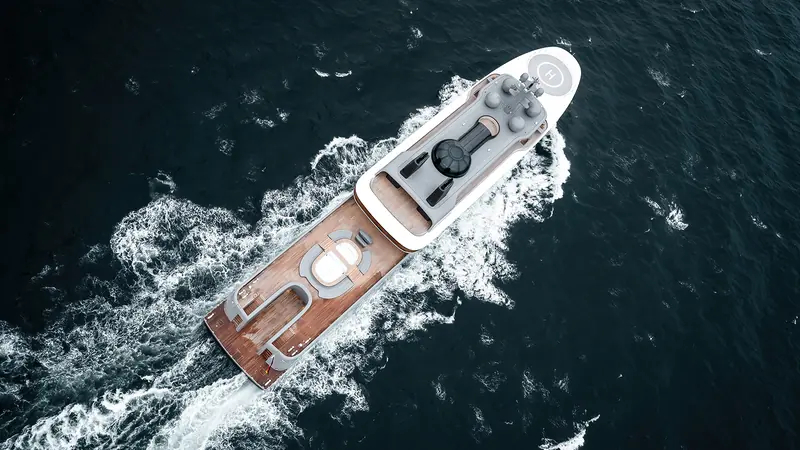
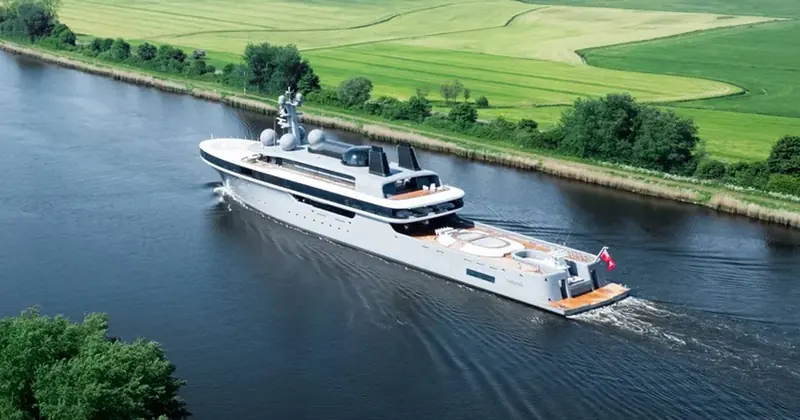
Nausicaa left Lurssen's Rendsburg yard in late May 2026 at 114.2 metres and 6,593 GT, the largest yacht the German builder has delivered this year and one of only a handful over 100 metres it has ever built with a single owner's brief driving every deck. Construction began in January 2022 under the working name Project Cosmos, and the yacht was built from the outset around a technology Lurssen had never fitted before: a pair of 500kW methanol fuel cells, ordered at the owner's specific request to let the yacht run on largely emissions-free power at anchor and at low speed.
That system was not on board when the yacht sailed away. BOAT International, reporting from sea trials and again at delivery, describes Nausicaa as having only "the provision of a fuel-cell system to convert methanol into hydrogen" - reserved space, piping and controls, not an installed and working stack. Autonocion's reporting reached the same conclusion independently, citing Lurssen's own description of the equipment as an emerging technology that will arrive "when it does." As delivered, Nausicaa runs on a conventional diesel-electric plant: two main and three auxiliary diesel generators feeding fully electric propulsion pods, backed by a battery bank rated to 2MW. Some other outlets reported the fuel cells as already operational; two independent trade-press accounts describing reserved provision, not an installed system, is the more careful reading, and it is the one this desk verified.
What is confirmed, and what Lurssen has not said
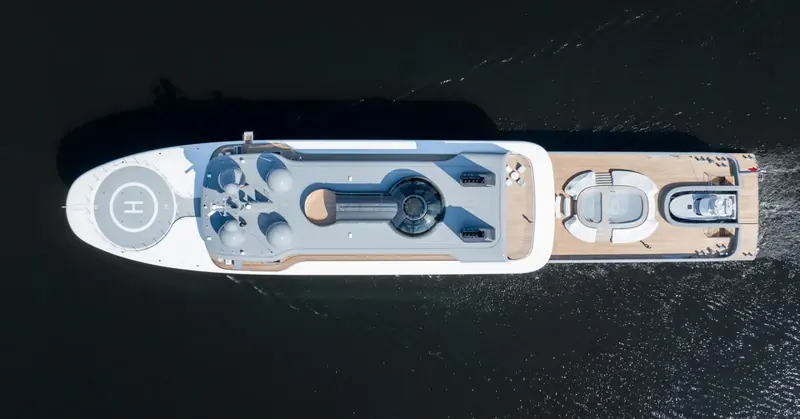
The engineering that is confirmed is substantial. Nausicaa's centrepiece is a 56 square metre Skydome study formed from seven heat-bent glass panes, each 3,000 by 2,800mm, 62mm thick and weighing 1,050kg - a single-piece glazing feat Peter Lurssen, the yard's chief executive, ties to a run of landmark glasswork stretching back through Rising Sun and Kismet. The hull is steel, reinforced to Ice Class 1D, with an aluminium superstructure to manage weight; she carries 18 guests across nine staterooms with a 36-strong crew, cruises at 20 knots on twin MTU 16V4000 diesels, and has a 19-metre glass-walled observation lounge and an 18-metre aft leisure deck with a pool and jacuzzi.
What Lurssen has not said is just as informative. No price has been published; press estimates run from roughly USD 350 million to USD 500 million, and the two figures cannot both be right, so neither should be treated as confirmed. No power or range figure has been published for the fuel-cell installation, because there is no installed system yet to measure - a genuine gap, not an omission. And Lurssen has not named the owner at all; every identification in circulation comes from outlets other than the builder.
Marc Newson's total brief
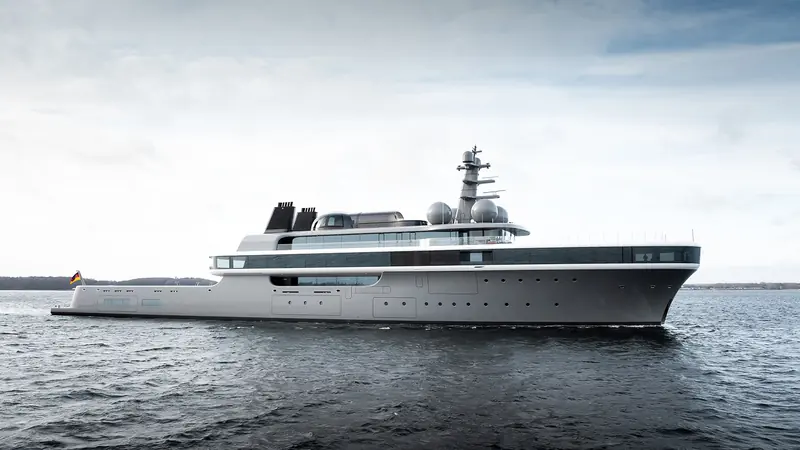
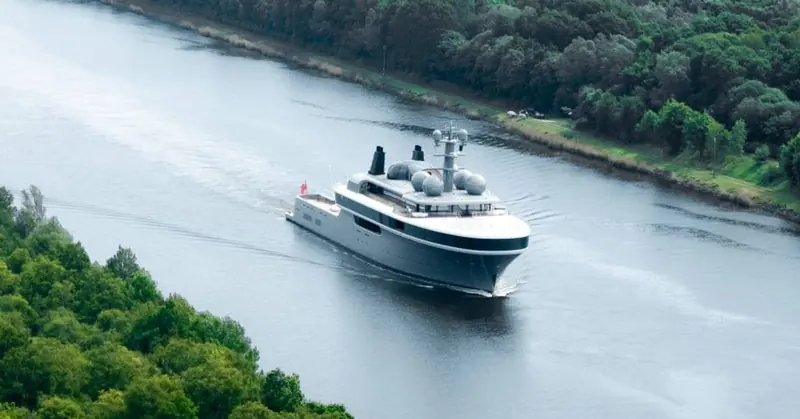
Nausicaa is also unusual in scope rather than just scale: Marc Newson, the Australian industrial designer, drew both the exterior and the interior, a level of single-author control Lurssen rarely hands over on a yacht this size. The result is a deliberately un-Lurssen-looking profile, closer to an explorer vessel than a classic tri-deck, which the yard has said was central to the owner's brief from the first sketches. "It is extremely challenging for a design project, of any description, to literally deliver on the vision conceived at concept stage," Newson said at delivery. "Here, I am very proud to say that every detail, at every scale, has been realised at the most coherent level."
Below the Skydome, the interior carries an art atrium running through two decks, a sushi bar and a 12.5-metre sportsfish tender launched on a 16-tonne sledge system - detail that reads as a working brief for a collector who travels and entertains, not a generic superyacht layout dressed up for a boat show. Peter Lurssen framed the yacht as a continuation of the yard's glass-engineering lineage rather than a one-off showpiece: "It is rare to find a modern Lurssen yacht that does not break new ground in glass engineering."
An explorer built for a collector Lurssen will not name
Multiple outlets outside Lurssen's own channels, including YachtBuyer and SuperyachtTimes' fleet database, identify the owner as Yusaku Maezawa, the Japanese entrepreneur and art collector. None of that reporting is attributed to Lurssen, which has not confirmed a name, so the identification should be read as widely reported rather than officially verified - a distinction that matters on a build this size, where mistaken ownership claims circulate easily and rarely get corrected. If the identification holds, the art atrium and the owner's private Skydome study read as brief items for a buyer with a working art collection, rather than generic luxury signalling.
The Ice Class 1D rating is the more concrete owner-facing decision. It buys the ability to operate from open polar water to the tropics on one hull, at the cost of a heavier steel structure than a standard displacement yacht would need - weight Lurssen offset by moving the superstructure to aluminium. For an owner who wants both Antarctic and Caribbean seasons on the same yacht rather than two vessels, that trade is the entire point of the specification; for a broker valuing the yacht later, it is also a hard limit on how much any refit can lighten her without touching class.
What it signals for the next fuel-cell order
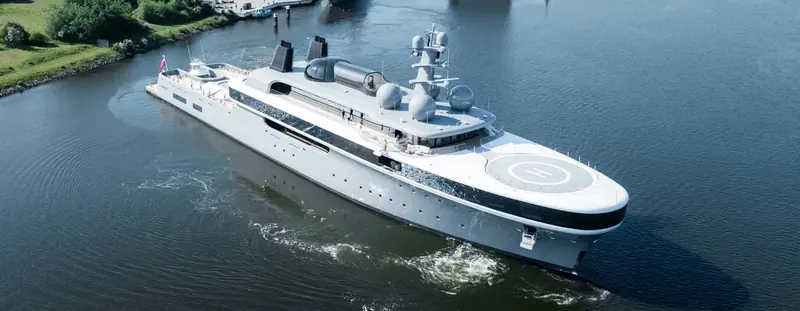
Nausicaa is the first Lurssen yacht built with fuel-cell provision, and the yard's own careful wording around it is the tell: methanol fuel cells at this scale are not yet a bought-and-fitted marine product, they are a technology still working through certification and supply timelines that a four-year build could not wait for. That lines up with the wider pattern this desk has tracked all year - shipping's own fuel rules keep slipping a year at a time - and it suggests the fuel cell stack, when it does arrive, will most likely be retrofitted rather than delivered with the hull.
The practical lesson for the next owner drafting a similar brief is to separate the two decisions Lurssen quietly separated here: the hull, tankage and class notation that make a yacht fuel-cell-ready, and the fuel cell stack itself, which is a second contract on its own timeline. A brochure or a press release that describes both as one delivered system, on this evidence, is describing the yard's ambition rather than what left the dock.
What is good, and what to watch
Strong points
- Genuine engineering featThe 56 sqm Skydome's seven heat-bent, 1,050kg glass panes are a real single-piece glazing achievement, not brochure language.
- Dual-climate capabilityIce Class 1D plus a tropical-spec interior lets one hull do a polar season and a Caribbean season without a second yacht.
- Single-author design controlMarc Newson drawing both exterior and interior gives the yacht a coherence multi-studio builds rarely achieve.
- Real silent-running capacityA 2MW battery bank is a substantial, currently-operational step toward quiet at-anchor running, unlike the fuel cells.
What to watch
- The headline technology is not aboardThe methanol fuel cells that justified the owner's brief were not fitted at delivery, only provisioned for.
- Price and owner both unconfirmedLurssen has published neither figure; press price estimates conflict by roughly USD 150 million.
- A four-year build even by Lurssen's recent paceThe yard delivered six yachts in the first seven months of 2026 on other programmes; this one took longer than most of them.
- No performance data on the actual selling pointNo range or speed figure exists yet for fuel-cell power, because there is no installed fuel cell to test.
Practical detail
| Builder / yard | Lurssen, Rendsburg (Germany) |
|---|---|
| Length / beam | 114.2m / 18.7m |
| Gross tonnage | 6,593 GT |
| Guests / crew | 18 guests in 9 staterooms / 36 crew |
| Propulsion / speed | Diesel-electric, 2x MTU 16V4000 + battery to 2MW; 20kn cruise |
| Ice class | 1D, steel hull, aluminium superstructure |
| Build / delivery | Started January 2022, delivered late May 2026 as Project Cosmos |
| Price | Not disclosed by Lurssen; press estimates range USD 350m-500m, unconfirmed |
| Fuel cells | Not installed at delivery - provision only; no power/range figure published |
| Owner | Not confirmed by Lurssen; widely reported as Yusaku Maezawa |
Questions this story answers
What happened?
Lurssen handed over the 114-metre Nausicaa in late May, the yard's biggest hull built around a headline green technology. The methanol fuel cells her owner specified were not on board at delivery - only the space reserved for them.
What is good about it?
Genuine engineering feat. The 56 sqm Skydome's seven heat-bent, 1,050kg glass panes are a real single-piece glazing achievement, not brochure language.
What should an owner or buyer watch?
The headline technology is not aboard. The methanol fuel cells that justified the owner's brief were not fitted at delivery, only provisioned for.
Who reported this?
BOAT International, YachtBuyer, SuperyachtTimes, Lurssen, Marc Newson, Peter Lurssen.
We do this for everyone who loves this world. The people who have spent their lives in it, and the people just discovering it. Yotters exists so that what we learn belongs to all of them.
Nobody pays us for this. No ads, no sponsors, nothing for sale. We just believe the world is a little better when knowledge is shared instead of kept.
If it gave you something today, tell us to keep going. Follow us, leave a like, or write a positive comment. We read every one, and they are what keeps us going.