Sunreef's 100 Eco Debuts a 770kWh Solar Catamaran at Monaco
What exactly is premiering in Monaco
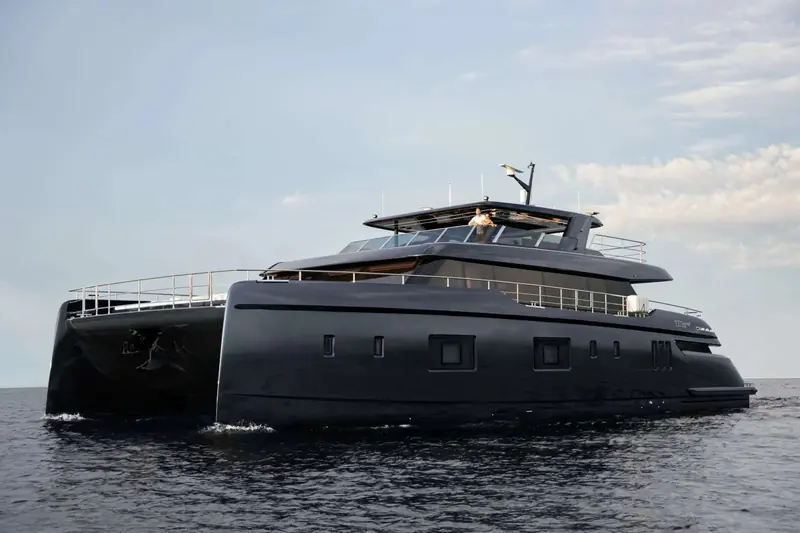
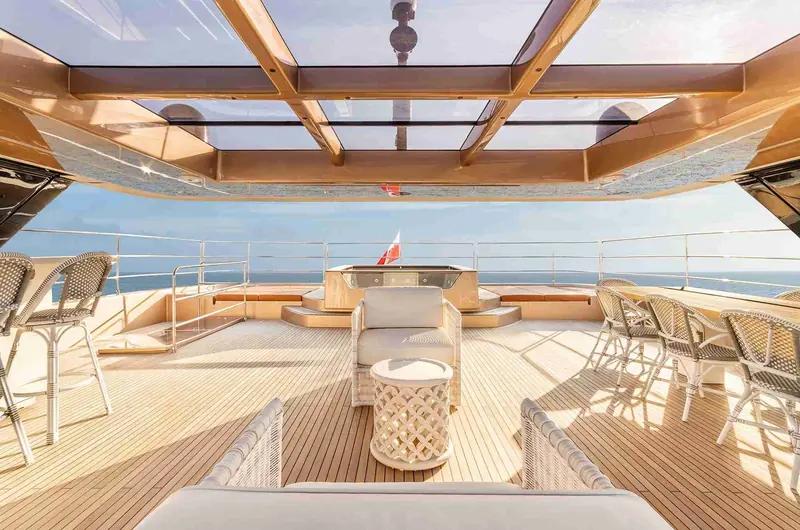
Sunreef Yachts will show the 100 Eco, a 29.26-metre sailing catamaran with electric propulsion and a proprietary solar-cell hull, at the Monaco Yacht Show from 23 to 26 September 2026. It is the yard's first full-size sailing catamaran built around a battery-electric drivetrain rather than diesel, according to Boat International. The hull on display, named Ipharra II, was sold at the 2022 Fort Lauderdale International Boat Show, with construction starting in early 2023 at Sunreef's Gdansk yard. It launched quietly on 26 June 2026 for sea trials ahead of its public debut, per Sunreef Yachts and Megayacht News. Beam is 12.83 metres, giving the platform the volume Sunreef needs to fit the battery bank and a full owner-grade interior.
The premiere matters because it extends a product line Sunreef has been building since its first Eco launches around 2019, moving the concept up from the 60 and 80-foot Eco catamarans already delivered to a genuine 100-foot flagship. Sunreef is positioning the boat around what it calls responsible long-distance cruising, aimed squarely at owners who want a showpiece at Monaco without a generator running audibly at the dock. That pitch lines up with a real regulatory shift in the Mediterranean, where more marinas and harbor authorities are tightening rules on idling generators, noise and local emissions at berth. A silent, solar-charged catamaran addresses a rule that is starting to cost owners berthing options in those ports.
How the propulsion and power system actually works
The 100 Eco pairs two 360kW electric motors with a 770kWh lithium battery bank, backed by onboard generators for when sail, sun and battery are not enough, according to Megayacht News and Yachting World. It carries 515 square metres of upwind sail area, so this is a sailing catamaran with electric auxiliary power rather than a motor yacht with solar trim. Sunreef describes the combination as offering potentially unlimited range under sail and solar assistance. Neither Boat International nor Yachting World, the two outlets that got the closest technical look at the boat, published an independently verified top speed or an electric-only range in nautical miles. That is a real gap for a buyer trying to compare this boat against a conventional diesel catamaran on paper.
Yachting World's own reviewers were candid about the practical limit here: most owners, they noted, will still want speeds that require firing up the generators, which caps how often the zero-carbon pitch actually applies. In practice that means the electric-and-solar system is strongest for at-anchor living, harbor arrivals and departures, and light-air passages, and weakest whenever an owner wants to cover distance quickly. For an HNWI buyer used to a diesel monohull's on-demand cruising speed, that is a genuine trade, not a footnote, and it is worth pressing Sunreef for hard numbers before signing rather than accepting the unlimited-range framing at face value.
What makes the solar skin different from a normal yacht's panels
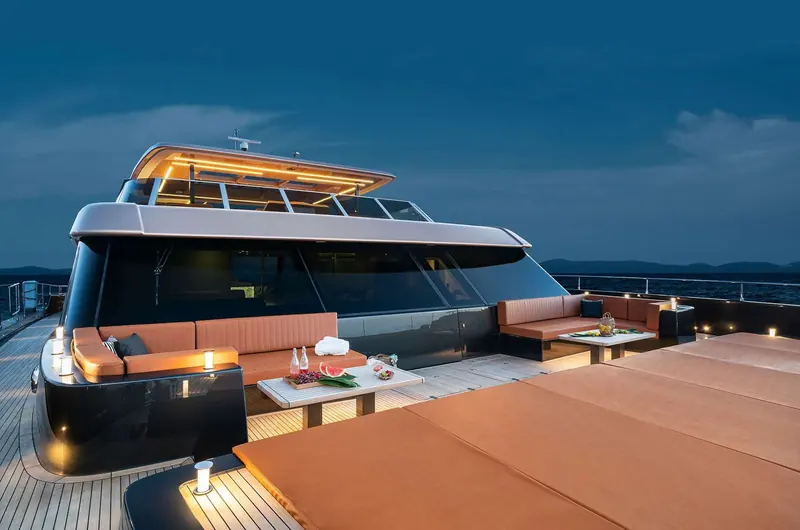
Sunreef's solar cells are laminated directly into the hull sides, superstructure and fixed bimini rather than bolted on as separate panels, covering roughly 242.5 square metres and rated up to 46 kWp, according to Multihulls World's technical listing. The cells are under one millimetre thick and weigh about 1.8kg per square metre, against 8 to 15kg per square metre for conventional rigid marine solar panels, per YACHT Magazine's reporting on Sunreef's Solar Skin program. Sunreef quotes cell efficiency of 24.8 percent, which it says is on par with the best rated residential solar panels on the market and 25 to 30 percent more output than conventional marine cells. The panels are also engineered for thermal stability above 100 degrees Celsius and rated to more than 20,000 load cycles, addressing the heat and flex a hull-integrated panel has to survive that a rooftop panel never sees.
The more interesting piece for an owner is the software layer: Sunreef uses AI-driven algorithms to adjust electrical output in real time as sails and rigging cast shifting shadows across the hull and bimini, according to YACHT Magazine's coverage of the underlying Solar Skin technology. That solves a problem a bolted-on panel array on a monohull's hardtop simply does not have to deal with, because a rigid panel bank needs a clear, fixed exposure to work efficiently. Integrating the cells into the structure also means no added windage, no visible panel array breaking up the yacht's lines, and no parasitic weight sitting on top of the boat the way a retrofit array would carry. For a sailing catamaran that already has a full rig to manage, that structural integration is the more defensible engineering claim than the unlimited-range marketing line, and it is where Sunreef genuinely differs from a solar panel installed on a conventional superyacht.
Who is buying hull one and what did they choose
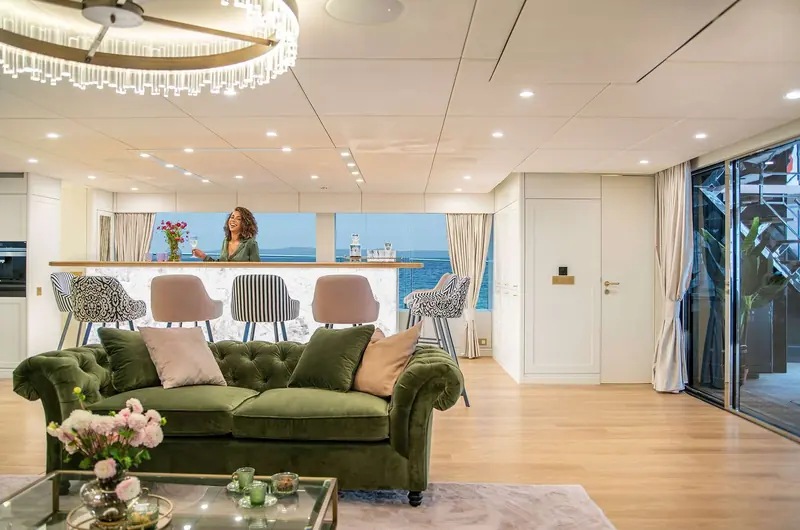
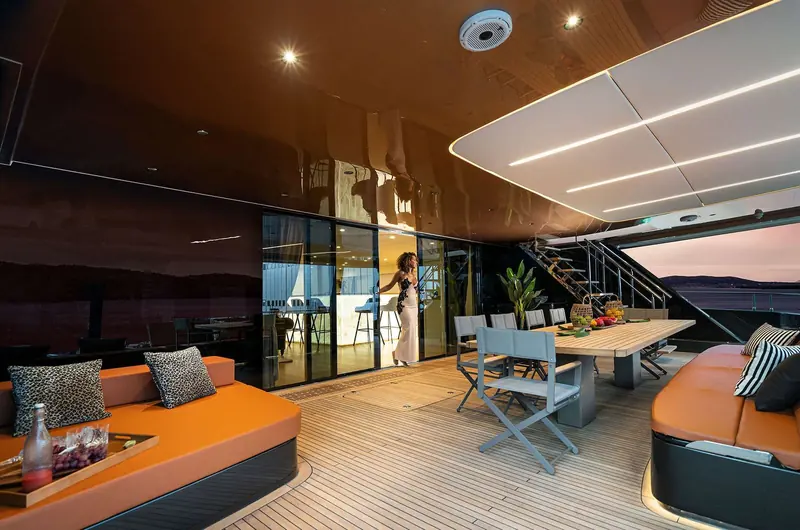
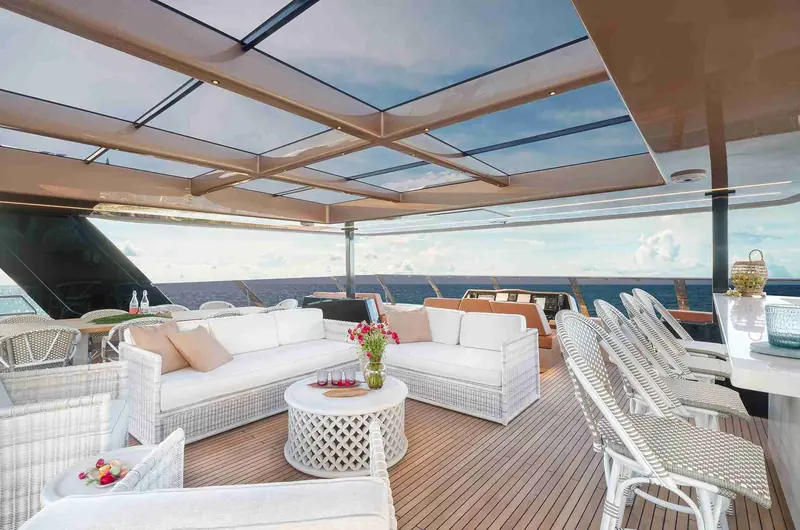
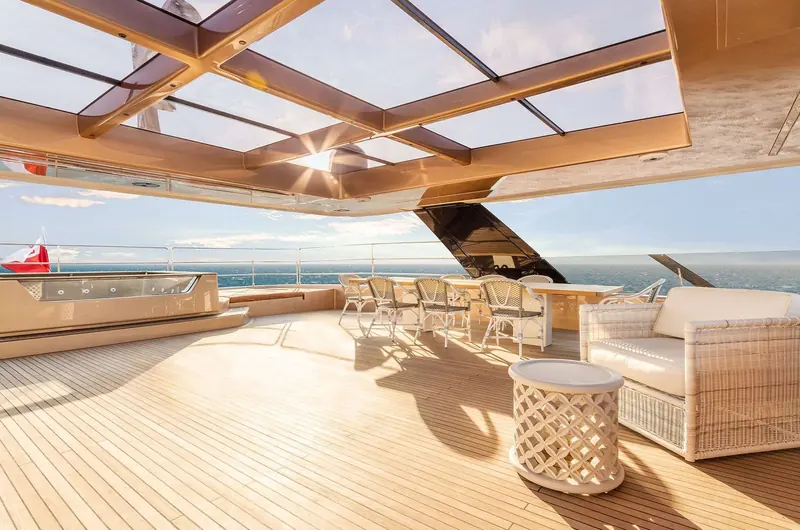
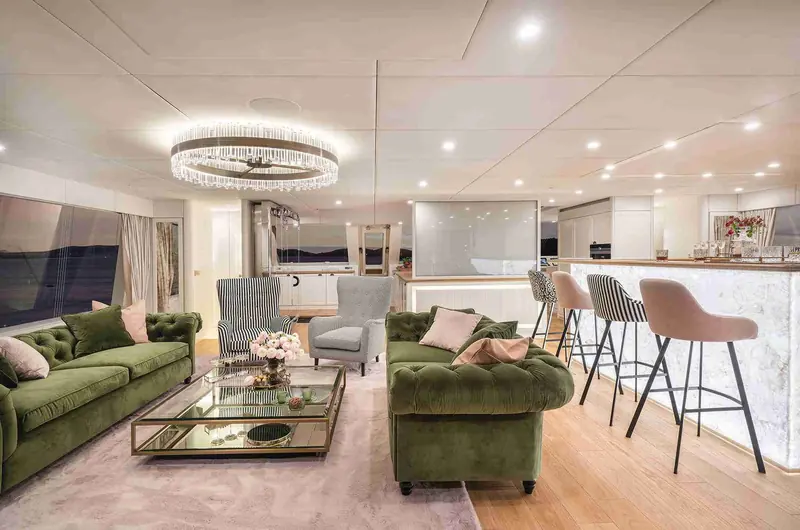
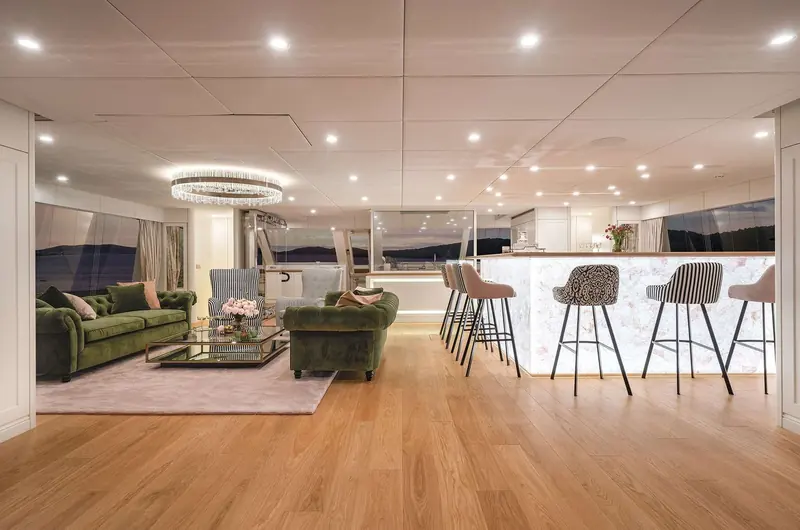
The first 100 Eco, hull Ipharra II, was ordered by a repeat Sunreef owner who was already a believer in the solar-skin technology before signing the contract, according to Sunreef Yachts and Boat International. That is a stronger signal than a first-time buyer taking a leap of faith on unproven technology, since this owner had presumably already lived with an earlier Sunreef solar or Eco installation. The layout on this hull includes a full-beam main saloon, a forward owner's suite, and an aft Ocean Lounge with a concealed garage for two jet skis, plus a spa, gym, bar and office, accommodating up to 12 guests in this configuration. That is a notably larger guest count than the standard 100 Eco brochure layout, which Yachting World describes as a forward master cabin plus four further double cabins for 8 guests and 5 crew, illustrating how far Sunreef will customize the platform for a repeat client.
One specific choice stands out as evidence this is a genuinely bespoke build rather than a spec boat with a paint job: the owner declined the optional flybridge spa pool that Sunreef offers on the model, per Boat International's reporting on the launch. From order to launch, the timeline ran from the 2022 Fort Lauderdale show to a June 2026 float-out, roughly three and a half years, which is a useful data point for any owner pricing out a bespoke Eco order today rather than a brochure delivery slot. Sunreef has not disclosed a price for this hull or for the 100 Eco generally; brokers have quoted the conventional, non-Eco Sunreef 100 platform from around EUR 12 million, but that figure says nothing about what the battery bank and solar-skin package add on top.
What Sunreef's smaller Eco boats tell us about the real verdict
Owners of Sunreef's smaller Eco catamarans report the concept works well at anchor and in light air, but none has demonstrated a true diesel-free ocean crossing. Multihulls World's sea trial of the 80 Eco in 2022 was conducted in 5 to 10 knots of wind and calm seas, testing electric propulsion and the yard's energy management system rather than a genuine offshore passage; that boat carries about 200 square metres of solar generating roughly 40kW. Broker listings for the 60 Eco show battery capacity reported inconsistently across hulls and years, from roughly 250kWh to 375kWh depending on the source, with cruise speed around 7 knots and a maximum near 11 knots, and auxiliary diesel generators doing real work to top up the battery on longer legs. That pattern across two smaller Eco models suggests the line is a genuine hybrid in practice, leaning on diesel generation whenever wind and sun are not cooperating, rather than a pure-electric passagemaker.
That history is the honest context for the 100 Eco's Monaco debut: the solar-skin technology is real, independently documented engineering, and the repeat-customer order is a genuine vote of confidence, but the unlimited-range language describes a best-case sailing scenario rather than a guaranteed cruising capability. The resale market for this specific proposition barely exists yet, since too few Eco-line hulls have changed hands to build a price curve, unlike the conventional Sunreef 100 power catamaran, where broker data on used boats is now reasonably deep. Add an undisclosed price premium for the battery and solar package, plus the smaller buyer pool that any large sailing catamaran faces against monohull superyachts of comparable length, and an owner should treat this as a genuinely differentiated boat bought for status, marina compliance and at-anchor silence, not yet as a proven diesel-free ocean cruiser.
What owners and crew report
Hull one's owner was already a solar-skin believer
Sunreef and Boat International both report the buyer was a repeat Sunreef owner who had confidence in the solar-skin technology before commissioning this boat
Sunreef Yachts / Boat InternationalThe owner cut the optional flybridge spa pool
Ipharra II's configuration drops Sunreef's optional flybridge Jacuzzi, a concrete customization choice reported on this specific hull
Boat InternationalThe 80 Eco's sea trial only covered calm, light-air conditions
the 2022 sea trial of the smaller 80 Eco ran in 5 to 10 knots of wind and calm seas, demonstrating the electric and solar system without testing genuine offshore conditions
Multihulls WorldIndependent reviewers call the unlimited-range claim theoretical
Yachting World's write-up on the 100 Eco states plainly that most owners will still want speeds that require the generators, undercutting the zero-carbon-crossing framing
Yachting World
What is good, and what to watch
Strong points
- Genuinely proprietary solar technologycells laminated at about 1.8kg per square metre versus 8-15kg for bolted-on panels, 24.8 percent efficiency, and real-time AI shading compensation for sails and rigging is a documented engineering advance, not a marketing sticker
- Repeat-customer validationhull one was ordered by an existing Sunreef owner who was already sold on the solar-skin concept before signing, a stronger signal than a first-time buyer's leap of faith
- Marina and berthing relevancesilent, low-local-emission running at anchor and in port fits a tightening Mediterranean regulatory trend on generator noise and emissions at berth
What to watch
- Electric-only range and speed are not publishedneither Sunreef nor the outlets that reviewed the boat have put a verified nautical-mile or knot figure on pure electric running, making direct comparison to a diesel catamaran impossible on paper
- Unlimited range is a sailing claim, not a motoring oneYachting World's own reviewers note most owners will still want speeds that require firing up the generators, so the zero-carbon pitch mainly covers at-anchor and light-air use
- Resale market is effectively unproventoo few Eco-line hulls have changed hands to establish a price curve, unlike the conventional non-Eco Sunreef 100 power catamaran where used-boat data is now reasonably deep
- Price premium undisclosedSunreef has not published what the battery bank and solar-skin package add over a standard hull, so buyers negotiate the eco premium without a public benchmark
- Catamaran ownership is a different proposition than a monohullberthing, resale comparables and the buyer pool for large sailing catamarans remain smaller and more specialized than for monohull superyachts of similar length
Practical detail
| LOA / Beam | 29.26 m (96 ft) / 12.83 m (42 ft); one technical sheet rounds LOA to 28.65 m |
|---|---|
| Propulsion | 2 x 360 kW electric motors, plus onboard generators for backup and higher-speed running |
| Battery | 770 kWh lithium bank |
| Solar array | approx. 242.5 sq m laminated into hull, superstructure and bimini, rated up to 46 kWp |
| Sail area | 515 sq m upwind |
| Guest capacity | 8 guests / 5 crew in standard layout; hull one (Ipharra II) configured for up to 12 guests |
| Electric-only range/speed | not published by Sunreef or independently verified by the outlets that reviewed the boat |
| Price | not disclosed for the 100 Eco; brokers quote the non-Eco Sunreef 100 platform from about EUR 12 million, an unrelated baseline |
| Delivery timeline | sold 2022 FLIBS, build started early 2023, launched 26 June 2026, world premiere at Monaco Yacht Show 23-26 September 2026 |
| How to order | direct through Sunreef Yachts; no confirmed charter listing found for this hull |
Questions this story answers
What happened?
Sunreef will unveil the 100 Eco, a 29-metre sailing catamaran built around a 770kWh battery and solar cells laminated straight into its hull, at the Monaco Yacht Show in September 2026. The order came from a repeat Sunreef owner already convinced by the yard's solar-skin technology before signing for a new boat. For an owner weighing a move into electric-hybrid cruising, the real story is what Sunreef still will not publish: exact electric-only range, top speed, and the price of going green.
What is good about it?
Genuinely proprietary solar technology. cells laminated at about 1.8kg per square metre versus 8-15kg for bolted-on panels, 24.8 percent efficiency, and real-time AI shading compensation for sails and rigging is a documented engineering advance, not a marketing sticker
What should an owner or buyer watch?
Electric-only range and speed are not published. neither Sunreef nor the outlets that reviewed the boat have put a verified nautical-mile or knot figure on pure electric running, making direct comparison to a diesel catamaran impossible on paper
What do owners and crew report?
Sunreef and Boat International both report the buyer was a repeat Sunreef owner who had confidence in the solar-skin technology before commissioning this boat (Sunreef Yachts / Boat International)
Who reported this?
Boat International, Yachting World, Megayacht News, Multihulls World, YACHT Magazine, Sunreef Yachts.
We do this for everyone who loves this world. The people who have spent their lives in it, and the people just discovering it. Yotters exists so that what we learn belongs to all of them.
Nobody pays us for this. No ads, no sponsors, nothing for sale. We just believe the world is a little better when knowledge is shared instead of kept.
If it gave you something today, tell us to keep going. Follow us, leave a like, or write a positive comment. We read every one, and they are what keeps us going.