Sunreef Launches Its 100 Eco Sailing Catamaran Ahead of Monaco
What exactly is the Sunreef 100 Eco?
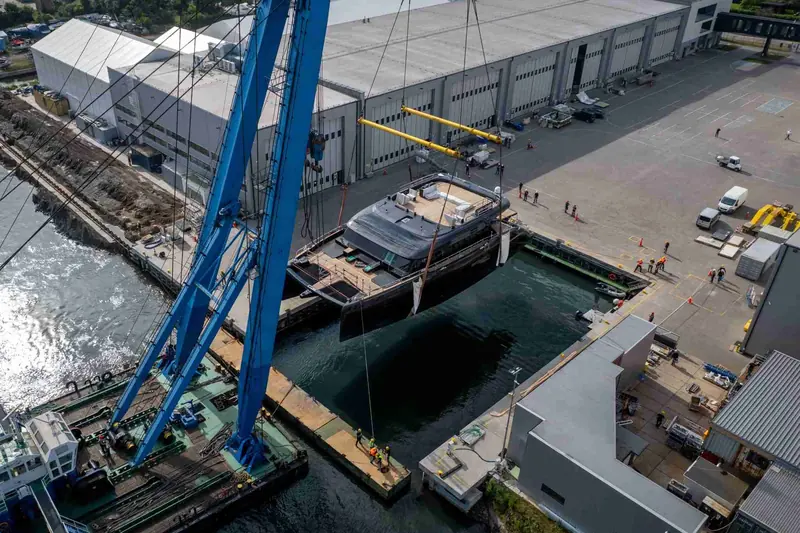
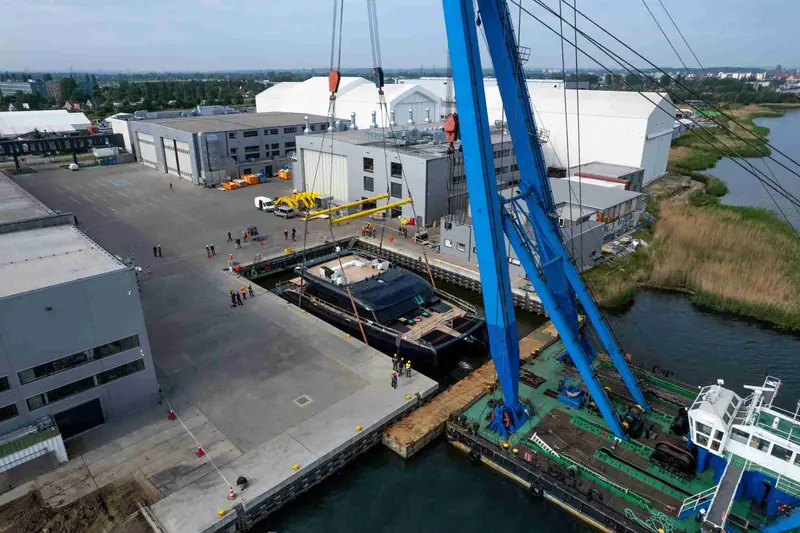
The 100 Eco is a 29.3-metre sailing catamaran launched by Sunreef at its Gdansk yard in June 2026, carrying twin 360kW electric motors, a 770kWh battery bank and roughly 45kWp of solar panels alongside a full sailing rig. It sits in Sunreef's Eco line, a hybrid range distinct from the yard's Zero catamarans, which are built to run without fossil fuel at all.
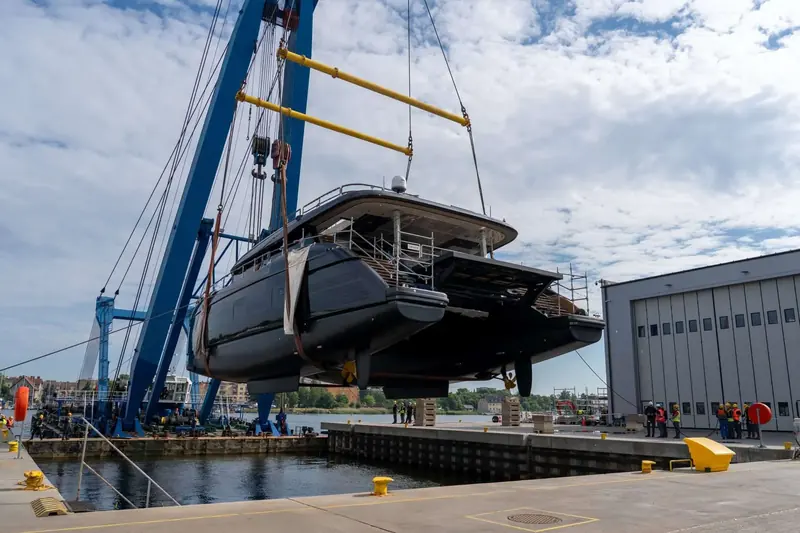
Sunreef confirmed the launch of the first 100 Eco at its Gdansk shipyard in June 2026, the largest hull yet in a hybrid sailing line that already includes 60, 70 and 80-foot models. The yacht measures 29.3 metres overall with a beam of about 12.8 metres, and Yachting World, which reviewed the first hull, records upwind sail area of 515 square metres, a mast, and a genuine sailing rig rather than the auxiliary sail sometimes fitted to a motor yacht for stability. That distinguishes the 100 Eco from Sunreef's separate Power Eco range, a motor catamaran of similar size built around the same hybrid idea but without a rig.
The name matters because Sunreef also builds a Zero range, catamarans engineered to run entirely without fossil fuel. The 100 Eco is not that boat. It carries electric propulsion and a large renewable-generation system, but per Yachting World's own reporting it is backed by onboard generators for the speeds and range most owners will actually use, a hybrid rather than a fossil-free design. An owner reading the Eco name should not assume it means the same thing as Zero; it means solar and battery power layered onto a conventional sailing catamaran, not a boat that has removed diesel from the equation.
How much power does the solar and battery system really provide?
Sunreef has installed a 770kWh battery bank and roughly 45kWp of solar capacity across the hulls, superstructure and bimini, feeding twin 360kW electric motors - real, independently reported figures, not a marketing round number.
Three independent outlets, Marine Industry News, Top Yacht Design and YACHT magazine, converge on the same core figures: two 360kW electric motors, a 770kWh battery bank, and a solar array rated at roughly 45kWp drawn from more than 240 square metres of panel surface built into the hulls, coachroof and bimini. YACHT magazine also reports a panel efficiency of 24.8 percent, high for marine-grade solar and a sign the array is doing real work rather than sitting on the deck as a styling cue. Yachting World puts the same solar figure at up to 45kW and records the accommodation as built on the first hull: eight guests in five cabins, a master forward and four doubles in the hulls, with crew quarters for up to five including a dedicated captain's cabin.
Those are substantial numbers for a catamaran of this size - a battery bank close to what some considerably larger motor yachts carry for hotel loads alone, feeding a solar array large enough to matter rather than a token gesture. Francis Lapp, Sunreef's founder and president, said of the launch: 'With the Sunreef 100 Eco, we are proving that the future of superyachting can be both luxurious and responsible. Combining electric propulsion, solar power and the efficiency of sailing, this yacht sets a new benchmark for clean cruising.' The installed capacity backs that claim up on paper; the question for an owner is how it behaves at sea.
Can the 100 Eco really cruise without burning fuel?
Only at low speed. Yachting World's own first-look assessment is that the unlimited, zero-carbon range Sunreef advertises holds up only in theory, because most owners will want cruising speeds that require running the generators.
Sunreef's own framing is that the solar array can keep the batteries topped up indefinitely, so a boat that only ever needed four to six knots could in principle cruise without ever burning fuel. Yachting World, reviewing the first hull, was candid about the gap between that claim and how the boat will actually be used: the solar input can keep the boat operating silently at anchor, killing the generator hum overnight or at sunset, but real passage-making at real speeds still calls for the generators most of the time. That is not a defect unique to this boat; it is true of every hybrid yacht built so far, and Sunreef has not published a top speed, a motoring range under generator power, or a fuel-burn figure that would let an owner compare the 100 Eco's real running cost against a conventional catamaran of the same size.
For an owner, the useful way to read the claim is to separate the two things it is actually good for. At anchor, in a marina, or making a slow passage under sail with the motors idling in support, the solar and battery system genuinely removes the noise and the diesel bill that a generator-only boat would carry. Making way at a normal cruising speed against wind or current is a different matter, and nothing published so far says how many hours that mode buys before the generators are needed. An owner should ask the yard for that number directly rather than take 'unlimited range' as a description of ordinary use.
Is the 100 Eco a real order, or a boat-show concept?
It is already sold. Sunreef confirms the first hull went to a returning owner of an earlier Sunreef yacht, and the boat is booked for its public debut at the Monaco Yacht Show in September, not a renderings-only reveal.
Unlike a concept released purely to gauge interest, the 100 Eco exists as a built, launched hull, and Sunreef and Marine Industry News both report that the first owner is a repeat Sunreef client rather than a new name to the brand, evidence that the yard's existing owner base is willing to pay for the hybrid system rather than treat it as a marketing exercise. The yacht makes its formal public debut at the Monaco Yacht Show, running 23 to 26 September 2026 at Port Hercule, where Marine Industry News reports it will be shown alongside the Power Eco model in the same size bracket.
For a prospective buyer, the practical read is that the 100 Eco is past the point where a concept quietly disappears after its unveiling: it has been through a shipyard launch, it has an owner, and it is heading to sea trials before Monaco. What is still missing is the information a serious buyer needs before signing - price, top speed, and a motoring range under power - and none of that has been published yet. Sunreef has a pattern of releasing those figures closer to a show debut, so Monaco is the point at which this yacht's practical case, rather than its environmental one, should become clear.
What is good, and what to watch
Strong points
- Already a real order, not a boat-show conceptThe first hull is launched, sold to a returning Sunreef owner, and booked for sea trials ahead of its Monaco debut - a different stage of readiness from a renderings-only reveal, and evidence the yard's own owner base is willing to pay for the hybrid system.
- A genuinely large installed renewable system, not a token gestureA 770kWh battery bank and roughly 45kWp of solar across three independent reports is a substantial installation for a catamaran this size, large enough to run the boat silently at anchor and materially cut the generator hours a conventional catamaran would need.
What to watch
- 'Unlimited range without emitting carbon' holds up only at low speedYachting World's own first-look assessment is that most owners will want cruising speeds that require running the generators, so the headline environmental claim describes a mode of use rather than how the boat will normally be sailed.
- The figures a real buyer needs are still missingNo top speed, no motoring range or fuel burn under generator power, and no price have been published, so a buyer cannot yet compare the 100 Eco's real running cost against a conventional catamaran of the same size.
Practical detail
| Price | Not published. Neither Sunreef's own launch announcement nor the trade coverage of the first hull states a base price for the 100 Eco. |
|---|---|
| Where to see her | Public debut at the Monaco Yacht Show, 23-26 September 2026, Port Hercule, alongside the Power Eco model in the same size bracket, per Marine Industry News's coverage of the show entry. |
| Propulsion and power | Twin 360kW electric motors drawing on a 770kWh battery bank, fed by roughly 45kWp of solar panels across the hulls, coachroof and bimini - figures reported consistently by Marine Industry News, Top Yacht Design and YACHT magazine - backed by onboard generators for higher speeds and longer passages, per Yachting World's review of the first hull. |
| Accommodation as built | Eight guests in five cabins - a master forward and four doubles in the hulls - with crew quarters for up to five including a dedicated captain's cabin, per Yachting World's review of the first hull. |
| What is not published | No top speed, no motoring range or fuel burn under generator power, and no price have been published for the 100 Eco. Sunreef's own claim of unlimited, zero-carbon range describes low-speed cruising only, per Yachting World's own assessment, not the boat's ordinary use. |
Questions this story answers
What happened?
Sunreef has launched the first 100 Eco, a 29.3-metre sailing catamaran that pairs twin electric motors, a 770kWh battery and roughly 45kWp of solar with a full sailing rig, distinct from the fully fossil-free Zero range the yard also builds. At least one hull is already sold to a returning Sunreef owner, and the boat makes its public debut at the Monaco Yacht Show in September. For an owner weighing the claim of near-silent, near-emission-free cruising, the honest reading is that the number that matters is how much of a passage is actually made on electric power alone, not the headline range figure.
What is good about it?
Already a real order, not a boat-show concept. The first hull is launched, sold to a returning Sunreef owner, and booked for sea trials ahead of its Monaco debut - a different stage of readiness from a renderings-only reveal, and evidence the yard's own owner base is willing to pay for the hybrid system.
What should an owner or buyer watch?
'Unlimited range without emitting carbon' holds up only at low speed. Yachting World's own first-look assessment is that most owners will want cruising speeds that require running the generators, so the headline environmental claim describes a mode of use rather than how the boat will normally be sailed.
Who reported this?
Marine Industry News, Yachting World, YACHT, Top Yacht Design, Sunreef Yachts.
We do this for everyone who loves this world. The people who have spent their lives in it, and the people just discovering it. Yotters exists so that what we learn belongs to all of them.
Nobody pays us for this. No ads, no sponsors, nothing for sale. We just believe the world is a little better when knowledge is shared instead of kept.
If it gave you something today, tell us to keep going. Follow us, leave a like, or write a positive comment. We read every one, and they are what keeps us going.