Lurssen's 114m Nausicaa Delivers, Still Running on Diesel
A Four-Year Build, Delivered on Diesel
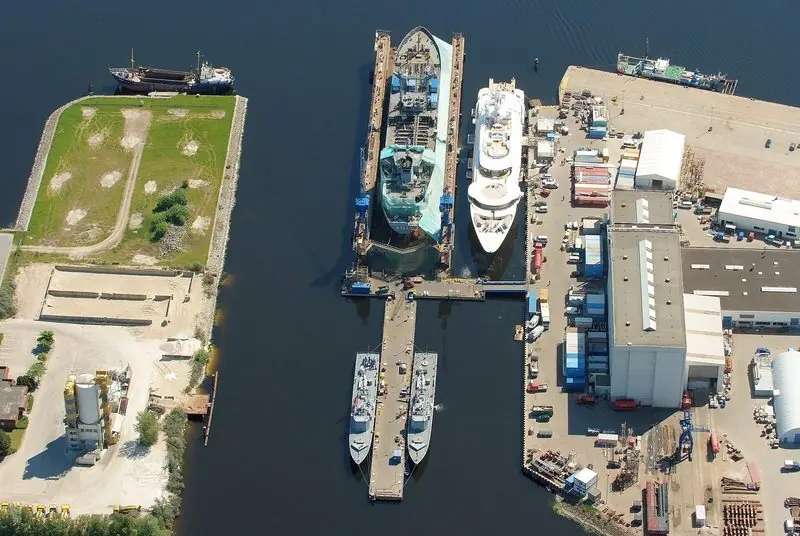
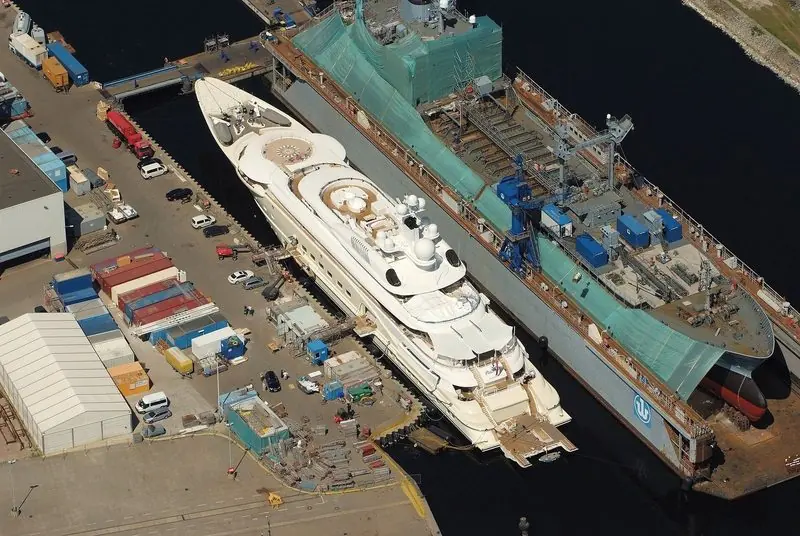
Nausicaa left Lurssen's Lemwerder yard for her owner on 25 May 2026, closing a build that started in January 2022, put her hull in the water under the working name Project Cosmos in August 2025, and finished sea trials that December. She is 114.2 metres long on an 18.7-metre beam, with an anticipated 6,593 GT pending final registry measurement, and was commissioned by a Japanese owner Lurssen has not named. Exterior and interior design is by Marc Newson, the Australian industrial designer better known for consumer electronics and furniture than yachts, working on his first large commission for the yard. As of her delivery report she was already under way toward Gibraltar, the traditional first stop for a new Lurssen leaving northern Germany for the Mediterranean.
Her propulsion at delivery is a five-engine diesel-electric plant, two primary generators and three auxiliary, driving fully electric azimuthing pods with a battery bank rated up to 2MW. That much is conventional for a Lurssen this size. What made Nausicaa a two-year trade-press story before she ever left the water is a separate system built into her machinery spaces: the provision, in Lurssen's own wording from BOAT International's delivery report, of a fuel-cell system to convert methanol into hydrogen and generate electricity from it. Provision, in this context, means the yard has built the space, the plumbing, the ventilation and the electrical architecture the fuel cells will eventually plug into. It does not mean the fuel cells are on board.
The Gap Between 'Equipped With' and 'Wired For'
That distinction was not how the story ran the first time round. Coverage at her August 2025 launch described Cosmos as equipped with two 500kW methanol fuel cells capable of 1,000 nautical miles on electric power alone and 15 days at anchor with zero emissions, language that reads as a working system rather than an installed-later one. BOAT International's own delivery report, filed the day she was handed over, corrects that: the fuel cells are an emerging technology in yachting that Lurssen says is happening, and when it does, its integration will mark a step away from fossil-fuelled propulsion. That is a yard talking about the future, not describing what left the dock. Nausicaa was delivered, and is currently cruising, on diesel.
The comparison the yard cannot avoid is Feadship's Breakthrough, a 119-metre delivered a year earlier, in May 2025, with a genuinely operational hydrogen fuel-cell system already generating power at handover. The two are not quite the same technology: Breakthrough stores liquid hydrogen in a cryogenic tank at minus 253 degrees Celsius, a proven but demanding storage method, while Nausicaa's provisioned system would reform methanol into hydrogen on board, trading the cryogenics for a fuel that can be bunkered at ambient temperature in more ports. Methanol is the easier fuel to source and store; liquid hydrogen is the technology that Feadship has actually made work. An owner choosing between the two approaches today is choosing between a system that exists and a system that is designed to exist.
The Newson Design: A Skydome Instead of a Wheelhouse View
Where Nausicaa is unambiguous is her design brief. Newson gave her an explorer-style profile across six decks, built around a 56-square-metre glass Skydome that functions as the owner's private study, connected by a terrace and topped by a continuous glass band that runs along her upper level. A 19-metre glass-encased observation lounge sits below it, turning what would ordinarily be enclosed superstructure into sightlines a conventional wheelhouse-forward layout does not offer. The hull itself is certified to Ice Class 1D, a genuine expedition rating rather than a styling cue, which puts Nausicaa in a small group of large yachts actually built to operate in cold and ice-adjacent water rather than merely photographed near it.
Aft, an 18-metre open deck carries a swimming pool and a Jacuzzi, and her tender garage holds a 12.5-metre sportsfish boat launched and recovered on a 16-tonne capacity sledge system, hardware sized for a serious fishing tender rather than a runabout. Taken together with the Skydome and the ice-rated hull, the design case for Nausicaa is coherent even without the fuel cells: this is a yacht built for an owner who wants to go somewhere remote and stay there in comfort, not one built to sit at a show dock. The propulsion story is the part still catching up to the rest of the boat.
Lurssen's Pace, and What Comes Next
Nausicaa is not an isolated delivery. Lurssen handed over the 102.4-metre Nixie in June 2026, and the yard has separately delivered six superyachts in a 105-day stretch this year, a cadence that puts Nausicaa inside a broader run of large, technically ambitious hulls leaving Lemwerder and Bremen close together rather than a one-off flagship moment. Set against that output, a yacht that ships with a genuine ice-class hull and a wired-but-empty fuel-cell bay reads less like an unfinished promise and more like standard practice for a yard de-risking a technology it does not yet trust to install on delivery day.
What happens next is the open question Lurssen has not answered publicly: no installation date, no confirmed supplier for the fuel-cell hardware itself, and no word on whether the owner intends to retrofit at all rather than simply carry the option. For a buyer weighing a comparable commission, the practical lesson is to ask a yard exactly that question before signing: whether an advertised future technology is contracted, costed and dated, or whether it is space held open against a system that, in Lurssen's own words, is still an emerging technology in yachting.
What is good, and what to watch
Strong points
- A genuine expedition hullIce Class 1D certification is a real operational rating, not a styling cue, and puts Nausicaa among a small group of large yachts actually built to work in cold water
- Design brief delivered in fullThe 56-square-metre glass Skydome, the 19-metre observation lounge and the six-deck explorer profile are finished and aboard, unlike the propulsion system
- Infrastructure, not vapourwareThe fuel-cell provision is built space, plumbing and wiring, a real de-risking step toward a future retrofit rather than pure marketing language
What to watch
- Delivered on diesel despite the coverageA year of trade press described the fuel cells as fitted; Lurssen's own delivery-day language confirms they are not, and the yacht runs on conventional diesel-electric today
- No installation dateLurssen has not said when, or whether, the methanol fuel cells will actually be fitted
- Trails Feadship's Breakthrough by a yearFeadship delivered a 119-metre with operational hydrogen fuel cells already generating power in May 2025; Nausicaa's equivalent system remains unbuilt
Practical detail
| Specifications | 114.2m LOA, 18.7m beam, anticipated 6,593 GT pending final registry measurement |
|---|---|
| Propulsion at delivery | Five-engine diesel-electric plant (two primary, three auxiliary) driving electric azimuth pods, battery bank up to 2MW |
| Fuel-cell provision | Space, plumbing, ventilation and electrical architecture for two 500kW methanol-to-hydrogen fuel cells; not installed at delivery, no announced install date |
| Build timeline | Construction started January 2022; launched August 2025; sea trials completed December 2025; delivered 25 May 2026 |
| Designer | Marc Newson, exterior and interior, his first large yacht commission |
| What is not published | The owner's identity beyond 'Japanese'; a fuel-cell installation date; final confirmed GT and price |
Questions this story answers
What happened?
Lurssen handed over the 114.2-metre Nausicaa in May after four years of construction, the yard's flagship answer to methanol-fuelled propulsion in large yachts. She left the yard running entirely on diesel: the fuel cells that trade press spent a year describing as fitted are wired-in floor space, not hardware, and Lurssen says plainly it does not yet know when that changes. For an owner weighing a bespoke build against a yard's marketing, the gap between designed for and delivered with is the whole story.
What is good about it?
A genuine expedition hull. Ice Class 1D certification is a real operational rating, not a styling cue, and puts Nausicaa among a small group of large yachts actually built to work in cold water
What should an owner or buyer watch?
Delivered on diesel despite the coverage. A year of trade press described the fuel cells as fitted; Lurssen's own delivery-day language confirms they are not, and the yacht runs on conventional diesel-electric today
Who reported this?
BOAT International, YachtBuyer, Yacht Harbour, Forbes, Superyachts.com.
We do this for everyone who loves this world. The people who have spent their lives in it, and the people just discovering it. Yotters exists so that what we learn belongs to all of them.
Nobody pays us for this. No ads, no sponsors, nothing for sale. We just believe the world is a little better when knowledge is shared instead of kept.
If it gave you something today, tell us to keep going. Follow us, leave a like, or write a positive comment. We read every one, and they are what keeps us going.