Dubai Harbour Marina
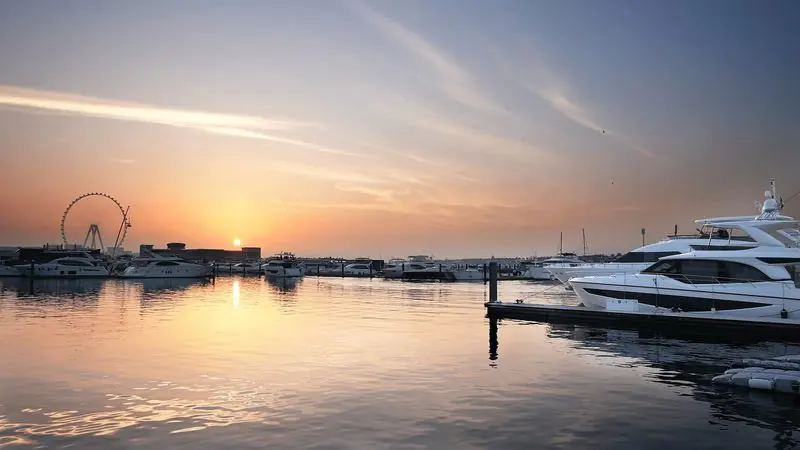
| Location | Dubai Harbour, between Palm Jumeirah and Bluewaters Island, Dubai, UAE |
|---|---|
| Layout | two marinas, Harbour Marina for charter vessels and Bay Marina for superyachts and private owners |
| Berths | 705 as published by the operator, against an original announcement of 1,100 over two phases |
| Maximum LOA | 160 m, with no stated limit on beam or air draft |
| Opened | 2021, designed with Camper and Nicholsons Marinas as consultant |
| Services | bunkering, pump-out and shore station, waste collection, ice, pedestal power and water, slipway, buggy service |
| Operations | 24/7 berthing assistance, 24/7 maritime permit assistance and 24/7 security |
| Accreditation | Yacht Harbour Association accredited and certified to ISO 14001:2015 |
| On site | a cruise terminal, restaurants, a crew club and a helipad with two landing platforms |
| Refit nearby | Dubai Maritime City, a 249-hectare cluster with ship lifts of 6,000 and 3,000 tonnes |
| Nearest real cruising | the Musandam fjords, with Khasab about 130 nautical miles away |
| Access caveat as of July 2026 | the Strait of Hormuz, the Gulf's only sea exit, has been repeatedly closed since fighting began between Iran and the United States on 28 February 2026 |
| The fuel station at Dubai Harbour serves vessels up to 35 m, as marked on the operator's own marina map. A superyacht bunkers by barge or truck and not at the pump, checked 28 July 2026 | |
| Maximum draught and depth alongside are not published anywhere by the operator, checked 28 July 2026, on the shallowest sea in this set | |
| Shore power is described as pedestal power at every berth with no amperage, no voltage and no frequency published, checked 28 July 2026. The UAE runs 50 Hz at 230 V single phase and 400 V three phase | |
| No berthing rate of any kind is published by the operator, checked 28 July 2026 | |
| How many of the 705 berths take over 60 m, and how many of those sit in Bay Marina rather than the charter basin, is not published, checked 28 July 2026 | |
| The operator's published maximum is 160 m of berth length, restated on its current marinas page in July 2026 | |
A marina built on made ground
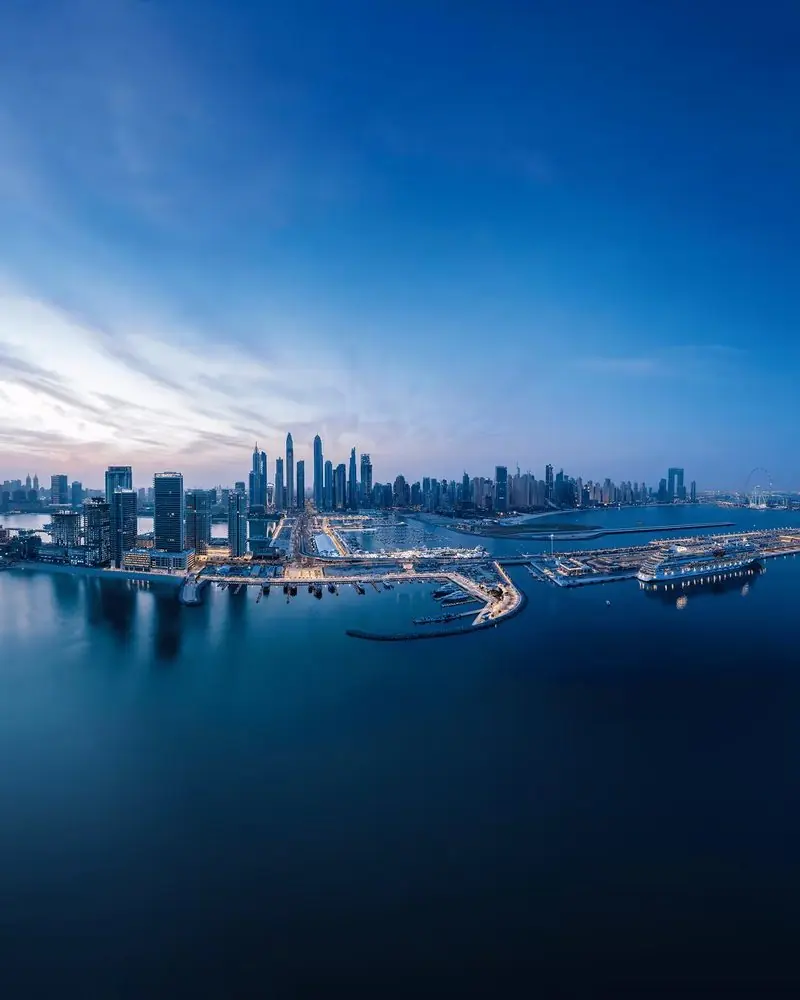
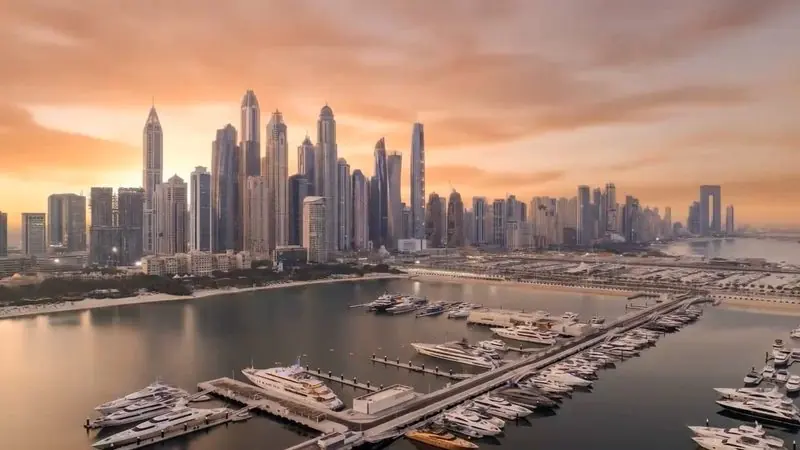
Dubai Harbour occupies reclaimed coastline between Palm Jumeirah and Bluewaters Island, a stretch of water that did not exist twenty years ago. It opened in 2021 and was developed with Camper and Nicholsons Marinas as consultant, which shows in the layout. The complex is split into two basins with different jobs, Harbour Marina taking charter vessels and day boats, and Bay Marina reserved for superyachts and private owners. Keeping the two apart is the single most useful design decision here.
The published capacity is 705 berths, which is short of the 1,100 announced when the project was launched across two phases, and even at that figure it is the largest marina in the Gulf. Maximum length overall is 160 metres and the operator states no limit on beam or air draft. Everything is new, dredged to purpose and built to modern standards. There is no character to it and no history, and the owners who berth here are not looking for either.
Arrival, and the weather that shapes the year
Access is direct from open water with no channel, no bar and no bridge, and the marina emphasises immediate access to the sea from the berth. The Gulf is effectively tideless for planning purposes and there is no swell to speak of behind the breakwaters. Berthing assistance is on duty around the clock. A yacht arriving at three in the morning is met.
The weather sets the season absolutely. From October to May the Gulf is a pleasant place with air temperatures in the twenties and thirties, flat water and reliable sun. From June to September it becomes close to unusable, with air in the mid-forties, sea temperatures that defeat air conditioning chillers and humidity that keeps guests indoors. The wind that matters is the shamal, the northwesterly that blows down the Gulf in winter and spring and raises a short steep sea that is unpleasant offshore and irrelevant inside the marina.
Superb infrastructure attached to a coastline with almost nowhere to go, behind a strait that has spent 2026 opening and closing.
How a berth is obtained
Berths are rented, on annual agreements for owners who base a yacht here and on shorter terms for visitors. Nothing is sold freehold. Access, payment and service requests run through the marina's own app, with a digital member identity for owners and crew, which is a more modern arrangement than most Mediterranean marinas manage. Concierge and permit handling are part of the package.
The paperwork is the part an owner should delegate. A foreign-flagged yacht entering UAE waters needs formal customs clearance and a maritime permit, and the marina provides permit assistance around the clock and coordinates inspections through appointed agents. It is a bureaucratic environment and it works smoothly when handled by people who do it daily. Owners who try to run it themselves lose days.
What the dock provides
Pedestal power and water are supplied at every berth, with bunkering, pump-out and shore station services, waste collection and ice available on site. There is a slipway for tenders and small craft, wellness facilities and a buggy service to move people around what is a very large site. A crew club and a spread of restaurants sit on the promenade. The marina holds accreditation from the Yacht Harbour Association and ISO 14001 environmental certification.
For anything structural, Dubai Maritime City is the destination, a 249-hectare maritime cluster on the far side of the city with more than twenty ship repair plots and two ship lifts rated at 6,000 and 3,000 tonnes. That is commercial shipping capability being used for yachts, so the scale is enormous and the finish quality varies by contractor. Regional yacht building at Gulf Craft and a growing base of specialist trades mean routine work is handled locally. Complex paint and interior projects still tend to go back to Europe.
Security and how visible a yacht is
Security runs 24 hours and access to the pontoons is controlled through the digital identity system. The UAE is a low-crime jurisdiction with heavy surveillance and a strong interest in keeping wealthy visitors comfortable, so the ambient level of personal security is high. Crew and contractors are logged. Guests can come and go without an escort in a way that would be unwise in several other places on this list.
Public exposure is a different matter. Dubai Harbour is a destination in its own right with a cruise terminal on site, a shopping and dining promenade and a steady flow of visitors along the waterfront, and Bluewaters and the Ain Dubai wheel are next door. Bay Marina is the more private of the two basins. Owners who want to be unobserved in Dubai keep the yacht at a smaller marina and lose the depth of service.
The city ashore
Dubai International is around forty minutes from the marina and Al Maktoum is a similar run in the other direction, both with long-haul services to almost everywhere and a heavy private aviation presence. The hotels, restaurants and shopping are as good as anywhere on this list, the Dubai Marina district is ten minutes away and the desert is an hour. Medical care is excellent and the schooling is international, which matters for crew retention.
The tax position draws owners as much as the weather. The UAE levies no personal income tax and Dubai has built a legal and banking apparatus aimed squarely at internationally mobile wealth. A yacht based here is close to the family office, the aircraft and the property. For an owner whose life already has a Gulf axis, the case for berthing the boat where he actually spends his winter is straightforward.
Season, the boat show and where a yacht can go
The Dubai International Boat Show is held at Dubai Harbour and was scheduled for 8 to 12 April 2026 in its 32nd edition, bookending a season that starts in earnest in October. Winter weekends fill the marina and the anchorages off the Palm and the World islands are busy with day boats. Ramadan shifts the rhythm of the city each year and is worth checking against a planned visit.
The cruising is the weakness even in a calm year. The Gulf is shallow, hot and short of natural harbours, and the coastline near Dubai is city, industry and reclaimed sand. Abu Dhabi and Sir Bani Yas are a long day west. The one genuinely worthwhile destination is the Musandam peninsula, Oman's mountainous northern tip with steep-sided inlets that get called fjords, around 130 nautical miles away with Khasab as the main port. It is a fine three-day trip and there is not a second one.
The door at the end of the Gulf
Everything about basing a yacht in Dubai rests on one assumption, which is that a yacht can leave. The Persian Gulf has a single sea exit, the Strait of Hormuz, and since fighting broke out between Iran and the United States at the end of February 2026 that exit has been closed, reopened and closed again. Formula One cancelled the Bahrain and Saudi Arabian Grands Prix on 14 March 2026 on safety grounds, races that had been due on 12 and 19 April. The United Nations reported in early July that shipping was at a near standstill in the strait, with around 6,000 seafarers stranded aboard hundreds of vessels against a normal flow of about 130 commercial ships a day.
The commercial consequence is insurance. War risk cover for a Hormuz transit was priced at just under 0.25 per cent of hull value before the conflict and reached around 5 per cent by March 2026, where cover was written at all. For an owner that is the difference between a routine delivery passage and a decision that has to go to the broker, the underwriter and the flag state. Anyone weighing a Dubai berth in the second half of 2026 should take current advice from a war risk specialist before committing a hull to the Gulf, because conditions have changed week by week.
The honest downside
Set the conflict aside for a moment and the structural reservations remain. This is a superb piece of marina infrastructure attached to a city with almost no cruising ground, in a climate that closes the season for four months of the year. A yacht based here spends most of its time alongside being used as a waterfront apartment with a view of the Palm. That is a legitimate way to own a boat and it is not the same as cruising.
The other reservation is character. Everything at Dubai Harbour was finished in the last five years and it reads that way, with the polish and the anonymity of a new development. Provisioning is excellent and expensive, contractors are improving fast from a low base, and the regulatory environment rewards using an agent. What used to be the strongest argument for Dubai, that an owner could keep the yacht where he spends his winter and run it out to the Indian Ocean when he wanted more, is the part that the region's politics has suspended.
The depth, the power and the fuel pump
Dubai Harbour publishes a 160 m maximum berth length and, checked on 28 July 2026, does not publish a depth. In a sea this shallow that is the omission a captain notices first, and it is not resolved anywhere on the operator's site, its marina map or its code of conduct. The shore supply is in the same condition. The description runs to pedestal power and water at every berth, with no amperage, no voltage and no frequency, on a marina claiming 160 m capability. The UAE runs 50 Hz at 230 V single phase and 400 V three phase, so a European yacht is on the right frequency and an American one is not, but the rating per pedestal is the number that decides whether a large hull lies here on shore power or on its generators through a Gulf summer, and that number is not published.
One detail on the operator's own marina map is worth more than the general description, and it is easy to miss. The fuel station is marked as serving vessels up to 35 m. A superyacht at this marina does not take fuel at the pump. It bunkers by barge or by road tanker, which is a different arrangement with different notice, different minimum quantities and a different price, and it needs to be set up before arrival rather than assumed. For a yacht planning a long Gulf winter with a Musandam run at the end of it, the bunkering arrangement is a bigger practical question than the berth.
Seven hundred berths, and no count of the big ones
The operator publishes 705 berths against an original announcement of 1,100 over two phases, split between Harbour Marina for charter vessels and Bay Marina for superyachts and private owners. What is not published, checked 28 July 2026, is how many of those positions take a yacht over 60 m and how many of them sit in Bay Marina rather than in the charter basin. For this readership that is the only part of the number that carries information. A marina with 705 berths and eight of them over 60 m is a different proposition from one with 705 and sixty, and the operator does not say which it is.
No price is published either, of any kind, which is a striking gap on a marina that is otherwise generous with detail. That should be read alongside the regulatory environment rather than separately from it. Dubai rewards using an agent, and an agent's fee, the maritime permit, crew visas and the handling of ships' stores and a yacht's cellar into the UAE all sit outside any berth rate that eventually gets quoted. An owner budgeting a Gulf season should ask for the berth, the permits and the agent as one number and not three, because the marina's silence on the first of them makes the other two harder to size.
Ashore, access and booking
| How a berth is obtained | Berths are rented, not sold: annual agreements for owners who base a yacht here, shorter terms for visitors. Access, payment and service requests run through the marina's own app with a digital member identity for owner and crew. |
|---|---|
| What it costs | No berthing rate of any kind is published, checked 28 July 2026 - a striking gap for a marina this detailed about everything else. Ask for the berth, the maritime permit and the agent's fee as one combined number, not three, when budgeting a season. |
| Fuelling a superyacht | The marina's own fuel station is marked as serving vessels up to 35 m. A superyacht bunkers by barge or road tanker instead, which needs its own permit from Dubai's Maritime Authority - a lease contract, vessel certificates, a permit to navigate Dubai waters, insurance and a Shipboard Oil Pollution Emergency Plan (SOPEP) are all required documents - and should be arranged well before arrival. |
| Accreditation | Accredited by The Yacht Harbour Association in January 2024 as a 5 Gold Anchor, Superyacht Ready and Clean Marina, with GMI-trained staff - a formally assessed rating, not just the operator's own description. |
| What is not published | Maximum draught and depth alongside, shore power voltage/amperage/frequency, and how many of the 705 berths take a yacht over 60 m are all absent from the operator's own site, checked 28 July 2026. Confirm all three directly before committing a large hull. |
| What to check before committing a season | The Strait of Hormuz is the Gulf's only sea exit and has been repeatedly disrupted since February 2026. Take current war-risk insurance advice before routing a hull through it, rather than assuming the passage that was open last month still is. |
| Refit and repair | Dubai Maritime City, a 249-hectare cluster with 6,000- and 3,000-tonne ship lifts, handles anything structural. Routine work is increasingly done locally; complex paint and interior projects still tend to go back to Europe. |
What owners and crew report
The operator frames the marina as a strategic logistics base, not just a berth
At the marina's opening, its managing director said the facility was intended to strengthen Dubai's status as a maritime hub for yacht owners, captains and maritime businesses needing a strategic logistics location - the operator's own account of its purpose, not an independent owner's report.
Selcuk Balci, Managing Director, D-Marin Dubai, via SuperyachtNews
What is good, and what to watch
Strong points
- A formally assessed, not just marketed, standardThe Yacht Harbour Association accredited Dubai Harbour 5 Gold Anchor, Superyacht Ready and Clean Marina in January 2024 - an independent assessment behind the operator's own claims.
- Modern infrastructure with no compromise on size160 m maximum length with no stated beam or air draft limit, direct open-water access with no channel or bridge, and 24/7 berthing and permit assistance.
- The tax and logistics case is realNo personal income tax and a legal and banking apparatus built for internationally mobile wealth put the yacht where an owner's family office, aircraft and property already are.
What to watch
- Almost nowhere to cruiseThe only genuinely worthwhile cruising ground is the Musandam peninsula, a three-day round trip about 130 nautical miles away. A yacht based here mostly serves as a waterfront apartment with a view.
- Four months of the year are close to unusableFrom June to September air temperatures reach the mid-forties and humidity keeps guests indoors, which closes the practical season outright.
- Basic numbers the operator will not publishNo berth rate, no depth alongside and no shore power specification appear anywhere on the operator's site - unusual omissions on a marina this detailed about everything else.
- Access now depends on regional politics, not seamanshipThe Strait of Hormuz, the Gulf's only sea exit, has been repeatedly closed and reopened since February 2026, and war-risk insurance pricing reflects it. The case for basing a yacht here assumes it can leave.
Who it is for: The owner whose winter life is already in the Gulf, who wants the yacht alongside the family office and who is prepared to take current war risk advice before moving it.