Falmouth Harbour Marina (Antigua)
| Location | Falmouth Harbour, south coast of Antigua, at 17 00.75 N 061 46.73 W, on the English Harbour main road |
|---|---|
| Operator | Antigua Slipway Ltd, the family boatyard business in English Harbour since 1966. The marina was established in 1994 |
| Berths | 30 stern-to and 30 alongside, on wide concrete docks with vehicle access |
| Maximum LOA | 330 ft, about 100 m, the figure the Antigua and Barbuda Yachting and Marine Association publishes for the vessel. The 535 ft on the marina's own site, and the 525 ft or 160 m in the listings, is the length of the superyacht quay built in the 2022 expansion, not a vessel maximum |
| Maximum draught | 20 ft, about 6.1 m, agreed by every source and the figure that actually governs |
| Shore power | 110 V, 208, 220 and 380 V three-phase per the trade association, with 400 V added on the marina's own site. Amperage is not published. Electricity is metered at USD 0.60 per kWh |
| Water | fresh water at the berths, metered at USD 0.15 per US gallon. Showers ashore USD 2 per person |
| Connectivity | free fibre-optic wifi across the marina. 24-hour security, parking, waste disposal, tender dock and crane-assisted container storage |
| Fuel | tax and duty-free ultra-low-sulphur diesel to the berth at up to 1,000 litres a minute, daily in high season and weekdays in low season, overnight on request. Price not published |
| VHF | channel 10. Marina office +1 268 460-6054 |
| Berthing tariff, read August 2026 with no season year on the page: winter 1 November to 31 May, stern-to USD 3.50 per ft per day and alongside USD 6.50; summer 1 June to 31 October, stern-to USD 2.55 and alongside USD 4.65. Monthly rates are lower in each band | |
| Customs status | English Harbour is a port of entry with Customs, Immigration and the Port Authority in one building, a walk over the hill from the marina. Online clearance through eSeaClear |
| National park | both harbours lie inside Nelson's Dockyard National Park, and National Parks Authority fees are compulsory on top of dockage and Port Authority fees. Visitor passes are published, at US$15 a day and US$100 for a season pass expiring at the end of the yachting season, EC$10 for locals and residents. The per-vessel charge on the yacht is not published anywhere |
| Neighbouring quays | Nelson's Dockyard Marina, 30 stern-to berths on bow moorings, run by the National Parks Authority on VHF 68; the former Antigua Yacht Club Marina, now the Antigua Superyacht Marina and Resort; and Catamaran Marina, to 200 ft and 15 ft draught |
| Haul-out | Antigua Slipway's marine railway takes 200 tons, to 150 ft length overall by 40 ft of beam by 14 ft of draft. Bailey's Boatyard runs a 70-ton travelift and an 80-ton Ascon lift; Jolly Harbour runs 75-ton and 85-ton travelifts and takes catamarans to 33 ft of beam; Shell Beach has 25 tons. Nothing on the island can lift a superyacht |
| Airport | V.C. Bird International (ANU) on the north coast, about 21.7 km and 35 to 45 minutes by road, with daily long-haul service to North America, year-round service to the United Kingdom and private jet handling. The only continental-European service, Condor from Frankfurt, is seasonal |
Two harbours, five quays, and who runs which
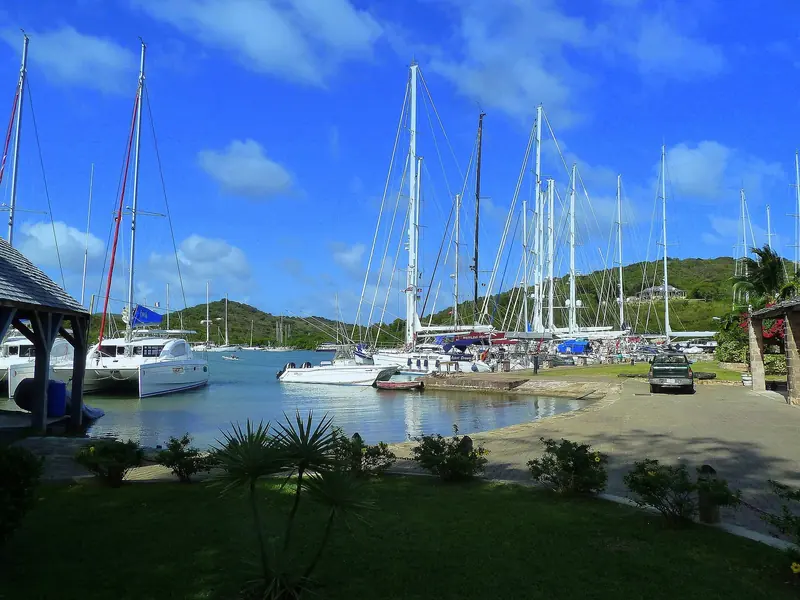
Falmouth Harbour is a horseshoe-shaped natural bay on the south coast of Antigua, at 17 00.75 N 061 46.73 W. The village and port of Falmouth sit on the north shore, and English Harbour, the deeper and more famous inlet, lies immediately to the east. The two are separated by a low neck of land you can walk across in a quarter of an hour, and together they hold five separate berthing operations under four different managements. Falmouth Harbour Marina, the largest, is on the English Harbour main road on the east side of Falmouth Harbour and is operated by Antigua Slipway Ltd, the family boatyard business that has been in English Harbour since 1966. The marina itself was established in 1994 and the trade association describes it as the island's largest mega-yacht marina and the longest established of the modern ones.
Next door in Falmouth is the marina long known as the Antigua Yacht Club Marina, gutted by fire on 2 and 3 October 2023 during Tropical Storm Philippe and since rebuilt and rebranded as the Antigua Superyacht Marina and Resort, with a further complex due to start construction in summer 2026. Antigua Slipway keeps its own quay and fuel dock at English Harbour alongside the boatyard, which is the fifth of the berthing operations and the one most often left off the list. At the north end of Falmouth Harbour, Catamaran Marina is a family-run operation taking yachts to 200 ft with 15 ft of draught. And over the hill in English Harbour, the marina inside Nelson's Dockyard is run by the National Parks Authority, a statutory not-for-profit corporation established under the 1984 National Parks Act, which puts its proceeds into restoration, conservation and archaeology. That is the arrangement to understand before you book: you are choosing between a commercial superyacht dock, a rebuilt resort marina, a boatyard quay, a small family quay and a state heritage body, all inside one national park, and every one of them adds National Parks Authority fees to your bill.
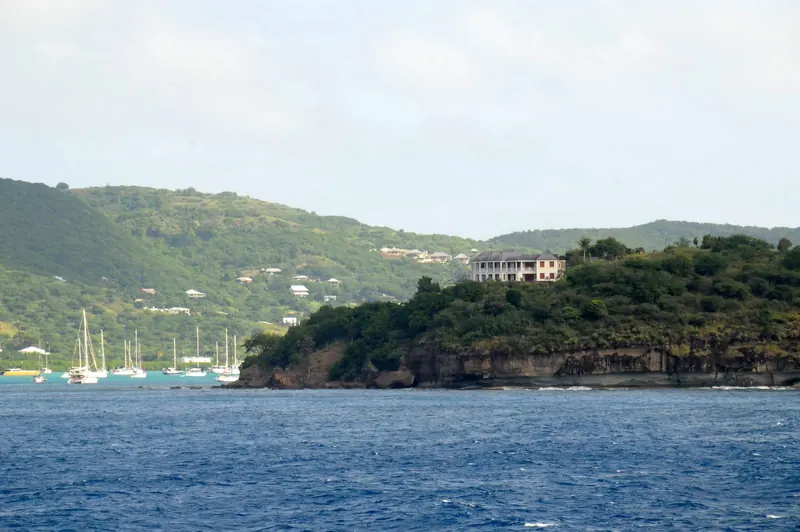
The marina itself, and the length figure that is really a quay
Falmouth Harbour Marina has thirty stern-to berths and thirty alongside, on wide concrete docks with vehicle access good enough for most sizes of truck, which matters more than it sounds when you are loading a refit or a charter turnaround. Electricity is available at 110 V, 208, 220 and 380 three-phase according to the trade association, and the marina's own site adds 400 V; its berth request form offers single-phase 120 V, single-phase 220 V and three-phase 380 V. Nobody publishes the amperage. There is fresh water at the berths, free fibre-optic wifi across the site, 24-hour security, parking, waste disposal, a tender dock and crane-assisted container storage. The marina works VHF channel 10.
The maximum length looks like an unresolved argument and is not one, and an owner of a very large yacht needs to know why before he plans a season. Falmouth Harbour Marina's own website says 535 ft, about 163 m, and repeats it in its own frequently asked questions. The Antigua and Barbuda Yachting and Marine Association, the trade body, states that yachts up to 330 ft, about 100 m, can be catered for stern-to and alongside. The two figures are not measuring the same thing. All At Sea, reporting the expansion that had been delayed by COVID, describes the marina's new custom-built concrete superyacht dock as 535 ft in length by 20 ft in width, on piles driven some 40 ft into the seabed. The 535 ft is the length of the quay. The 525 ft that Yachting Pages carries is the same wall rounded the other way, printed as berths up to 160 metres, and Antigua's own press reported the same opening. That leaves 330 ft as the only published figure that describes a vessel, and it is the number to plan against; 535 ft is the amount of concrete the marina has to lay a fleet along. What every source does agree on is the draught: 20 ft, about 6.1 m, and that is the figure that will actually stop you. Anyone over about 100 m should treat the website headline as a conversation to have with the dockmaster rather than a booking to make.
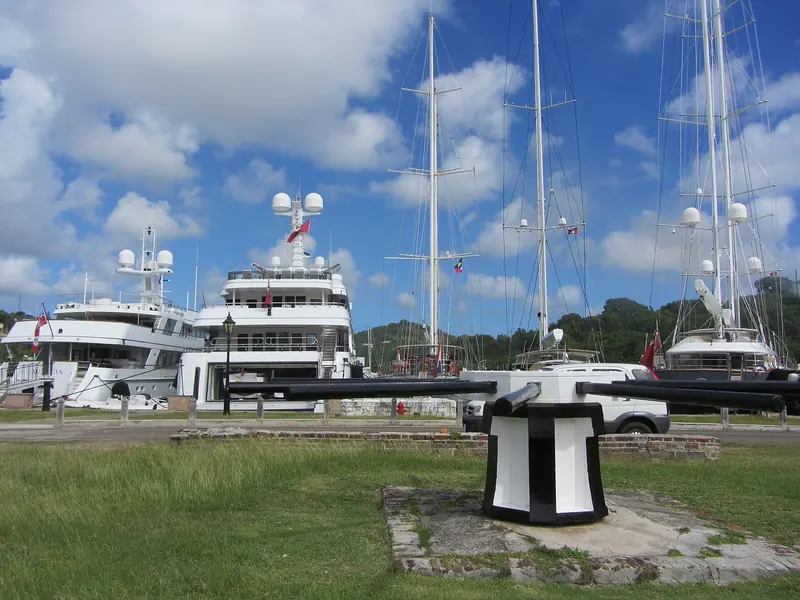
It publishes its dockage, which almost nothing in the Caribbean does, and then adds a compulsory national park fee that nobody publishes at all.
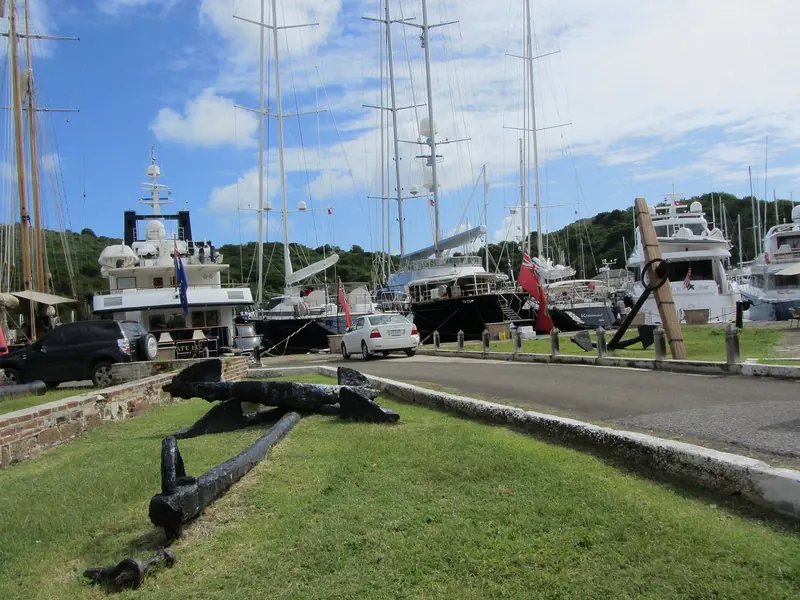
The approach, Bishop Shoal, and clearing in on foot
Antigua uses IALA B buoyage, which is the American convention and the opposite of Europe: red buoys to starboard on entry, green to port. Get that wrong on arrival after an ocean crossing and Bishop Shoal will remind you. The shoal lies to the east of the Falmouth Harbour entrance, is marked by a large red buoy which you leave to starboard, and breaks visibly in anything but the calmest water. Once past it, leave the next red buoy to port and follow the buoyed channel, which leads to both the Antigua Superyacht Marina and Falmouth Harbour Marina. Catamaran Marina is the other way, red buoy to starboard, lining up two orange triangles on the hillside, with leading lights for a night entry. You may anchor almost anywhere in the harbour so long as you stay clear of the channels and of the exclusion area in front of the two big marina docks.
The clearance procedure is the best thing about arriving here and it is worth spelling out. Call the Coastguard on VHF 16 from six hours out to request entry into Antiguan and Barbudan waters. Come alongside and fly the Q flag. Port Health clears the vessel before anything else happens and nobody but the master goes ashore until entry is complete. Then it is Customs, Immigration with the ED cards and six copies of the crew and passenger lists, back to Customs, and finally the Port Authority to pay entrance, rubbish disposal, anchorage or dockage and the cruising permit. All three authorities sit in the same building at English Harbour, and a crew berthed in Falmouth walks over the hill to do it. Clearing out reverses the order, starts at the Port Authority, needs four copies of the lists, and you have 24 hours to leave once it is done. The online route is eSeaClear. Every vessel in Antiguan waters must carry a valid cruising permit, and receipts for Port and National Parks fees must be produced even if you leave the country through a different port.
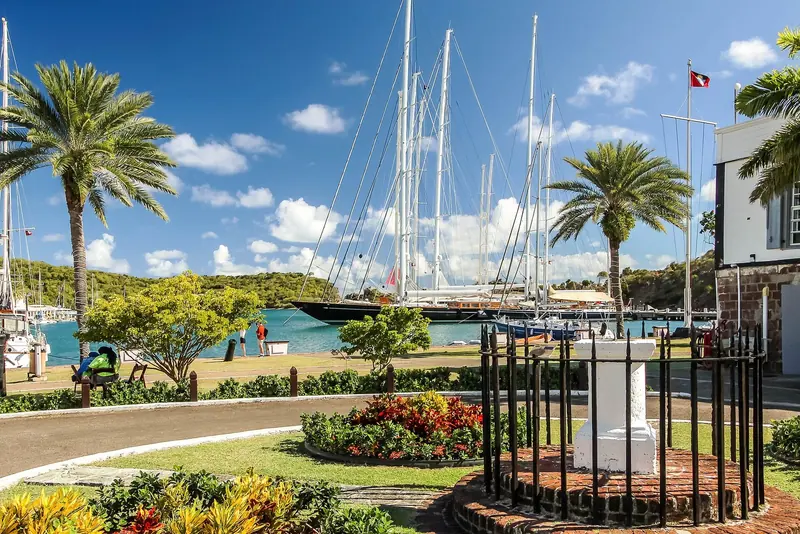
What a berth costs, and the fee you cannot look up
Falmouth Harbour Marina publishes a rate card, which is unusual in the Caribbean superyacht market and is a genuine reason to deal with it. Read on 6 August 2026, and carrying no season year on the page, the rates run per foot per day in US dollars. Winter, 1 November to 31 May: stern-to USD 3.50 daily and USD 3.20 on a monthly basis, alongside USD 6.50 daily and USD 5.95 monthly. Summer, 1 June to 31 October: stern-to USD 2.55 daily and USD 2.45 monthly, alongside USD 4.65 daily and USD 4.44 monthly. Fees are payable in advance, checkout is noon, and Visa and Mastercard are taken. One caution: the terms line under the table says alongside rates are double, which does not match the table, because double the winter stern-to rate would be USD 7.00 and not USD 6.50. Get the number confirmed in writing before you arrive.
In money, a 40 m yacht is 131 ft, so a winter night alongside is about USD 852 and stern-to about USD 459; the same yacht in summer alongside is about USD 609. A 60 m yacht at 197 ft pays roughly USD 1,280 a night alongside in winter. Those are Yotters calculations on the published rate and not quotations. On top of them sit three charges you cannot price from any public source. Electricity is metered at USD 0.60 per kWh and water at USD 0.15 per US gallon, which are published. National Parks Authority fees are only half published. They are compulsory for every vessel anchored in English or Falmouth Harbour or berthed at any of the five quays inside the park. The park's visitor passes are on the record: Antigua News Room, reporting the Authority in August 2022, gives US$15 for a visitor day pass and US$100 for a season pass that expires at the end of the yachting season, with EC$10 for locals and residents, EC$50 for a one-year pass and EC$200 for a family pass covering up to six people. For a crew of eight that is US$120 a visit or US$800 for the season. What is not published anywhere is the per-vessel charge on the yacht itself: the Authority carries no fee schedule on its own site and the trade association's clearance page names the obligation without a figure. Port Authority entrance, rubbish and cruising permit fees are likewise unpublished. The yacht agency Med Yacht Services, in its 2026 Antigua fee sheet, budgets customs clearance at USD 250 to 550 and immigration including escort at USD 250 to 500, and lists National Park fees simply as at cost. That is the closest thing to a public number that exists.
Fuel, power, water and what the duty-free actually covers
Duty-free fuel is available at every marina in Falmouth and English Harbour, which is the standard arrangement for yachts in transit through Antigua and one of the reasons the fleet stops here rather than somewhere else in the chain. Falmouth Harbour Marina delivers tax and duty-free ultra-low-sulphur diesel directly to the berth at flow rates of up to 1,000 litres a minute, which will bunker a large motor yacht inside a working day. Service is daily through the high season and weekdays only in the low season, with overnight bunkering available on request. Neighbouring quays are less industrial about it: the marina now trading as the Antigua Superyacht Marina supplies duty-free diesel by mobile pump, and Antigua Slipway and Catamaran Marina both run fuel docks.
What the marina does not do is publish a fuel price, and neither does anyone else in the harbour, so a captain plans a bunker against a fresh quote rather than a posted rate. That is the pattern across the whole cost base here. Metered utilities are published and modest, at USD 0.60 per kWh and USD 0.15 per US gallon of water, with showers ashore at USD 2 a head. Everything else is quoted. Antigua imports essentially all its fuel, food and hardware, and the island's largest supermarket, Epicurean Fine Foods, is at Jolly Harbour and St John's on the other side of the island rather than in Falmouth, where you have the Dockside Supermarket in Nelson's Dockyard and Bailey's near the Catamaran Marina for everyday shopping. Owners provisioning a charter here should expect to pay a landed-import premium on almost everything and to build a run across the island into the schedule.
The yard question, and the 200-ton ceiling
This is the structural weakness of Falmouth and English Harbour and no amount of dock length changes it. The marine trades within walking distance are genuinely dense for a Caribbean port: marine engineering, electronics, rigging, a sail loft, a dive shop and several chandleries, plus yacht carpentry and refit services around Nelson's Dockyard, so routine work, running repairs and a charter refit between seasons are all straightforward. What you cannot do is get out of the water. Antigua Slipway, which also runs Falmouth Harbour Marina, states a maximum haul-out capacity of 200 tons for vessels up to 150 ft length overall by 40 ft of beam by 14 ft of draft on its marine railway, and it calls itself the most complete boatyard in the Caribbean. Bailey's Boatyard at the north end of Falmouth Harbour runs a 70-ton travelift and an 80-ton Ascon lift and hauls boats to 12 ft of draught. Across the island, Jolly Harbour has two travelifts, 75 tons and 85 tons, and takes catamarans to 33 ft of beam; Shell Beach has 25 tons.
Two hundred tons is a large sailing yacht or a modest motor yacht. It is not a superyacht, and every yacht at the top end of the Falmouth quay displaces several times it. Antigua is a place to run a big boat from, not a place to lift one, and paint, steel and structural work leave the country. That may be about to improve at the margin: Antigua Slipway announced a US$2.5 million redevelopment of its marine railway, replacing the ageing underwater structure with a modern steel system built to international engineering standards, with construction scheduled to begin in June 2026, 50 to 60 jobs during the build, and a stated ambition to become the largest single-vessel yacht haul-out facility in the Caribbean, serving tugs and commercial work boats from St John's as well as yachts. No tonnage has been attached to the 2026 tranche itself. What the yard did say when it completed phase one in March 2023, a rebuilt railway cradle good for 100 ft and 100 tons, is that phase two, the underwater railway renovation, would take haul and launch capacity to 200 ft length overall and 270 tons. That is the number to watch, and until the steel is in the water, plan a slipping on the 200-ton figure.
The calendar, and the six months when the harbour empties
Two fixed dates take the entire harbour and they are the reason to book early or stay away. Only one of them is still ahead. The Antigua Charter Yacht Show runs 4 to 9 December 2026, its 65th edition, organised by the Antigua and Barbuda Yachting and Marine Association and held across three quays at once: Nelson's Dockyard Marina, Falmouth Harbour Marina and the Antigua Yacht Club Marina. It has run since 1961, brings around a hundred charter yachts, and is the event at which the Caribbean charter season is actually sold. The spring racing has already been and gone this year. The Antigua Classic Yacht Regatta ran 15 to 20 April 2026 and Antigua Sailing Week followed on 22 to 26 April 2026, its 57th edition, cut to a shorter four-day format with point-to-point courses around the island and based across English and Falmouth Harbours. Anyone planning the next season should hold the 2027 dates instead: the Classics on 14 to 19 April 2027 and Sailing Week, the 58th edition, on 21 to 25 April 2027. Antigua is also the Atlantic finish line: the RORC Transatlantic Race that left Lanzarote on 11 January 2026 with 21 teams finished here.
Then it stops. The Atlantic hurricane season runs 1 June to 30 November with the peak from August to October, and the yachting economy of both harbours goes with it. Crewed charter inventory leaves for the Mediterranean, restaurants and businesses close for the summer, and the marina's own operations reflect it: bunkering drops from daily service to weekdays only, and the tariff falls by roughly 27 per cent on stern-to and 28 per cent alongside. English Harbour has a long reputation as a hurricane hole and it is a good one, but it is not a guarantee against a direct hit and nobody sensible leaves a yacht here unattended without a written hurricane plan. Bailey's Boatyard sells hurricane storage cradles accepted by all the major yacht insurers and prices its summer storage accordingly. The October 2023 fire, which destroyed the main Antigua Yacht Club Marina building during Tropical Storm Philippe and was locally attributed to a lightning strike, is the reminder of what a storm season can do to the shoreside even when the boats survive.
Ashore, and the honest cost of being here
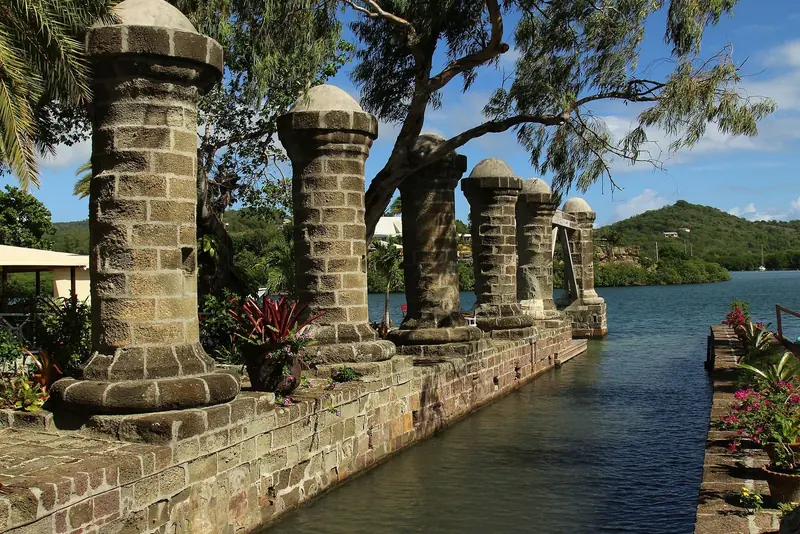
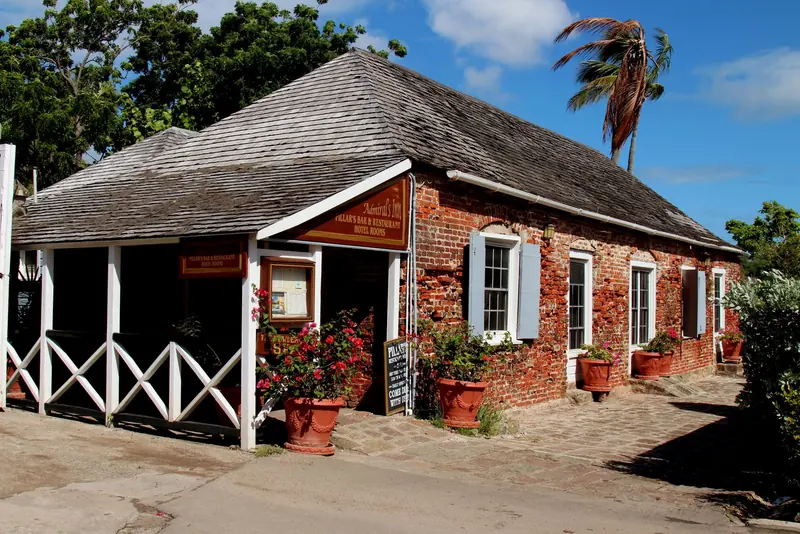
The compensation for all of the above is that this is one of the most enjoyable places in the Caribbean to keep a boat. Nelson's Dockyard, inscribed by UNESCO in 2016 as the Antigua Naval Dockyard and Related Archaeological Sites, is the only continuously working Georgian naval yard in the world and it is a fifteen-minute walk from the marina, with a hotel, restaurants, a chandlery and a supermarket inside its walls. Eating is better than the harbour's size suggests: Cloggy's at the yacht club, run by Ton and Vanessa Smit, is consistently the highest-rated table in Falmouth, Boom sits on the marina, and Pillars is in the Admiral's Inn inside the Dockyard, with Trappas and Colibri filling out the middle. The set piece is Shirley Heights Lookout above the harbour, where the Sunday party runs 1600 to 2200 with a steel pan band until 1900 and reggae after it, for USD 10 or EC 25 on the gate, and a quieter Thursday reggae evening at the same price.
Two honest caveats about being ashore. The airport is not on the harbour. V.C. Bird International is on the north coast, about 21.7 km and 35 to 45 minutes away by road, and while it does carry daily long-haul service to North America and year-round service to the United Kingdom plus private jet handling, the only continental-European link is seasonal, Condor from Frankfurt, and every crew change and every guest arrival is an hour of driving each way. Taxi fares are set by the Antigua and Barbuda Transport Board on a zone basis, but the current schedule is not published anywhere and the copies circulating online are years out of date, so agree the fare with the dispatcher before you get in the car. And security is not what it was: Noonsite, drawing on cruiser reports and the Caribbean Safety and Security Net, records that thefts of dinghies, outboards and loose gear are rising across many Caribbean ports including this one, and that even locked and secured hardware is being taken. Lift the tender at night.
Ashore, access and booking
| Getting there | V.C. Bird International Airport (ANU) sits on the north coast of the island, roughly 21.7 km from English Harbour, and the drive takes 35 to 45 minutes depending on traffic. It is a real international airport with daily long-haul service to North America and year-round service to the United Kingdom, plus private jet handling, so guests from those markets arrive without connecting through a hub. Continental Europe is seasonal only: Condor from Frankfurt is the single continental link and it does not run year-round. Either way it is an hour of road at each end of every crew change. Taxi fares are set on a zone basis by the Antigua and Barbuda Transport Board; the catch is that the current schedule is not published anywhere and the rate sheets circulating online are years out of date. Ask the dispatcher at the taxi coordination point for the official rate to Falmouth or English Harbour and confirm it before you get in. Fares are per taxi for up to four passengers, and both US and Eastern Caribbean dollars are taken. |
|---|---|
| Arriving by sea | Antigua uses IALA B buoyage: red to starboard on entry, the reverse of Europe. The one hazard is Bishop Shoal, east of the Falmouth Harbour entrance, marked by a large red buoy which you leave to starboard and which breaks visibly except in flat calm. Past it, leave the next red buoy to port and follow the buoyed channel, which serves both Falmouth Harbour Marina and the Antigua Superyacht Marina. For the Catamaran Marina at the north end, leave that same red buoy to starboard and line up the two orange triangles on the hillside; there are leading lights for a night approach. Call the marina on VHF 10. Anchoring is permitted almost anywhere in the harbour provided you keep clear of the channels and of the exclusion area in front of the two large marina docks. There is no lock, no bridge and no pilotage requirement. |
| Clearing in and out | Call the Coastguard on VHF 16 from six hours out of Antigua to request entry. Come alongside at any marina and fly the Q flag; everyone stays aboard until Port Health has cleared the vessel, and only the master then goes ashore. The order is Customs, then Immigration with ED cards for every person, passports, the general declaration and six copies of the crew and passenger lists, back to Customs for final approval, then the Port Authority to pay entrance, rubbish disposal, anchorage or dockage and the cruising permit. US and EC dollars and Visa or Mastercard are accepted. Clearing out starts at the Port Authority, needs four copies of the lists, and obliges you to depart within 24 hours. All three authorities are in one building at English Harbour, an easy walk from a Falmouth berth. Online procedures run through eSeaClear. Crew leaving the boat need an onward ticket or a signed letter from the captain or a local agent. Keep every Port and National Parks receipt, because they are demanded even if you clear out through a different port. |
| Reserving a berth | Berths are booked directly through the marina's own berth request form or its office on +1 268 460-6054, and the form asks for LOA, beam, draught, gross tonnage, flag, port of registry, arrival and departure dates and your electricity requirement, so have the yacht's particulars to hand. There is no published minimum stay and no published long-stay contract, only a monthly rate that is a few per cent under the daily. Book the December Charter Yacht Show and the April regatta fortnight months out: the show alone fills three marinas with around a hundred yachts, and the Classics and Sailing Week take the harbour for two consecutive weeks every April, 14 to 19 and 21 to 25 April in 2027. Because the marina's 535 ft headline is the length of its superyacht quay rather than a vessel maximum, and the published vessel figure is 330 ft, a yacht over about 100 m should have the dockmaster confirm the berth in writing rather than rely on the website number. |
| What a berth costs | Rates are per foot per day in US dollars, read on 6 August 2026 with no season year printed on the page. Winter, 1 November to 31 May: stern-to USD 3.50 daily and USD 3.20 monthly; alongside USD 6.50 daily and USD 5.95 monthly. Summer, 1 June to 31 October: stern-to USD 2.55 daily and USD 2.45 monthly; alongside USD 4.65 daily and USD 4.44 monthly. Berthing fees are payable in advance, checkout is noon, Visa and Mastercard are accepted. Note the contradiction on the marina's own page: the terms say alongside rates are double, which would make winter alongside USD 7.00 rather than the USD 6.50 in the table, so confirm the figure in writing. As arithmetic on the published rate, a 40 m yacht at 131 ft pays about USD 852 a night alongside in winter, about USD 459 stern-to, and about USD 609 alongside in summer; a 60 m yacht at 197 ft pays roughly USD 1,280 alongside in winter. Those are Yotters calculations, not quotations, and they exclude power, water, National Parks and Port Authority fees. |
| Fuel, water, power and what is extra | Tax and duty-free ultra-low-sulphur diesel is delivered directly to the berth at flow rates of up to 1,000 litres a minute, which is genuine bunkering capacity rather than a fuel dock. Service is daily through the high season and weekdays in the low season, with overnight delivery on request; submit the vessel details and quantity in advance. No price is published, so budget from a fresh quote. Duty-free fuel is available at every marina in Falmouth and English Harbour, and the neighbouring Antigua Superyacht Marina supplies it by mobile pump. Electricity at the berth is metered at USD 0.60 per kWh, fresh water at USD 0.15 per US gallon, and showers ashore are USD 2 a person. Wifi, parking, security and waste disposal are included. On top of all of it come the per-vessel National Parks Authority charge and the Port Authority fees, neither of which has a published schedule, though the park's own visitor passes are published at US$15 a day and US$100 a season. |
| The yard, and what has to leave the island | Routine and technical work is well covered within walking distance: marine engineering, electronics and rigging, a sail loft, a dive shop, several chandleries, and yacht carpentry and refit services clustered around Nelson's Dockyard. Antigua Slipway, which also owns this marina, is the yard, hauling up to 200 tons on its marine railway, for vessels up to 150 ft length overall by 40 ft of beam by 14 ft of draft, with storage ashore on welded cradles and tie-down straps, a fuel dock, a chandlery, two restaurants and a hotel. Its rates are quoted in Eastern Caribbean dollars, are subject to government taxes and are not published; you contact the office team for an estimate, haul-outs need 24 hours' cancellation notice, and accounts unpaid at 30 days attract 2.5 per cent a month. Bailey's Boatyard in Falmouth Harbour runs a 70-ton travelift and an 80-ton Ascon lift, hauls to 12 ft of draught, and keeps hurricane cradles accepted by the major yacht insurers; Jolly Harbour across the island runs 75-ton and 85-ton travelifts and takes catamarans to 33 ft of beam, and Shell Beach has 25 tons. Nothing on Antigua can lift a superyacht, so paint, steel and structural work is a passage to another country. |
| Eating, drinking and provisioning | Cloggy's at the yacht club, run by Ton and Vanessa Smit, is the highest-rated table in Falmouth and looks down over the harbour; Boom sits on the marina; Pillars is inside the Admiral's Inn in Nelson's Dockyard; Trappas and Colibri fill out the middle of the range. The institution is Shirley Heights Lookout on the ridge above English Harbour: the Sunday party runs 1600 to 2200 with a steel pan band to 1900 and reggae after, entry USD 10 or EC 25, with drinks around EC 10 to 16 and food around EC 35, and there is a quieter Thursday reggae evening at the same admission. For provisioning, the Dockside Supermarket sits inside Nelson's Dockyard and Bailey's is near the Catamaran Marina, both fine for daily shopping. Serious provisioning means a drive: Epicurean Fine Foods, the island's largest grocer, is at Jolly Harbour and St John's on the other side of Antigua. Everything is imported and priced accordingly. |
| The fixed dates, and what is NOT published | Still ahead: the Antigua Charter Yacht Show, 4 to 9 December 2026, the 65th edition, run by the Antigua and Barbuda Yachting and Marine Association across Nelson's Dockyard Marina, Falmouth Harbour Marina and the Antigua Yacht Club Marina, with around a hundred yachts. Already run this year: the Antigua Classic Yacht Regatta, 15 to 20 April 2026, and Antigua Sailing Week, 22 to 26 April 2026, the 57th edition in a shortened four-day point-to-point format. Next spring: the Classics 14 to 19 April 2027 and Sailing Week 21 to 25 April 2027, the 58th edition. The RORC Transatlantic Race finishes here each winter, the 2026 edition having left Lanzarote on 11 January with 21 teams. Hurricane season runs 1 June to 30 November. Not published: the per-vessel National Parks Authority charge on a berthed or anchored yacht, which appears nowhere in any form, although the park's visitor passes are published at US$15 a day, US$100 a season and EC$10 for residents; the Port Authority entrance, rubbish and cruising permit fees; the marina's fuel price; the shore power amperage; any long-stay or seasonal contract rate beyond the monthly per-foot figure; and Antigua Slipway's haul-out, storage and docking rates, which its own rates page answers with an invitation to ask. |
What owners and crew report
The marina's 535 ft is the length of its dock, not the length of a yacht
All At Sea, reporting the expansion of Falmouth Harbour Marina's superyacht dock after a COVID delay, describes the new custom-built concrete dock as 535 ft in length by 20 ft in width, built on piles driven some 40 ft into the seabed. That is the origin of the 535 ft on the marina's own website and of the 525 ft, or 160 metres, in the trade listings: they are the quay. The vessel figure is the trade association's, which states that yachts up to 330 ft in length can be catered for stern-to, with a 20 ft maximum draught, thirty stern-to and thirty alongside berths and electricity at 110 V, 208, 220 and 380 three-phase.
All At SeaYou can clear in on foot, and the fuel is duty-free at every quay
Cruisers report walking from Falmouth over to Nelson's Dockyard to complete clearance formalities, with Customs, Immigration and the Port Authority in a single building, and duty-free fuel available in all the harbour's marinas. The one navigational caution repeated by everyone is Bishop Shoal off the entrance, marked by a large red buoy which under the American buoyage convention is left to starboard on entry.
NoonsiteA storm took out a marina building, not the boats
A fire in the marina complex in October 2023, during Tropical Storm Philippe and locally attributed to a lightning strike, gutted the main Antigua Yacht Club Marina building and a number of well known businesses with it. Temporary services reopened on the old site in container buildings within about four months, and the operation has since been rebuilt and rebranded as the Antigua Superyacht Marina and Resort, with a further complex due to start construction in summer 2026.
NoonsiteDinghy and outboard theft is rising and locks are not enough
Based on reports to Noonsite from cruisers and from the Caribbean Safety and Security Net, thefts of dinghies, outboards and unsecured or loose items are on the rise in many Caribbean ports, this one included, and even locked and secured hardware is being stolen. The practical advice is to lift the tender at night rather than to rely on a cable.
Noonsite and the Caribbean Safety and Security NetThe yard is spending USD 2.5 million to stay relevant
Antigua Slipway Ltd announced a US$2.5 million redevelopment and upgrade of its marine railway at English Harbour, replacing the ageing underwater structure like for like with a modern steel system built to international engineering standards. Construction was scheduled to begin in June 2026, is expected to create 50 to 60 jobs during the build, and is intended to produce the largest single-vessel yacht haul-out facility in the Caribbean, also serving tugs and commercial work vessels from St John's Port. No tonnage has been attached to this tranche, but on completing phase one in March 2023, a rebuilt cradle good for 100 ft and 100 tons, the yard said phase two would take haul and launch capacity to 200 ft length overall and 270 tons.
Antigua NewsroomAn agent will budget the clearance you cannot price yourself
The yacht agency Med Yacht Services, in its Antigua fee sheet for the 2026 season, budgets customs clearance at USD 250 to 550 and immigration including escort at USD 250 to 500, and carries National Park Association fees simply as at cost, with surcharges of 10 per cent for holidays and peak season and 20 to 25 per cent for expedited events. That is the nearest thing to a public figure for the unpublished side of the bill.
Med Yacht Services
What is good, and what to watch
Strong points
- A published rate card in a market that mostly refuses to publish oneWinter and summer, daily and monthly, stern-to and alongside, all in US dollars per foot per day, with metered power at USD 0.60 per kWh and water at USD 0.15 per US gallon on the same page. An owner can build a season budget from public information, which he cannot do at most Caribbean superyacht quays.
- Clearance on foot, in one building, at a port of entryCustoms, Immigration and the Port Authority all sit together at English Harbour, a fifteen-minute walk over the hill from the berth, and the online route runs through eSeaClear. For a yacht arriving off the Atlantic this is as painless as Caribbean entry gets.
- Industrial bunkering, tax and duty-free, at the berthUltra-low-sulphur diesel delivered alongside at up to 1,000 litres a minute, daily through the high season and overnight on request, with duty-free fuel available at every quay in both harbours.
- The densest marine trade cluster in the Eastern Caribbean, on footMarine engineering, electronics, rigging, a sail loft, a dive shop, chandleries and yacht carpentry are all within walking distance, with Antigua Slipway's own yard attached to the same ownership as the marina.
- It is where the Caribbean charter market is transactedThe Antigua Charter Yacht Show, 4 to 9 December 2026 and in its 65th year, occupies three marinas and around a hundred yachts, and the Classics and Sailing Week take the harbour every April, 14 to 19 and 21 to 25 April in 2027. A charter yacht based here is in the room.
What to watch
- Nothing on the island can lift a superyachtAntigua Slipway's marine railway takes 200 tons to 150 ft and 40 ft of beam, Bailey's 80, Jolly Harbour 85 and Shell Beach 25. Paint, steel and structural work is a delivery passage to another country. Even the announced USD 2.5 million railway rebuild is aimed at 200 ft and 270 tons, which still does not reach the yachts on the marina's own dock.
- The compulsory fee nobody publishesEvery vessel anchored in either harbour or berthed at any of the five quays inside Nelson's Dockyard National Park pays National Parks Authority fees on top of dockage and Port Authority charges. The park's visitor passes are published, at US$15 a day and US$100 a season. The charge on the vessel itself is not, and it appears neither on the Authority's site nor on the trade association's clearance page nor anywhere else Yotters could find.
- The headline length on the marina's own site measures its concreteThe 535 ft the marina publishes is the length of the superyacht quay completed in the 2022 expansion, 535 ft by 20 ft on piles driven some 40 ft into the seabed, and the 525 ft or 160 metres in the listings is the same wall. The published vessel figure, from the trade association, is 330 ft. An owner reading the website alone would size a season on a number that describes the dock and not his boat. Only the 20 ft draught limit is stated the same way by everyone.
- Six months of the year the place shutsHurricane season runs 1 June to 30 November, crewed inventory leaves, restaurants and businesses close for the summer, and the marina's own bunkering drops from daily to weekdays. English Harbour is a good hurricane hole but not a safe one in a direct hit, as the October 2023 storm fire showed.
- Fuel and provisions are quoted, not posted, and everything is importedNo marina in the harbour publishes a fuel price. The island's largest supermarket is at Jolly Harbour on the opposite coast, and a landed-import premium runs through the whole cost base from diesel to groceries to spares.
- The airport is an hour of road and the taxi fare is unknowable in advanceV.C. Bird International is 21.7 km and 35 to 45 minutes away on the north coast. Fares are set by zone by the Transport Board, but the current schedule is not published and the versions online are years out of date, so every transfer is negotiated at the rank.
- Tender and outboard theft is a live problemNoonsite, drawing on cruiser reports and the Caribbean Safety and Security Net, records rising theft of dinghies, outboards and loose gear in this and other Caribbean ports, with locked and secured hardware being taken.
Who it is for: The owner running a large yacht through a Caribbean winter who wants a published rate, duty-free fuel at the berth and the whole charter market next door, and who will send the boat elsewhere the moment it needs lifting.