Flisvos Marina (Athens)
| Location | Palaio Faliro, Athens Riviera, Saronic Gulf, at 37 56.12 N, 023 40.74 E |
|---|---|
| Operator | LAMDA Flisvos Marina S.A., on a 40-year concession granted in 2002 |
| Berths | 310, for yachts from 15 m to 110 m LOA |
| Large-yacht capacity | more than half the berths designed for yachts over 30 m |
| Depths | 4.5 m to 16 m |
| Shore power | 32A to 630A per berth, with fuel station and helicopter landing area on site |
| Pricing basis | annual fee is length overall multiplied by beam multiplied by a published rate per square metre |
| Published 2026 tariff | EUR 236 per square metre per year for yachts over 44 m LOA, EUR 252 for most of the 20 m to 36 m range, VAT excluded |
| Transit yachts | a daily rate equal to 2.5/365 of the annual fee, for the first 90 days |
| Extras on the 2026 tariff | water EUR 8 per cubic metre, power EUR 0.37 per kWh, fixed 24/7 services EUR 2 per square metre per month |
| Alongside | berthing is charged at double the stern-to rate |
| Athens International Airport | 35km, 40 to 45 minutes by road |
| Full 2026 rate scale, valid from 1 January 2026: EUR 270 per square metre per year up to 16 m LOA, EUR 265 at 17 m, EUR 260 at 18 m, EUR 257 at 19 m, EUR 252 from 20 m to 36 m, EUR 248 at 37 m, EUR 245 at 38 m, EUR 242 at 39 m, EUR 240 from 40 m to 44 m and EUR 236 above 44 m | |
| Worked example on the 2026 price list | a 60 m yacht of 11 m beam is 660 square metres, so EUR 155,760 a year before VAT, or EUR 1,066 a day as a transit yacht at the 2.5/365 rate |
| The fixed 24/7 services charge of EUR 2 per square metre per month adds EUR 1,320 a month, or EUR 15,840 a year, to that same 60 m yacht | |
| Arrival connection and disconnection is charged at EUR 10 to EUR 30 per arrival, with a possible extra for a plug adaptor | |
| Shore power bands published on the 2026 price list: 32 A, 63 A, 100 A, 125 A, 250 A, 320 A, 400 A and 630 A, each carrying a fixed monthly charge on top of the EUR 0.37 per kWh metered rate | |
| Frequency | not stated on the marina's price list or site, checked 28 July 2026. The Greek grid runs 50 Hz at 230 V and 400 V |
| Secure independent storage ashore | EUR 220 per month on the 2026 price list |
| Minimum charges | a yacht under 15 m is billed as 15 m and a beam under 4 m is billed as 4 m. A hull with a length to beam ratio over 6 is billed on a beam of LOA divided by 6 |
| How many of the 310 berths take over 60 m is not published by the operator, checked 28 July 2026 | |
A city marina on the Athens Riviera
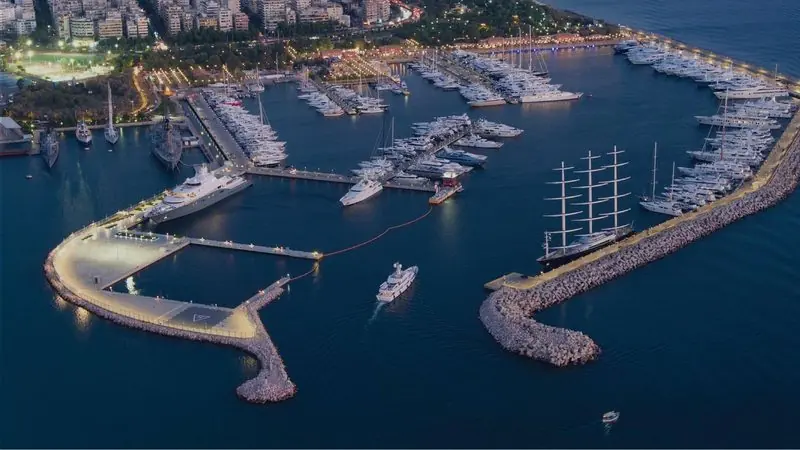
Flisvos sits at Palaio Faliro, on the coastal strip that runs southeast from Piraeus towards Glyfada and Vouliagmeni, roughly six kilometres from the centre of Athens. The tram stops outside the gate and Posidonos Avenue runs past the front door, so this is a marina embedded in a working suburb of four million people. The basin faces the Saronic Gulf, with Aegina and the Argolid on the horizon. LAMDA Flisvos Marina S.A. holds a 40-year concession granted in 2002 and has run the place since the Athens Olympics rebuilt this coast.
The position is the argument. From the fairway an owner is inside the Saronic in twenty minutes, at Hydra or Spetses inside a morning, and among the Cyclades the same day. Piraeus, with its ferries, chandlers and agents, is a short run west. Athens Marina, three kilometres along the same coast, takes a longer yacht, but Flisvos holds the largest permanent superyacht capacity in Greece and sits under an hour from the airport.
The entrance and what the wind does
The marina entrance is oriented west, which the operator states allows safe entry and exit in adverse weather, and an on-site control tower manages movements in and out and inside the basin. Depths run from 4.5 metres at the inner pontoons to 16 metres at the outer positions, so the deep berths carry a large displacement hull comfortably. An external windward protection was built specifically to shield the yachts from wave action and strong southerly winds. In a Saronic southerly, that wall is the reason nothing moves inside.
The seasonal wind is the meltemi, the dry northerly that fills in from around June and blows through September. In the Saronic it is a working breeze and not the hammer it becomes in the central Cyclades, so departures from Flisvos are rarely cancelled by it. What it does control is where a yacht goes next, because a hard meltemi week pushes sensible itineraries west into the Ionian or south into the lee of the Peloponnese. Owners who plan an August in Mykonos on a fixed date learn this once.
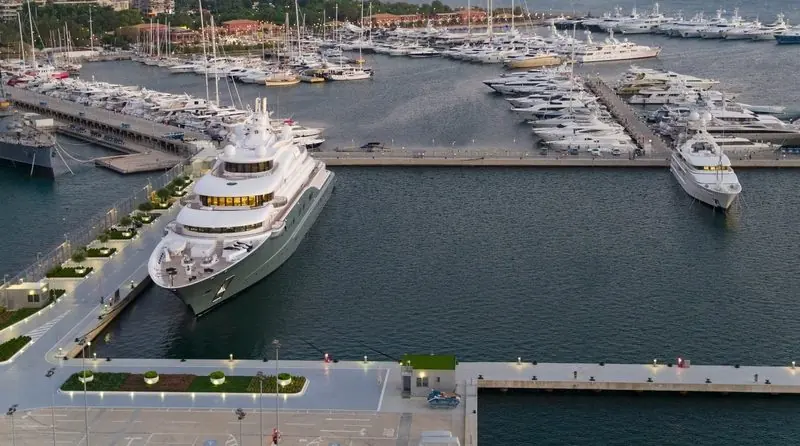
The largest permanent superyacht capacity in Greece, with a long-haul airport 40 minutes away.
The berth mix and what is realistically free
Flisvos publishes 310 berths taking yachts from 15 to 110 metres, with more than half of them laid out for boats over 30 metres. That is an unusual ratio. Most marinas of this size are mostly small berths with a handful of large ones bolted on at the outer wall, and here the large-yacht positions are the core of the business. The marina calls itself the mega-yacht destination in Greece and the berth plan backs it up.
Availability is tightest at the top of the range and in the shoulder months, because Flisvos is also where a good number of Greek-based charter yachts keep their home berth and turn guests around. An owner asking for a 70 metre position in July with two weeks notice will usually be disappointed. Annual berthing is the way in, and it is treated as a commitment for the calendar year. Transit berths exist and are priced to reflect that they are a convenience.
How it is charged, and a worked example
Berths at Flisvos are rented, not owned. There is no freehold to buy and no lease to trade, because the marina itself operates on a state concession that runs to 2042. The annual fee is calculated by multiplying the yacht's length overall by its beam and applying a published rate per square metre, so a beamy boat pays for its beam. Minimum charges of 15 metres LOA and four metres beam apply, and yachts lying alongside instead of stern-to pay double.
On the price list valid from 1 January 2026, the rate is EUR 236 per square metre a year for yachts over 44 metres LOA and EUR 252 for most of the 20 to 36 metre band. Worked through, a 60 metre yacht with an 11 metre beam covers 660 square metres and so pays around EUR 155,700 a year before VAT, plus the fixed 24/7 services charge of EUR 2 per square metre a month, another EUR 1,320 monthly. Transit yachts pay a daily rate equal to 2.5/365 of the annual fee for the first 90 days, which for the same boat is roughly EUR 1,070 a day. Water is EUR 8 per cubic metre and power EUR 0.37 per kWh on top.
What is on the quay
Shore power is supplied per berth from 32 to 630 amps, with monthly standing charges by amperage and a connection fee on each arrival. There is a fuel station inside the marina, potable water at the berth, sewage collection stations and arrangements with certified waste contractors, plus 24/7 technical support and mooring assistance. A helicopter landing area sits on the marina grounds. Secure storage units are let separately at EUR 220 a month on the 2026 list.
For heavy work an owner leaves. There is no lift or hardstanding at Flisvos, and the nearest serious capability is Olympic Marine at Lavrio on the east coast of Attica, which runs a 350-tonne travel lift and did the well-known rebuild of the 106.5 metre Dream, extending her hull by 15 metres. Lavrio is about an hour by road and reachable by sea around Cape Sounion. Agents, brokers, charter managers and chandlers keep offices inside the marina, so the day-to-day support is on the doorstep.
Security, customs and privacy
The marina is fenced with a single controlled entry and exit point for both vehicles and pedestrians, 24-hour guarding with vehicle patrols, CCTV and a watch tower giving a 360-degree view of the basin. The Flisvos Port Police is based in the administration building on the premises, and customs and port authority offices are on site, which removes a great deal of the running about that Greek paperwork otherwise involves. A dedicated firefighting vessel is crewed and on call around the clock.
Privacy is decent but not absolute. The marina is bordered by a public coastal park and a busy promenade, and its restaurants and shops draw Athenians in the evening, so people do walk within sight of the yachts. What they cannot do is get onto the pontoons. Owners who want a quay nobody can look at will find Flisvos more exposed than a gated industrial marina, and considerably less exposed than a town harbour.
Athens ashore, and a week with a family
Athens International Airport is 35 kilometres away, 40 to 45 minutes depending on traffic, with direct long-haul routes and a dense European schedule. The Acropolis and the city's museums are 20 minutes by car, and the coast south towards Glyfada and Vouliagmeni holds the good hotels, the beach clubs and Astir. The marina itself has restaurants, cafes, retail, an ATM, showers, a first aid station and 650 parking spaces. The Neraida floating museum, a restored 1939 steamer, is moored inside the marina and open to visitors.
For a family week Athens is unusually good value as a base, because the archaeology, the food and the beaches are all within half an hour and the yacht can take the guests to Hydra for lunch. Schooling, hospitals and normal urban life keep crew in post for years. The Riviera has been rebuilt steadily since 2004 and the Ellinikon redevelopment on the old airport site is remaking the strip immediately south of the marina. Building work along that stretch will be a fact of life for several more years.
Season, timing and the honest downside
The Greek season runs May to October, with July and August the peak and the shoulder months of late May, June and September the ones experienced owners prefer. Flisvos is busiest at the ends of that window, as yachts arrive to store, provision and take on guests before heading east or south. Winter is quiet and berths are easier. Greece charges TEPAI, a cruising fee of EUR 8 per metre per month for craft over 12 metres, payable in advance for every month a yacht is in Greek waters.
The downsides are the ones that come with a city. Palaio Faliro is not scenic, the water in the gulf is urban water, and the traffic on Posidonos Avenue is constant. Greek bureaucracy around charter licensing, crew paperwork and customs is heavier than in Italy or Spain, and having the port police on site softens that without removing it. There is no lift on site, so a hull problem means a passage to Lavrio. What Flisvos gives in exchange is a proper large-yacht berth at the front door of the best cruising ground in the Mediterranean.
The whole rate scale, and what a 60 m yacht actually pays
Flisvos publishes a one-page price list and the full scale is worth having rather than the two rates usually quoted. Valid from 1 January 2026, the annual fee is length overall multiplied by beam multiplied by a rate that steps down as the yacht gets longer. EUR 270 per square metre up to 16 m, EUR 265 at 17 m, EUR 260 at 18 m, EUR 257 at 19 m, then a long flat run at EUR 252 from 20 m to 36 m, EUR 248 at 37 m, EUR 245 at 38 m, EUR 242 at 39 m, EUR 240 from 40 m to 44 m, and EUR 236 for anything above 44 m. VAT is excluded throughout. Alongside berthing doubles the figure. There are minimum charges that catch small and narrow hulls, and a beam correction for anything with a length to beam ratio above six.
Worked through on a 60 m yacht of 11 m beam, the area is 660 square metres and the annual berth is EUR 155,760 before VAT. That is not the invoice. The fixed 24/7 services charge, which covers security, boat assistance, waste, technical support, parking at the berth and wifi, runs at EUR 2 per square metre per month and adds EUR 1,320 a month or EUR 15,840 a year. Power is metered at EUR 0.37 per kWh on top of a fixed monthly charge that varies by amperage band, and water is EUR 8 per cubic metre. Connection and disconnection is EUR 10 to EUR 30 on each arrival, with a further charge possible for a plug adaptor. The same yacht arriving as a transit rather than an annual berth holder pays 2.5/365 of the annual figure per day, which is EUR 1,066 a day for the first 90 days.
The amperage bands, and the frequency that is not printed
The price list is unusually explicit about power because it prices it by band, and the bands are the specification. Flisvos charges against 32 A, 63 A, 100 A, 125 A, 250 A, 320 A, 400 A and 630 A. That top band is a genuine large-yacht supply and matches the marina's published claim of up to 630 A per berth. What the list does not say, checked on 28 July 2026, is the voltage or the frequency, and neither appears anywhere else on the marina's site. Greece runs 50 Hz at 230 V single phase and 400 V three phase, in common with the rest of continental Europe. A 60 Hz yacht coming east across the Atlantic converts or runs generators.
The other unanswered question is distribution. The marina states 310 berths and that more than half were designed for yachts over 30 m, which is a genuinely useful statistic and still leaves the top of the range uncounted. How many positions take 60 m, 80 m or the headline 110 m is not published, checked 28 July 2026, and the depth range of 4.5 m to 16 m is given marina-wide rather than berth by berth. For a yacht at the top of the range both figures need to come out of the berthing application rather than off the website, and the annual contract terms on notice, refund and whether a berth is held while the yacht cruises are equally absent from the published list.
Ashore, access and booking
| Getting there | Athens International Airport is about 35 km away, 40 to 45 minutes by road on the marina's own account. Taxi quotes vary widely between sources, from around EUR 48 flat-rate with a private transfer operator to USD 80 to 100 on a general fare aggregator; agree the fare before the transfer. There is no direct rail line from the airport, but the Trocadero tram stop sits right outside the marina gate and connects into the Athens tram network, and the X96 Piraeus-Airport Express bus stops at Floisvos. |
|---|---|
| Arriving by sea | Work VHF channel 9. No Flisvos-specific pilotage or hazard guide could be found; the general caution for this stretch of the Saronic Gulf is the dense ferry, tanker and cruise-ship traffic converging on Piraeus nearby, which any arrival should allow for. |
| Reserving a berth | Contact +30 210 9871000-2 or [email protected]. There is no online booking system on the marina's own site; third-party platforms including MarinaReservation.com, Seasy, Metarina and 2Yachts list Flisvos. Book well ahead for July and August, when independent guides describe the marina as filling; allocation of the largest berths, above 30 m, is described by at least one broker as informal rather than a simple booking, though Yotters could not independently confirm this. |
| Haul-out and technical work | Not confirmed on site. The marina's own services page does not list a haul-out, dry dock or travel lift, though a third-party booking intermediary's listing claims one exists. Until the marina confirms otherwise directly, assume technical work beyond routine servicing means Zea Marina or another Athens-area yard. |
| Eating within walking distance | On site: the Pentelico Pier One complex, housing Coquillage and Brasserie Sud, plus ZINC Bar Restaurant, Due Cavalieri, Mare Mare Ristorante, Journey and Breeze Cafe and Drinks. Independently confirmed nearby: Mailo's Faliro and Estrella cafe in Palaio Faliro. |
| After dark | Rooftop bars around the marina serve cocktails with Acropolis views and DJ sets on weekend nights, by general travel-guide description; Yotters could not attribute this to one specific named source, so treat it as indicative rather than verified in detail. |
| What is NOT published, and the fixed dates | Haul-out capability is unconfirmed either way. No single maximum LOA and draught figure is settled: Dockwalk says 90 m and 9 m, other directories say up to 180 m and 13 m. Flisvos's own recurring flagship event is a Concours d'Elegance classic-car show each October, not a boat show; the Olympic Yacht Show, the major Greek yachting event, is held at Olympic Marine, not here. |
What owners and crew report
The marina's own account of why it wins the superyacht trade
Stavros Katsikadis, Managing Director of LAMDA Flisvos Marina, told Superyachts.com that the marina's proximity to the Acropolis lets guests combine berthing with sightseeing, presenting it as the marina's core pitch; on the 2018 Five Gold Anchors Platinum award he said, "this accreditation recognizes our continuous efforts to show the high quality of yachting services in Greece." This is the operator's own account, not an independent report.
Stavros Katsikadis, Managing Director, LAMDA Flisvos Marina, via Superyachts.com and GTP HeadlinesThe marina was engineered against a known swell problem
Trade coverage of the marina's engineering describes works added specifically to protect against strong south winds, a west-facing orientation, and a completed northern outer port division built to cut wave reflection inside the basin, implying swell was a genuine issue the design had to solve rather than a footnote.
Charterworld.com
What is good, and what to watch
Strong points
- The closest full-service superyacht marina to central AthensFlisvos sits about 6 km from the historic centre, closer than Alimos, which lies further out towards the airport.
- Greece's first 5 Gold Anchors Platinum marinaAwarded in October 2018 by the Yacht Harbour Association, scoring over 95 per cent across every assessed category, a rating neither Alimos nor Zea holds.
- A genuine destination, not a bare pontoonA 3,800 square metre retail and dining promenade carries around a dozen restaurants and cafes and five shops on site.
- Direct public transport at the gateThe Trocadero tram stop sits right outside the marina and connects into the Athens tram and metro network, unusually good transit access for a marina at this level.
- A deep, independently checkable certification stackISO 9001, 14001 and 45001, Blue Flag since 2007, ICOMIA Clean Marina status, an EFQM 6-Star award in 2025 and Monaco Smart and Sustainable Marina recognition in 2022 sit alongside the anchor rating.
What to watch
- No confirmed haul-out or dry-dock capabilityThe marina's own services page lists mooring assistance, technical support, fuel, power, water and security, but no haul-out or travel lift; one third-party booking intermediary claims a shipyard exists, which Yotters could not confirm and treats as unverified. Zea Marina, by contrast, is confirmed to offer on-site boatyard services.
- Public capacity figures disagree sharplyDockwalk gives a maximum of 90 m LOA and 9 m draught; other directories give up to 180 m and 13 m draught. Get any specific berth's limits confirmed in writing rather than relying on a directory figure.
- Genuinely crowded in July and AugustIndependent guide content advises booking well ahead for peak season, when the marina fills, and berths over 30 m are described by at least one broker as informally allocated rather than openly booked, a claim from a commercial intermediary that Yotters could not independently verify.
- The approach shares Piraeus's commercial trafficThe wider Piraeus and Saronic Gulf approach carries continuous ferry, tanker and cruise-ship traffic, though no Flisvos-specific pilotage guide describing how the marina itself briefs an arrival through it could be found.
- No self-service online booking on the marina's own siteReservation runs through phone, email or third-party aggregators such as MarinaReservation.com, Seasy and Metarina, an extra step for an owner used to instant confirmation.
Who it is for: The owner who intends to cruise Greece and the eastern Mediterranean seriously and wants a permanent base with a real city and a real airport attached.