Gustavia (St Barths)
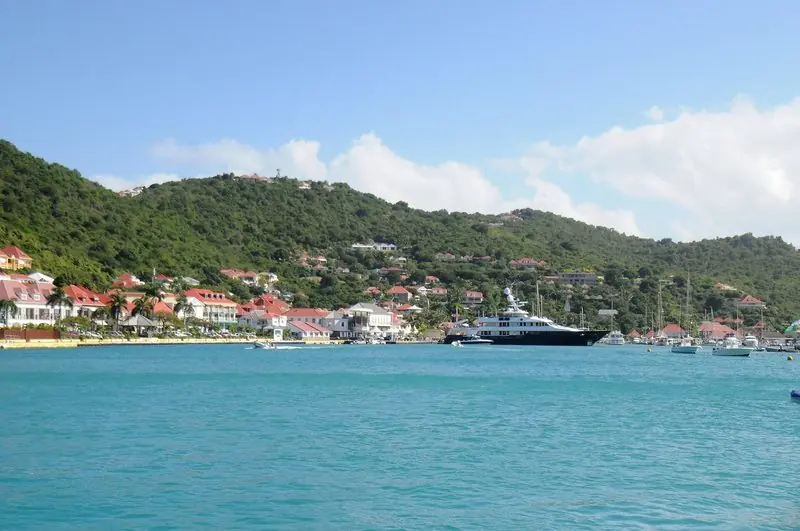
| Location | Gustavia, Saint-Barthelemy, French West Indies |
|---|---|
| Island | about 25 square kilometres, population 10,660 in 2023, roughly 200,000 visitors a year |
| Status | left the European Union in January 2012 and is now an Overseas Country or Territory, outside EU customs and VAT, operating as a free port with duty-free retail |
| Currency | euro |
| Port | administered as a pleasure port and a commercial port, with a 3 knot speed limit in the channel |
| Clearance | handled through the port's online clearance system, with immigration via the Gendarmerie nationale |
| Quay berthing | stern-to, generally quoted as suiting yachts up to around 60 m, with a mooring field inside for smaller craft |
| Larger yachts | anchor in the outer roadstead and tender ashore |
| Depths | not published by the port, so draught should be confirmed with the port office |
| Airport | Gustaf III, a single 646 m concrete runway with a specific pilot licence required, served by Pilatus PC-12, Cessna 208B, DHC-6 Twin Otter and Britten-Norman Islander aircraft |
| Jet access | none on the island, with guests routing through Princess Juliana on Sint Maarten by commuter aircraft or ferry |
| Season | Christmas and New Year peak plus the spring Bucket regatta, with the summer closed by the Caribbean hurricane season |
| Shore power does not appear on the pleasure port's published service list at all. Voltage, amperage and frequency are published nowhere | |
| Water, metered at the tap on every quay: EUR 0.012 per litre for a subscriber boat, EUR 0.019 per litre for a visitor, which is EUR 12 and EUR 19 per cubic metre | |
| Worked comparison | the same cubic metre of water costs EUR 6.22 at Monaco and EUR 3.79 at Antibes. Fifty cubic metres at Gustavia costs a visitor EUR 950 |
| Published services | water, wifi on a code from the harbour office, refuse with compulsory sorting, sanitary facilities, marine reserve liaison, SNSM lifeboat station, postal address for crew mail |
| Refuse containers are on the Quai General de Gaulle and the Quai de La Collectivite. Sorting is compulsory island-wide | |
| Harbour office hours | 07:00 to 18:00, seven days a week, all year. Sanitary facilities 07:30 to 18:00. VHF channel 12 |
| Formalities are compulsory for access to the pleasure port and can be started online up to 24 hours ahead, but are only registered once the document is printed and signed at the port office | |
| The port states in writing that an agent is not necessary and not compulsory at Saint-Barthelemy, because every harbour office officer is bilingual | |
| Immigration questions go to the Gendarmerie nationale, not to the harbour office | |
| Speed limit in the channel | 3 knots |
The island and the harbour
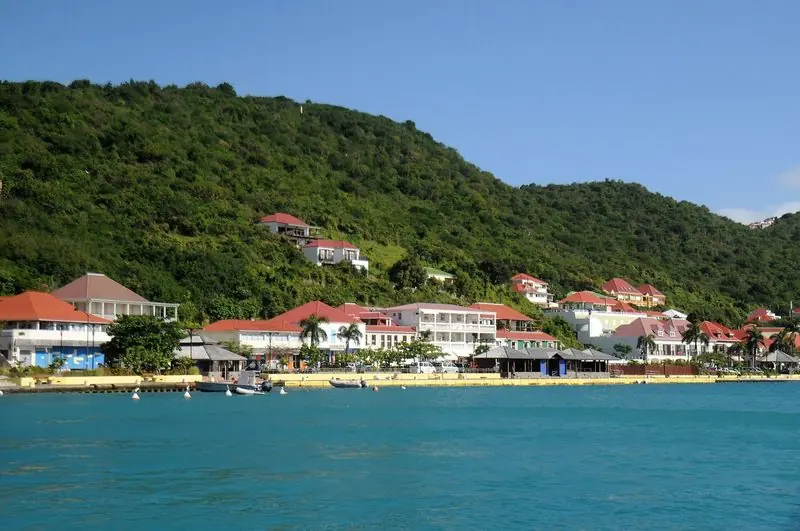
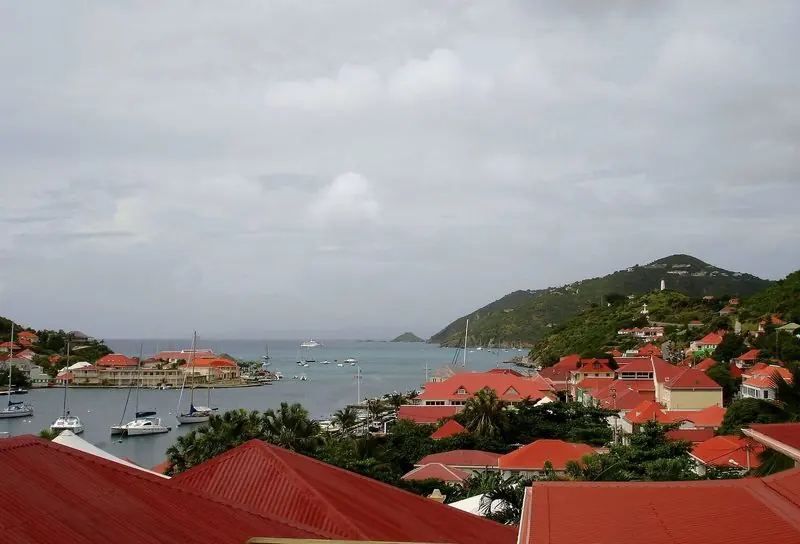
Saint-Barthelemy covers about 25 square kilometres and had a population of 10,660 in 2023, of whom roughly 2,300 live in Gustavia itself. The town occupies 3.4 square kilometres around a natural inlet that was originally called Le Carenage for the shelter it gave to damaged ships, which remains a fair description of what the harbour physically is. Gustavia was founded in 1785 and named for Gustav III of Sweden, and the island was Swedish from 1784 to 1878 before returning to France.
Three forts, Oscar, Karl and Gustav, sit above the water, and the lighthouse dates from 1961. The island draws around 200,000 visitors a year and its economy runs on tourism and duty-free retail. Trade winds keep air and sea temperatures around 27 degrees for most of the season, which is the practical reason the fleet crosses the Atlantic for the winter.
Getting in and the port's own rules
The port is administered as two installations, a pleasure port and a commercial port, under the island's port authority. The speed limit in the channel is three knots and it is enforced. Movements in and out are coordinated with the port office, which is not a formality in a harbour this size at Christmas.
Clearance is handled through the port's own online system, with immigration questions going to the Gendarmerie nationale. An owner arriving from an EU member state should note that this is an arrival into a territory outside EU customs, so the paperwork is a genuine international clearance. Agents on the island handle the process routinely and most yachts use one.
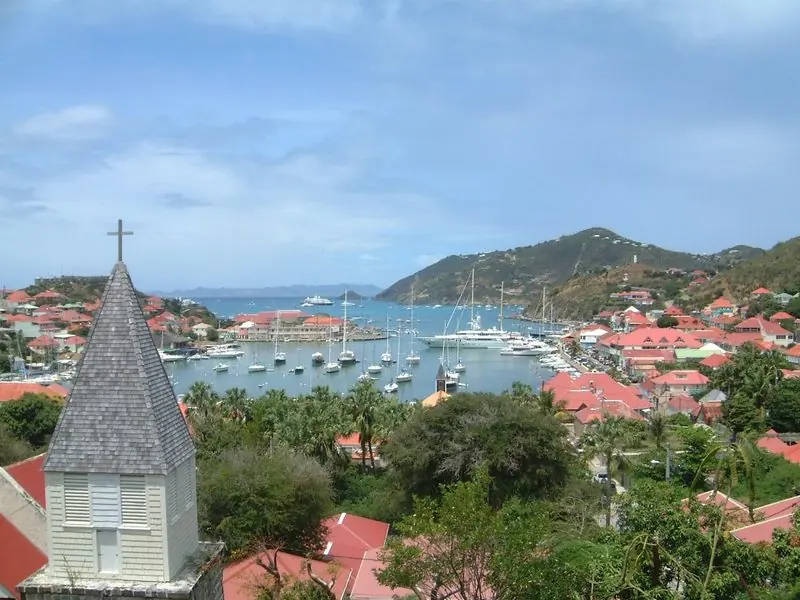
There is no amount of money that makes the quay at Gustavia longer.
The quay and the roadstead
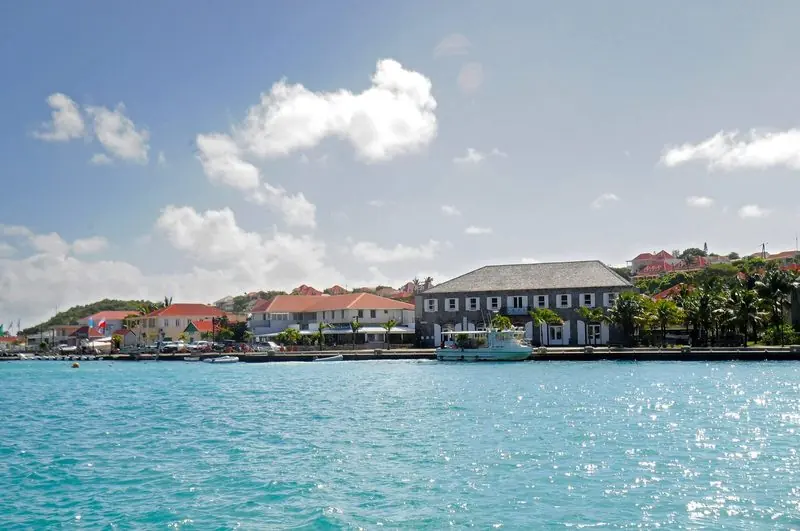
The inner harbour takes yachts stern-to along the quay, on lines run to heavy rings set into the old wall, with a mooring field for smaller boats inside. The quay is generally quoted as suiting yachts up to around 60 metres, a limit shaped as much by the shelter and by insurance as by the stonework. Depths in the inner harbour are modest and the port does not publish a maximum draught, so a deep hull is a question for the port office in advance.
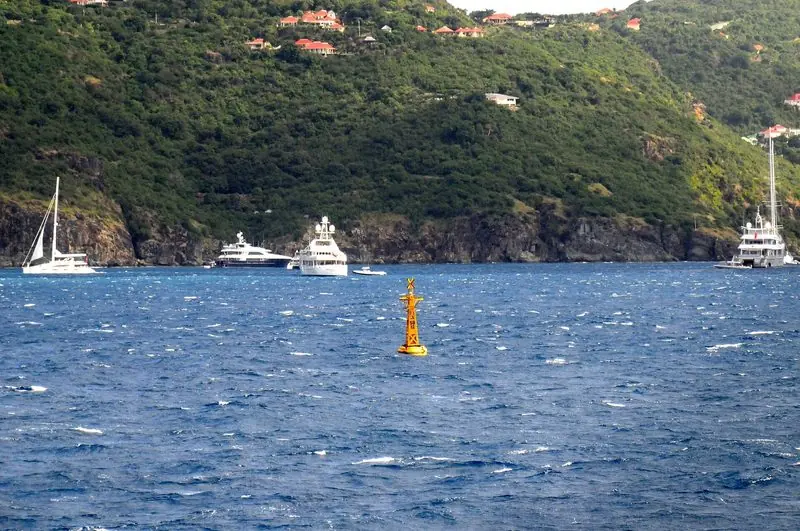
Everything larger lies in the outer roadstead and runs guests ashore by tender, which is how the biggest yachts in the Caribbean have always done Saint-Barthelemy. The result at New Year is a line of very large yachts anchored in full view of the town with tenders working continuously to the quay steps. A berth on the quay puts an owner in the middle of Gustavia. It does not put him anywhere the anchored fleet cannot also reach in four minutes.
Availability, and what booking actually means
The harbour is small and the demand around Christmas and New Year is out of all proportion to it. Reservations for the peak window are made months ahead and the quay is spoken for long before December. An owner deciding in October that he would like to be in Gustavia for New Year is deciding to anchor.
Outside that window the picture changes completely. From January through to the spring the island is busy but not besieged, and space is obtainable. The Bucket regatta in the spring brings the large sailing fleet in and tightens things again for a few days. Through the summer and autumn the island empties, because the Caribbean hurricane season runs roughly from June to November and the fleet is back in the Mediterranean.
Duty-free status, and why it matters
Saint-Barthelemy left the European Union in January 2012 and became an Overseas Country or Territory, so it is French, its residents are French and EU citizens, its currency is the euro, and it sits outside the EU customs and VAT territory. It operates as a free port and duty-free retail is a cornerstone of the island's economy.
For an owner that has two consequences. Goods bought ashore are bought duty-free, which is why the boutiques along the Rue de la Republique are what they are. And a yacht's customs position is not the same as it would be in Martinique or Guadeloupe, so anyone moving a European-flagged yacht through the region should take the status into account when planning the winter.
Services on a small island
For its size Gustavia handles yachts well, with fuel and water available in the harbour and a network of agents who make provisioning, transport, crew logistics and clearance straightforward. The island imports almost everything, and the supply chain into it is unusually well organised because the same chain feeds the hotels and villas. French provisions arrive for the season and can be sourced at a standard that surprises people.
What does not exist is technical capacity. There is no yard, no lift and no serious spares holding, and water and power on the quay are limited enough that many yachts run their own systems and top up when they can. Anything mechanical means St Maarten, which is a short hop, or a longer run to a proper Caribbean yard. A yacht that intends to spend the season here should arrive with everything working.
Security, privacy and how visible the yacht is
Saint-Barthelemy has been a discreet island for decades and the culture of the place protects the people who come to it. Crime is not a practical concern. The port is small enough that everyone in it is known to the harbour office.
Privacy from cameras is a different matter over Christmas and New Year. The quay is the town's promenade, the restaurants and bars back straight onto it, and the anchored fleet outside is photographed from every hillside and every tender. For those two weeks Gustavia is as exposed as Monaco in September. From mid-January it goes quiet.
Getting there, which is the real problem
Gustaf III airport has a single concrete runway of 646 metres running down a slope onto a beach, with an extremely steep arrival over the hilltop road on runway 10 and a specific pilot licence required to land there. The aircraft that use it are Pilatus PC-12s, Cessna 208B Caravans, DHC-6 Twin Otters and Britten-Norman Islanders. The largest type ever cleared for the airport was the DHC-7. No business jet is landing on Saint-Barthelemy.
In practice guests fly into Princess Juliana on Sint Maarten and transfer by commuter aircraft with Tradewind Aviation, St Barth Commuter or Winair, or come across by fast ferry. It works, and it is what everyone does, but an owner planning a week with family and staff should build the transfer into the plan and not assume the jet lands at the island.
The honest downside
The harbour cannot supply what people want from it. There are more owners who want to be alongside in Gustavia at New Year than there is quay, by a wide margin, and no amount of money changes the physical length of the wall. Prices for that window are among the highest short-stay costs in yachting. The island is expensive across the board and the peak weeks are priced accordingly.
The rest of it is the geography. This is a seasonal destination with a hurricane exposure that closes the summer, no technical support, a runway that excludes jets, and an island small enough to cross in half an hour, so a family staying a fortnight will have seen it. Owners treat Gustavia as the centrepiece of a Caribbean winter and pair it with the Mediterranean for the other half of the year.
What the port supplies, which is less than expected
The pleasure port publishes its service list and shore power is not on it. What is on it is water, wifi, refuse, sanitary facilities, a working relationship with the island's marine reserve and an SNSM lifeboat station of its own. Water is metered at the tap on every quay and it is expensive: EUR 0.012 per litre for a subscriber boat and EUR 0.019 per litre for a visitor, which is EUR 12 and EUR 19 per cubic metre. Set against Monaco at EUR 6.22 and Antibes at EUR 3.79 for the same cubic metre, water at Gustavia costs three to five times Riviera prices, which is what desalination on an island of 25 square kilometres costs. A visiting yacht taking 50 cubic metres pays EUR 950 for it.
Sorting refuse is compulsory across Saint-Barthelemy and the port provides the containers on the Quai General de Gaulle and the Quai de La Collectivite. Wifi is open to anyone on a code collected from the harbour office. The showers and WCs are reserved to port users and open 07:30 to 18:00. The harbour office itself is open 07:00 to 18:00 every day of the week and all year round, and works VHF channel 12. What the port does not list, and shore power is the conspicuous absence, is a question to put to the port office before the passage rather than an assumption to make on arrival.
Who clears the yacht, and why an agent is optional here
Entry and exit formalities are compulsory for access to the pleasure port, and there are two ways to complete them. Either at the port office directly, or online through the port's own clearance system no more than 24 hours ahead. The online route does not finish the job. The port states that the formality is only registered once the document has been printed and signed at the port office, so the online form saves the queue and not the visit. Immigration is handled separately by the Gendarmerie nationale, which is who to contact about anything to do with a crew member's status rather than the harbour office.
On agents the port is unusually direct, and it is worth taking at face value. Every officer in the harbour office is bilingual, and the port states in writing that it is in no way necessary for a vessel to have an agent at Saint-Barthelemy to represent her, then repeats on its formalities page that an agent's presence is not compulsory. Very few ports at this level publish that, and most of the ones that do not are protecting a local trade. Speed in the channel is limited to 3 knots, and the port repeats the limit on every page of its own site, which is a fair indication of how it is treated.
Ashore, access and booking
| Booking the quay | The pleasure port does not take advance reservations by name; an owner or agent contacts the harbour office directly (VHF 12, or its online clearance system up to 24 hours ahead) with the yacht's dimensions and dates, and berthing is allocated from there. For the Christmas and New Year window, space on the wall is spoken for months ahead regardless. |
|---|---|
| What it costs to sit alongside | The port publishes no berth rate of any kind. What it does publish is water, metered at EUR 0.012 per litre for a subscriber and EUR 0.019 per litre for a visitor (EUR 12 to 19 per cubic metre) - three to five times the Riviera price at Monaco (EUR 6.22) or Antibes (EUR 3.79). A visiting yacht taking 50 cubic metres pays about EUR 950 for water alone. |
| What is not published | No maximum draught or depth alongside, no berth tariff, and no shore power specification (voltage, amperage or frequency) appear anywhere on the port's own site. A deep or power-hungry yacht should raise all three with the harbour office before committing to a date. |
| Do you need an agent | The port states in writing that an agent is not necessary or compulsory, because every harbour office officer is bilingual - unusually direct for a marina at this level. Most large yachts use one anyway for provisioning, transport and crew logistics rather than for the clearance itself. |
| Getting there | No jet lands on the island: Gustaf III airport's 646 metre runway takes only Pilatus PC-12s, Cessna 208B Caravans, DHC-6 Twin Otters and Islanders. Guests fly into Princess Juliana on Sint Maarten and transfer by commuter aircraft or fast ferry. |
| Technical support | There is no yard, no lift and no serious spares holding on the island. Anything mechanical means a short hop to St Maarten or a longer run to a proper Caribbean yard, so a yacht wintering here should arrive with everything already working. |
| Next door | The quay is the town's promenade: duty-free boutiques and restaurants back directly onto it, and the anchored fleet outside is in full view from every hillside. The season runs Christmas through the spring Bucket regatta; the Caribbean hurricane season (roughly June to November) closes it. |
What owners and crew report
The waters here are unusually weather-reliable for a Caribbean venue
In seventeen years running the St Barths Bucket, the regatta has lost only a single race day to weather - a track record its own race chairman points to as evidence the trade-wind season around the island is dependable rather than lucky.
Peter Craig, St Barths Bucket regatta race chairman, via Boat InternationalThe approach still needs a careful eye, tradewinds or not
The Caribbean's most established cruising guide warns sailors approaching St Barths to study the charts and keep a good lookout rather than trust the marked channel blind, noting that the navigation lights and buoys on the approach have been known to fail or shift position.
Chris Doyle, Doyle Guides, via Caribbean Compass
What is good, and what to watch
Strong points
- The one anchorage everyone else is watchingAt New Year the Gustavia roadstead is the most photographed gathering of large yachts in the Caribbean, and a berth or a good anchoring spot puts an owner in the middle of it.
- Duty-free and well organised for its sizeSaint-Barthelemy sits outside EU customs and VAT as a free port, and despite the island's tiny scale, agents, provisioning and fuel and water are handled efficiently through a supply chain built to feed the same hotels and villas.
- Genuinely weather-reliable racing and cruising conditionsTrade winds hold the season at a steady mid-20s Celsius, and the St Barths Bucket's own race chairman has lost only one race day to weather in seventeen years running it.
What to watch
- The quay cannot supply the demand for itThere is more demand for a New Year berth than there is wall, by a wide margin, and no amount of money lengthens the quay - an owner deciding in October is usually deciding to anchor, not berth.
- No technical capacity at allNo yard, no lift and no meaningful spares holding on the island; a mechanical problem means St Maarten at best.
- No jet accessThe 646 metre runway excludes every business jet; guests transfer via Sint Maarten by commuter aircraft or ferry, which has to be built into any plan.
- Basic facts the port will not publishNo berth rate, no maximum draught and no shore power specification appear anywhere on the operator's own site, which leaves a captain confirming by phone what most marinas of this standing publish outright.
Who it is for: An owner who crosses for the Caribbean winter and wants his yacht in the one anchorage everyone else is looking at on New Year's Eve.