Marina Baie des Anges
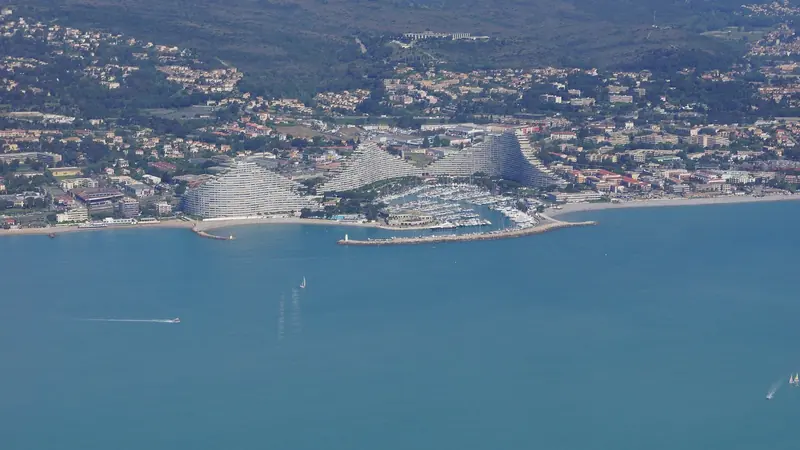
| Location | Avenue Jean Marchand / Route du Bord de Mer (RD6098), 06270 Villeneuve-Loubet, Alpes-Maritimes, on the coast between Nice and Antibes. |
|---|---|
| Approach position approximately 43 deg 38.0' N, 007 deg 08.4' E; the entrance channel (passe) faces southeast and is marked by lit breakwater beacons. | |
| Operator's published total | 515 berths; third-party marina directories and brokerage listings variously cite 527 to 548 berths for the same port. |
| Berths split roughly into 470-474 long-term private moorings (6 to 35 metres) and about 50-53 public/visitor berths (3 to 18 metres), per the operator and the Figaro Nautisme guide. | |
| Maximum LOA published by the operator | 28 metres; separate brokerage and berth-resale listings mention occasional spots to 35-38 metres. |
| Draught | approach channel and outer basin about 5 metres; inner basins quoted at only 2 to 3 metres by the professional Figaro Nautisme marine guide. |
| VHF channel 9, monitored; harbour office mobile line +33 7 48 72 71 52; main phone +33 4 65 00 00 40. | |
| Fuel station near the boatyard, open 7 days a week year-round, with extended hours (0830-1230 and 1330-1930) in April-June and September-October. | |
| Operator since January 2021 | a 30-year concession held by Sodeports with Eiffage Concessions and the Caisse des Depots' Banque des Territoires, roughly 64 million euros committed to renovation through 2024. |
| Harbour master named on official/professional channels: Emmanuelle Marquet. | |
| Certifications | Ports Propres (Clean Harbours) and 'Actifs en biodiversite' (active biodiversity) labels. |
| Nearest airport | Nice Cote d'Azur (NCE), about 9-12 km away, roughly 12-15 minutes by road depending on the source. |
| Villeneuve-Loubet's own train station is within walking distance of the marina. | |
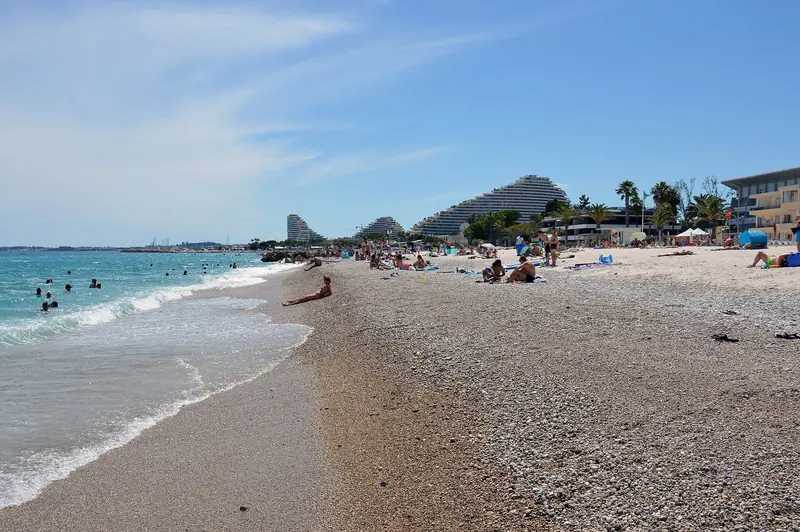
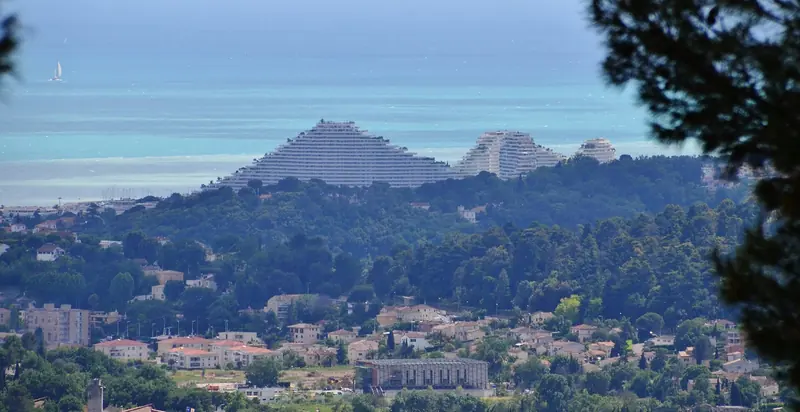
| Architecture | four pyramid/wave-shaped residential towers - Amiral (1970) and Commodore (1972) are consistently dated; Ducal and Baronnet completion dates disagree across sources, ranging from the mid-1970s to 1990-1992. |
| Architect Andre Minangoy designed the complex for developer Jean Marchand's Marina/CICA group; Minangoy died in 1985 before the whole project was finished. | |
| The complex received France's Architecture Contemporaine Remarquable heritage label in November 2000; total apartment count is reported anywhere from about 1,300 to 1,600 across sources. | |
| Quayside amenities built into the towers' ground floor: supermarket, chandlery, laundromat, showers/WC with 24-hour badge access, and Michelin-starred restaurant La Flibuste (chef Eugenie Beziat). | |
Why does the marina look like a fleet of concrete sails?
The marina sits in Villeneuve-Loubet, between Nice and Antibes, wrapped around a roughly 6-hectare basin cut into what was marshland and open coast until the late 1960s. Developer Jean Marchand's Marina group commissioned architect Andre Minangoy to design a self-contained resort of apartments, shops and a harbour in one, and Minangoy answered with four stepped, wave-shaped towers whose concave balconies curve outward like sails or breaking surf. The effect is deliberate: from the water the buildings read as a fleet at anchor, and from the coast road they are visible for miles in both directions, which is exactly why they still divide opinion decades later.
The apartment blocks, known individually as Amiral, Commodore, Ducal and Baronnet, were built out over roughly two decades rather than all at once, so the resort grew around the finished marina in stages instead of arriving complete. Sources disagree on the exact interior population, citing anywhere from about 1,300 to 1,600 apartments across the four towers, but all agree the marina basin, shops and boatyard were built as the functional ground floor of the whole scheme, not added afterward. That sequencing is why the port still feels integrated with the towers rather than bolted onto them: the berths, chandlery and quay-front restaurants sit literally inside the base of the architecture.
Who built it, and why did such a controversial design get finished?
Construction began in 1968 or 1969, depending on the source, under Jean Marchand's Marina/CICA development group, with the first tower, Amiral, delivered in 1970 and the second, Commodore, following in 1972 - the two dates every source checked for this entry agrees on. The later towers, Ducal and Baronnet, took much longer: published completion dates for them range from the mid-1970s to as late as 1990-1992, and no two of the sources reviewed give identical years, so treat any single completion date for those two buildings as approximate rather than confirmed. Minangoy died in 1985, partway through the build-out, and never saw the full complex completed.
The scale of the project, a mass of concrete far larger than anything else on this stretch of coast and one that closes off sea views from the coast road, triggered genuine controversy when it went up, with critics calling it a visual barrier at sea level. That reception softened over time: in November 2000 the regional heritage commission awarded Marina Baie des Anges France's Architecture Contemporaine Remarquable label, an official recognition of significant 20th-century architecture, citing the towers' ambition even while acknowledging the same scale that once drew objections. The design has also been credited, fairly or not, with influencing later curved-concrete resort projects built elsewhere.
How big is the marina, and what can actually berth there?
Marina Baie des Anges' own site states 515 berths, split between roughly 474 privately-held long-term moorings (6 to 35 metres) and about 50 public or visitor berths (3 to 18 metres); the professional Figaro Nautisme marine guide independently confirms the 515 figure. Other marina databases and brokerage sites, however, list the total anywhere from 527 to 548 berths and cite maximum lengths up to 35 or even 38 metres for isolated spots, which the operator's own published maximum of 28 metres does not mention. Depth is similarly two-tier: the approach channel and outer basin (avant-port) carry about 5 metres, but the inner basins are quoted at only 2 to 3 metres.
That gap matters for anyone planning a call with real draught: a boat cleared to enter on the 5-metre approach can still find its assigned inner berth considerably shallower, so a deep-draught yacht should confirm berth-specific depth directly with the harbour office rather than relying on the headline approach figure. The entrance itself faces southeast, is lit for day and night access in most weather, and is monitored on VHF channel 9, with a harbour-side mobile line backing up the office during the day. A 3-knot speed limit applies inside the breakwaters, and the port holds Ports Propres clean-harbour certification alongside an active-biodiversity label. A public careening area and boatyard, run by Bleumer with an 80-tonne travel lift, sits beside the fuel station for haul-outs and repairs.
How do you get a berth, and what does it actually cost?
Visiting boats book through the capitainerie by phone, VHF or the marina's own reservation page; the operator, Sodeports, under a 30-year public concession it won jointly with Eiffage Concessions and the Caisse des Depots' Banque des Territoires in 2021, does not list current escale rates on its website, only pointing visitors to a dedicated tariffs page without published figures at the time of writing. Older third-party tariff sheets, dated 2020-2021 and not confirmed current, quoted roughly 42 euros a night for a 10-metre boat and about 78 euros for a 14-metre boat in high season with water and power included, useful as a rough historical benchmark only.
Long-term berths work differently: owners buy a 'garantie d'usage', a fixed-term usage-rights contract rather than an outright deed, with one dated third-party listing citing about 104,000 euros for 15 years on a 12-metre monohull berth. Owners who are not using their berth can also list it for summer sub-letting through the marina operator, which retains a 10 percent commission on the rental. None of these figures were confirmed against a current official price list, so anyone budgeting for a stay or a purchase should treat them as reference points and call the harbour office for the live number before committing.
How close is this to Nice airport, and what is there to do once you tie up?
Nice Cote d'Azur Airport (NCE), one of France's busiest, is a genuinely short hop away: road-distance figures found for this entry range from about 9 to 12 kilometres depending on the routing tool, with drive times quoted at 12 to 15 minutes, which makes crew changes and provisioning runs unusually easy for a marina this size. Villeneuve-Loubet's own train station is within walking distance of the port, and the whole quayside promenade is flat, pedestrian and wheelchair-friendly - reviewers repeatedly single this out, since many Riviera marinas are hemmed in by traffic in a way this one is not.
Because the marina was designed as the ground floor of the residential towers rather than added beside them, everyday services sit right on the water: a supermarket, a laundromat, chandlery and general shops line the quay, and the Michelin-starred restaurant La Flibuste, run by chef Eugenie Beziat, occupies a prominent spot on the harbour front. Antibes and its old town are a short drive away, and Nice itself is close enough for a half-day visit without moving the boat. For a crew that wants walkable amenities without renting a car, this is a genuine practical advantage over some larger, more spread-out Riviera ports.
Is there anything a visiting skipper should watch for before choosing this stop?
Professional marine guides describe the port as accessible in normal conditions but flag a specific caution: swell from the southeast, south or southwest builds up in the entrance channel and can make the approach uncomfortable or worse, since the passe itself faces southeast and is not sheltered from that quadrant. The entrance is marked by a green light on the eastern breakwater and a red light on the southern breakwater, each flashing twice every 6 seconds, so night entry is workable once those two lights are identified. Skippers should still check the forecast for wind and sea state from the southeast, south and southwest before timing an arrival, particularly outside the height of summer when conditions can turn faster. Inside the breakwaters the basin is well protected and the 3-knot limit keeps wash down, but the exposed approach is the one weather-related risk worth planning around.
Beyond the weather, the practical caution is informational rather than nautical: no two sources checked for this entry, the operator's own site, professional marine guides, and third-party brokerage or marina-database listings, agree exactly on berth totals, maximum LOA or even inner-basin depth, and current tariffs are not published anywhere official. None of that makes the marina a bad stop; the architecture, the walkable quay and the airport proximity are real and well documented. It does mean a visiting or buying skipper should verify berth-specific length, draught and price with the harbour office directly rather than trusting any single number found online, including the ones in this entry.
Ashore, access and booking
| Getting there | Nice Cote d'Azur Airport (NCE) is about 9-12 km away, roughly 12-15 minutes by road (routing tools disagree slightly on the exact figure); Villeneuve-Loubet's own train station is within walking distance of the marina. |
|---|---|
| Superyacht/yacht berthing | The operator's own figures state a maximum LOA of 28 m with an approach draught to 5 m. Third-party brokerage and berth-resale listings separately mention isolated spots to 35-38 m. Inner basins are quoted at only 2-3 m by a professional marine guide, so confirm berth-specific depth directly rather than relying on the headline approach figure. |
| Berth pricing | Not published on the marina's current official site. Dated (2020-2021) third-party tariff sheets quoted about EUR 42/night for a 10 m boat and EUR 78/night for a 14 m boat in high season (water and power included), and roughly EUR 104,000 for a 15-year usage-rights ('garantie d'usage') contract on a 12 m berth. Treat these as historical reference points, not current rates. |
| Fuel | Attended fuel station near the boatyard, open 7 days a week year-round; extended hours 0830-1230 and 1330-1930 in April-June and September-October. |
| VHF and contact | VHF channel 9 (monitored); harbour office +33 4 65 00 00 40; harbour mobile +33 7 48 72 71 52. |
| What is not published | Current 2026 escale or annual tariffs, the single largest berth actually available today, and one authoritative total berth count (515 per the operator versus 527-548 in third-party marina directories). |
What owners and crew report
Visitor reviews are almost all about the towers, not the berths
Tripadvisor's own review titles for the port ('Amazing buildings and marina', 'The giants of the French Riviera', 'A nice walk', 'Beautiful') are overwhelmingly from passers-by admiring the architecture rather than from boat owners rating their stay - genuine berthing feedback is hard to find in public reviews.
Tripadvisor (Port Marina Baie des Anges attraction page)Foot access and dining draw consistent praise
Visitor write-ups repeatedly highlight that the quayside promenade is flat, pedestrian and wheelchair-friendly, walkable from Villeneuve-Loubet's train station, with a well-stocked supermarket and the Michelin-starred La Flibuste right on the water - an unusually walkable setup compared with more car-dependent Riviera marinas.
Tripadvisor visitor reviews of Port Marina Baie des AngesSailor-community mooring reviews are genuinely thin
Navily and sea-seek.com carry the port's technical entry (berth counts, size range, mooring buoys prohibited) but neither shows a meaningful volume of skipper star-ratings or written comments for this specific port, unlike larger nearby stops such as Antibes or Monaco - word of mouth on day-to-day service quality is limited outside brokers' own listings.
Navily and sea-seek.com marina directories
What is good, and what to watch
Strong points
- Unmatched locationAbout 12-15 minutes from Nice Cote d'Azur Airport and walkable from Villeneuve-Loubet's own train station, with Antibes and Nice both a short drive away - genuinely convenient for crew changes and provisioning.
- Architecture and walkable amenities in oneThe port is built into the ground floor of a protected 20th-century architectural landmark, so a supermarket, chandlery, laundromat and the Michelin-starred La Flibuste sit right on the quay instead of a car park away.
- Active reinvestment, not managed declineA 30-year concession awarded in 2021 to Sodeports, Eiffage Concessions and the Caisse des Depots' Banque des Territoires committed roughly 64 million euros to modernising the port through 2024, and it holds Ports Propres and active-biodiversity certifications.
What to watch
- Inconsistent public data on size and limitsBerth totals range from 515 (the operator's own figure) to 548 in third-party directories, and maximum LOA is quoted anywhere from 28 to 38 metres depending on the source - nothing beyond the operator's own 28 m / 5 m figures should be assumed without a direct call.
- No published current pricingThe operator's live site does not publish escale or annual tariffs; the only figures found online date to 2020-2021 and are not confirmed current.
- Swell-exposed, southeast-facing entranceProfessional marine guides warn that swell from the southeast, south or southwest builds up in the approach channel, and inner-basin depth (2-3 m) is shallower than the headline 5 m approach draught, so deep-draught boats should confirm conditions and berth-specific depth before arrival.
Who it is for: This marina suits owners and skippers of yachts up to about 28-30 metres who want a walkable, amenity-rich Riviera base close to Nice airport and are willing to confirm exact berth size, depth and price directly with the harbour office rather than trust published figures.