Marina di Porto Cervo (Sardinia)
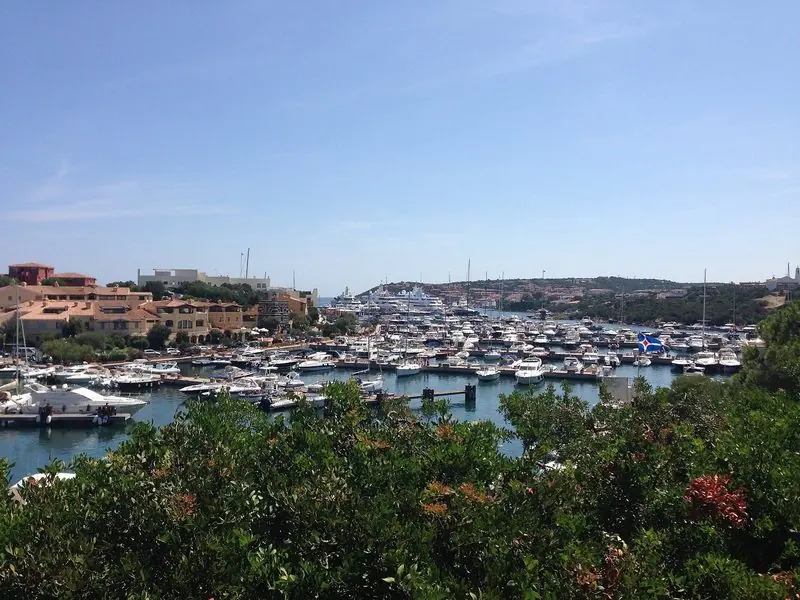
| Location | Porto Cervo, Costa Smeralda, north-east Sardinia, Italy |
|---|---|
| Owner | Smeralda Holding, an indirect wholly-owned subsidiary of the Qatar Investment Authority since 2012 |
| Operator | IGY Marinas, management agreement renewed 21 February 2025 |
| Berths | 700 total, of which 100 are sized for megayachts |
| Max LOA | 160 m, max draught 8 m, no beam restriction |
| Two harbours | New Marina open year-round, Old Port open only 1 June to 30 September |
| Shore power | 16, 32, 63, 125 and 250 amp supplies |
| On site | Cantiere Porto Cervo, a full-service yard in the same ownership |
| Cost, 2026 charter-market guidance | about EUR 4,000 to EUR 9,000 a night in August for a 30 to 40 m yacht |
| Availability | first fortnight of August described as effectively sold out by mid-May |
| Airport | Olbia Costa Smeralda about 31km, roughly 35 to 40 minutes by road |
| Fixed dates 2026 | Giorgio Armani Superyacht Regatta 26-30 May, Maxi Yacht Rolex Cup 6-12 September, Rolex Swan Cup 13-19 September |
| On-site travel lift | 40 tonnes, rubber-tyred open-end |
| Slipway trolley to the covered sheds | hulls to 45 m LOA, 8.5 m beam, 3.2 m draught. Shed storage to 250 tonnes across 7,360 square metres in three buildings |
| Anything above those limits leaves Sardinia, most often for Genoa or La Spezia | |
| Shore power sockets on the 2026 tariff | 32 A single-phase, 32 A three-phase, 63 A, 150 A and 250 A three-phase with neutral and earth. Voltage and frequency are not published, the Italian grid is 50 Hz and no 60 Hz supply is advertised |
| Socket deposits, 2026 card | EUR 200 for 32 A single or three-phase, EUR 300 for 63 A, EUR 750 for 150 A, EUR 950 for 250 A, plus EUR 20 to connect |
| Cost, published Porto Nuovo 2026 card, VAT included, category IX (to 40 m LOA and 10 m beam): EUR 3,698 a day 1 to 20 August, EUR 2,571 a day 10 July to 5 September, EUR 101 a day in January to March | |
| Cost, same card, category X (to 55 m LOA and 10 m beam): EUR 5,437 a day 1 to 20 August, EUR 3,780 a day 10 July to 5 September | |
| Cost, category X+ (over 55 m LOA or over 10 m beam) is charged by area: EUR 7.38 per square metre per day from 10 July to 5 September, EUR 0.33 in January to March | |
| Daily services on top, category IX | electricity EUR 650, water EUR 65, garbage EUR 89. Category X: EUR 740, EUR 134, EUR 117. Category X+ by area at EUR 1.400, EUR 0.700 and EUR 0.300 per square metre per day |
| Cost, seasonal contract 1 May to 31 October 2026: EUR 195,819 for category IX, EUR 325,707 for category X. Winter contract 1 November to 30 April: EUR 15,882 and EUR 23,640 | |
| Berths on the outer side of Pier A are dynamically priced, moving between the category VIII and X+ rates | |
| Extras | Molo A and ISPS zone pass EUR 50, ISPS guard EUR 40 an hour. Discounts on application for stays over two months |
| Wind on the approach | the marina names the Grecale, the north-easterly, as the condition that complicates access, with buoys off the main quay allowing a bow mooring without anchoring |
| Approach hazard | the Passo delle Galere between the Li Nibani inlets, easily confused with the Passo delle Rocche, with treacherous soundings |
The approach and the inlet
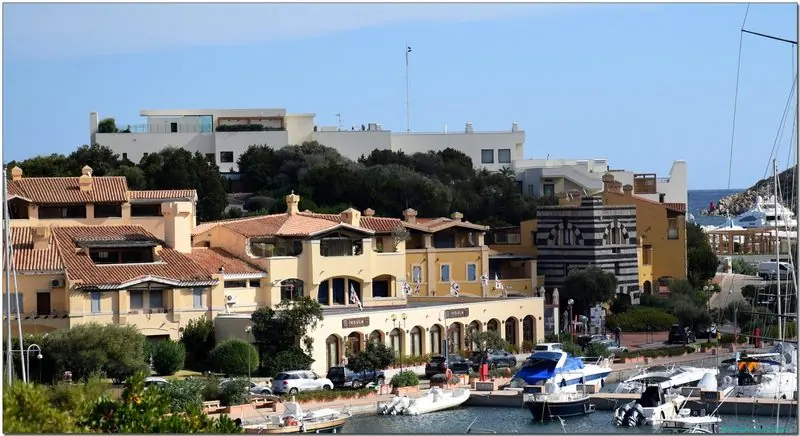
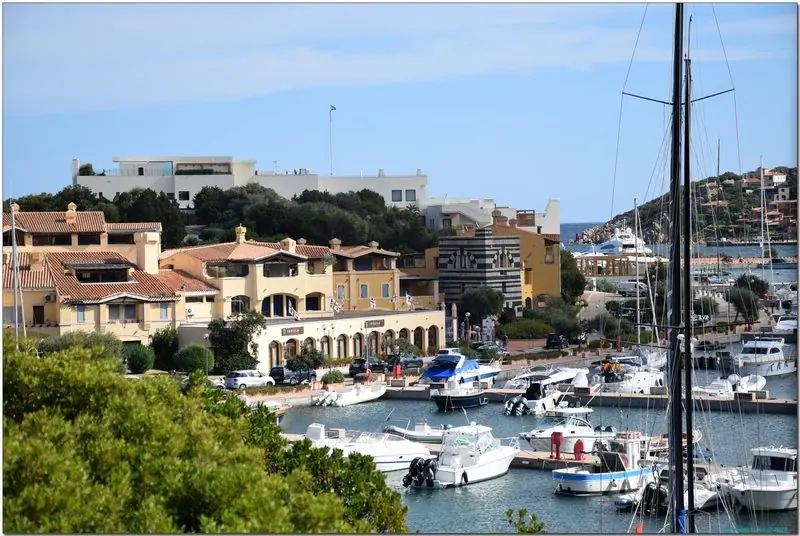
The marina lies inside a narrow granite inlet on the Costa Smeralda, roughly 41 degrees 08 minutes north, 9 degrees 31 minutes east. The approach is straightforward in daylight and the inlet is genuinely well sheltered, which is the reason the Aga Khan's consortium picked this bay in the first place. Depths in the inlet run from about seven metres down to under two at the head, so the deep water is at the outer end where the marina puts the largest yachts. The port monitors VHF 16, 11 and 9 and runs a 24 hour watch at the New Marina.
The wind that governs the coast is the mistral out of the north-west, and it can blow hard enough to shut down tender work and make the outside passages unpleasant for days. Inside the inlet the effect is muted. Easterlies are the direction that troubles the anchorage off the entrance, and they are rare here. Cala Granu, a few minutes round the corner, is the standard bolthole when the mistral is up, with a shallow sandy bottom that holds well.
Two harbours and what they take
The marina runs as two harbours. The New Marina is open year-round with 24 hour VHF cover. The Old Port opens 1 June and closes 30 September, which is the single most useful thing an owner can know about capacity here, because roughly a third of the water disappears from the offer outside those four months. Total berthing is quoted at 700, of which 100 are sized for megayachts.
The published envelope is 160 metres maximum length, eight metres maximum draught and no beam restriction, on floating docks with full service alongside. Some secondary listings quote lower figures of around 100 metres and six metres, which reflect particular pontoons and not the marina's outer capability. In practice the biggest yachts lie at the deep end on the New Marina quays and everything else is fitted around them. Berthing is alongside or stern-to depending on the position, with berthing assistance provided.
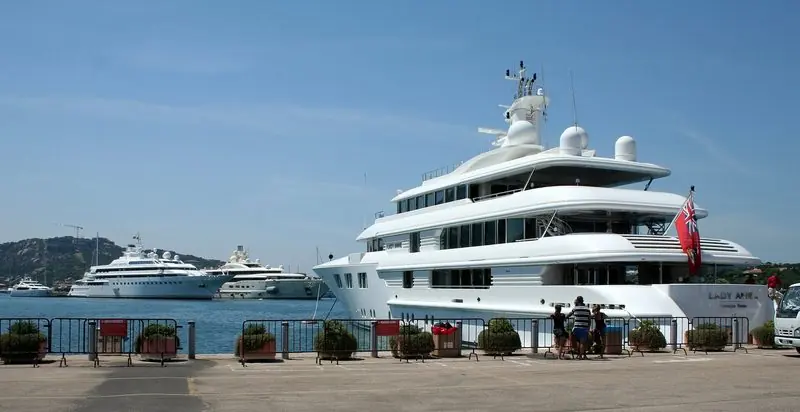
Ten weeks at full pitch and then the Old Port closes on the last day of September.
The berthing reality in August
The honest answer for the first fortnight of August is that Porto Cervo is closed. Charter-market guidance published for 2026 describes the inventory for those two weeks as functionally claimed by around 1 May and effectively gone by mid-May, and advises anyone enquiring inside six weeks to plan on an anchorage. That is not a marketing line. It is how the harbour works.
The fallback is well established and perfectly comfortable. Yachts lie at Cala Granu or off Porto Cervo Sud and run guests in by tender, which is what a large part of the fleet does anyway because the anchorages here are excellent. Pevero bay next door is sheltered from the west and holds well on sand and rock, though the southern side is now a buoy field and there is no public tender landing in Cala Romantica. Outside the peak, from June and again from September, space at the marina is obtainable at reasonable notice.
Who owns it, and how a berth is obtained
The marina, the shipyard, the Pevero golf club and the four Costa Smeralda hotels all belong to Smeralda Holding, an Italian company that has been an indirect wholly-owned subsidiary of the Qatar Investment Authority since 2012. IGY Marinas runs the marina and the yard under a management agreement, renewed on 21 February 2025. So an owner deals with IGY at the quay and with a single landlord for almost everything ashore.
Transient and seasonal berths are booked direct with the marina. Longer tenure exists in the form of concession leases that are traded privately through berth brokers, and these carry an expiry date that an owner must check before he pays for one, since a listed concession can be close to its end. Annual arrangements at the New Marina suit yachts that use Sardinia as a summer base. The best positions are held by returning owners and rarely surface.
What it costs, from the published card
Porto Cervo publishes a daily tariff for the New Marina and it is a great deal more specific than the charter-market guidance usually quoted. The 2026 card works in ten categories set by length and beam together, running from category I at 6.5 m and 2.5 m up to category X at 55 m and 10 m, with a category X+ for anything longer or wider. Rates include VAT, which the card applies at 10 per cent where allowed. A category IX yacht, up to 40 m and 10 m of beam, pays EUR 3,698 a day between 1 and 20 August, EUR 2,571 a day from 10 July to 5 September, EUR 1,069 in June and EUR 101 in January to March. Category X, to 55 m, pays EUR 5,437 and EUR 3,780 across the same August and high-summer windows. Above 55 m the card stops quoting a berth and starts charging by the square metre, at EUR 7.38 per square metre per day from 10 July to 5 September.
The headline rate is not the invoice. Water, electricity and refuse are billed as separate daily charges by the same category. For a category IX yacht that is EUR 650 a day of electricity, EUR 65 of water and EUR 89 of refuse, so the real August day rate is EUR 4,502 rather than EUR 3,698, and a fortnight in the first half of August comes to EUR 63,028 before any pass, deposit or fuel. On top of that sit a EUR 20 electrical connection charge, a Molo A and ISPS zone pass at EUR 50, an ISPS guard at EUR 40 an hour and a refundable socket deposit that runs from EUR 200 for 32 A to EUR 950 for 250 A. Berths on the outer side of Pier A are dynamically priced and float between the category VIII and X+ rates. A yacht committing to the whole season pays EUR 195,819 in category IX and EUR 325,707 in category X for 1 May to 31 October, against EUR 15,882 and EUR 23,640 for the 1 November to 30 April winter contract, which is the clearest statement of what August is worth here. Rates for the Old Port are not published at all and come by email.
Power, water, waste and the yard
Shore power is offered at 16, 32, 63, 125 and 250 amps, which covers a large yacht running its systems alongside without leaning on generators. Water, fuel, waste collection, laundry and provisioning are all handled at the berth, and the marina runs wifi and 24 hour security across the site. The Old Port and New Marina have separate offices and separate numbers, which catches out crews arriving in the shoulder season.
The real advantage over most destination marinas is the Cantiere Porto Cervo on site, a full-service yard in the same ownership that handles repair, maintenance, fitting-out and full refits. A fault that would otherwise mean a delivery passage to Genoa or La Spezia can often be dealt with in the bay. For scheduled heavy work most owners still go to the mainland yards, but the yard removes the risk of a broken week in August.
Security, privacy and how visible the yacht is
Security is 24 hours and the pontoons are controlled, which for a marina inside a private resort development means the yacht is behind more than one layer. The Costa Smeralda has been built and policed since the 1960s around the assumption that the people using it want to be left alone, and that culture holds.
Visibility is a different question in August. The marina quay becomes an evening promenade, the boats are photographed continuously, and the walk from the passerelle to the Piazzetta is short and public. It is nothing like Monaco during the show, but nor is it private. Owners who want to disappear use the anchorages around the Maddalena archipelago and come in only when they want to be ashore.
Ashore, the airport and a family week
Olbia Costa Smeralda airport is about 31 kilometres away, roughly 35 to 40 minutes by road, with summer connections across Europe and jet handling on site. That is the shortest airport run of any marquee Mediterranean marina, which matters when guests rotate weekly. The village behind the marina is small and entirely purpose-built, with the Piazzetta at its centre, boutiques, and the four resort hotels at Cala di Volpe, Romazzino, Pitrizza and Cervo within a few minutes' drive.
For a week with a family the strength is the water. The beaches of the Costa Smeralda are among the best in the Mediterranean, the Maddalena archipelago is an hour away by tender or a short cruise by yacht, and the Pevero golf course sits behind the village. What Porto Cervo does not have is a town with any life of its own. There is no old quarter, no market and little to walk around, so families who want culture take the yacht to Corsica or the Italian mainland.
The calendar, and the honest downside
The Yacht Club Costa Smeralda gives the year its fixed points. For 2026 that means the Giorgio Armani Superyacht Regatta on 26 to 30 May, the Rolex TP52 World Championship on 15 to 20 June, the Palermo to Porto Cervo to Monte Carlo race on 18 to 23 August, the Maxi Yacht Rolex Cup on 6 to 12 September and the Rolex Swan Cup on 13 to 19 September. Note that the superyacht regatta lost its long-standing Loro Piana title and now runs under Giorgio Armani.
The downside is the shape of the year. Porto Cervo is intense for about ten weeks and closed for the rest, the Old Port shuts entirely from October to May, and much of the village goes with it. Prices in the peak are the highest in the Mediterranean and there is no competitive alternative ashore because one holding company owns the hotels, the golf, the yard and the marina. A yacht based here full-time spends eight months in a resort that is not open.
What the yard can actually lift
Cantiere Porto Cervo sits inside the marina and in the same ownership, which is a real advantage over most destination ports, but the machinery has limits worth knowing before a season is planned around it. The travel lift is a rubber-tyred open-end machine rated to 40 tonnes, which covers tenders, sportsboats and the small end of the sailing fleet and nothing else. Above that the yard works through a hydraulically operated horizontal trolley on the slipway, which moves boats into the covered sheds and is rated for hulls up to 45 m in length, 8.5 m of beam and 3.2 m of draught. The sheds themselves take stored boats of any type up to 250 tonnes, across three buildings totalling 7,360 square metres with fire protection and forced ventilation.
So the honest position is that a 40 m motor yacht drawing 3 m and carrying 9 m of beam is at the edge of what can come out of the water here, and a 60 m yacht cannot be lifted at Porto Cervo at all. What the yard does well is everything that can be done afloat or on the outside hardstanding, where repair, maintenance and conversion work is carried out on units up to 45 m. The trades on site cover diesel and petrol engines, electrical, electronic, radio-navigation and sound insulation work, carpentry, joinery, painting and onboard systems, with a 6 m lathe for shaft line grinding. Anything needing a bigger lift leaves the island, most often for the Ligurian yards at Genoa and La Spezia.
The wind that complicates the entrance
The mistral out of the north-west is the wind that governs the coast and it is the one most crews plan for. The marina's own technical sheet names a different one for the approach. Access to the harbour can be awkward in the Grecale, the north-easterly, which comes in over the mouth of the inlet rather than down it. In front of the main quay the marina has laid a run of buoys that allow a bow mooring to be taken without letting go an anchor, which is the practical answer to a Grecale day and worth requesting rather than discovering.
Two approach notes come from the same sheet. From seaward the harbour is picked up by steering for Capo Ferro, the dark headland 46 m high carrying its lighthouse north of Porto Cervo, and then by the two entrance lights of the bay together with the profile of the hotels and the village behind. Crews who do not know the area are specifically told to avoid the Passo delle Galere between the Li Nibani inlets, which is easily mistaken for the Passo delle Rocche and carries treacherous soundings. Inside, the marina publishes a maximum draught of 8 m, and the inlet shoals from about 7 m to under 2 m towards its head, so the deep water and the large yachts are both at the outer end.
Ashore, access and booking
| Getting there | Olbia Costa Smeralda is the airport, about 30 km away and 31 to 35 minutes by road, stretching to around 40 minutes in July and August through the Arzachena bottleneck. Pre-booked private transfers are quoted from about EUR 76 with tolls included; metered taxis are scarce at Olbia in the peak, with waits of 30 to 60 minutes reported in July, so book the car rather than join the rank. Published taxi fares vary so widely between guides that no single figure is reliable. Helicopter operators fly the leg in about ten minutes to the Porto Cervo helipad. That is the shortest airport run of any marquee Mediterranean marina, which matters when guests rotate weekly. |
|---|---|
| Arriving by sea | The New Marina keeps a 24-hour VHF watch and works channels 16, 11 and 9, and the Maritime Authority monitors 16 around the clock. Port direction is +39 0789 905111, Marina Est +39 0789 936666, night emergency +39 335 1200241, the Capitaneria +39 0789 563648 and medical services +39 0789 94577. Offices run 08:00 to 20:00 in summer and 09:00 to 18:00 in winter, with mooring assistance continuous, holidays included. From seaward, steer for Capo Ferro, the dark 46 m headland and lighthouse north of the inlet, then pick up the two entrance lights with the hotels and village behind. Avoid the Passo delle Galere between the Li Nibani inlets, easily confused with the Passo delle Rocche and carrying treacherous soundings. Italian coastal rules bind outside: no navigation within 200 m of the shore and 10 knots inside 1 km. |
| Reserving a berth | Booked direct with the marina, online or by email, and IGY states plainly that advanced reservations are strongly recommended. The New Marina and the Old Port keep separate offices and separate numbers, which catches out shoulder-season arrivals. Captains check in and check out with the marina office for every stay. Charter-market guidance for 2026 describes the inventory for the first fortnight of August as functionally claimed by around 1 May and effectively gone by mid-May, and tells anyone enquiring inside six weeks to plan on an anchorage. Longer tenure exists as concession leases traded privately through berth brokers, and those carry an expiry date the buyer must check for himself. |
| What a berth costs, with the daily charges on top | The 2026 New Marina card works in ten categories set by length and beam together, VAT included at 10 per cent where allowed. Category IX, to 40 m and 10 m of beam, is EUR 3,698 a day from 1 to 20 August, EUR 2,571 from 10 July to 5 September, EUR 1,069 in June and EUR 101 from January to March. Category X, to 55 m, is EUR 5,437 and EUR 3,780 across the same two windows. Above 55 m or 10 m of beam the card stops quoting a berth and charges by area, EUR 7.38 per square metre per day from 10 July to 5 September. Water, electricity and refuse are then billed as separate daily charges by the same category rather than metered: category IX pays EUR 650 of electricity, EUR 65 of water and EUR 89 of refuse a day, so the real August day rate is EUR 4,502 and a fortnight in early August is EUR 63,028 before any pass, deposit or fuel. Category X pays EUR 740, EUR 134 and EUR 117. Add EUR 20 to connect, EUR 50 for the Molo A and ISPS pass, EUR 40 an hour for an ISPS guard, and a refundable socket deposit from EUR 200 at 32 A to EUR 950 at 250 A. Seasonal contracts for 1 May to 31 October are EUR 195,819 in category IX and EUR 325,707 in category X, against winter contracts of EUR 15,882 and EUR 23,640 for 1 November to 30 April. |
| Services, power and the yard | Shore power comes at 32 A single-phase and three-phase, 63 A, 150 A and 250 A three-phase with neutral and earth. High-speed fuel pumps, provisioning, laundry concierge, waste collection, floating docks, wifi and 24-hour security across the site. Cantiere Porto Cervo is on the same water and in the same ownership, which removes the risk of a broken week: a 40 tonne rubber-tyred travel lift, a hydraulic slipway trolley taking hulls to 45 m LOA, 8.5 m of beam and 3.2 m of draught into the sheds, and 7,360 sq m of covered storage in three buildings for boats to 250 tonnes, with a 6 m lathe for shaft-line grinding. Above those limits nothing can come out of the water in Sardinia and the yacht goes to Genoa or La Spezia. The marina's own ferry crosses the inlet every half hour from 09:00, last departure 01:00, between 20 June and 20 September. |
| Eating within walking distance | On the Piazzetta itself: Il Portico and Paper Moon, with La Pergola in Giardino and the Cervo Bar at the Cervo hotel a few paces behind. Langosteria sits at Porto Vecchio. Along Via Porto Vecchio on the marina front are Zuma, Finger's, Il Pomodoro, Pedri Garden and Crazy Pizza, with Cibo on the Promenade du Port at Via Aga Khan 1 and Goosto at Piazzetta Clipper on Via della Marina Nuova. The names most guests ask for, Matsuhisa and Beefbar, are at the Cala di Volpe hotel and are a car ride rather than a walk, as is Novikov. |
| After dark, and the fixed dates | Phi Beach at Forte Cappellini runs from sunset bar into an open-air club under international DJs. Billionaire sits in a villa on the hill above the village with terraces over the coast. Sottovento, going since 1979, is the discreet salon rather than the dance floor. The Yacht Club Costa Smeralda gives the year its fixed points: the Giorgio Armani Superyacht Regatta 26 to 30 May 2026, the Rolex TP52 World Championship 15 to 20 June, the Palermo to Porto Cervo to Monte Carlo race 18 to 23 August, the Maxi Yacht Rolex Cup 6 to 12 September and the Rolex Swan Cup 13 to 19 September. |
| The anchorages, and the park rules that changed for 2026 | Above 40 m a large part of the fleet lies off and tenders in, and the anchorages are good enough that many do it by choice. Cala Granu is 10 m over sand and covers north-west, west and south-west. Liscia di Vacca, off Pitrizza, is 15 m on rock and sand. Pevero holds on sand, rock and weed and covers a wide arc, but it is crowded all summer and the only dock, in Cala Romantica, is private, so there is no public tender landing. Anchoring is forbidden inside the Pevero and Cala di Volpe buoy fields and permitted 200 m clear of the last buoy, and at Porto Rotondo it is prohibited within 200 m of the Marinella buoy camp. Towing jet skis and toys inside a buoy camp is not allowed. In the Maddalena archipelago, ordinance 33/2026 dropped the blanket ban on staying overnight at anchor for the 2026 season while tightening the seabed rules: a valid park permit, a closed black water system, sand only, no posidonia, marked buoy fields closed to anchors, and permits now bought online through the park. |
| What is NOT published | The Old Port has no published tariff at all. Rates come by email, so roughly a third of the marina's water, and the third that is only open 1 June to 30 September, carries no public price. Shore power voltage and frequency appear nowhere in the tariff; Italy is on the 50 Hz grid and no 60 Hz supply is advertised, so a 60 Hz yacht should assume she converts on board. Berths on the outer side of Pier A are dynamically priced and float between the category VIII and X+ bands rather than sitting at a fixed rate. And concession leases at the New Marina trade privately with no public register, no published expiry and no recorded prices, which is why a listed concession can be much closer to its end than the asking price suggests. |
What owners and crew report
Above 40 m the fleet lies off and tenders in, and the guides say where
The captain's tool published for the Porto Cervo and Porto Rotondo area gives Cala Granu at 10 m over sand, sheltered from north-west, west and south-west; Liscia di Vacca at 15 m on rock and sand; and Pevero holding on sand, rock and weed but very busy with multiple yachts through the summer, with no tender landing because the only dock, in Cala Romantica, is private. It also records that anchoring is forbidden inside the Pevero and Cala di Volpe buoy fields and permitted 200 m clear of the last buoy.
Nautica Assistance, The Captain's ToolBrokers tell clients to plan on an anchorage inside six weeks
Costa Smeralda charter guidance for 2026 describes the marina inventory for the first fortnight of August as functionally claimed by around 1 May and effectively gone by mid-May, and advises anyone enquiring inside six weeks to base on the Cala Granu or Porto Cervo Sud roadstead and tender in. Above 40 m it reports that yachts frequently anchor in those two places anyway.
Yachts for Kings, 2026 Costa Smeralda rate mapThe operator relationship was renewed, not re-tendered
IGY Marinas announced on 21 February 2025 that it had renewed its management agreement with Smeralda Holding for the marina and shipyard, a 700-slip facility taking yachts to 160 m, with chief executive Steven English citing five years of the partnership. For an owner that reads as continuity of the front desk rather than a change of standard, which is the useful part.
IGY Marinas, reported by Marina WorldThe Maddalena rules moved again for 2026, so older advice is wrong
Cruising guidance for the 2026 season reports that ordinance 33/2026 removed the blanket ban on staying overnight at anchor in the archipelago while tightening the seabed requirements: a valid park permit, a closed black water system, sand only with no damage to posidonia, and no anchoring inside marked buoy fields, with the permit system moved online. Inspections are reported on entering archipelago waters in the peak.
mySKIPPER.guide, and NavilyNo independent owner survey of this marina exists
There is no published owner or captain satisfaction survey for Porto Cervo, the Old Port has no public tariff, and concession leases trade privately with no register. Everything beyond the New Marina's own 2026 card is charter-market commentary, and should be read as such.
Yotters desk, checked August 2026
What is good, and what to watch
Strong points
- A deep granite inlet that genuinely shelters160 m maximum length, 8 m of draught and no beam restriction, on floating docks with full service alongside, in the bay the Aga Khan's consortium chose for its shelter.
- A full-service yard on the same water and in the same ownershipCantiere Porto Cervo turns a fault that would otherwise mean a delivery passage to Liguria into a job done in the bay.
- The shortest airport run of any marquee Mediterranean marinaOlbia Costa Smeralda is about 30 km and 31 to 35 minutes, with jet handling on site, so guests can rotate weekly.
- The New Marina card is published in fullTen categories by length and beam, four seasonal windows, per-square-metre pricing above 55 m and both seasonal and winter contract figures.
- The fallback is comfortable rather than a penaltyCala Granu, Liscia di Vacca and Porto Cervo Sud are good anchorages minutes away, and mooring assistance runs 24 hours year-round at the New Marina.
What to watch
- The year is about ten weeks longThe Old Port opens only 1 June to 30 September and much of the village closes with it, so a yacht based here full-time spends eight months in a resort that is shut.
- The fluids are charged by category, not meteredA category IX yacht pays EUR 804 a day of electricity, water and refuse on top of the berth whatever she actually consumes, taking the real August rate to EUR 4,502.
- The first fortnight of August is gone by mid-MayCharter-market guidance for 2026 tells anyone enquiring inside six weeks to plan on an anchorage. That is how the harbour works, not a sales line.
- One landlord owns everything ashoreSmeralda Holding owns the marina, the shipyard, the Pevero golf club and the four Costa Smeralda hotels, so there is no competitive alternative to price against.
- The yard cannot lift a large yachtThe travel lift stops at 40 tonnes and the slipway trolley at 45 m, 8.5 m of beam and 3.2 m of draught, so a 60 m yacht cannot come out of the water anywhere in Sardinia.
Who it is for: An owner whose summer is built around six weeks in Sardinia and who bases the yacht somewhere else for the other ten months.