Marina Port de Mallorca / STP Palma
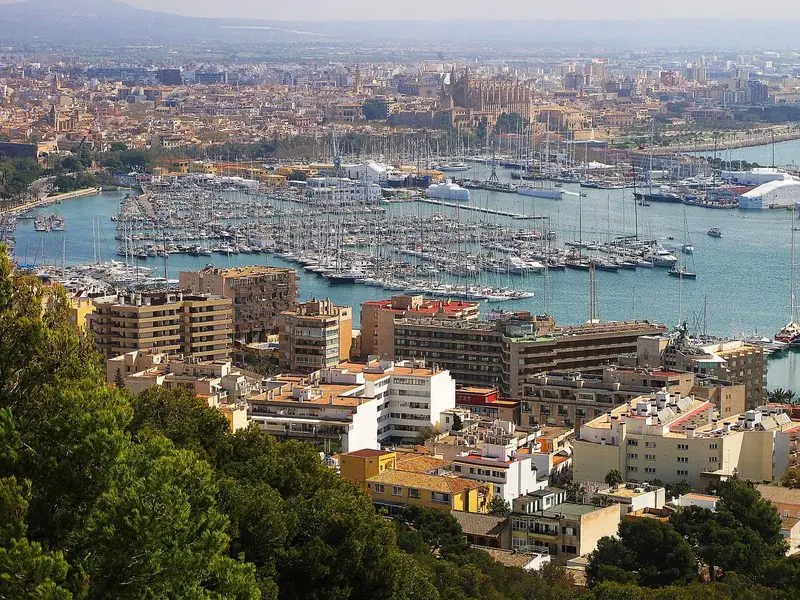
| Location | commercial port of Palma de Mallorca, at about 39 33.8 N 2 38.4 E |
|---|---|
| Operator | IPM Group, which also holds Marina Port de Mallorca, Marina Ibiza, Marina Port Ibiza and Varadero Valencia |
| Marina Port de Mallorca | 200 berths with a maximum of 50 m, facilities refurbished in 2017 |
| STP yard capacity | yachts to 120 m and 1,000 tonnes |
| Travelifts | six, at 30, 100, 150, 200, 700 and 1,000 tonnes, with the 1,000 tonne machine stated to be the only one in Europe |
| Yard footprint | about 130,000 square metres technical area, 86,000 of land, 44,000 of water, 5,000 of workshops, seven dry dock pits |
| Throughput | around 1,500 yachts a year, up to 140 under repair at once, over 1,800 travelift movements annually |
| Open yard | owners appoint their own contractors from over 500 specialist companies on site, with a daily workforce above 1,500 |
| February 2026 | STP launched large-refit capability for vessels up to 115 m LOA at new facilities |
| For yachts over 50 m afloat | STP's own berthing area, or Club de Mar Mallorca with over 500 berths, more than 40 superyacht positions and a 170 m maximum |
| Certification | STP holds ISO 9001, ISO 14001 and OHSAS 45001, and the marina holds Blue Flag, EMAS and ISO 9001 |
| Next fixed date | Palma International Boat Show, 28 April to 1 May 2027 |
| Haul and launch, 2025 published maximum tariff, charged as one operation: EUR 6,964.34 high season and EUR 5,878.98 low season at 40 m, EUR 3,869.08 and EUR 3,265.87 at 30 m, EUR 1,061.24 and EUR 1,029.08 at 20 m | |
| Above 40 m the 40 m rate applies plus 10 per cent for every metre over 40 m, so a 60 m yacht is three times the 40 m figure | |
| Movement within the storage area 40 per cent of the tariff, suspension from the water 60 per cent | |
| Hardstanding | EUR 0.930 per square metre a day for days 1 to 15 and EUR 1.080 from day 16 in high season, EUR 0.720 and EUR 0.790 in low, liquid waste removal included |
| Dry dock pit occupation | hardstanding rate plus 20 per cent |
| Berth for a yacht under repair | EUR 0.710 per square metre a day high season, EUR 0.570 low |
| Low season at STP is January, July, August and December. Everything else is high season | |
| Water and electricity are the Balearic Port Authority's Palma tariffs plus 15 per cent handling. Refuse EUR 7.13 per 100 litre bag plus EUR 0.10 per square metre of boat per day, plus 50 per cent if hazardous. Telephone and data are supplier rates plus 10 per cent | |
| Ancillaries | hull cleaning EUR 4.30 per square metre, compressed air EUR 31.51 a day, ladder to 2 m EUR 14.29 a day, parking EUR 1.430 an hour, covered premises EUR 42.99 per square metre a month |
| Worked example | a 45 m yacht on a 9 m beam, hauled in October for thirty days, pays EUR 10,446.51 for haul and launch and EUR 12,210.75 for the hardstanding, EUR 22,657.26 of yard tariff before contractors |
| Formalities | entry and exit declarations are made in person at the maritime border post in the Port of Palma with all crew passports, seaman's books or on-board contracts, current crew list and ship's registration certificate |
| Border post public hours 08:00 to 14:00 Monday to Friday, with out-of-hours cases by telephone appointment only | |
Where it is and what the approach is like
The yard sits inside the commercial port of Palma de Mallorca at 39 degrees 33.83 minutes north, 2 degrees 38.38 minutes east, on the western side of the city waterfront. The Bay of Palma is wide, deep and easy to enter in almost any conditions, with no bar, no narrows and no tidal constraint. Commercial and ferry traffic is heavy and the port operates to commercial rules, so arrivals are coordinated.
The bay's one habit worth planning around is the afternoon sea breeze, which builds reliably through the summer and can make a lunchtime manoeuvre in a tight berth harder than the same job at eight in the morning. Yards and marinas here schedule lifts accordingly. Southwesterlies push swell into the bay in winter, which is the direction to watch if a yacht is lying afloat over the refit season.
What the marina takes, and where a bigger yacht goes
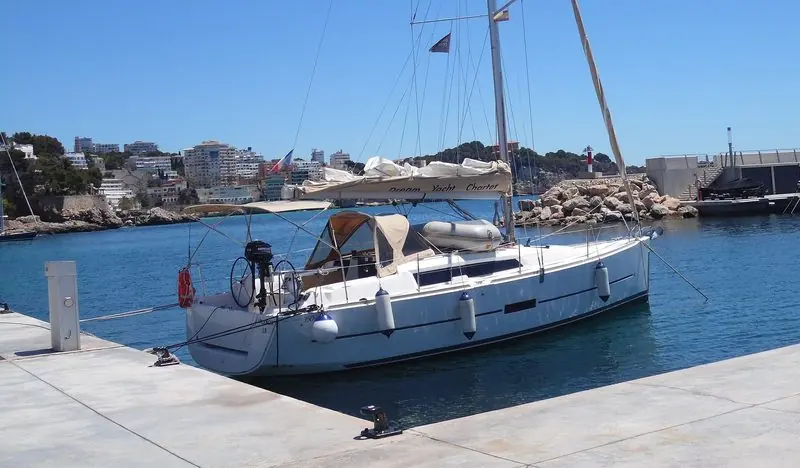
Marina Port de Mallorca itself holds 200 berths and tops out at 50 metres. Its facilities were refurbished in 2017 and it runs as an eco-port with collection of oily, grey and black water, 24 hour security and camera coverage, a concierge desk and berthing assistance. It sits under the IPM Group, the same ownership as STP, Marina Ibiza and Marina Port Ibiza.
Above 50 metres an owner is looking at STP's own berthing area, which covers about 44,000 square metres of water inside the yard, or at Club de Mar Mallorca across the water. Club de Mar runs over 500 berths with more than 40 positions sized for superyachts and megayachts and takes yachts up to 170 metres, and it is in the middle of a major expansion. Palma's capacity for very large yachts is therefore real, but it is spread across three operators and not concentrated in one marina.
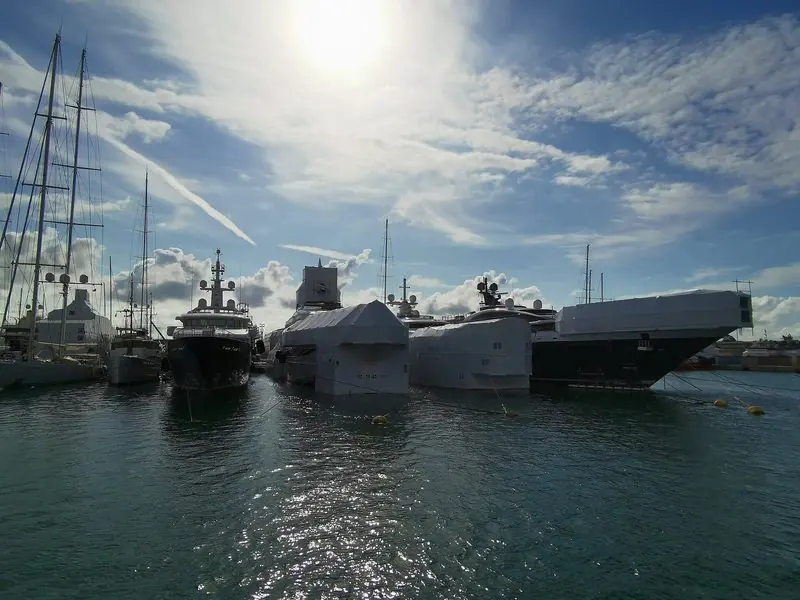
The only thousand-tonne travelift in Europe, and an open yard that hands the project risk back to the owner.
What the yard can actually lift
STP covers a technical area of about 130,000 square metres, made up of roughly 86,000 square metres of land and 44,000 of water, with 5,000 square metres of workshops and seven dry dock pits. It handles yachts up to 120 metres and 1,000 tonnes.
The lifting capability is the reason the fleet comes. Six travelifts run at 30, 100, 150, 200, 700 and 1,000 tonnes, and the yard states that its 1,000 tonne machine is the only one of that size in Europe. In February 2026 STP launched a large-refit capability for vessels up to 115 metres length overall at new facilities, which extends what it can take alongside for major projects. In June 2026 it commissioned a solar array for its own consumption.
The open-yard model, and what it moves onto the owner
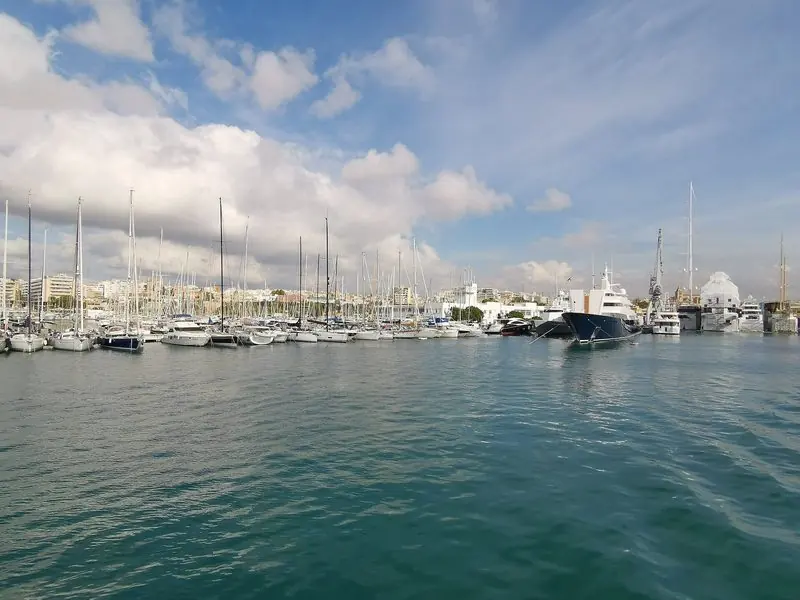
STP works on an open shipyard model. The yard supplies the space, the lift and the infrastructure, and the owner or the captain appoints the contractors. More than 500 specialist companies operate on the site, the daily workforce exceeds 1,500 people, and the yard puts through around 1,500 yachts a year with up to 140 under repair at once and more than 1,800 travelift movements annually.
For an owner the advantage is control and price. Contractors compete for the work, nothing is marked up through a single main contractor, and a captain with a trusted painter or engineer can bring him in. The cost of that is coordination risk. There is no single yard taking responsibility for the whole project, no one warranty covering the finished job, and no main contractor to chase when two trades collide on the schedule. Owners who run big refits here appoint a project manager and treat it as a construction site.
How a slot and a berth are obtained, and what they cost
Afloat berths at Marina Port de Mallorca are booked online or through reception, with long-term rates quoted on request. Yard slots are booked with STP and the large ones go early, because only a handful of yards in Europe can lift at the top of this range and the winter window is finite. A yacht needing a haul-out at 700 or 1,000 tonnes should be talking to the yard a season ahead.
Nothing here is sold as a concession, so an owner is a customer and not the holder of a berth asset. Pricing runs on length for the berth and on a combination of lift, hardstanding days and contractor invoices for the yard. The refit bill is dominated by the trades, so the yard tariff is the smaller part of a project and the choice of contractors is the larger one.
Standards, waste and security
STP holds ISO 9001, ISO 14001 and OHSAS 45001, carbon footprint certification and UN Global Compact membership. Marina Port de Mallorca carries a Blue Flag, EMAS registration and ISO 9001. For an owner that matters because paint, solvent and wash-down handling in a yard of this size is exactly where an environmental problem becomes the yacht's problem.
Security is 24 hour with camera coverage on the marina side, and the commercial port perimeter adds a layer beyond that. Privacy during a refit is limited in the sense that hundreds of contractors move across the site daily, which is a consideration for owners who care about what is photographed inside their boat. Serious owners write confidentiality into contractor terms.
The city, the crew and the airport
Palma is the reason the industry settled here and not somewhere cheaper. It is a real city with a cathedral, an old town, restaurants that stay open in January and housing that crew can actually live in, so the skilled labour stays through the winter. That is the difference between a yard that can be staffed and one that cannot.
Palma's airport is one of the best-connected in the Mediterranean, minutes from the port, with direct flights from across Europe year-round and a summer schedule that is close to saturation. For a refit that matters more than it sounds, because a specialist or a part can reach the yacht the same day. For an owner it means joining the boat is easy in every month of the year.
The season, which runs backwards
Palma's busy period is the opposite of everywhere else in this guide. The yards run hard from October to spring while the resort ports are shut, and the city fills with crew on winter projects. Space in the yard and the marinas is tightest in exactly the months when Porto Cervo is empty.
The turn comes with the Palma International Boat Show, which marks the start of the season and is scheduled for 28 April to 1 May in 2027. From there the fleet moves out into the Balearics, and Mallorca's north coast calas, the run to Ibiza and Formentera and the racing in the bay carry the summer. An owner can finish a refit and be cruising the same week without a delivery passage.
The honest downside
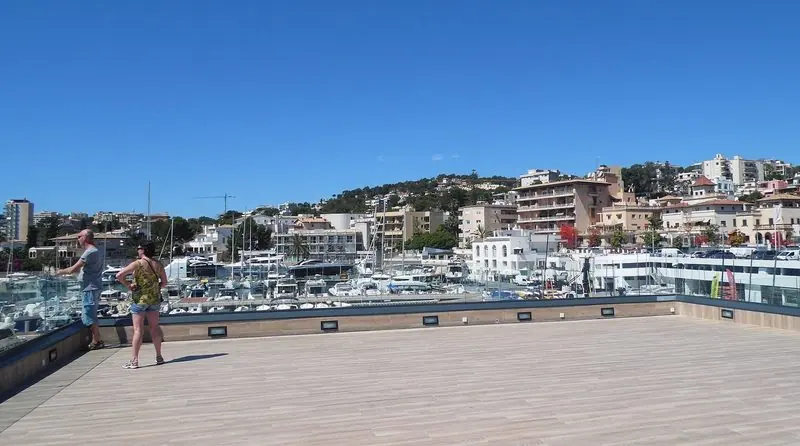
It is an industrial site and it looks like one. Paint tents, dust, noise, forklifts and a working commercial port are the view, and no owner should plan to entertain guests aboard while the yacht is in the yard. The afloat marina caps at 50 metres, so a large yacht is split between operators and the neat single-address arrangement that Porto Montenegro or Barcelona offers does not exist here.
Two other things need settling before a yacht bases in the Balearics. Spain levies a matriculation charge of 12 per cent, and the exemption for exclusive charter use has historically been limited to yachts under 15 metres with a reform to remove that threshold proposed and unresolved, so take Spanish advice first. And the posidonia anchoring rules that now govern the Balearics constrain where the yacht can lie once the refit is over.
What a lift actually costs, from the published tariff
STP works under a concession from the Balearic Port Authority, which means its maximum tariffs are a matter of public record rather than a quotation. On the 2025 schedule a haul and launch, charged as a single operation, costs EUR 6,964.34 in high season for a yacht of 40 m and EUR 5,878.98 in low season. A 30 m yacht is EUR 3,869.08 and EUR 3,265.87, and a 20 m yacht is EUR 1,061.24 and EUR 1,029.08. Above 40 m the published table stops and a rule takes over: the 40 m rate applies with an increase of 10 per cent for every metre of length above 40 m. Moving a yacht within the storage area is charged at 40 per cent of the tariff and suspending her from the water at 60 per cent.
The rule above 40 m is steep enough to be worth working out before a slot is booked. A 50 m yacht is the 40 m rate plus 100 per cent, or EUR 13,928.68 in high season. A 60 m yacht is the 40 m rate plus 200 per cent, EUR 20,893.02. Hardstanding is separate and charged by area, at EUR 0.930 per square metre a day in high season for the first fifteen days and EUR 1.080 from day sixteen, against EUR 0.720 and EUR 0.790 in low season, with liquid waste removal included and no additional charge permitted for it. A yacht in one of the dry dock pits pays the hardstanding rate plus 20 per cent. Water and electricity are the Port Authority's own Palma tariffs with 15 per cent added as a handling charge, refuse is EUR 7.13 for a 100 litre bag plus EUR 0.10 per square metre of boat per day and half as much again if it is hazardous, and telephone and data are the supplier's rates plus 10 per cent. The schedule is silent on VAT.
The season that runs backwards, written into the tariff
The clearest proof that Palma works against the Mediterranean calendar is in the yard's own definition of its seasons. Low season at STP is January, July, August and December. Those are the four months when the fleet is either laid up over Christmas or out cruising, and the yard discounts them. High season is everything else, which is to say the spring and autumn refit windows when every yacht in the western Mediterranean wants a slot at the same time. A berth held alongside for a yacht under repair costs EUR 0.710 per square metre a day in high season and EUR 0.570 in low, again with liquid waste removal included.
Worked through, a 45 m motor yacht on a 9 m beam hauled in October for a month of work pays EUR 10,446.51 for the haul and launch, which is the 40 m rate plus 50 per cent, then EUR 5,649.75 for the first fifteen days on the hard and EUR 6,561.00 for the next fifteen on a 405 square metre footprint. That is EUR 22,657.26 of yard tariff before a single contractor invoice. The identical job in August, in the yard's low season, is EUR 8,818.47 for the lift and EUR 9,173.25 for the thirty days ashore. Ancillaries are published on the same schedule and add up quietly: hull cleaning at EUR 4.30 per square metre, compressed air at EUR 31.51 a day, a ladder up to 2 m at EUR 14.29 a day, parking at EUR 1.430 an hour and covered premises for a contractor at EUR 42.99 per square metre a month.
Who clears the yacht, and the six-hour window
Palma is where a yacht crossing into or out of the Schengen area does its paperwork, and the procedure is published. If Mallorca is the first Schengen port, the captain presents in person at the maritime border post in the Port of Palma to make the entry declaration, carrying the passports of every crew member, each seaman's book or, in its absence, the on-board employment contract, a copy of the current crew list and a copy of the ship's registration certificate. The exit declaration on leaving the Schengen area takes the same documents. Embarking or disembarking a crew member of non-European nationality is a further separate visit, with that person's passport presented for stamping alongside the same set of papers.
The constraint is the clock. The border post is open to the public from 08:00 to 14:00, Monday to Friday. Outside those hours an urgent case is handled by telephoning the post's mobile number and arranging an appointment, which is a concession rather than a service. A yacht arriving on a Friday evening from a non-Schengen port with a crew change booked for Saturday morning has a problem no amount of money solves cleanly. Nothing in the published procedure requires an agent. What it requires is somebody standing at the border post inside a six-hour weekday window with the right documents in the right order, which is why almost every large yacht uses one.
Ashore, access and booking
| Getting there | Palma de Mallorca's airport sits about 8 km from the port, among the busiest in the Mediterranean for direct European connections, which is part of why crew actually stay through a winter refit rather than rotating out. |
|---|---|
| Arriving by sea | The Bay of Palma is wide, deep and enters easily in almost any conditions, no bar, no narrows, no tidal constraint, inside the commercial port of Palma on the western waterfront. |
| Booking a slot or a berth | Afloat berths at Marina Port de Mallorca are booked online or through reception with long-term rates on request. Yard slots are booked directly with STP, and the large ones go early because only a handful of European yards can lift at the top of this range and the winter window is finite. Hill Robinson, which manages refits here, describes calling in January for a February start as not advisable. |
| What the yard actually costs | STP's tariffs are public record under its Balearic Port Authority concession rather than quoted privately. The 2025 schedule prices a haul and launch, as a single operation, at EUR 6,964.34 in high season for a 40 m yacht and EUR 5,878.98 in low season. |
| The open-yard model in practice | The yard supplies space, the lift and infrastructure; the owner or captain appoints from more than 500 to 600 specialist companies on site. Hill Robinson's own assessment is that this freedom is valuable only if someone coordinates the moving parts, since the binding constraint is not yard capacity but the specialist workshops, which book out early. |
| Eating and crew life | The yard sits inside a real city with a cathedral and an old town rather than a resort strip, and restaurants and shops stay open through January, which is the reason skilled crew and contractors stay through winter instead of leaving with the season. |
What owners and crew report
The industry here is treated as an identity, not just a trade
Tomi Salom, President of the Balearic Marine Cluster, frames the refit industry as part of the islands' economy and culture rather than a service the island happens to host, which shows up on the ground as a workforce with generational boatbuilding knowledge and a city built around the yards rather than tolerating them.
Tomi Salom, Balearic Marine ClusterBerth demand at the top of the range keeps outrunning supply
STP's own leadership points to repeated requests for berths at the largest end of the range as the reason behind its capacity expansion, which is a direct signal that the 120 m, 1,000-tonne ceiling was already the binding constraint before it was raised.
Joan Rossello, CEO, STP Shipyard PalmaThe open-yard freedom only pays off with a coordinator
Hill Robinson, which manages refit projects at STP, is explicit that choosing the best rigger, paint team and electronics contractor from the site's hundreds of companies is genuinely valuable only if someone is managing those moving parts, and that the specialist workshops rather than the yard itself are what books out first.
Hill Robinson
What is good, and what to watch
Strong points
- The only 1,000-tonne travel lift in EuropeAlongside 100, 150, 200 and 700-tonne lifts and seven keel pits across roughly 130,000 square metres, putting through around 1,500 yachts a year.
- Open-yard choice of contractorMore than 500 specialist companies operate on site, so an owner or captain picks the rigger, the paint team and the electronics contractor rather than being tied to one yard's in-house crew.
- Crew infrastructure that survives the winterPalma is a real city with housing, restaurants and an airport that stays busy in January, which is why the skilled labour base does not leave with the season the way it does at resort yards.
- Its season runs opposite the rest of the MediterraneanLow season at STP is January, July, August and December, the exact months the cruising fleet is either laid up over Christmas or out on charter, so refit slots and pricing work against the crowd rather than with it.
What to watch
- It is an industrial site and it looks like onePaint tents, dust, noise, forklifts and a working commercial port are the view; no owner should plan to entertain guests aboard while the yacht is in the yard.
- Freedom of contractor choice is also the owner's problem to manageHill Robinson's own account is that the open-yard model creates opportunity and complexity together, and the value of choosing the best specialist for each trade only holds if someone is coordinating them.
- The specialist workshops, not the lifts, are what runs out firstHill Robinson names the talleres as the binding constraint over the yard itself, and describes booking a February start in January as not advisable.
- The afloat marina caps at 50 metresMarina Port de Mallorca itself tops out well below the yard's 120 m lifting capacity, so a large yacht afloat and a large yacht in for a lift are two different arrangements on two different waiting lists.
Who it is for: An owner who runs the boat hard, refits it properly and wants the yard, the trades and the summer cruising ground in one place.