Marina Port Tarraco (Tarragona)
| Location | Moll de Llevant, inside the Port of Tarragona, Costa Dorada, Spain |
|---|---|
| Berths | 32, sized from 45 m to 160 m LOA |
| Largest positions | one berth of 160 m by 32 m and one of 150 m by 30 m |
| Depth | more than 9 m average depth across the marina |
| Harbour entrance | 350 m wide with around 22 m of water |
| Shore power | up to 1,600A at 400V, plus a 6,600V / 2,000 kVA connection for the largest yachts |
| Pricing basis | charged on the size of the berth in length by beam, not on the yacht |
| Published tariff from 1 January 2026 | a 35 m by 8 m berth at EUR 205 per day for stays up to a week, or EUR 4,200 per month |
| Published tariff from 1 January 2026 | the 160 m by 32 m berth at EUR 3,380 per day, or EUR 61,440 per month |
| Utilities on the 2026 tariff | electricity EUR 0.29 per kWh, water EUR 4.90 per cubic metre, port tax included and VAT excluded |
| Alongside | berthing carries a 50 per cent surcharge over stern-to |
| Airports | Reus 7km, about 10 minutes, and Barcelona El Prat about 80km |
| Berth mix from the marina's published berth map, checked 28 July 2026: 5 berths of 45 m by 10 m, 2 of 50 m by 12 m, 2 of 60 m by 14 m, 7 of 70 m by 15 m, 4 of 80 m by 16 m, 3 of 90 m by 18 m, 3 of 100 m by 20 m, 2 of 115 m by 22 m, 3 of 130 m by 25 m, 1 of 150 m by 30 m and 1 of 160 m by 32 m | |
| Berth count is 33, not the 32 usually quoted. The marina's own services page states 33 berths from 45 m to 160 m, checked 28 July 2026 | |
| Berths by size band | 26 of the 33 take 60 m and above, 17 take 80 m and above, 10 take 100 m and above, and only 2 take more than 130 m |
| Mid-range tariff valid from 1 January 2026: an 80 m by 16 m berth at EUR 846 per day for stays up to seven days, EUR 589 per day beyond seven, EUR 15,360 per month or EUR 73,728 for six months | |
| Shore supply frequency | the marina publishes 400 V and a 6,600 V connection but not the frequency, checked 28 July 2026. The Spanish grid runs 50 Hz |
| Local winds | the llevant from the east and the garbi, the afternoon southwesterly sea breeze of the Catalan coast |
| Spanish matriculation tax (IEDMT) | 12 per cent, the same charge the Ibiza and Palma entries carry |
A yacht enclave inside a cargo port
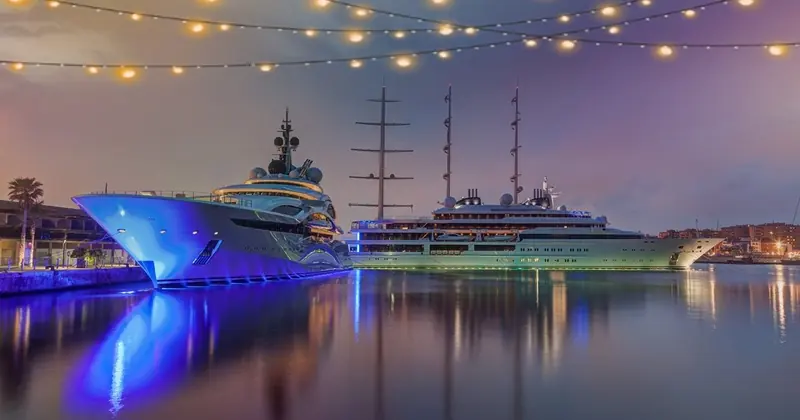
Marina Port Tarraco occupies the Moll de Llevant, a quay set inside the Port of Tarragona on Spain's Costa Dorada. The surrounding harbour is one of the country's heavyweight commercial ports, handling 32.33 million tonnes of cargo in 2024 and ranking first in Spain for agricultural goods, with a long history bound up in the petrochemical plants inland. The yacht basin is a gated enclave within that estate, fenced off and run separately. An owner driving in passes bulk terminals and cranes before he reaches the marina barrier.
That industrial parentage is precisely what makes the place useful. Commercial ports are dredged for ships, so the water is deep where a purpose-built yacht harbour would be shallow. The marina publishes an average draft of more than nine metres across its berths, and the harbour entrance is 350 metres wide with around 22 metres under it. There are no small-boat pontoons here at all. The smallest berth on the plan is 45 metres.
The approach, and what the weather does to it
The marina sits at roughly 41 06.5 N, 001 14.6 E, a straightforward coastal approach from either direction along the Catalan shore. Entry is through the commercial port's main mouth, which is wide, deep and unobstructed, and the harbour is enclosed behind long breakwaters that give good shelter once inside. There are no tidal restrictions worth planning around on this coast. A captain arriving at night comes in through a lit commercial entrance with no narrow buoyed channel to feel his way down.
The one weather caveat is swell. Shipping data for Tarragona notes swell restrictions on the port, and a big southeasterly can make the outer approach uncomfortable even though the basin itself stays calm. Inside, the marina is well protected and yachts sit quietly through the winter months. The Costa Dorada is a lower-drama stretch of coast than the Gulf of Lion to the north, where the mistral does its worst. Owners who have watched a hull surge against fenders in Antibes tend to notice the difference.
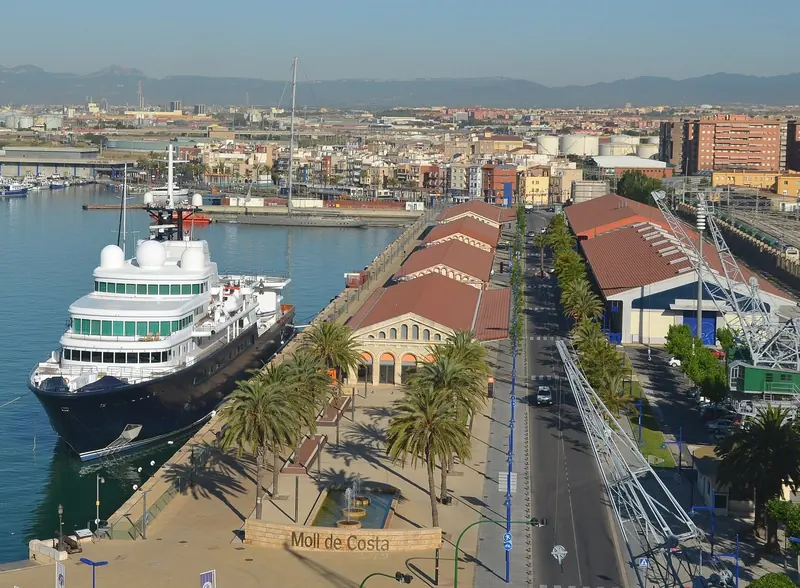
A commercial cargo port turns out to be the one place in the western Mediterranean with enough water under a big hull.
Berth sizes and what is realistically available
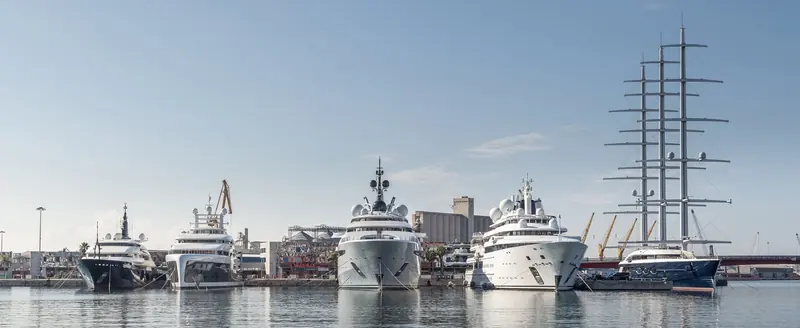
The berth plan is unusually legible because the marina publishes the whole of it. Five positions of 45 m by 10 m, two of 50 by 12, two of 60 by 14, seven of 70 by 15, four of 80 by 16, three of 90 by 18, three of 100 by 20, two of 115 by 22, three of 130 by 25, one of 150 by 30 and one of 160 by 32. That is 33 berths, and the marina's own services page says 33 rather than the 32 that circulates elsewhere. Counted at the sizes that actually decide anything, 26 of the 33 take 60 m and above, 17 take 80 m and above, 10 take 100 m and above, and exactly two take more than 130 m. Figures from the marina's berth map, checked 28 July 2026.
The distribution is the argument for the place. Fourteen of the 33 sit in the 70 m to 90 m band, which in most Mediterranean harbours is the size that has to be squeezed in against the breakwater. Here it is the middle of the range. Availability is better than the glamour ports because Tarragona is not a place people berth for the address, and the marina fills through the winter with boats laid up between seasons and yachts waiting on yard slots. The scarcity is all at the top. Above 130 m there is one berth of 150 m and one of 160 m, so an owner at that size is not asking for a berth but for a specific berth to be free in a named month. The marina does not publish occupancy or a booking horizon and no honest figure can be given for one.
How a berth is taken and what it costs
Berths at Port Tarraco are rented, not sold. There is no title to buy and no long lease trading privately in the way Monaco or Porto Cervo positions do, so an owner deals directly with the marina and pays for the time he uses. Periods are structured as stays of up to seven days, stays beyond seven days, monthly, quarterly and half-yearly, with the rate per day falling as the commitment lengthens. Bespoke arrangements are offered for longer stays.
Pricing is on the berth, measured length by beam, and not on the yacht that occupies it, which matters for a hull that is beamy for its length. On the tariff published as valid from 1 January 2026, a 35 by 8 metre berth is EUR 205 a day for a stay of a week or less, EUR 168 a day beyond that, and EUR 4,200 a month. The 160 by 32 metre berth is EUR 3,380 a day or EUR 61,440 a month. Port tax is included and VAT is not, electricity runs at EUR 0.29 per kWh and water at EUR 4.90 per cubic metre, and lying alongside instead of stern-to adds 50 per cent.
Power, waste and the yard inside the gate
Shore power goes to 1,600 amps at 400 volts, with a 6,600 volt, 2,000 kVA connection available for the largest yachts, which means a 100 metre hull can run its hotel load without generators alongside. Fresh water and black water discharge are at each berth. Waste is collected under a MARPOL certificate. Berthing assistance is provided on arrival and departure, which on a windy day with a 90 metre boat is not a courtesy but a requirement.
The reason many owners are here at all is PTW Shipyard, which operates inside the marina and takes yachts to 50 metres on hardstanding and to 140 metres afloat. The marina also works closely with Astilleros de Mallorca and Pinmar Yacht Supply, so paint, joinery and specialist trades can be brought in. A yacht can therefore sit on its berth, have work done and never make a delivery passage to a yard. For an owner watching the calendar between a September handover and a December Caribbean crossing, that saves real weeks.
Security, customs and how private it is
The marina is ISPS code compliant, fenced, gated and covered by 24-hour manned security and closed circuit television. This is a controlled industrial site, so the general public simply cannot walk along the quay and photograph a yacht's aft deck, which is the opposite of what happens in Monaco or Portofino. Guests and contractors are logged in and out. Crew keep the privacy that a town-centre berth erases.
The marina also holds Authorised Economic Operator status, a European Union customs accreditation that speeds clearance of goods, which matters when a refit is pulling in parts from three countries. Spain's customs and VAT regime is the same here as anywhere in the country, so an owner's fiscal position does not change by moving to Tarragona. What changes is the paperwork friction on spares and stores. Owners running a heavy technical programme rate this higher than they expected to.
Ashore, and the run to Barcelona
Tarragona's old town is a fifteen minute walk from the quay and is a UNESCO World Heritage site, built on the Roman provincial capital of Tarraco, with an amphitheatre above the sea and a preserved circus under the medieval streets. It is a real Catalan working city of about 130,000 people with good restaurants and no yachting scene to speak of. The train station is 500 metres from the marina, and high-speed rail reaches Madrid in under two and a half hours. Reus airport is seven kilometres away, roughly ten minutes.
Barcelona is about 80 kilometres up the coast, an hour or so by car, which puts its restaurants, galleries and El Prat airport within an easy evening. For a family week the Costa Dorada beaches are wide and sandy, PortAventura World and Ferrari Land are twenty minutes down the road, and the golf is decent. The marina runs a courtesy van with a driver and has a fitness centre on site. None of this is Saint-Tropez, and owners who choose Tarragona are not looking for Saint-Tropez.
Season, timing and the honest downside
Tarraco works year round and does its best business out of season. Yachts arrive in October and November for winter lay-up and yard periods, leave in April and May for the Balearics, and pass through in July and August as staging stops. The marina positions itself as a winter haven, and crew retention is easier here than in a remote yard town because the city has schools, hospitals and normal life. Spring is when berths tighten as everyone wants to be out before June.
The downside is the setting. The berth sits in an industrial port with cargo movements, dust when the bulk terminals are working, and a view of cranes from the sun deck. There is no evening scene on the quay and no reason for a guest to come aboard for the location. Owners who want their yacht to be part of a picture will hate it. Owners who want nine metres of water, a yard on site and a berth they can actually get will take it every time.
The llevant, the garbi, and the frequency nobody prints
The wind here has names. The llevant is the easterly that comes in off the sea with cloud and rain and pushes swell into the outer approach, and it is the one that makes the entrance uncomfortable rather than the basin. The garbi is the afternoon southwesterly sea breeze that builds through the summer day along the Catalan coast and drops in the evening, which is a manoeuvring consideration for a beamy hull coming off a berth at four in the afternoon and nothing at all at eight in the morning. Neither is a mistral. The Costa Dorada sits south of the Gulf of Lion and the difference in a winter lay-up is the whole point of coming here.
The gap in an otherwise exact page is the frequency of the shore supply. Port Tarraco publishes 1,600 A at 400 V and a 6,600 V, 2,000 kVA connection for the largest hulls, and states neither the frequency nor whether the high-amperage supply is hard-wired by the marina or plugged by the crew. Checked on 28 July 2026, that information is not on the marina's site or in its customer service guide. Spain runs 50 Hz, so a 60 Hz yacht arriving from the United States or the Caribbean needs a converter or stays on generators, and on the one page in this set that quotes a 6,600 V connection that is the fact with the most to lose from an assumption. It is a question for the berth enquiry and not one to settle on arrival.
The 12 per cent that meets a yacht in Spain
Spain charges a matriculation tax, the Impuesto Especial sobre Determinados Medios de Transporte, at 12 per cent. It bites on first registration of a recreational vessel over 8 m under the Spanish flag, and it also bites on a foreign-flagged yacht put to use in Spain by a Spanish resident or by a company established in Spain, which is the version that catches owners who assume flag alone settles it. It is a one-off charge on value, not an annual one, and it is the same 12 per cent the Ibiza and Palma entries on this site already carry.
It is raised here because Port Tarraco is sold explicitly as a base rather than a stop, and a base is where the residence question gets asked. An owner using the marina as a winter lay-up between Mediterranean seasons is in a different position from an owner who has moved a yacht, a management company and a household to Spain, and the second of those needs the exemption route confirmed in writing before the hull arrives rather than after. Commercial registration and genuine charter use are the usual answers and both come with conditions that are checked. This is a matter for a Spanish tax adviser and the point of naming it is that the question exists at all.
Ashore, access and booking
| Peak-season berth rate, 100m yacht | EUR 1,321 per night for a 100m x 20m berth booked for 7 nights or fewer, or EUR 920 per night if booked for longer than 7 days (roughly EUR 9,247 for a 7-night stay at the short-stay rate). Per Port Tarraco's own rate card effective 1 January 2026; VAT not included, T5 port tax included; rate is for stern-to mooring, alongside mooring adds a 50 per cent surcharge. |
|---|---|
| How to reserve | Contact Port Tarraco directly at [email protected] or +34 977 244 173. The marina states its offers are 'always personalised and adapted' to the yacht, so quote LOA, beam and dates rather than expecting a published instant rate for anything but the smallest berths; no fixed minimum lead time is published. |
| Eating within walking distance | In the old town: Casa Balcells on Pla de la Seu facing Tarragona Cathedral, and Solric Alta Taverna on Placa de la Font for tapas and terrace dining. In the port district of El Serrallo, a cluster of seafood restaurants sits near the fishing harbour. All are a walk or short taxi from the marina gate, not inside it. |
| Transport and services nearby | Reus airport is about a 7 to 10 minute drive. Barcelona's airports are roughly 90km away. Tarragona's main train station is about 500 metres from the marina, with the AVE high-speed line about 15 minutes away giving a Madrid journey of around 2.5 hours. |
| Check before booking | Confirm current cargo-port traffic conditions with the marina before setting an ETA. Port Tarraco sits inside a working commercial port that runs 24/7, and leisure vessels must give way to manoeuvring merchant ships, keep 50 metres clear of vessels at anchor or working, and monitor VHF Channel 16 while transiting. |
What owners and crew report
The Emir of Qatar's superyacht keeps returning to Port Tarraco
Al Lusail, the 123m Lurssen delivered in 2017 to Sheikh Tamim bin Hamad Al Thani, Emir of Qatar, has been reported making repeat, low-profile calls at Port Tarraco while cruising the Spanish coast. Qatari Diar's original 2011 purchase of the marina was widely reported at the time as intended partly to secure a discreet home berth of this kind for the family's fleet.
LuxurylaunchesMarina's own management says trading turned around after 2015
Marc Colls, Port Tarraco's General Manager, has said management took over in 2011 'when the general economic situation was very different' and that business has been markedly better since 2015. This is the marina's own promotional account of its history, not an independent visitor's report.
Marc Colls, General Manager, Port Tarraco, quoted by CharterworldCurrent owner-operator compares the infrastructure directly to Port Adriano
When Mallorcan marina group Ocibar bought Port Tarraco from the Qatari Diar fund in February 2020, its chief executive said the infrastructure 'matches what we are offering in Port Adriano.' This is an operator's own assessment, made to justify the acquisition, not a customer's review; Ocibar also runs Port Adriano and Marina Botafoc.
Antonio Zaforteza, CEO, Ocibar, quoted by SuperyachtNewsThe refit contractor on site describes Tarragona as a winter refit push
Carlos Morales, Managing Director of Astilleros de Mallorca, said opening a service base at Port Tarraco in 2021 was 'a very important and positive step' for supporting captains and engineers with refit, repair and maintenance plans over the winter season. This is the shipyard's own account of why it set up there, not an independent yacht's report.
Carlos Morales, Managing Director, Astilleros de Mallorca, quoted by SuperyachtNews
What is good, and what to watch
Strong points
- First Mediterranean superyacht marina wired for 6.6kV shore powerPort Tarraco added 6.6kV onshore power on top of its existing 1,250-amp/400V connections, a commercial-marine-grade voltage not otherwise offered at Mediterranean superyacht marinas at the time it was installed. The marina's own marketing team framed it as getting ahead of expected EU rules that will require shore power for yachts and merchant ships in port.
- Room for a fleet of giants at once, not just oneBeyond individual berths, the basin has a 140 metre waiting quay and the capacity to moor six or more yachts over 100 metres simultaneously, a scale few deep-draft Mediterranean marinas can match.
- A genuine refit cluster inside the gate, not one contractorAstilleros de Mallorca (founded 1942, operating at Port Tarraco since 2021) and PTW Shipyard both work on site. PTW runs a 300 tonne travel lift and hard standing for yachts up to 45m, a technical dock for yachts up to 85m, and can work on yachts up to 120m at the berth itself, with Pinmar Yacht Supply also on site for outfitting. A refit can be organised without moving the yacht to Barcelona.
- A regional airport minutes from the gangway, plus railReus airport is roughly a 7 to 10 minute drive from the marina. Tarragona's own train station is about 500 metres away, and the AVE high-speed line is reachable in about 15 minutes, putting Madrid around 2.5 hours away by rail. This is useful for crew changes and short-notice arrivals without routing everyone through Barcelona.
What to watch
- Reus airport does not cover most owners' likely home routesReus is a budget-and-charter airport. Its scheduled network (Ryanair, Jet2, TUI, easyJet, Vueling) leans heavily on UK and Ireland leisure routes such as Dublin, London Stansted and Manchester, with no long-haul service. Owners and guests arriving from outside Europe still need Barcelona's airport, roughly 90km away, or a private jet into Reus itself.
- A lingering industrial reputation the marina is still working to shakePort Tarraco's own current CEO has acknowledged that early complaints about the working coal-handling side of the port, dating to the marina's 2007 development, left an association that 'has stuck in some people's minds,' and that rebranding since the 2020 Ocibar takeover is partly aimed at dispelling it.
- Mooring the wrong way costs 50 per cent moreUnder the marina's own 2026 rate card, published rates are for stern-to (Mediterranean-moor) berthing. A yacht that needs to lie alongside instead pays a 50 per cent surcharge on the base rate, before VAT.
- It is still a working cargo port's fairway, not a private lagoonUnder Tarragona Port Authority rules, leisure and sailing vessels crossing the port must keep at least 50 metres clear of any ship at anchor or manoeuvring, give way to manoeuvring merchant vessels, and keep a listening watch on VHF Channel 16. The commercial port runs 24 hours a day, 365 days a year, so that traffic can appear at any hour.
Who it is for: The owner of a 60 to 140 metre yacht who needs guaranteed deep water, a refit yard on the same site and a berth he can actually book.