ONE15 Marina Sentosa Cove (Singapore)
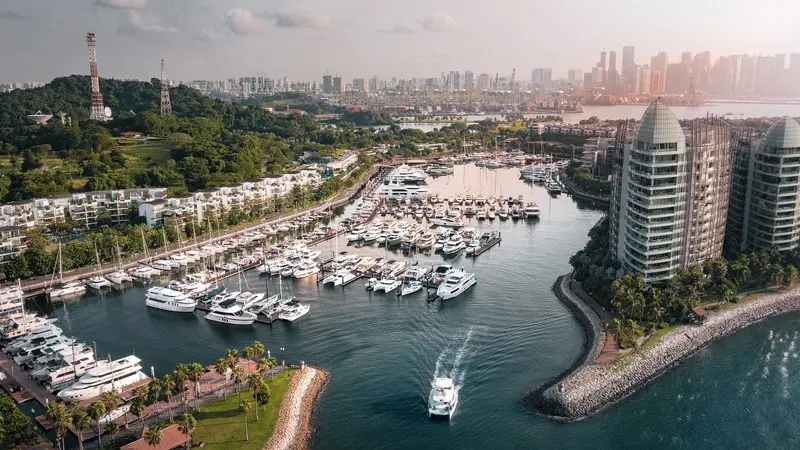
| Location | Sentosa Cove, Singapore, at 1 14.50 N, 103 50.40 E, on VHF channel 77 |
|---|---|
| Operator | Operating since 2007, part of the SUTL group |
| Berths | 270 wet berths including around 32 mega yacht berths, plus 60 dry berths |
| Maximum LOA | 220 feet, roughly 67 metres, with a published maximum draught of 4.5 metres |
| Accreditation | built to the Platinum Gold Anchor standard and accredited Superyacht Ready in 2022 |
| Awards | International Marina of the Year in 2022 and 2023, and Best Asian Marina seven times |
| Shore power | metered, up to three-phase 500 amp, with metered potable water and a waste pump-out system |
| Clearance | the only private marina in Singapore with a customs, immigration and quarantine facility on site |
| 2026 berthing rate over 120 feet | SGD 8.83 per foot per day for non-members and SGD 7.63 for members, GST included |
| 2026 monthly rate over 120 feet | SGD 190.31 per foot for members, or SGD 158.60 per foot on an annual commitment |
| Fuel | petrol and diesel sold daily from 8am to 11pm, with bulk discounts of up to 20 per cent above 5,000 litres |
| Ashore | 26 hotel rooms, dining venues, a members' lounge, pool, gym, tennis and pickleball courts, and a shuttle to VivoCity |
| Frequency and voltage | the marina publishes up to three-phase 500 A and states neither, checked 28 July 2026. Singapore runs 50 Hz at 230 V single phase and 400 V three phase |
| What 500 A three phase at 400 V amounts to: about 346 kVA, which is a genuine large-yacht supply and enough to carry a 60 m hull alongside without generators in equatorial heat | |
| How many of the roughly 32 mega yacht berths take over 50 m, against the 67 m ceiling, is not published, checked 28 July 2026 | |
| The published maximum draught of 4.5 m is the binding constraint and applies against a 220 foot maximum length. A 67 m yacht drawing more than 4.5 m does not fit whatever its length | |
| There is no superyacht travel lift on site. The marina's 60 dry berths are for small craft, so any haul-out means leaving Singapore | |
| Hull fouling intervals in equatorial water are not published by the marina and no diving or antifouling schedule is quoted, checked 28 July 2026 | |
A yacht club with a marina attached
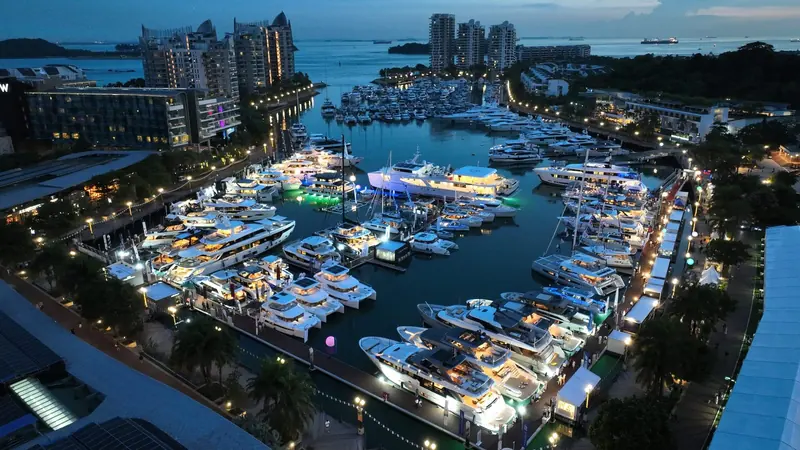
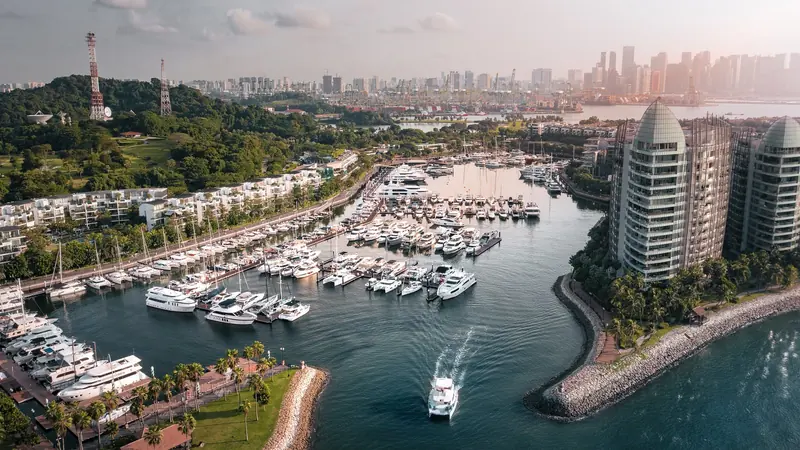
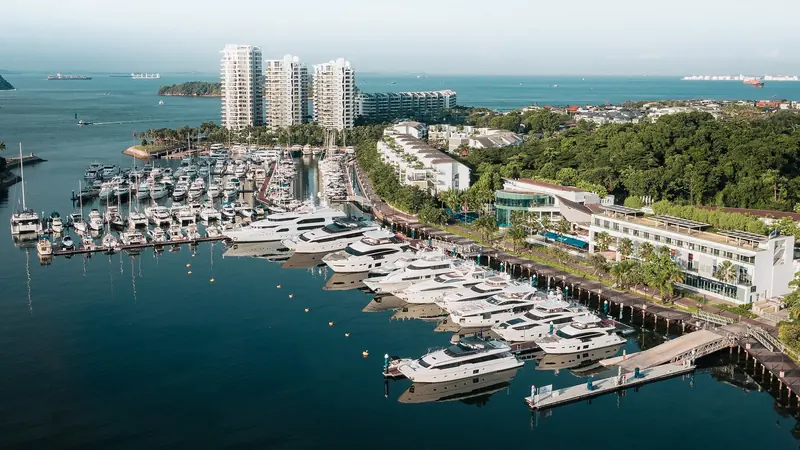
ONE15 opened in 2007 inside Sentosa Cove, the gated waterfront residential district on the eastern end of Sentosa island. It is a private club as much as a marina, with 270 wet berths of which around 32 are sized for mega yachts, 60 dry berths, a clubhouse, 26 hotel rooms, restaurants, a pool and tennis courts. Berth holders and members share the same facilities.
The standards are independently checked, which is worth something in a region where marina quality varies widely. The marina was built to the Platinum Gold Anchor standard set by the Yacht Harbour Association and the Marina Industries Association, was accredited Superyacht Ready in 2022, and has been named International Marina of the Year twice and Best Asian Marina seven times. Maximum length is 220 feet, around 67 metres, with a published maximum draught of 4.5 metres.
Approaching through the world's busiest water
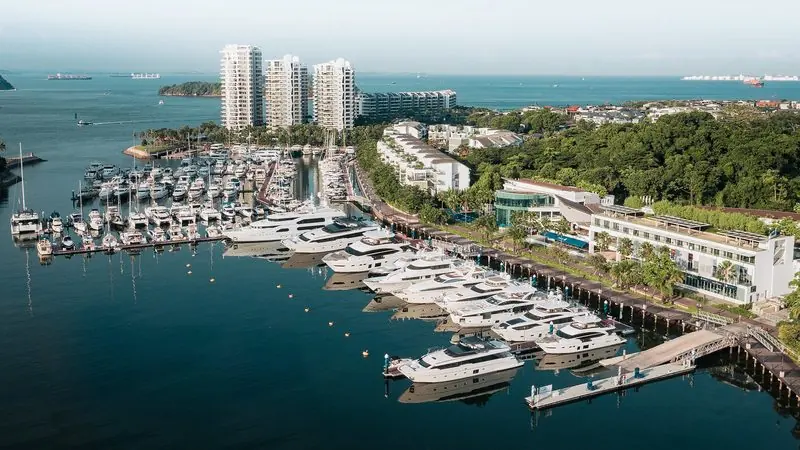
Getting to Sentosa Cove means crossing or skirting the Singapore Strait, one of the most heavily used shipping lanes anywhere, with anchorages full of tankers and container ships and a continuous flow of traffic in the separation scheme. It is not difficult water, and it demands a proper watch and a working understanding of where commercial vessels are permitted to be. The marina works VHF channel 77.
Once inside, the basin is enclosed, calm and completely sheltered. Singapore sits almost on the equator, so there is no typhoon season and no cyclone season at any point in the year, which is a genuine structural advantage over Hong Kong, Phuket or anywhere in the South Pacific. What the climate does deliver is heat and humidity at a steady thirty degrees, two monsoons, and the sudden line squalls that come off Sumatra before dawn.
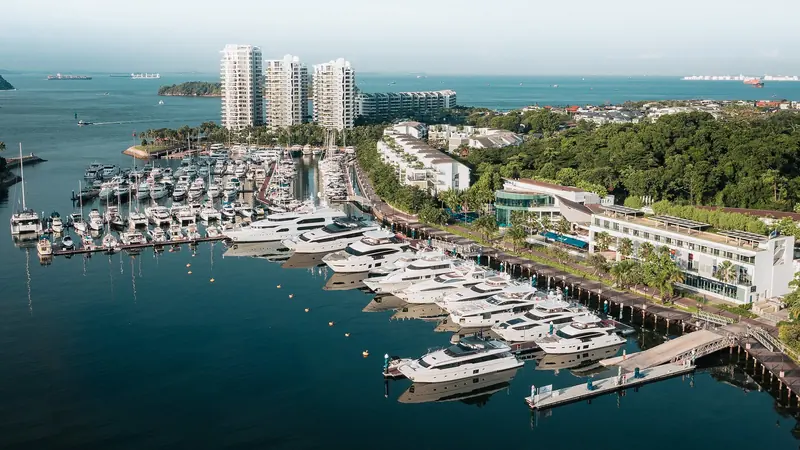
On the equator there is no storm season, which is a form of security no Mediterranean or Caribbean berth can offer.
Clearance on the dock
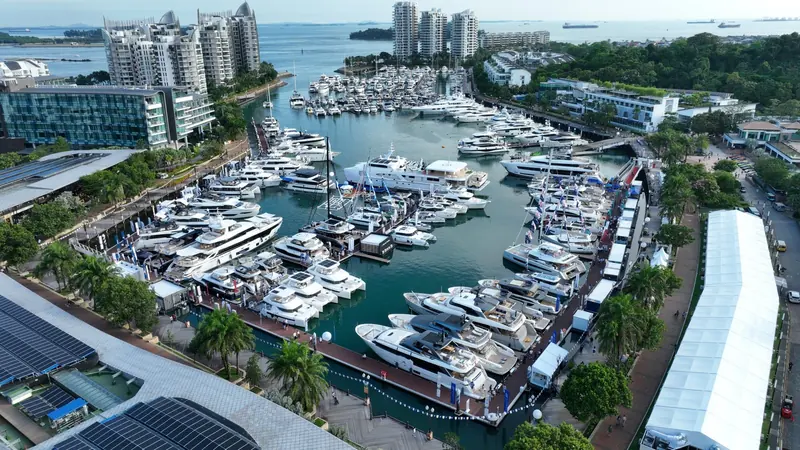
The marina holds a customs, immigration and quarantine facility on the premises and is the only private marina in Singapore that does. For an owner arriving from Indonesia or Malaysia that removes the requirement to clear elsewhere and then reposition, which in this part of the world can otherwise consume a day. Singapore is an efficient jurisdiction and the paperwork works when it is presented correctly.
Beyond arrival, the questions worth taking advice on are the licensing of a yacht used commercially and the treatment of charter, because the marina applies surcharges accordingly. A vessel with a charter licence pays double the berthing rate and a commercial berth carries a 15 per cent premium. Goods and services in Singapore attract 9 per cent GST, which is included in the marina's published rates.
What it costs
ONE15 publishes its full tariff, charged per foot and inclusive of GST. Above 120 feet a non-member pays SGD 8.83 per foot per day and a member SGD 7.63. A 60 metre yacht measures around 197 feet, so a non-member night is roughly SGD 1,740. Monthly, a member above 120 feet pays SGD 190.31 per foot, or SGD 158.60 on an annual commitment, which for the same yacht is about SGD 37,500 a month or SGD 31,200 on the annual rate.
Charges are based on the physical measurement of the vessel or the length of the berth, whichever is greater, with a minimum charge of 35 feet, and a catamaran or a beamy monohull that overhangs its allocation pays an additional 100 per cent. A deposit of two months' berthing is required for member vessels staying beyond a month. Fuel is sold at the marina daily from 8am to 11pm with bulk discounts that reach 20 per cent above 5,000 litres of diesel.
Power, waste and daily running
Power is metered and supplied up to three-phase 500 amp, which covers the fleet the marina accepts but is worth checking against a specific vessel's requirement before arrival. Potable water is metered at the berth and there is a waste pump-out system across the marina. A fire protection system covers the pontoons and a buggy service moves people between the berths and the clubhouse.
Southeast Asia is not a refit region in the way that Florida or the northern Mediterranean is, and Singapore's commercial yards are geared to shipping. Routine engineering, electronics and interior trades are available and competent. Anything structural or a full paint job means a passage to Phuket, where the group operates a sister marina at Panwa, or a longer run to Australia or New Zealand.
Security and privacy
The marina is gated with 24-hour security and CCTV throughout, inside Sentosa Cove, which is itself a controlled residential enclave. Singapore has among the lowest crime rates of any developed country and the ambient security level is such that most of the precautions a crew takes in the Caribbean are unnecessary here. Guests come and go without an escort.
Privacy is good by the standards of this list. Sentosa Cove is residential and not a tourist promenade, so there is no passing crowd photographing the aft deck. The clubhouse and its restaurants are for members and their guests, with no public access. An owner who wants to be seen will find Singapore an oddly indifferent audience.
The city, and where a yacht actually goes
Changi is 30 to 40 minutes from the marina and is one of the best connected airports in the world, with direct services to Europe, Australia, North America and every Asian capital. The city has the banking, legal and family office infrastructure that explains why so much internationally mobile wealth keeps an address here. Medical care, schooling and food are excellent, and crew retention is easier than in most of Asia.
The cruising is the weak point and everyone knows it. Singapore itself has nowhere to go. The nearest genuine anchorages are in Indonesia's Riau islands, an hour or two south, and the group operates its own marina on Nirup Island there. Malaysia's east coast and Tioman are a day away, Langkawi and Phuket are a passage of several days round the peninsula, and Borneo and the Anambas reward a longer commitment. Clearing in and out of Indonesia and Malaysia requires an agent and patience.
Season, timing and the honest downside
There is no season here, which is the point. The equatorial climate means a yacht can be used or worked on in any month, and insurance does not impose a named storm plan because there are no named storms. The two monsoons shift the wind direction and the rainfall pattern without closing anything down. Regional cruising is easiest from around March to October, when the northeast monsoon has eased.
The reservations are heat, distance and the absence of anything to sail to. Thirty degrees and ninety per cent humidity is hard work for guests and harder on machinery, air conditioning runs permanently, and growth on the hull is rapid enough to need constant attention. This is a place to keep a yacht near an owner's business and to use as a base for trips into Indonesia and Thailand. As a cruising destination in its own right it does not really exist.
Three hundred and forty-six kVA, and what it is worth here
The marina publishes a metered supply up to three-phase 500 A and, checked on 28 July 2026, states neither the voltage nor the frequency. Singapore runs 50 Hz at 230 V single phase and 400 V three phase, which puts a European yacht on the right frequency and an American one on a converter. Worked out, 500 A of three phase at 400 V is about 346 kVA, and that is a genuinely useful number rather than a marketing one. In a climate that holds thirty degrees and high humidity all year, air conditioning is the dominant hotel load and it never switches off, so the difference between a dock that can carry it and one that cannot is measured in generator hours every single night of the year.
That makes the shore supply here worth more than it would be in a temperate marina, and it is the practical argument for keeping a yacht in Singapore rather than at anchor in the Riau islands. The counterpart is what the marina does not say. There is no travel lift on site capable of a superyacht, the 60 dry berths being small craft storage, so any haul-out is a passage out of Singapore. And the fouling question, which is real in equatorial water and moves faster than most owners expect, is not sized anywhere. Neither a diving interval nor an antifouling interval is published, checked 28 July 2026, and both belong in a running budget for a yacht kept here rather than in an observation about warm water.
Four and a half metres, and how many big berths there really are
The headline is 220 feet, roughly 67 m, and the number that actually governs is the published maximum draught of 4.5 m. A 60 m yacht drawing 4.8 m does not fit this marina regardless of what the length limit says, and that is the check to run first rather than last. Of the 270 wet berths, around 32 are described as mega yacht berths, and how many of those take over 50 m against the 67 m ceiling is not published, checked 28 July 2026. On a marina that is otherwise unusually precise about money, publishing rates per foot per day and per month for members and non-members, the absence of a size breakdown at the top of the range stands out.
The rest of the proposition is settled and worth restating in that light. The customs, immigration and quarantine facility on site is the only one at a private marina in Singapore, which removes the single most tedious part of arriving. There is no typhoon season and no named storm plan, so insurance behaves differently here from Hong Kong or Phuket. What the marina cannot supply is somewhere to go, and the answer to that is the Riau islands an hour or two south, which sit in Indonesia and require a cruising permit and an agent. That permit, its lead time and its cost are the gating item on the whole cruising argument and are not documented on the marina's material.
Ashore, access and booking
| Getting there | Changi Airport is 30 to 40 minutes away by car; ferries from Batam and Bintan land at nearby HarbourFront. |
|---|---|
| By sea | The marina works VHF channel 77. The approach crosses or skirts the Singapore Strait, one of the world's busiest shipping lanes, so a proper watch matters more than local knowledge. |
| Reserving a berth | Book through the marina office. Peak season, November to April, fills first and vessels over 80 feet should reserve well ahead. Member vessels staying beyond a month post a deposit of two months' berthing. |
| What a berth costs | Above 120 feet: SGD 8.83 per foot per day for non-members, SGD 7.63 for members, GST included. A 60 m yacht runs to roughly SGD 1,740 a night. |
| Monthly rate | Above 120 feet: SGD 190.31 per foot for members, or SGD 158.60 per foot on an annual commitment. For a 60 m yacht that is around SGD 37,500 a month, or SGD 31,200 annually. |
| Fluids | Shore power metered up to three-phase 500 A, about 346 kVA. Potable water metered at the berth. Diesel and petrol sold dockside 8am to 11pm, with bulk discounts up to 20 per cent above 5,000 litres. |
| Clearance | Customs, immigration and quarantine are on site, the only private marina in Singapore with all three together, which saves a day for a yacht arriving from Indonesia or Malaysia. |
| Haul-out | No superyacht travel lift on site; the 60 dry berths are small-craft storage only. The nearest capable yard is across the strait in Batam, Indonesia, 45 to 60 minutes away, with lifts up to 700 tons handling hulls to 80 m. |
| Where to eat | Quayside Isle's restaurant row is a five-minute walk from the pontoons. Sentosa Cove Village carries a supermarket and a 24-hour convenience store for provisioning. |
| After dark | The clubhouse, pool and members' lounge stay open to berth holders. Sentosa's beach clubs and Resorts World are a short taxi away, though Sentosa Cove itself stays quiet after dinner. |
| Fixed dates | Peak season runs November to April. Shoulder season, May to August, suits refits and quieter cruising. There is no named-storm season at any point in the year. |
What owners and crew report
Crews who have based here describe it as an easy, low-drama stop
Captain Mark of the yacht Batavia and his crew named ONE15 among the marinas that made their season, singling out the staff and the shoreside facilities. The marina published the account itself rather than an independent survey, so it reads as a satisfied-customer story rather than a critical review, and no negative first-hand account from a captain or owner is publicly attached to their name.
Captain Mark, M/Y Batavia (via ONE15 Marina)
What is good, and what to watch
Strong points
- No storm seasonSingapore sits almost on the equator, so there is no typhoon or hurricane plan to write, unlike Hong Kong, Phuket or anywhere in the Caribbean.
- Clearance on the dockThe only private marina in Singapore with customs, immigration and quarantine together on site, which removes a full day of transiting for a yacht arriving from Indonesia or Malaysia.
- Genuine large-yacht powerA metered three-phase 500 A supply works out to about 346 kVA, enough to run a 60 m yacht's air conditioning around the clock in equatorial heat without falling back on generators.
- Independently rated, not just self-reportedPlatinum Gold Anchor status from the Yacht Harbour Association and Marina Industries Association, plus repeat International Marina of the Year wins judged outside the marina itself.
What to watch
- Nowhere to actually cruiseSingapore itself has no cruising ground. The nearest anchorages are an hour or two south in Indonesia's Riau islands and require a separate cruising permit and an agent to clear.
- No haul-out on siteThe 60 dry berths are small-craft storage only. Anything needing a lift means a passage across the strait to Batam, or further afield if the work is a full repaint.
- Heat and fouling nobody sizesA steady 30 degrees and high humidity mean air conditioning runs continuously and hull growth is fast, yet the marina publishes no antifouling or diving interval to budget against.
- The top end of the berth list is unpublishedAround 32 berths are described as mega yacht sized, but how many of those actually clear 50 m against the 67 m ceiling is not stated anywhere.
Who it is for: The owner with an Asian business life who wants the yacht 40 minutes from Changi, year-round use and no hurricane plan to write.