Pier Sixty-Six Marina (Fort Lauderdale)
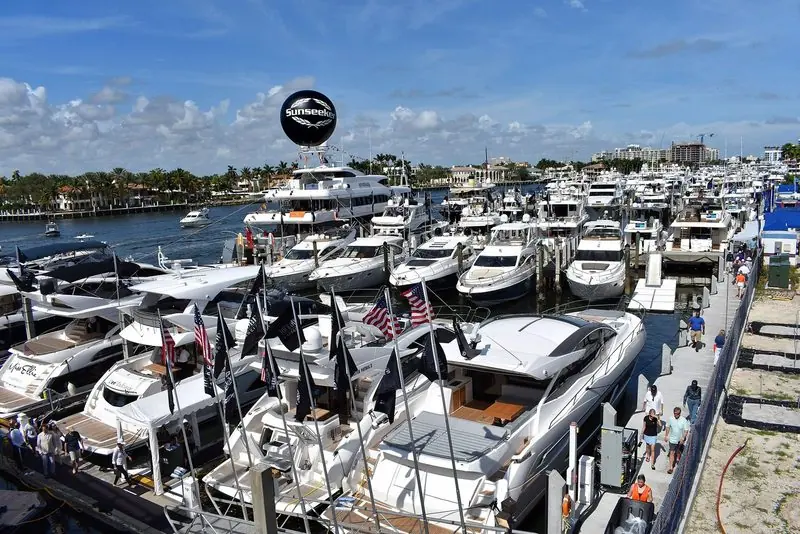
| Location | 2301 SE 17th Street, Fort Lauderdale, Florida, the first marina inside Port Everglades |
|---|---|
| Slips | 164 deep-water slips for vessels from 40 to 400 feet (about 12 m to 122 m) |
| Dockage | 5,000 linear feet, or 1,525 metres, split across Pier North with 127 slips and Pier South with 37 |
| Maximum draft | 30 feet, or 9.1 metres |
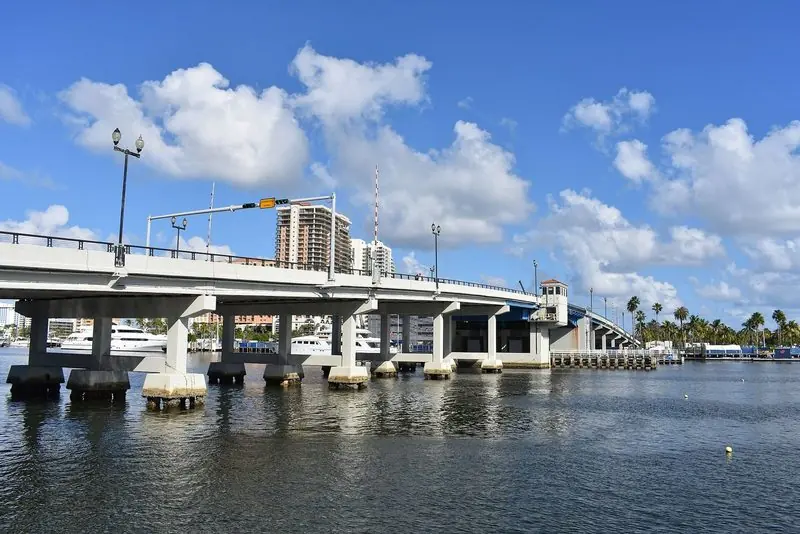
| Bridge | Pier South has no bridge between it and the ocean, Pier North lies inside the SE 17th Street bascule bridge with 55 feet of closed clearance |
| Shore power | 30 amp to 1,200 amp per pedestal |
| Fuel | in-slip high-speed fuelling and bunkering, sold tax free |
| Port Everglades entrance channel | 500 feet wide and 45 feet deep |
| Redevelopment | a USD 1 billion rebuild of the resort, marina and residences by Tavistock, with the hotel reopening in 2024 |
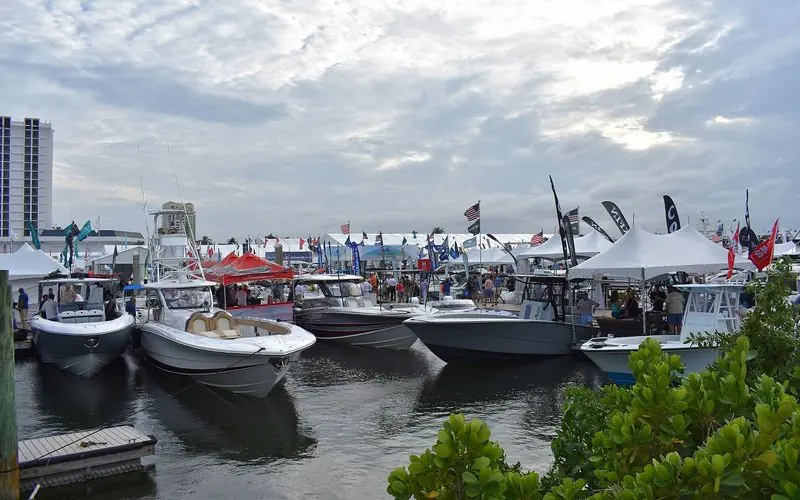
| Events | a venue of the Fort Lauderdale International Boat Show, running 28 October to 1 November 2026 in its 67th edition |
| Refit nearby | Safe Harbor Lauderdale Marine Center, 65 acres on the New River with a 485-tonne lift |
| Florida tax | state sales and use tax on a vessel purchase is 6 per cent, capped at USD 18,000 under Statute 212.05 |
| Shore power, from the marina's own site checked 28 July 2026: up to 1,200 A per pedestal | |
| Frequency | Florida runs 60 Hz at 120 V, 208 V and 480 V. Pier Sixty-Six publishes neither voltage nor frequency, checked 28 July 2026, on the dock where the Mediterranean fleet arrives after crossing west |
| A 50 Hz yacht therefore needs a frequency converter aboard or stays on generators. Converter availability at the pedestal is a question for the slip booking and is not answered on the marina's site | |
| Customs cannot be cleared at the marina. The marina runs a shuttle to the US Customs office, and US and Canadian nationals may report through the Mobile Passport app | |
| The 17th Street bascule bridge opens on the hour and the half hour on demand and is hailed on VHF channel 19. Pier South needs no bridge, Pier North does | |
| The property is a designated Foreign Trade Zone | |
| Dock detail | floating docks with 3 feet of freeboard, 2 inch pump-out and water connections, 30 feet of water alongside |
| Tidal range | about 2.5 feet on a normal tide and 3.5 feet on a king tide |
| Fort Lauderdale International Airport | 4.8 miles by road |
The first berth inside the inlet
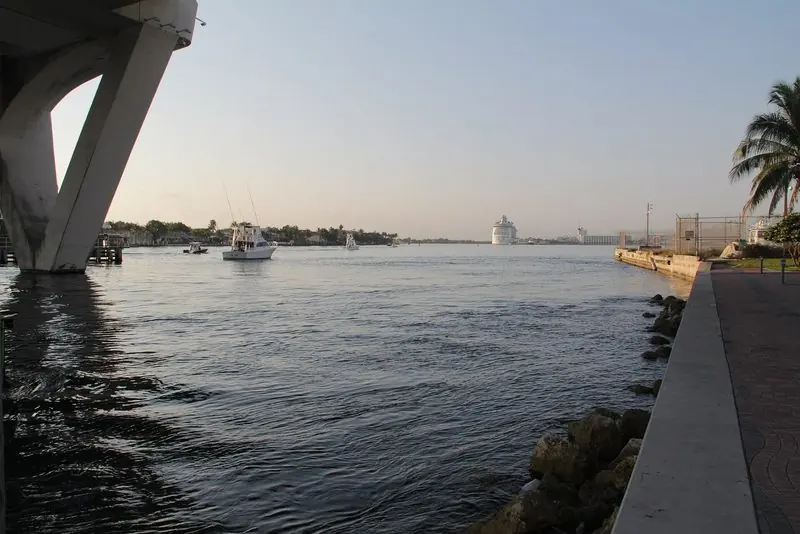
Port Everglades is a man-made harbour cut straight in from the Atlantic, and its entrance channel runs 500 feet wide and 45 feet deep before narrowing to 450 feet and 42 feet through the turning basin. That is commercial shipping water, dredged for tankers and cruise ships, and a yacht of any size simply comes and goes. Pier Sixty-Six sits on the 17th Street Causeway immediately inside, which makes it the first marina a yacht reaches after the sea buoy.
The practical value of that position is time. A yacht at Pier South can leave the dock and be in the Gulf Stream inside twenty minutes with no bridge to wait for and no shallow channel to feel down. Bimini and the Bahamas bank are around fifty nautical miles east across the Stream, which is a morning run. Fort Lauderdale has no tide worth planning for and no seasonal closure.
Two piers and one bridge
The marina is split by the SE 17th Street Causeway. Pier South carries 37 slips across 2,000 linear feet and has no bridge obstruction between it and the port entrance, which is why the largest and tallest yachts go there. Pier North holds 127 slips across 3,000 linear feet and lies inside the bridge. In total the marina publishes 5,000 linear feet of dockage, 164 deep-water slips and a maximum draft of 30 feet.
The bridge itself is a bascule with 55 feet of vertical clearance at mean high water closed, opening on the hour and half hour from 7am to 7pm. Since February 2026 it stays shut during weekday rush hours, at 7.30, 8.30, 4.30 and 5.30, other than on federal holidays. A yacht with a tall arch or a mast berthed north of it is therefore on a timetable set by Broward County commuters. Owners who care about that book south.
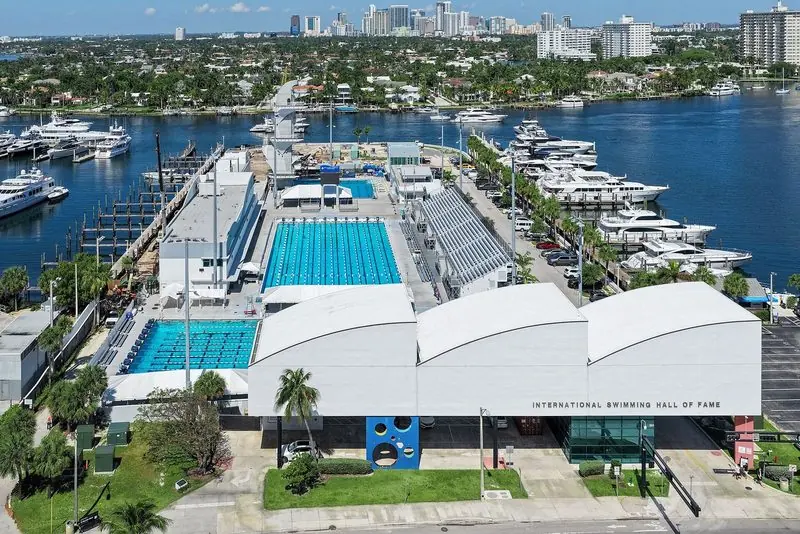
Twenty minutes from the dock to the Gulf Stream, and every trade a yacht could need inside a five-mile radius.
Getting a slip, and what it is priced on
Everything at Pier Sixty-Six is rented. Slips are quoted by the foot per day, with monthly and annual arrangements available and rates rising sharply through the winter and around the boat show. Nothing here is sold or leased in perpetuity in the way a Mediterranean berth can be, although the redevelopment includes private residences whose owners have their own dockage arrangements. An owner takes a slip the way he takes a hotel suite.
Availability follows the season. From late October, when the boat show fills every marina in the county, through to April, South Florida dockage is genuinely tight and the good slips go to repeat customers and to yachts that have committed early. Summer is quiet, cheap and hot. The single hardest week to find anything is boat show week, when a large part of the world fleet is in town.
Power, fuel and the tax angle
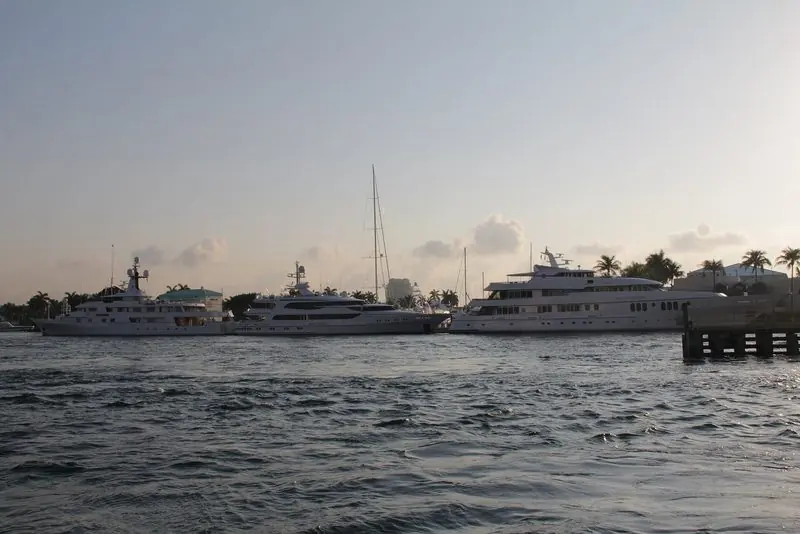
Shore power runs from 30 amp domestic service to 1,200 amp per pedestal, which covers the entire fleet the marina accepts. Fresh water, slip-side pumpout, complimentary wifi and parking close to the vessel are standard. Fuelling is done in the slip from high-speed pumps, so a 60 metre yacht bunkers without moving, and the fuel is sold tax free.
Florida's tax treatment is a large part of why so many yachts are based here. State sales and use tax on a vessel purchase runs at 6 per cent but is capped at USD 18,000 under Florida Statute 212.05, so the tax on a USD 40 million yacht is the same as the tax on one at USD 300,000. Florida charges no state income tax. Owners still need proper advice on use tax, delivery and how long the boat sits in state, because the exemptions have conditions and the traps are well documented.
The trades on the doorstep
Fort Lauderdale calls itself the yachting capital of the world and the claim survives examination. Every major broker, management company, crew agency, chandler and specialist contractor keeps an office within a few miles of this dock, and parts that would take a week to reach a Mediterranean marina arrive the same afternoon. For an owner that translates into shorter yard periods and fewer excuses.
For structural work the yards are inland on the New River. Safe Harbor Lauderdale Marine Center covers 65 acres and is described as the largest yacht repair facility in the United States, running five lifts including one rated at 485 tonnes, with covered sheds and a resident contractor base. Derecktor and Bradford also operate locally. The New River route involves several bridges and a pilot, so the transit takes planning.
Security, privacy and the resort above
The marina runs 24-hour security with controlled dock access, concierge service and parking beside the vessel. What it is not is private. Pier Sixty-Six sits on a busy causeway between a public road and a working commercial port, the docks are visible from the bridge and from the restaurants, and Port Everglades is one of the busiest cruise ports in the world, so several very large ships pass close by on a winter Saturday.
The redevelopment has changed the character of the place. Tavistock has spent around USD 1 billion rebuilding the resort, the marina and a set of residences, with the hotel and its rotating rooftop landmark reopening in 2024 and a marina promenade of shops and restaurants added. That brings people. Owners who want anonymity in South Florida keep the yacht on a private residential dock up the New River or on Las Olas Isles.
Ashore, flights and a family week
Fort Lauderdale-Hollywood International is about ten minutes from the dock and handles both scheduled long-haul and one of the heaviest private jet loads in the United States, with Miami International 40 minutes south as the alternative. That is the shortest airport transfer of any major yachting centre anywhere. Guests arrive and are aboard before the crew have finished the paperwork.
The town itself is a working city with good restaurants, beaches across the road and the Everglades an hour west. For a family the yacht is the point, because the Bahamas are the destination. The Abacos, the Exumas and Eleuthera give a fortnight of clear water and short passages, and clearing into the Bahamas is straightforward. Winter weather in South Florida is dry and warm, with cold fronts every week or two that bring a day of north wind and lumpy Gulf Stream.
Season, storms and the honest downside
The Florida season runs from the boat show at the end of October to Easter. The Fort Lauderdale International Boat Show is the largest in-water show in the world and spreads across seven venues including Pier Sixty-Six Marina and the Superyacht Village at Pier Sixty-Six South, with the 67th edition set for 28 October to 1 November 2026. From June to November the Atlantic hurricane season puts South Florida squarely in the box, and most insurance policies impose named-storm plans on yachts that stay.
The downsides are heat, exposure and traffic. August in Fort Lauderdale is brutal and humid, the causeway is loud, and the bridge schedule irritates anyone berthed north of it. This is a place to run a yacht from and not a place to sit and look at a view. Owners choose it because everything they might need is within five miles.
Sixty hertz, and what a European yacht does about it
This is the dock where a Mediterranean yacht arrives after crossing west, and it is one of two pages in this set where the frequency of the shore supply decides whether the boat plugs in at all. Florida runs 60 Hz, at 120 V, 208 V and 480 V depending on the service. A yacht wired for the European 50 Hz standard cannot simply connect. It needs a frequency converter aboard, or a converter supplied at the pedestal, or it runs its generators and pays for the fuel and the hours. Checked on 28 July 2026, Pier Sixty-Six publishes 1,200 A per pedestal and states neither the voltage nor the frequency, which is a strange omission on a marina that markets itself to owners who have never been able to plug in since leaving the shipyard.
The practical sequence is to settle it at the booking and not on the quay. A captain should ask what voltage and frequency the specific pedestal delivers, whether the marina has converters and at what rating, whether the connection above a given amperage is made by the dock team or by the crew, and what the changeover costs. The same question travels the whole American east coast and the Caribbean, so an owner basing a European hull in Florida for a winter usually solves it once, aboard, rather than negotiating it at every marina. On a yacht that arrives without a converter, generator hours become a real line in the winter budget and the maintenance schedule shifts with them.
The federal paperwork, which is not done here
The single most useful thing the marina says about formalities is that they do not happen on its dock. Customs cannot be cleared at Pier Sixty-Six. Arriving vessels take a shuttle the marina arranges to the US Customs office, and US and Canadian nationals have the option of reporting through the Mobile Passport app. That is a materially different arrival from Yacht Haven Grande, where Customs and Border Protection sit on the property, and it needs planning into the first day rather than discovering at the fuel dock. The property itself is a designated Foreign Trade Zone, which is a customs status attaching to goods on the site and not a clearance point for the yacht.
Three federal points shape a European yacht's first Florida winter and none of them are marina matters. Customs and Border Protection issues a cruising licence to recreational vessels of certain flags, which relieves the yacht of formal entry and clearance at each subsequent US port, and eligibility turns on a reciprocity list that CBP maintains and revises, so the flag is checked against the current list rather than assumed. Crew need the correct visa class before arrival, and a B1 or B2 is not automatically the right answer for a paid crew member on a foreign-flagged yacht. Above all, the Passenger Vessel Services Act prohibits a foreign-flagged vessel from carrying passengers for hire between two United States points, which means the Riviera charter model does not transfer to Florida and an owner who assumes it does is exposed. Formally importing a foreign-built hull into the United States attracts duty under the tariff schedule and is a decision taken with an American maritime attorney, not a broker.
Ashore, access and booking
| Contact and VHF | VHF 16/71 for hailing; marina office (954) 728-3578 or [email protected]. Confirmed on the marina's own site and matched by Dockwalk's marina database. |
|---|---|
| Operator | CoralTree Hospitality Group runs the reopened resort and marina day to day, under owner/redeveloper Tavistock Development Company. Marina Director is Megan Lagasse - 20 years in the trade, including a stint at IGY's Yacht Haven Grande in St. Thomas and four years as Bahia Mar's general manager, per the marina's own site and the Marine Industries Association of South Florida. |
| Booking a slip | Reservations go through an online slip-rental form or a direct call/email to the marina office, giving vessel specs and arrival/departure dates. The marina's public FAQ does not publish an advance-notice window or a deposit figure, and draws no public distinction between transient and annual terms - that is negotiated directly with the dockmaster. |
| Pricing | No official rate card is published anywhere findable. The only per-foot figure that turned up - roughly USD 7 to 9 per foot per night for transient dockage, from a Fort Lauderdale yacht brokerage's marina guide - has no second source to confirm it, so treat it as indicative only, not a quote. |
| Fuel | Tax-free, in-slip diesel bunkering at up to 200 gallons per minute. The mechanism behind the tax-free claim is real, not just marketing copy: the marina sits inside a CBP-designated Foreign Trade Zone tied to Port Everglades. |
| Shore power | The marina's own site cites pedestals up to 1,200 amps; a 2025 trade piece aimed at captains (The Triton) cites 30-amp to 1,000-amp service. The two do not agree at the top end, so read the ceiling as roughly 1,000 to 1,200A rather than a hard number until confirmed dockside. |
| Getting there | FLL airport is about 5 miles away, roughly 10 to 15 minutes by road. Signature Aviation is the FBO at FLL itself. Banyan Air Service, often mentioned in the same breath, is actually based at Fort Lauderdale Executive Airport (FXE) - a separate general-aviation field a short drive away, not at FLL. |
| Customs | No CBP office on site. Per the marina's own FAQ, crew either take a marina shuttle to the U.S. Customs office or use the Mobile Passport app - consistent with clearance itself not happening dockside. |
What owners and crew report
Depth through the whole approach is the standout, not just at the dock
A 50ft sailboat drawing 8ft found 10ft of water the entire way from the canal to the berth, which the reviewer called the single most important feature for his boat - and it held. The same reviewer warned the marina basin entrance, off a canal off the New River, is hard to pick out after dark, and vanishes entirely behind a docked megayacht if one happens to be blocking the sightline.
William Mcnutt, S/V Vacatio (Waterway Guide review, Jun 2025)Floating docks with dockside trash pickup, but no showers or laundry on site
The same reviewer praised the floating docks and a feature he said he had not seen anywhere else - a trash bin at the end of each finger dock that staff empty for you - plus a free filtered-water kiosk for drinking (the tap water in Fort Lauderdale runs high in sulfur and there is no equivalent filtering for tank fills). His complaint: no showers, no laundry on site, and the nearest laundromat is coin-operated, expensive and 'sketchy'.
William Mcnutt, S/V Vacatio (Waterway Guide review, Jun 2025)Staff and location draw praise across different ownership eras of the docks
A second reviewer, docked here in a 55ft sailboat before the most recent redevelopment phase, called the harbor location and access great and singled out then-marina manager Megan and her staff by name as 'a great amazing team', noting the docks had recently been rebuilt while the original 1957 hotel tower was still under reconstruction.
Richard Alcott, S/V Sea Cloud (Waterway Guide review, Jan 2021)
What is good, and what to watch
Strong points
- A real Foreign Trade Zone, not just a pricing gimmickThe tax-free fuel rests on the marina sitting inside a CBP-designated Foreign Trade Zone linked to Port Everglades - a legal status, not a discount policy the marina could revoke.
- Genuine marina-industry leadership installed for the reopeningCoralTree Hospitality brought in Megan Lagasse as Marina Director - prior stops at IGY's Yacht Haven Grande and four years running Bahia Mar - ahead of the 2025 relaunch. That is a marina professional, not a hotel generalist covering the waterfront.
- The trade is voting with its feetThe reopening was timed to the 66th Fort Lauderdale International Boat Show in October 2025, and Azimut and Benetti opened their Americas headquarters on site - a concrete signal from manufacturers, not just PR.
- Crew welfare beyond the dockA 13,000 sq ft Zenova Spa with nine treatment rooms, a 24-hour Technogym fitness center, and up to 12 planned food-and-beverage concepts on property give crew stuck aboard for a season somewhere to actually go.
What to watch
- No published rate cardPricing is opaque. The one per-foot figure found (roughly USD 7 to 9/ft/night, from a brokerage's marina guide) is uncorroborated - the real number comes from calling, not from browsing.
- Still finishing as of the 2025 reopeningRestaurants such as Garni and Pelican Landing were still opening through spring 2025 after the headline relaunch, and reporting on the project does not describe the full 12-concept dining rollout as complete until around October 2026 - book early in the cycle and part of what is advertised may not be open yet.
- Two piers split by a working causeway bridgePier North and Pier South sit on opposite sides of the 17th Street Causeway Bridge, so which side a yacht is assigned changes the walk - or tender - to the resort core. Worth asking at booking; the marina does not volunteer it.
- Published specs are not fully reconciled since the rebuildEven basic numbers disagree between the marina's own site and trade coverage - shore power cited at both 1,200A and 1,000A is the clearest example - which suggests the post-renovation spec sheet has not been fully cleaned up yet.
Who it is for: The owner splitting the year between Florida and the Bahamas who values trade depth, tax certainty and a ten-minute airport transfer.