Port de Saint-Tropez
| Location | Saint-Tropez, Var, on the south side of the Gulf of Saint-Tropez |
|---|---|
| Capacity | 734 berths across two basins, with around 100 kept for visitors |
| Maximum lengths by quay | Jean Lescudier basin up to 25 m, Old Port from 25 m to 50 m, Estienne d'Orves mole up to 90 m |
| Maximum draught on the Estienne d'Orves mole: 4 metres | |
| Pricing basis | overall length multiplied by overall beam multiplied by a rate per square metre that varies by quay and season |
| 2026 daily rate, very high season 10 July to 20 August: EUR 9.24 per square metre in the Old Port and EUR 7.29 on the Estienne d'Orves mole, VAT included | |
| 2026 daily rate, low season | EUR 1.59 per square metre in the Old Port and EUR 0.91 on the Estienne d'Orves mole |
| Included | Rates include water and electricity but not the electrical adapter or the tourist tax |
| Booking | vessels over 18 metres book through Magelan eResa and confirm with a deposit of 50 per cent of the stay |
| Contracts | a winter contract from 15 October to 1 April and a summer contract from 1 May to the start of Les Voiles |
| Regatta week | Les Voiles de Saint-Tropez runs from 26 September to 4 October 2026 |
| Airports | La Mole about 15km for private aviation, Nice around 110km by road |
| Full 2026 daily tariff in EUR per square metre, VAT included: low season 1 November to 1 April, Old Port 1.59, Estienne d'Orves mole 0.91, Jean Reveille mole 0.81, Jean Lescudier basin 0.71 | |
| Intermediate season 1 to 30 April and 4 October to 1 November: Old Port 2.55, Estienne d'Orves 2.48, Jean Reveille 1.77, Jean Lescudier 1.06 | |
| High season 30 April to 10 July and 20 August to 4 October: Old Port 7.03, Estienne d'Orves 5.37, Jean Reveille 3.86, Jean Lescudier 2.35 | |
| Very high season 10 July to 20 August | Old Port 9.24, Estienne d'Orves 7.29, Jean Reveille 5.12, Jean Lescudier 2.94 |
| 2026 seasonal packages in EUR per square metre, VAT included: low season 15 October to 1 April, Old Port 90.02 and Estienne d'Orves 84.57. High season 1 May to 26 September, Old Port 628.96 and Estienne d'Orves 604.77 | |
| Worked example on the 2026 tariff | a 70 m yacht of 12 m beam is 840 square metres, so EUR 6,124 a night on the Estienne d'Orves mole in very high season, or EUR 508,007 for the whole 1 May to 26 September package |
| Rates include water and electricity but exclude the tourist tax and the rental of the electrical adapter. The tourist tax is not quantified anywhere on the port's published material, checked 28 July 2026 | |
| The day runs from 14:00 to 12:00 the following day | |
| Old Port high season and very high season daily rates include one diver intervention per day, laying up to two mooring lines. The low season Jean Reveille and Jean Lescudier packages include one diver intervention per season | |
| Maximum lengths and the draught limit by basin: Jean Lescudier up to 25 m, Old Port 25 m to 50 m, Estienne d'Orves mole up to 90 m with a maximum draught of 4 m | |
| How many positions on the Estienne d'Orves mole take over 50 m is not published, checked 28 July 2026 | |
| Anchoring framework | arrete prefectoral 123/2019 of 3 June 2019, prefet maritime de la Mediterranee, article 6 prohibits anchoring in any zone corresponding to the habitat of a protected marine plant where the act is liable to damage it. The order itself sets no length threshold; its article 7.2 leaves zones and length thresholds to local orders |
| Local order for the Gulf of Saint-Tropez: arrete prefectoral 248/2020 of 15 December 2020, consolidated to arrete prefectoral 251/2023 of 3 August 2023. It applies to vessels of 24 m overall and above from Cap du Pinet at Ramatuelle to the Pointe de Saint-Aygulf at Frejus, and permits anchoring only seaward of a 40-point line given in the annex | |
| Three inshore exceptions inside that gulf, open only to vessels of 24 m to 45 m: off the plage des Cigales at Grimaud, the plage de la Nartelle at Sainte-Maxime, and the plage de la Gaillarde at Roquebrune-sur-Argens | |
| Pampelonne bay, Cap du Pinet to the Pointe de la Bonne Terrasse, is a ZMEL, a licensed mooring zone, under interprefectural order 350/2021 of 10 December 2021 (maritime prefect) and 114/2021 of 9 December 2021 (prefet du Var), consolidated by AIP 182/2026 of 23 June 2026. It holds 184 moorings across five sectors, run by the commune of Ramatuelle from 1 April to 31 October, plus one free anchoring-on-sand area reserved for vessels of 24 m up to 45 m | |
| Of the 184 Pampelonne moorings, 60 are visitor buoys in sectors A, B and C: 27 take up to 30 m overall, 28 take up to 50 m, and only 5 in the whole bay take up to 80 m. Sector D is 50 resident berths up to 20 m and sector E is 74 places up to 15 m for passage boats and beach-club tenders | |
| The state domain fee for the Pampelonne mooring zone is EUR 42,716 for 2026 and EUR 85,431 for 2027, and the commune is entitled to charge users for the service | |
| Vessels of 45 m overall and above, or 300 GT and above: arrete prefectoral 157/2024 of 23 May 2024, modified by arrete prefectoral 177/2026 of 3 June 2026. Yachts of 45 m to 80 m must declare an intended anchoring to the nearest semaphore at least one hour ahead; yachts of 80 m and above need an authorisation from the maritime prefect via CROSS MED | |
| Mandatory anchoring zones under that order: in Pampelonne bay, one zone for vessels of 80 m and above and a separate zone for 45 m to 80 m, and anchoring anywhere else in that sector is prohibited for those vessels. In the Gulf of Saint-Tropez, between the Pointe de la Rabiou and the Pointe des Sardinaux, there is one zone for vessels requiring authorisation, and anything of 120 m and above is confined to its eastern part | |
| Penalty for breaching a maritime prefect's anchoring order: up to one year imprisonment and EUR 150,000, article L.5242-2 of the code des transports | |
| Penalty for damaging the protected seagrass itself: up to three years imprisonment and EUR 150,000, article L.415-3 of the code de l'environnement, doubled inside the core of a national park or a nature reserve | |
| The same arretes also give judicial police officers and authorised maritime agents the power to seize the vessel used to commit the offence, article L.5243-6 of the code des transports | |
| Sentences actually handed down | the Tribunal maritime de Marseille fined the master of the 26 m Take Off EUR 20,000 with a one-year ban from French territorial waters for three anchorings in prohibited zones off Cannes and Saint-Tropez between June 2021 and September 2023, and the master of the 51 m My Falcon EUR 15,000 for one anchoring off Cannes |
| On 22 November 2024 the same court awarded ecological damages of EUR 86,537 against Take Off and EUR 22,423 against My Falcon, paid to the Agence de l'eau Rhone Mediterranee Corse for seagrass restoration, plus EUR 5,000 and EUR 4,000 in moral damages to France Nature Environnement and the Ligue de Protection des Oiseaux. It was the first French ruling to recognise ecological damage to a posidonia meadow | |
| The same ruling held that a vessel anchoring in a zone protected by prefectural order is presumed to have damaged the meadow unless it proves otherwise | |
| Enforcement, 2025 figures from the prefecture: 1,500 checks on vessels at anchor across the French Mediterranean producing 100 formal reports; the semaphore chain reported 1,485 suspected offences of all kinds, of which 1,157 concerned anchoring, up 18 per cent on 2024, and 738 of those were posidonia related | |
| The semaphore chain is 19 stations, 12 on the mainland and 7 in Corsica, manned around the clock and watching with optical, radar, radio and drone sensors. This, not satellite imagery, is the mechanism that catches yachts on the meadows | |
| Seabed charting | the prefecture of the Var's own posidonia leaflet directs boaters to DONIA, an app produced by Andromede Oceanologie with the Agence de l'eau Rhone Mediterranee Corse and free to download, at donia.fr. It maps seabed type, bathymetry and the anchoring regulations. No arrete names a charting product; the legal reference is the coordinates and charts annexed to the orders themselves |
A fishing harbour that never stopped being one
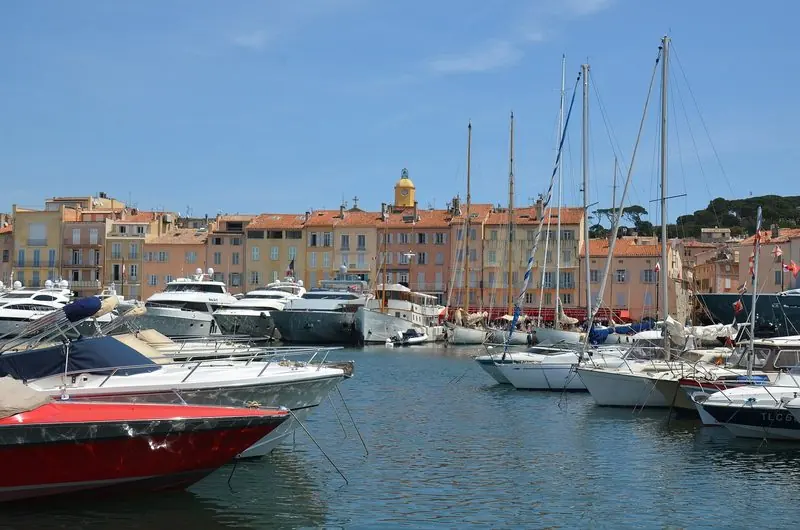
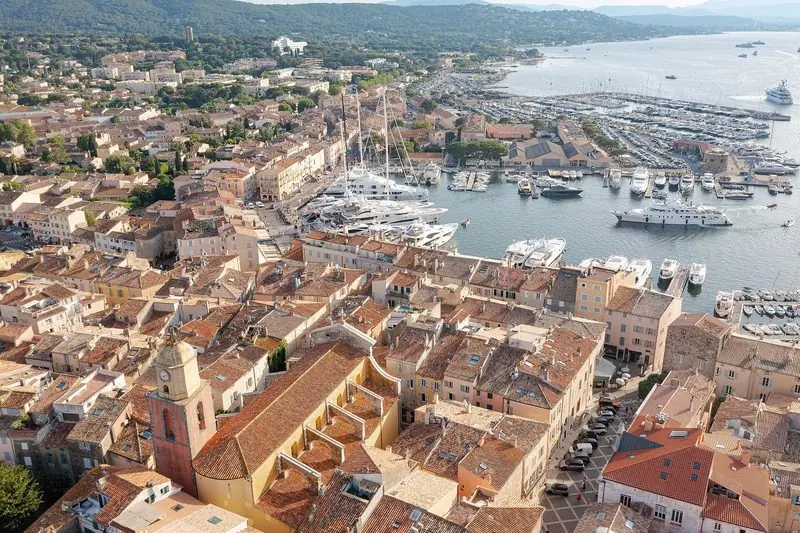
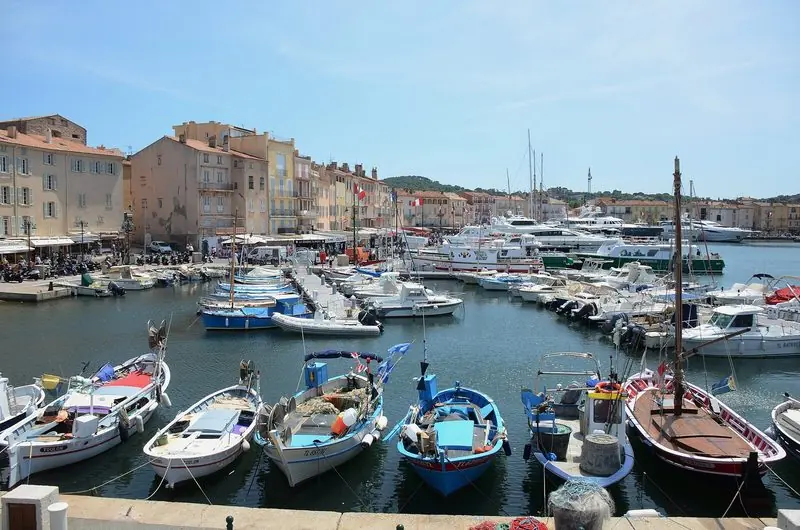
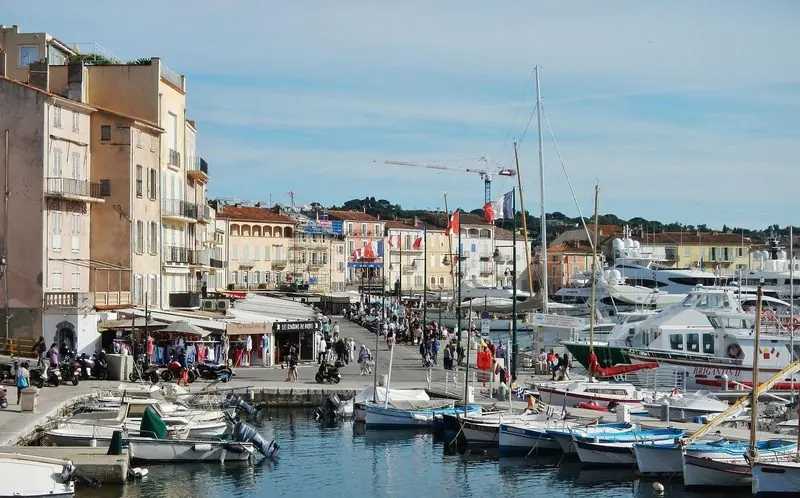
Saint-Tropez sits on the south shore of its own gulf, facing north across the water towards Sainte-Maxime. The port is small, old and awkwardly shaped, which is exactly why it works. Yachts lie stern-to along the quays with their passerelles landing a few metres from the cafe tables, and the town wraps around the water in a single curve of ochre buildings. Nothing about the layout was designed for a 70 metre motor yacht, and owners come precisely for the effect of putting one there.
The harbour holds 734 berths across two basins with around a hundred kept for visitors. Three quays matter to a large yacht. The Jean Lescudier basin takes up to 25 metres, the Old Port from 25 to 50, and the Mole d'Estienne d'Orves, the outer breakwater, up to 90 metres with a maximum draught of four metres. That draught limit is the number that decides whether a given hull can come at all.
The approach and the summer traffic
The Gulf of Saint-Tropez is a wide, deep bay entered from the east with no navigational difficulty, and the port office works VHF channel 09 and is open around the clock in summer. What makes the arrival demanding is other people. In July and August the gulf is thick with tenders, day boats and charter craft, and the harbour entrance is a bottleneck. Berthing on the town quay is done stern-to onto a lazy line in front of an audience.
The prevailing hazard is the mistral, the cold northwesterly that funnels down the Rhone valley and blows hard across this coast for three days at a stretch. It arrives with clear skies and catches people out. The port includes a diver's intervention in some of its rates, laying up to two mooring lines a day on the Old Port quays in high season, which is a measure of how much attention the mooring arrangements need.
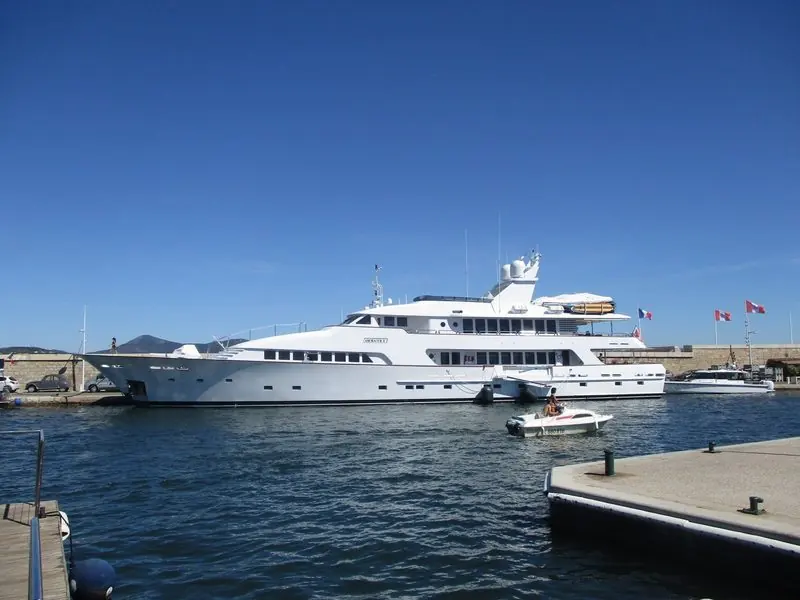
Four thousand euros a night for fifty metres in August, and the harbour still runs out of room.
What it costs, precisely
Saint-Tropez prices by area, taking overall length multiplied by overall beam, and applies a rate per square metre that changes by quay and by four seasons. On the 2026 tariff the very high season runs from 10 July to 20 August. In that window the Old Port is EUR 9.24 per square metre per day including VAT and the Estienne d'Orves mole is EUR 7.29. A 50 metre yacht with a nine metre beam covers 450 square metres, which is EUR 4,158 a night on the town quay.
The same yacht in low season, from 1 November to 1 April, pays EUR 1.59 per square metre in the Old Port, or EUR 715 a night. Rates include water and electricity and exclude the electrical adapter and the tourist tax. Reservations for vessels over 18 metres go through the Magelan eResa system and are confirmed on payment of a deposit equal to half the stay. Everything is payable on arrival and cheques are not accepted.
Anchoring off the peninsula, and the posidonia rule
Anchoring off Pampelonne is the standard answer to a full port, and it comes with a constraint the beach clubs will not mention. Posidonia oceanica seagrass is a protected habitat and anchoring on it is prohibited by arrete prefectoral 123/2019 of 3 June 2019, the maritime prefect's framework order for the French Mediterranean, whose article 6 forbids anchoring in any zone corresponding to the habitat of a protected marine plant where the act is liable to damage it. The 24 metre figure is not in that order. Thresholds and zones are set by the local orders made under its article 7.2, and the one covering this gulf is arrete prefectoral 248/2020 of 15 December 2020, consolidated to 3 August 2023, which applies to vessels of 24 metres overall and above between Cap du Pinet at Ramatuelle and the Pointe de Saint-Aygulf at Frejus and pushes them outside a line given in coordinates. Pampelonne bay itself, Cap du Pinet round to the Pointe de la Bonne Terrasse, sits under a separate interprefectural order of 9 and 10 December 2021 that turned the whole bay into a managed mooring zone, consolidated by the order of 23 June 2026. Breaching a maritime prefect's anchoring order carries up to one year in prison and EUR 150,000 under article L.5242-2 of the code des transports, and damaging the seagrass is a separate offence under article L.415-3 of the code de l'environnement at up to three years and EUR 150,000, doubled inside the core of a national park or a nature reserve. Those are ceilings rather than tariffs. The maritime court in Marseille fined the master of a 26 metre yacht EUR 20,000 and banned him from French territorial waters for a year over three anchorings in prohibited zones off Cannes and Saint-Tropez, and on 22 November 2024 the same court ordered a further EUR 86,537 for the ecological damage. The meadows off Pampelonne and around the Cap are exactly where a yacht would otherwise choose to lie, so the usable sand is narrower than the chart suggests and the good patches fill early.
The enforcement is real and it is systematic rather than a matter of a patrol boat happening past. The nineteen semaphore stations along the French Mediterranean coast watch the anchorages with optics, radar and drones, and in 2025 they reported 1,157 suspected anchoring offences, 738 of them posidonia related, while at-sea units ran 1,500 checks on vessels at anchor and wrote 100 formal reports. The practical answer is the same one that works in the Balearics: use the published seabed charting to find sand before committing, drop where the plotter and the eye agree, and keep the chain off the grass rather than trusting scope. A yacht that anchors here regularly should have the zones on the bridge, not in an email.
Getting a berth at all
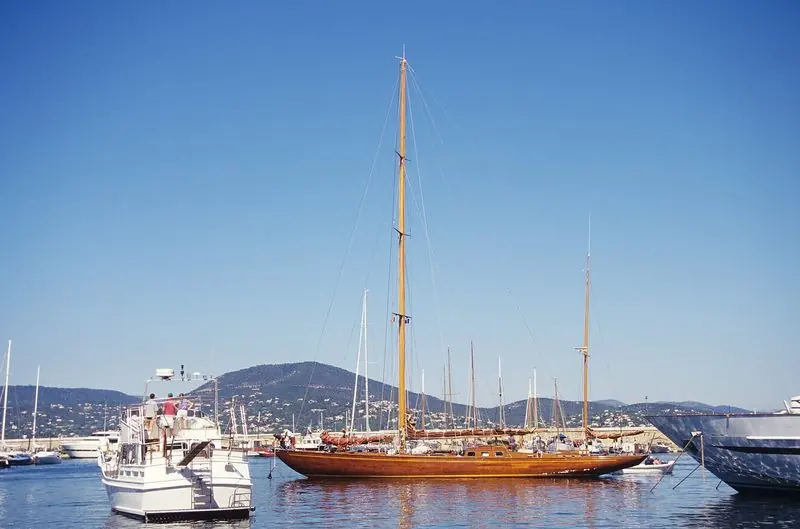
Berths at Saint-Tropez are rented from the municipal port and nothing is sold. There are two contract seasons, a winter contract from 15 October to 1 April and a summer contract from 1 May to the start of Les Voiles, plus daily passage rates for everyone else. Requests are made online and the port operates two systems, Navily for boats under 18 metres and Magelan eResa above that.
In practice the harbour runs close to full from late June to the end of August and the good positions go to yachts the port already knows. An owner who wants the town quay in the first fortnight of August should be talking to the port office in the winter. Owners who leave it late end up anchored off Pampelonne and tendering in, which many of them do by choice.
Services, and what has to happen elsewhere
The port runs a fuel station and the rates for berths include water and power at the pontoon. Provisioning, laundry, florists and every kind of concierge service are within a few hundred metres, because the town's economy is built on servicing yachts and the people on them for four months a year. The port has been certified as a clean harbour active in biodiversity and joined the SEA Index as an institutional member in 2024, with artificial fish nurseries installed around the basin.
There is no yard capability here worth the name. Anything beyond a diver and an engineer means moving the boat, and the regional centre for serious refit work is La Ciotat, a comfortable day's run west along the coast, with Marseille beyond it. Golfe-Juan and Antibes are closer for technical support. Owners running a Saint-Tropez season keep their yard periods for the winter and somewhere else.
Privacy, which does not exist here
There is no discreet berth in Saint-Tropez. The Old Port quays put a yacht's aft deck within conversational distance of the pavement, and from May to September a continuous crowd walks past photographing the boats. Crew set up ropes and boards and spend a good part of their day asking people not to step aboard. The Estienne d'Orves mole is marginally more removed from the cafes and still fully visible.
Owners who choose Saint-Tropez have decided that visibility is a feature. The ones who have not tend to anchor off Pampelonne or in the lee of the Cap and use the tender, which gives them the town at dinner and privacy at breakfast. That is the standard compromise on this coast and it explains why the anchorage is often busier than the port.
Ashore, and the coast around it
The town is genuinely beautiful out of season and genuinely overwhelmed in August, when the population multiplies and the road in from the autoroute can take two hours. La Mole airport, around 15 kilometres west, handles business aviation and is the helicopter hub for the gulf, and Nice is roughly 110 kilometres by road at about an hour and a half in normal traffic. Most guests arrive by helicopter or by tender from a bigger airport.
The peninsula holds the beach clubs at Pampelonne, the hill village of Ramatuelle, and vineyards that produce most of the rose the town drinks. By sea the Iles d'Hyeres and Porquerolles are half a day west, Cannes and the Lerins islands are an easy morning east, and Corsica is an overnight passage. For a family week the mix of beach, town and short passages is as good as the Mediterranean offers.
Season, timing and the honest downside
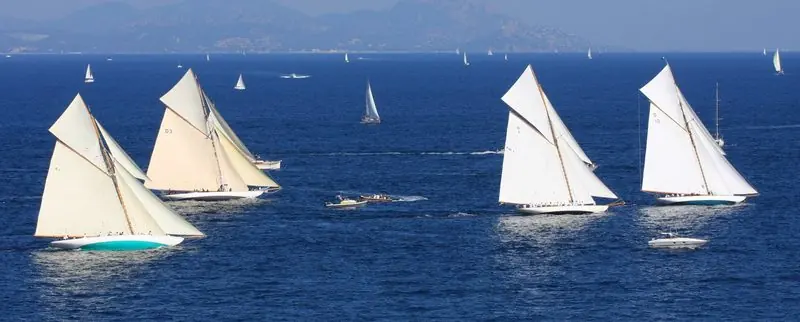
The port's own calendar sets the rhythm. Low season runs from 1 November to 1 April, mid season covers April and the second half of September, high season starts on 30 April, and the very high season is 10 July to 20 August. Les Voiles de Saint-Tropez, the classic and maxi regatta that closes the Mediterranean season, runs from 26 September to 4 October in 2026 and fills the harbour with a fleet of over 300 sailing yachts. The Giraglia in June is the other fixed point.
The downsides are cost, crowding and the four metre draught limit that quietly excludes a slice of the modern fleet. August in Saint-Tropez is not restful, the prices are among the highest anywhere per square metre of water, and an owner is buying a stage and not a refuge. The compensation is that no other harbour in the world puts a large yacht so close to so much of what its owner came for.
The whole 2026 tariff, and a 70 m yacht in August
Saint-Tropez publishes its full tariff on one page and there is no reason to quote only part of it. Rates are per square metre of length overall multiplied by beam overall, VAT included, and they vary by basin and by four seasons. Daily, in the very high season from 10 July to 20 August, the Old Port is EUR 9.24 and the Estienne d'Orves mole is EUR 7.29. In the high season either side of that, 30 April to 10 July and 20 August to 4 October, they are EUR 7.03 and EUR 5.37. In the intermediate weeks of April and October they are EUR 2.55 and EUR 2.48, and in the low season from 1 November to 1 April they fall to EUR 1.59 and EUR 0.91. The Jean Reveille mole and the Jean Lescudier basin sit below both throughout.
Worked through on a 70 m yacht of 12 m beam, which is 840 square metres, a night on the Estienne d'Orves mole in the second week of August is EUR 6,124 with VAT in it and water and electricity included. The same yacht taking the high season package from 1 May to 26 September pays EUR 604.77 per square metre, which is EUR 508,007 for the season. The low season package from 15 October to 1 April is EUR 84.57 per square metre, or EUR 71,039. What none of those figures include is the tourist tax, which the port names as an exclusion and does not quantify anywhere, or the rental of the electrical adapter, which is the connector between the quay and the yacht and is charged separately. Reservations above 18 m go through Magelan eResa and are confirmed on a deposit of 50 per cent of the stay, calculated before the tourist tax and any optional services. Cheques are not accepted.
Anchoring off Pampelonne, and the rule that governs it
Lying off the peninsula is the standard answer to a full harbour in August, and it comes with a legal condition that has to be stated alongside the advice. Posidonia oceanica, the seagrass that covers much of this seabed, is a protected habitat in French Mediterranean waters, and anchoring on it is prohibited by arrete prefectoral 123/2019 of 3 June 2019. The 24 m threshold comes from the local order for this stretch of coast, arrete prefectoral 248/2020 of 15 December 2020, with Pampelonne bay governed separately by the interprefectural order of 9 and 10 December 2021 that made the bay a managed mooring zone. Vessels of 45 m and over, or 300 GT and over, also fall under arrete prefectoral 157/2024 of 23 May 2024, modified 3 June 2026, which makes them declare an intended anchoring to the nearest semaphore an hour ahead, or seek permission outright above 80 m, and confines them to designated zones in both Pampelonne bay and the gulf. Enforcement runs through the coastal semaphore stations, which watch with optics, radar and drones, and through boarding parties at sea; the penalties are set out in the key facts. The meadows off Pampelonne and around the Cap are exactly the ground in question. A yacht that drops on posidonia is not committing a technical breach of a mooring rule, it is damaging a protected habitat, and the consequences run to prosecution rather than a berth fee.
The practical version is that a large yacht anchors on sand and only on sand, that the sand patches off Pampelonne are identifiable from the chart and from the water and are not where everyone else is lying, and that a captain who cannot positively identify the bottom does not drop. Where the bottom is uncertain, the answer is a mooring buoy or the harbour. Any advice to anchor off Pampelonne that does not carry this rule is incomplete, because it is the kind of omission that costs an owner money rather than time. The port's own rates make the same point from the other direction, since the daily figure in the Old Port during high season includes a diver laying up to two mooring lines every day, which is a measure of how much attention holding gets taken seriously here.
Ashore, access and booking
| Nearest airports | La Mole (business aviation) about 15 km/20 min by road; Toulon-Hyeres about 52 km, roughly 1 to 1.5 hours by road or 14 minutes by helicopter; Nice about 110 km, roughly 1.5 hours by road. |
|---|---|
| VHF and speed limit | Call the harbour master on VHF channel 9 before entering (24-hour monitoring in summer); channel 16 or +33 (0)4 94 40 54 52 (Saint-Raphael coastguard) for emergencies. Harbour speed limit is 3 knots; visiting yachts are normally directed to the first quay on the right of the entrance in the outer basin, and mooring assistance runs 8am to 7pm. |
| How berths are actually reserved | Online: Navily for boats under 18m, Magelan eResa for 18m and above, confirmed with a 50 percent deposit excluding tourist tax; cheques are not accepted. In July and August vessels over 18m are capped at two two-day stays a month. Getting a summer slot on the Old Port quay has historically depended on the port's own goodwill as much as the booking system - enough that ten former port staff and intermediaries are due before the Draguignan criminal court in November 2026 over a bribery scheme for those berths. The port says reservations have since been digitised and made more traceable. |
| Berth cost | Priced by LOA x beam. On the 2026 tariff, 10 July to 20 August: EUR 9.24/sqm/day on the Old Port quay and EUR 7.29/sqm on the Estienne d'Orves mole, including water and electricity, excluding tourist tax and the shore-power adapter rental. Low season (1 Nov to 1 Apr) falls to EUR 1.59 and EUR 0.91/sqm. |
| Fuel and fluids | SP98 petrol, standard diesel and tax-free diesel are sold from the green-lighthouse jetty (Groupe Bergon); summer hours are 8am to 8pm. Diesel across the French Riviera in 2026 is averaging around EUR 2.50 a litre. Water and electricity are included in the berth rate; the shore-power adapter itself is rented separately. |
| Services on the quay | Free waste pump-out, free wifi (password given at check-in), shore power via MARECRIAL sockets from 16A to 250A, and a diving service on request; Old Port high-season berths include one diver-laid mooring-line service a day. |
| Eat on the quay | Senequier, on Quai Jean Jaures since 1887, and Le Girelier, a seafood house on the same quay for more than 60 years, both sit a few steps from the stern-to berths. |
| After dark | Les Caves du Roy at the Hotel Byblos and the VIP Room are both a short walk from the port; Caves du Roy has been the fixture nightclub of the Riviera season for decades. |
| Fixed dates | Les Voiles de Saint-Tropez runs 26 September to 4 October 2026, filling the harbour with roughly 250 to 300 classic and racing yachts; the Giraglia passes through in June. |
What owners and crew report
For years, the real price of an Old Port berth included a cash top-up
An investigation opened by the Draguignan public prosecutor in 2023 found former port employees demanding EUR 1,000 to EUR 15,000 in cash on top of the published rate for scarce Old Port slots between 2022 and 2024. Investigators seized EUR 856,000 and estimate around EUR 2 million changed hands in total. Ten defendants, including former port staff, are due before the Draguignan criminal court on 23 November 2026.
Agence France-Presse (AFP)The town hall itself admits the port cannot meet demand
Saint-Tropez's own director general of town services put the peak-season waiting list at 50 to 90 boats for every one of the roughly 30 transit berths the Old Port has for yachts over 18 metres.
Benoit Ravix, quoted by Agence France-Presse (AFP)Captains describe the stern-to turn itself as the hard part, not the paperwork
Spinning a yacht stern-first into the commercial part of the harbour means trusting "the eyes on the aft deck" doing the manoeuvre, and July and August - the port's busiest weeks - are markedly windier and more crowded than the May/June window most captains prefer for this stretch of coast.
Captain James Griffith, interviewed by Fraser YachtsA fire on a packed stern-to quay is not a hypothetical
On 10 July 2025 the 41m Sea Lady II caught fire roughly two hours after mooring in the Old Port. It took until midnight to bring under control, two crew were treated for smoke inhalation, and by August the hull had partially sunk and was being written off as likely for scrap.
Boat International
What is good, and what to watch
Strong points
- The walk-off-the-quay scene has no equal on this coastSenequier, trading on the same stretch of Quai Jean Jaures since 1887, and the seafood house Le Girelier, a fixture for more than 60 years, both sit steps from the stern-to berths, and Les Caves du Roy at the Hotel Byblos is a short walk up from the port - an owner's guests can go from swim platform to nightclub table without a car.
- It remains the historic anchor of the Riviera season, not a manufactured oneThe port has drawn big yachts since the 1950s, and Les Voiles de Saint-Tropez each autumn still fills the same basin with around 250 to 300 classic and modern racing yachts, a fixture the town has run in one form or another for decades.
What to watch
- Only about 30 transit berths exist for anything over 18 metresAgainst that, AFP reported the town's own director general of services putting the peak-season waiting list at 50 to 90 boats per space, and in July and August the port itself limits vessels over 18m to two two-day stays a month.
- Berth allocation ran on bribery for years, not just relationshipsTen people, including former port employees, are due before the Draguignan criminal court on 23 November 2026 after an investigation found cash payments of EUR 1,000 to EUR 15,000 changing hands for Old Port slots between 2022 and 2024; investigators seized EUR 856,000 and estimate roughly EUR 2 million was paid in total. The port says reservations have since been digitised.
- The 4-metre draught and the quay's own numbers quietly cap the fleet that can even tryThe only quay taking anything over 50 metres, the Estienne d'Orves mole, tops out at a 4-metre draught, and the port does not publish how many of its big-yacht positions exceed 50 metres, so a deep-draught 70m-plus yacht has to check compatibility before it books at all.
- The density that makes the quay glamorous also makes it dangerousOn 10 July 2025 the 41m Sea Lady II caught fire in the Old Port two hours after docking; it took until midnight to control and the hull later partially sank, a reminder of how tightly boats lie stern-to on the busiest berths.
Who it is for: The owner who wants to be in the middle of the French Riviera season and treats being looked at as part of what he is paying for.