Port Vauban / IYCA (Antibes)
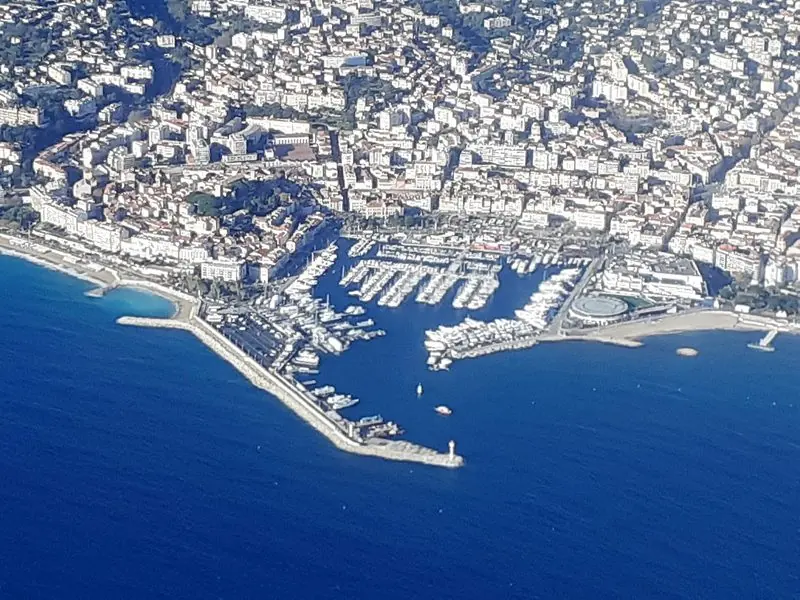
| Location | Antibes, Alpes-Maritimes, Cote d'Azur, France |
|---|---|
| Operator | Vauban 21 under a public service delegation from the city, running 25 years from 1 January 2017 to December 2042 |
| Port capacity | quoted at 1,500 berths across all basins |
| IYCA outer quay | 650 m long with 19 permanent berths, plus a published project to extend it to 1,250 m |
| IYCA berth sizes | seven at 70 x 16 m, four at 80 x 18 m, six at 90 x 20 m, one at 150 x 28 m, one at 165 x 40 m |
| Max draught on the outer quay | quoted at 5 to 8 m, with inner basins only 2 to 4 m |
| Entrance | about 50 m wide, lit for day and night access, 3 knot limit, exposed to the eastern sector |
| Mooring | stern-to on a mooring-box system that replaced the old ground chains and buoys |
| Tenure | leases sold privately, reported at EUR 10 m to over EUR 20 m for 50 m-plus positions in 2026 commentary |
| Redevelopment | EUR 135 million programme, IYCA district rebuilt to a Philippe Prost design, further buildings scheduled for 2026 |
| On the quay | crew centre, ISPS controlled access with CCTV, fuel station, pumping station, licensed heliport of about 28 x 29 m |
| Nearby | Monaco Marine Antibes yard for yachts of roughly 5 to 45 m, with MB92 and Compositeworks at La Ciotat about 90 minutes west |
| Shore power | 230 V plus or minus 10 per cent at 50 Hz single-phase, or 400 V plus or minus 10 per cent at 50 Hz three-phase. No 60 Hz supply |
| Connection cable specified by the port | one flexible cable per socket, single length, maximum 25 m, HO7 RN-F 3G2.5 for 16 A and 3G6 or 5G6 for 32 A |
| The port warns in writing that without an on-board isolation transformer, electrolysis can damage the yacht or her neighbours | |
| Metered fluids for yachts of 12 m and over, 2026 card: water EUR 3.79 per cubic metre and electricity EUR 0.38 per kWh, VAT included | |
| A yacht lived aboard without electricity metering pays a 10 per cent surcharge on the berthing fee | |
| Tariff bands run by length and beam together, from Z-QDM at 53.99 m and 12 m up to Z15 at 158.99 m and 27 m. Beam is a hard cap in each band | |
| Seasons | high is May, June and September. July and August are the middle band. Low is 1 January to 1 May and 1 October to 1 January |
| Cost, 2026 card, VAT included, per day | Z05 (to 85.99 m, 17 m beam) EUR 3,479 high, EUR 3,163 July and August, EUR 1,582 low |
| Cost, 2026 card, VAT included, per day | Z08 (to 106.99 m, 20 m beam) EUR 4,718, EUR 4,289, EUR 2,253. Z15 (to 158.99 m, 27 m beam) EUR 7,434, EUR 6,758, EUR 3,833 |
| July and August discount | 30 per cent off the high-season rate for category Z03 and above on stays of fifteen consecutive nights or more |
| Winter contract, one month minimum, VAT included, per day: EUR 331 for Z-QDM, EUR 1,299 for Z07 to 99.99 m, EUR 2,319 for Z15 | |
| Worked example | a 100 m yacht on a 19 m beam wintering 1 October to 1 May pays 212 days at EUR 1,299, or EUR 275,388, before metered water and power |
| Short technical stops | under 30 minutes alongside is free with no access to water or power, and under six hours is charged at 50 per cent of the base rate in any season |
| Cancellation | for stays of ten nights or fewer, free 72 hours or more before arrival, otherwise the full stay is charged. For 11 to 30 nights, 30 per cent at seven days and the full stay inside that |
| Movements must be notified to the port office at least 24 hours ahead. Grande Plaisance reservations go to [email protected] | |
| Fibre optic internet at 1 Gb, taken by RJ45 at the berth | |
The approach and the entrance
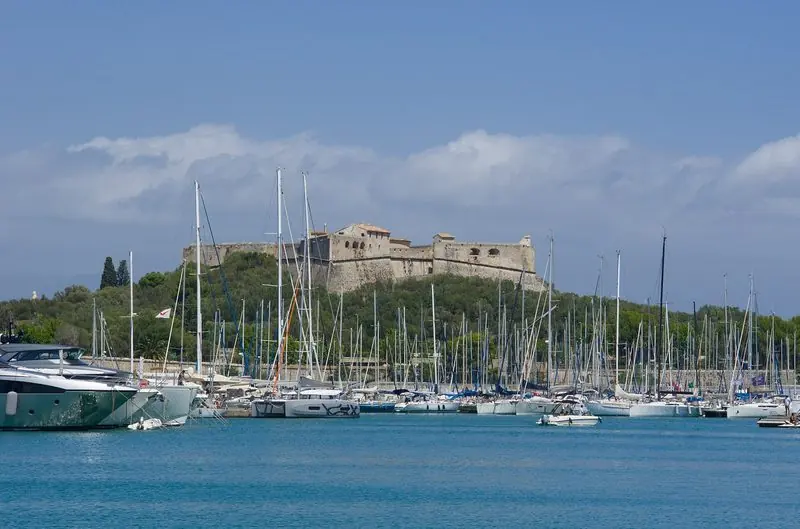
Port Vauban sits on the eastern side of the Antibes peninsula, tucked under the ramparts and the Fort Carre at the top of the Baie des Anges. The approach from seaward is clean, with the entry lit day and night and access possible in most conditions. The channel itself is narrow by superyacht standards at about 50 metres wide, and the speed limit through the entrance and the basins is three knots. Depth at the entrance runs from around five to eight metres.
The weakness is the east. The main stone breakwater covers the port from northerly swell, and the Vauban tower shelters the inner harbour, but the entrance is open to the eastern sector and a strong easterly makes the approach awkward and the outer berths lively. Captains coming in from Corsica or Italy in a blow will often hold off or divert. Inside the basins the depths drop to two to four metres, which is the single most important fact about the port. A yacht over about 30 metres is not going anywhere except the outer wall.
What the port holds and where a large yacht goes
Port Vauban is quoted at a capacity of 1,500 berths, taking everything from small local craft upwards, and it is that mix that gives the place its working character. Almost all of that number is irrelevant to a large-yacht owner. The berths that matter are on the outer breakwater run by the International Yacht Club d'Antibes, the quay everyone calls the Quai des Milliardaires, created in 1986 specifically to take yachts of 50 metres and up.
The IYCA quay currently runs 650 metres out to sea and holds nineteen permanent berths, with a published expansion project that would take it to 1,250 metres. The layout is precise and worth knowing before enquiring. There are seven positions of 70 by 16 metres, four of 80 by 18, six of 90 by 20, one of 150 by 28 and one of 165 by 40. Maximum draught on the outer quay is quoted at five to eight metres.
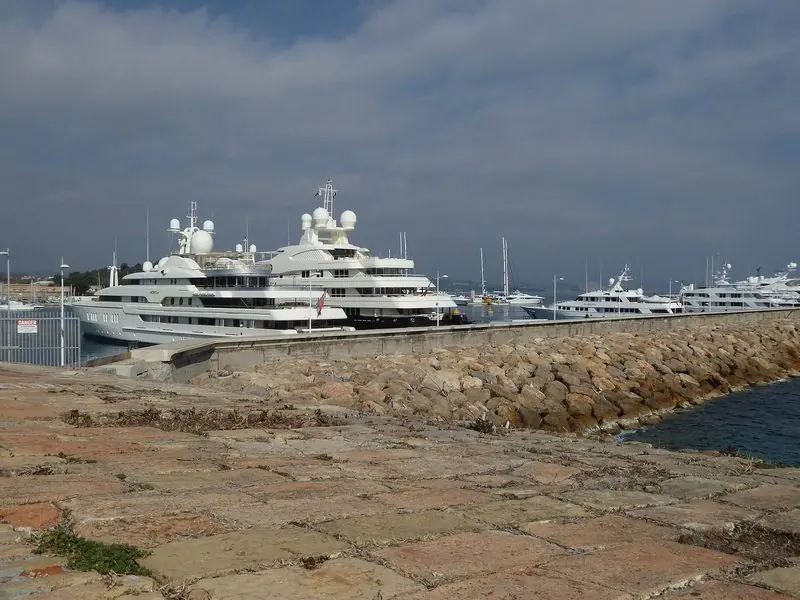
Nineteen berths on the outer wall, and every one of them is a lease that expires in December 2042.
The berthing reality in season
Yachts lie stern-to along the breakwater. The old arrangement of ground chains and mooring buoys has been replaced by a mooring-box system installed during the recent works, which removes the chain-fouling and buoy-hunting that used to make manoeuvring here slow. Berthing assistance is provided and the tight channel means arrivals are coordinated with the port.
Availability in July and August is effectively nil at the permanent positions, because all nineteen are held under long leases by owners who use them. What moves is stopover space when a leaseholder is away, and that is allocated by the club and the port. An owner planning a Riviera summer without a lease should assume Antibes is a place he visits by arrangement, not a berth he can call on.
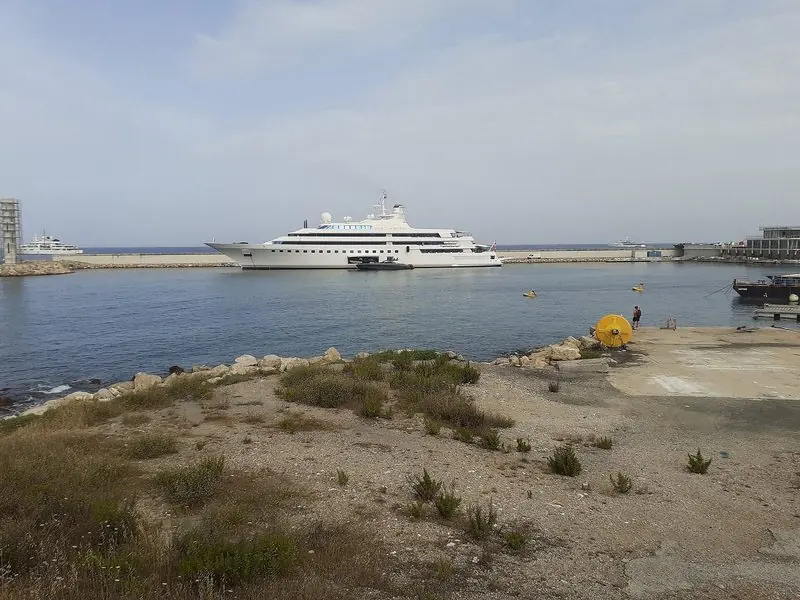
What a berth here actually is, and how it is bought
The French system is different from Monaco's and the difference decides the money. Port Vauban is run under a delegation of public service, and since 1 January 2017 the concession has been held by Vauban 21, a company formed by the local chamber of commerce with the Caisse des Depots and Caisse d'Epargne Cote d'Azur. That concession runs 25 years, to December 2042. A berth lease on the quay is a right of use that expires with the concession, so what an owner buys is a wasting asset with a known end date and no guaranteed renewal.
Leases change hands privately, usually through a small circle of berth brokers and the major brokerage houses. Reported figures for 50 metre-plus positions on the quay have run into eight figures, with EUR 10 million to over EUR 20 million cited in 2026 market commentary, and one smaller superyacht berth was publicly listed at EUR 4,150,000 including VAT with the payment spread over eighteen years. Those are asking prices in a market with a handful of transactions, so treat them as a range. Below the breakwater, annual and seasonal contracts in the public port are handled directly by Vauban 21.
Power, fuel, waste and crew
The quay carries water and electricity, a fuel station and a pumping station with waste collection. The recent EUR 135 million redevelopment rebuilt the IYCA district to a design by the Philippe Prost architecture studio and added the things a large crew actually uses. There is a dedicated crew centre with a lounge, gym and changing rooms, a members' lounge bar with about 700 square metres of terrace, electric golf carts for moving people and stores along a 650 metre quay, and a concierge desk.
Security on the breakwater is controlled private access with CCTV, which puts the yacht behind a gate and away from the public promenade that runs through the rest of the port. There is a licensed heliport on the quay measuring roughly 28 by 29 metres with day and night landing authorisation and four helicopter parking spaces. Membership at the club is tiered, and the tier an owner takes determines what he can use ashore.
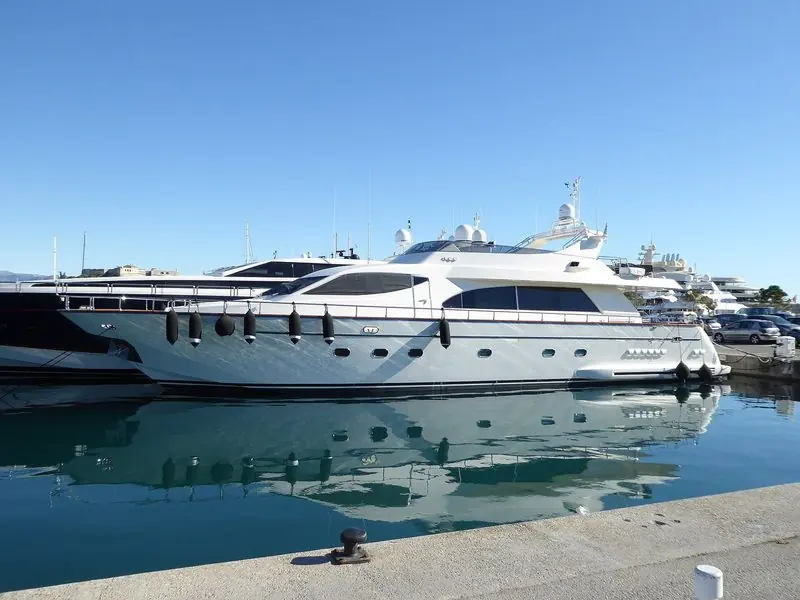
The trade base, which is the real reason to be here
Antibes holds the densest concentration of yacht crew, crew agencies, brokerages and marine trades anywhere in the world, and it is walking distance from the quay. Anything an owner needs done in a week, from an engineer to a varnish team to a chef at four hours' notice, can be found in the old town behind the port. That depth is why so many yachts are managed out of Antibes even when they berth elsewhere.
For work on the yacht itself, Monaco Marine's Antibes yard sits on the port at about 16,000 square metres and handles more than 230 vessels a year, though its lift range covers roughly 5 to 45 metres. Anything larger goes along the coast. La Ciotat, about ninety minutes west, carries MB92 and Compositeworks and the heavy lifting capacity for yachts up to 100 metres and beyond. An owner based in Antibes has the trades on his doorstep and the big yards within a day's steaming.
The town and what a family does for a week
Antibes is a real town with a life outside yachting, which is unusual on this coast. The old town behind the ramparts has a covered Provencal market that runs most mornings, the Picasso museum in the Chateau Grimaldi sits on the sea wall a few minutes from the quay, and the beaches of the Cap and Juan-les-Pins are a short drive. Juan-les-Pins supplies the summer nightlife. Cannes is twenty minutes west, Nice twenty minutes east, and the hill villages behind the coast fill an afternoon.
Nice Cote d'Azur airport is about twenty minutes from the quay in normal traffic, with full private-jet handling and long-haul connections, which makes Antibes the easiest large-yacht base on the coast for guests flying in. Hotels near the port are good but not at the Monaco level. Families tend to use the yacht as the accommodation and the town as the shore base.
The season and the weeks that fill it
The Riviera pattern applies. The port builds from May, runs hard through July and August and holds into September. The fixed date that shapes the local calendar is the Cannes Yachting Festival, running 8 to 13 September in 2026 across the Vieux Port and Port Canto, which pulls yachts along this stretch of coast and tightens space either side of it. Monaco's show follows a fortnight later.
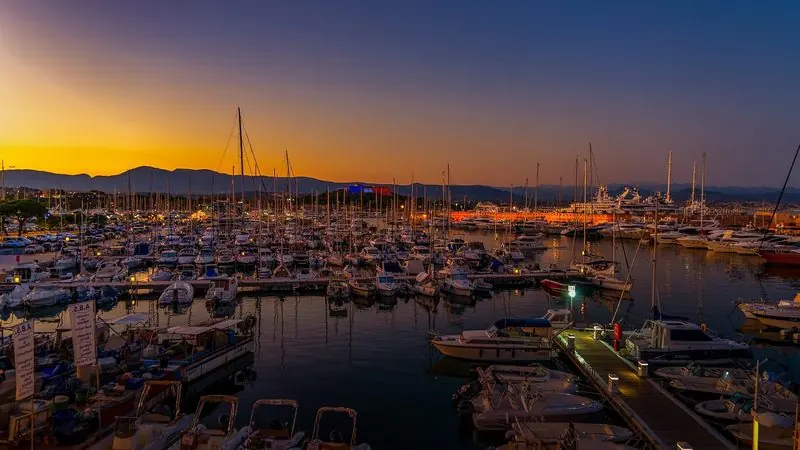
Unlike the resort ports, Antibes does not empty. Several thousand crew live in the town year-round, the brokerages and agencies work through the winter, and the port stays occupied while yachts prepare and stand down. Winter berthing is genuinely obtainable and reasonably priced. The redevelopment programme continues through 2026 with three new buildings and a recycling point scheduled, so an owner should expect construction activity somewhere in the port.
The honest downside
The lease is the problem. Every euro spent on a berth here runs out in December 2042 unless the city renews on terms nobody can predict, and there is no freehold to fall back on. Owners paying eight figures are buying roughly sixteen remaining years of use as things stand in 2026, and the resale market is thin enough that a forced sale would be slow.
The port itself has honest flaws too. It is open to the east and uncomfortable in a strong easterly. The inner basins are shallow and busy with small craft. It is a working harbour with the noise and traffic of one, and the public quays are genuinely public. An owner who wants a manicured resort marina will find Antibes rough at the edges compared with Porto Cervo or Yalikavak.
Shore power, and the cable rules that go with it
The port's 2026 tariff document states the supply plainly, which is rare. Port Vauban is fed at 230 V plus or minus 10 per cent, 50 Hz single-phase, or 400 V plus or minus 10 per cent, 50 Hz three-phase, through standard-compliant sockets. There is no 60 Hz supply, so a 60 Hz yacht converts on board. The document goes further and specifies the cable: one flexible cable per socket, in a single length of no more than 25 m, type HO7 RN-F at 3G2.5 for a 16 A socket and 3G6 or 5G6 for a 32 A socket. It also warns in writing that without an isolation transformer on board, electrolysis can damage the yacht or her neighbours, which is the port saying that galvanic corrosion here is the owner's problem and not the port's.
Fluids for a yacht of 12 m and over are billed on actual consumption where there is an individual metered connection, and on a flat rate where there is not. Metered, water is EUR 3.79 per cubic metre and electricity EUR 0.38 per kilowatt hour, both with VAT included, on the 2026 schedule. A yacht lived aboard without electricity metering pays a 10 per cent surcharge on the berthing fee itself, not on the power. Water is rounded up to the whole cubic metre. Hoses and cables are supplied by the yacht, and the water tap must be self-closing.
The published tariff, and the season that is not July
Port Vauban publishes a full superyachting tariff and it is banded by length and beam together, in sixteen categories from Z-QDM at 53.99 m and 12 m of beam up to Z15 at 158.99 m and 27 m. Beam is a hard cap in each band, so a wide hull moves up a category regardless of her length. The surprise is the season structure. High season at Antibes is May, June and September, not July and August, and the rates say so. A category Z05 berth, up to 85.99 m and 17 m of beam, costs EUR 3,479 a day with VAT in May, June and September against EUR 3,163 in July and August and EUR 1,582 in low season. Category Z08, to 106.99 m and 20 m, runs EUR 4,718, EUR 4,289 and EUR 2,253. Category Z15 runs EUR 7,434, EUR 6,758 and EUR 3,833. Low season is 1 January to 1 May and 1 October to 1 January.
Two discounts sit under those headline numbers. In July and August a yacht in category Z03 or above staying fifteen consecutive nights or more is discounted 30 per cent on the high-season rate. And a winter contract, available for stays of one month or more, prices the same berths far lower: EUR 331 a day with VAT for Z-QDM, EUR 1,299 for Z07 up to 99.99 m and 19 m of beam, EUR 2,319 for Z15. Worked through, a 100 m yacht on a 19 m beam sitting on the Quai Camille Rayon from 1 October to 1 May pays 212 days at EUR 1,299, or EUR 275,388 for the winter, before metered water and power. The same yacht alongside for a week in June pays EUR 4,288 a day, or EUR 30,016. Cancellation terms are strict enough to matter: a stay of ten nights or fewer cancelled inside 72 hours of arrival is charged in full.
Ashore, access and booking
| Getting there | Nice Cote d'Azur is the airport, about 20 to 30 minutes away on the A8 with long-haul and full private-jet handling. Riviera taxi firms advertise a fixed transfer at roughly EUR 55 to EUR 85 for a standard car and about EUR 140 for a seven-seat van, tolls included. The cheap route is the train: tram from either terminal to Nice-Saint-Augustin, then about 18 minutes to Antibes station from around EUR 5, and the station is a short walk from the port. Cannes is 20 minutes west, Monaco about 45 minutes east, and there is a licensed heliport of about 28 by 29 m on the IYCA quay itself with day and night landing authorisation and four helicopter parking spaces. |
|---|---|
| Arriving by sea | Call the port on VHF channel 9, which keeps a permanent watch, and give the vessel's name, her dimensions and how long you want to stay. The entrance is about 50 m wide, lit for day and night access, and the limit through the access passage and the basins is 3 knots. Swimming, sailing under sail and windsurfing are forbidden inside the port. Movements must be notified to the port office at least 24 hours ahead. Anchoring outside is regulated by size: under 45 m is limited to 72 hours, extensible in further 72-hour periods; 45 to 79 m needs the La Garoupe semaphore on +33 4 93 61 32 77; 80 m and over is capped at 24 hours, renewable to 72 for safety or technical reasons, through CROSS MED on VHF 16 or +33 4 94 61 16 16. |
| Reserving a berth | Large-yacht enquiries go to [email protected], club and membership matters to [email protected], and general port business to [email protected]. On arrival the port takes an arrival form, a copy of the registration document and the insurance certificate. Cancellation terms are strict enough to shape a plan: on a stay of ten nights or fewer, free at 72 hours or more before arrival and the whole stay charged inside that; on 11 to 30 nights, 30 per cent at seven days and the whole stay inside. A technical stop of under 30 minutes alongside is free with no water or power, and under six hours is charged at 50 per cent of the base rate in any season. |
| What a berth costs | The 2026 card is banded by length and beam together in sixteen categories, VAT included, and beam is a hard cap. Category Z05, to 85.99 m and 17 m of beam, is EUR 3,479 a day in high season, EUR 3,163 in July and August and EUR 1,582 in low season. Z08, to 106.99 m and 20 m, is EUR 4,718, EUR 4,289 and EUR 2,253. Z15, to 158.99 m and 27 m, is EUR 7,434, EUR 6,758 and EUR 3,833. High season at Antibes is May, June and September, not the school holidays. A yacht in Z03 or above staying fifteen consecutive nights or more in July or August takes 30 per cent off the high-season rate. Winter contracts of a month or more run EUR 331 a day for Z-QDM, EUR 1,299 for Z07 and EUR 2,319 for Z15. |
| Power, fluids and services | Shore supply is 230 V single-phase or 400 V three-phase, both at 50 Hz and both plus or minus 10 per cent. There is no 60 Hz supply, so a 60 Hz yacht converts on board. The port specifies the cable as well: one flexible lead per socket, a single length of no more than 25 m, HO7 RN-F 3G2.5 for a 16 A socket and 3G6 or 5G6 for 32 A. Metered fluids for yachts of 12 m and over on the 2026 card are EUR 3.79 per cubic metre of water, rounded up to the whole cubic metre, and EUR 0.38 per kWh, VAT included; a yacht lived aboard without electricity metering pays a 10 per cent surcharge on the berthing fee. The fuel station sits in front of the capitainerie and opens 08:00 to 20:00 in season, 09:00 to 12:00 and 14:00 to 17:00 out of it, with ice on sale there. Also on site: pump-out and waste collection, three shower and WC blocks, a launderette, five chandlers, 1 Gb fibre by RJ45 at the berth, and on the IYCA quay ISPS controlled access with CCTV, a crew centre with lounge, gym and changing rooms, a 700 sq m members' lounge bar with two terraces, electric golf carts for the 650 m walk and a concierge desk. |
| Eating within walking distance | Le Figuier de Saint-Esprit, Christian Morisset's one-star, is a few streets off the port inside the ramparts. Le Vauban in the middle of the old town does a three-course set menu, and L'Arazur is the small chef-owner room about two minutes from the quay. The covered Marche Provencal on Cours Massena is where crews provision: every morning 07:30 to 13:00, to 13:45 from 1 June to 31 August, closed Mondays from 1 September to 31 May. The craft market takes the same hall in the afternoons, Thursday to Sunday 15:30 to 00:30 from mid-June to end September. The town's other Michelin star, Les Pecheurs, is out on Cap d'Antibes and needs a car. |
| After dark | The Blue Lady is the crew institution and has been for more than twenty years, close to the entrance of the old town, with the Bluewater agency directly opposite it. The Hop Store is the large Irish pub a few steps from Port Vauban and the Quai des Milliardaires, with live music and DJs at weekends and a young, loud summer crowd. The Drinkers Club is the smaller version with outside tables. For a proper club with names on the bill it is over the hill to Juan-les-Pins; Antibes itself keeps a handful of DJ bars and the Absinthe Bar's stone cellar in the old town. |
| Fixed dates, and the building works | Les Voiles d'Antibes, the first big classic gathering of the Mediterranean season and now in its 30th year, runs 27 to 31 May 2026 from Bastion Saint-Jaume, with the village capped at 2,500 people at a time. Jazz a Juan takes the Pinede Gould at Juan-les-Pins from 9 to 19 July 2026. The Cannes Yachting Festival is 8 to 13 September 2026 across the Vieux Port and Port Canto, with the Monaco Yacht Show a fortnight later. The redevelopment is not finished: the Merli pier is due complete by end March 2026, three new buildings go up at Anse Saint-Roch from spring with crews working between the CREPS gate and the Village des Artisans from mid-July, there is a three-week pause in August, parking drops to about 100 spaces, and the fishermen's area is rebuilt between November 2026 and March 2027. |
| What is NOT published | The port publishes an unusually complete tariff, and then stops precisely where an owner most wants a number. IYCA membership fees are published for none of the three tiers, Horizons, Premium and Standard. There is no register of lease transactions on the Quai des Milliardaires: the eight-figure numbers that circulate are asking prices in a market with a handful of deals a year, and the one openly listed position, at EUR 4,150,000 including VAT over an eighteen-year term, came through a berth broker rather than the port. Draught on the outer quay is given as a 5 to 8 m range rather than berth by berth, and the port publishes no minimum depth alongside a named position. |
What owners and crew report
A berth here is a wasting asset, and the market for one is tiny
A superyacht position on the quay was listed publicly in July 2025 at EUR 4,150,000 including VAT and all service charges, payable in instalments across an eighteen-year term, with annual rental income estimated at about EUR 220,000. The listing did not state berth dimensions, the lease expiry or the itemised service charges, which is normal for this market and the reason an owner needs his own reading of the concession before he pays.
Marina World (21 July 2025)Antibes is where crew are found, and that is what an owner is really buying
Flying Fish's dockwalking guide puts the Bluewater agency directly opposite The Blue Lady pub, tells arriving crew to take accommodation east of the road running beside the railway so they are close to the marina and the agencies, and gives the Mediterranean hiring season as roughly April to October, with Cannes 20 minutes west and Monaco 45 minutes east as the next dock walks.
Flying FishThe Blue Lady and the Hop Store are crew rooms, not guest destinations
YPI Crew describes The Blue Lady as a yachting community institution of more than twenty years and the starting point for junior crew, and the Hop Store as a large pub a few steps from Port Vauban and the Quai des Milliardaires that gets rowdy through the summer with live music and weekend DJs. Worth knowing in both directions when an owner is choosing where to take a party ashore.
YPI CrewThe rebuild was specified around what crew asked for, and it is still running
Dockwalk reported the EUR 135 million programme in May 2022: crew relaxation areas with shade for barbecues and sport, private storage and technical space for repairs, and a dedicated crew centre with lounge, fitness room, gym and adjoining changing rooms. Port Vauban's own 2026 schedule shows the work continuing, with three buildings at Anse Saint-Roch, a three-week pause in August and the fishermen's area rebuilt the following winter.
Dockwalk (5 May 2022)There is no independent owner survey of this quay, and there cannot be
Lease transactions on the Quai des Milliardaires are private, IYCA membership fees are unpublished, and no owner or captain satisfaction survey exists for the berth. Every figure in circulation above the port's own tariff is asking price or market commentary, and should be read as such.
Yotters desk, checked August 2026
What is good, and what to watch
Strong points
- The only quay on the Riviera outside Monaco that takes 150 mNineteen permanent positions on the breakwater, including one of 150 by 28 m and one of 165 by 40 m, with 5 to 8 m of water.
- The deepest crew and trade base in the world is behind the quayAgencies, brokerages, engineers, chandlers and provisioners inside the ramparts, which is why yachts are managed from Antibes even when they berth elsewhere.
- It publishes what most Mediterranean ports keep backSixteen tariff bands, three seasons, the long-stay discount, cancellation terms, metered fluid rates and even the shore cable specification, all in one 2026 document.
- Winter is genuinely cheap and the town stays openA winter contract runs from EUR 331 a day for Z-QDM, and several thousand crew live here year-round, so the trades work through.
- Guests arrive easilyNice Cote d'Azur is 20 to 30 minutes by road with private-jet handling, and there is a licensed heliport on the quay itself.
What to watch
- The lease ends in December 2042Vauban 21 holds a 25-year delegation from 1 January 2017. A buyer in 2026 is paying eight figures for about sixteen remaining years with no guaranteed renewal.
- The port is open to the eastern sectorA strong easterly makes the 50 m entrance awkward and the outer berths lively, and yachts running in from Corsica or Italy divert rather than sit it out.
- Only the outer wall is usable by a large yachtThe inner basins carry 2 to 4 m across roughly 1,500 mixed berths, so nothing much over 30 m goes anywhere but the breakwater.
- 50 Hz only, and corrosion is written up as the owner's problemNo 60 Hz supply at all, and the tariff document warns in writing that without an isolation transformer on board, electrolysis can damage the yacht or her neighbours.
- It is a construction site into 2027Three buildings at Anse Saint-Roch through 2026 with only a three-week pause in August, parking cut to about 100 spaces, and the fishermen's area rebuilt November 2026 to March 2027.
Who it is for: An owner who runs the yacht hard and wants the world's deepest crew and service base within walking distance of the passerelle.