St Katharine Docks Marina (London)
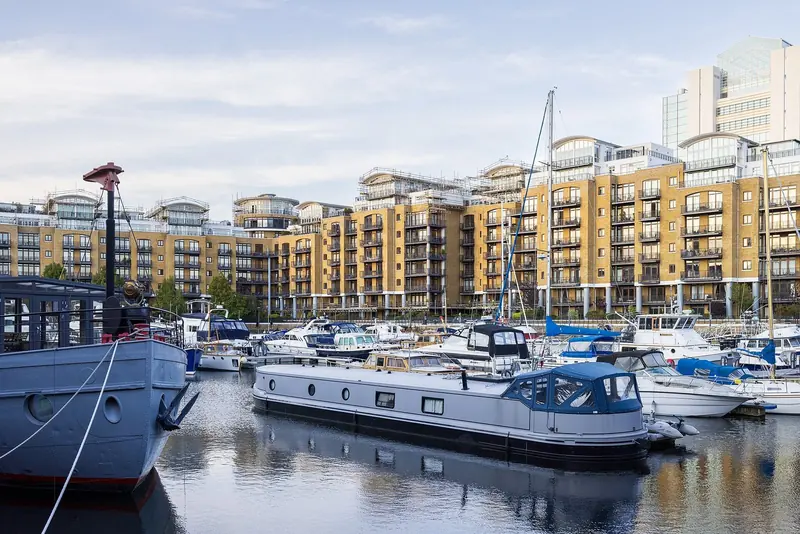
| Location | 50 St Katharine's Way, London E1W 1LA, immediately east of Tower Bridge on the north bank of the Thames |
|---|---|
| Operator | SKD Marina Ltd, managed by IGY Marinas (Island Global Yachting), which the marina's own page dates to February 2020 |
| Berths | 185 in three basins (East Dock, West Dock and the Centre Basin), including 16 megayacht berths per IGY; a reconfiguration of the pontoons in 2017 raised capacity |
| Vessel size | up to 40 m per the marina's own site and guide; IGY's page gives 137 ft (42 m) length, 39 ft (12 m) beam and 11.5 ft (3.5 m) draft as maxima |
| Depth | the marina publishes no depth; a 2017 Practical Boat Owner guide gave 4 m at both berth and approach |
| Entry | through a single lock, open from about 2 hours before to 1.5 hours after high water at London Bridge, 0600 to 2030 from April to October and 0800 to 1800 from November to March |
| VHF | channel 80, call sign St Katharine's, once Tower Bridge is in sight; London VTS is on channel 14 at the Thames Barrier and above, and on 68 downriver of Sea Reach No. 4 |
| Telephone | marina reception +44 (0)20 7264 5312, 0900 to 1700 daily subject to locking periods; 24 hour estate security +44 (0)20 7264 5296 |
| Waiting buoys | five yellow buoys downstream of the lock entrance for vessels up to 15 m and 25 tonnes per the marina's visitor guide; Thames Visitor Moorings says six |
| Power | metered at every berth; the marina does not publish the amperage, with IGY quoting 16 A to 125 A and a second listing up to 63 A three phase |
| Accreditation | Five Gold Anchors from the Yacht Harbour Association and International Clean Marina status, per the marina's 2026 guide |
| Built by | Thomas Telford, opened October 1828; the docks were badly bombed in the Second World War and became a marina in the 1990s |
| Residential use | banned under the conditions of mooring; third party insurance of at least GBP 5,000,000 is required |
| Fixed date | the Classic Boat Festival, held 12 and 13 September in 2026, free to enter |
What this marina is and who it suits
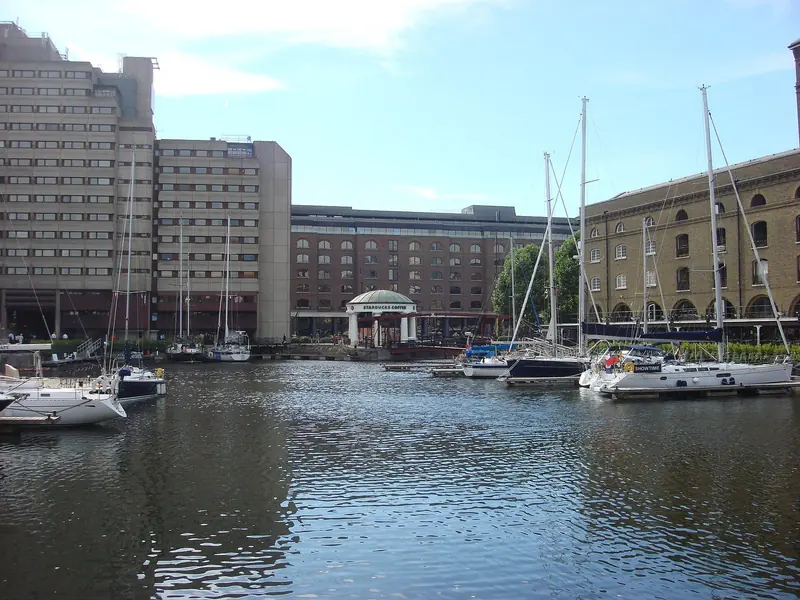
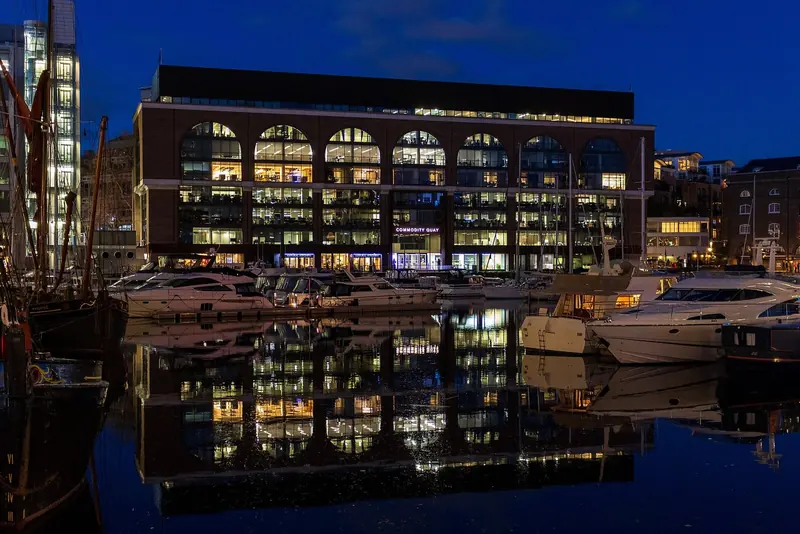
It is a rare thing: a working marina in the middle of central London, a few minutes on foot from the Tower of London and Tower Hill station. The marina says it provides 185 berths in three basins, the East Dock, the West Dock and the Centre Basin, for vessels up to 40 metres. IGY's own page counts 16 of those as megayacht berths and gives a 42 metre maximum length, 12 metre beam and 3.5 metre draft, which is why this page quotes both figures and not one. If you are above about 35 metres, ask for your exact berth before you plan a passage.
The people who use it fall into three groups. Cruising sailors and motor yacht owners come for a night or a week and treat it as a floating base for the city. Annual berth holders, a limited number according to the tariff, keep boats here year round. And classic boat owners fill the basins for the September festival. The marina is managed by IGY Marinas, which the marina's site dates to February 2020, and it carries the Yacht Harbour Association's Five Gold Anchor award and International Clean Marina status according to its 2026 guide.
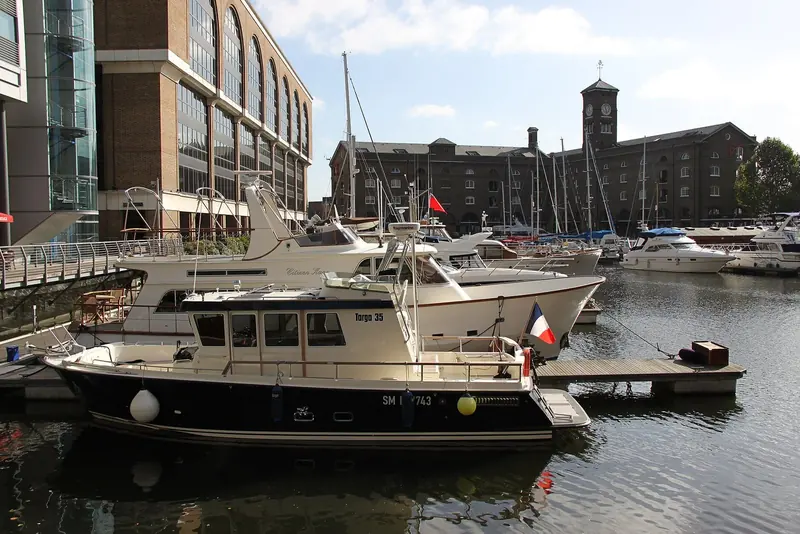
Telford, the Blitz and the marina years
About 11,300 people were moved on to make way for the basins, and the name comes from the hospital and church that stood on the site. The docks specialised in luxury cargo: sugar, rum, spices, perfumes and wines, with 32,000 tons of tea a year, and ivory trade continued into the early twentieth century, which is how Ivory House got its name. Most of the warehouses on the east side were destroyed in the Blitz and the basins fell out of use.
A redevelopment from the late 1960s turned the dock into a leisure harbour and by the 1990s it had become the marina and mixed-use estate you see now, with more than 520,000 square feet of office, retail and residential space around it. Two surviving buildings do the postcard work: the timber-framed Dickens Inn and Ivory House with its clock tower. A reconfiguration of the pontoons in 2017 increased the number of berths, which matters if you read an older guide: figures printed before 2017 describe a different marina.
St Katharine Docks prices a 12 metre boat at GBP 205 a night in summer and gives 20 metres and over as price on application, so the larger the yacht the less you can learn before you ring.
Coming up the Thames to the lock
The marina's visitor guide gives the route in stages. At Sea Reach No. 4 you move from VHF 69 to channel 68 and call London VTS. Inbound yachts use the Yantlet Secondary Channel to keep clear of large commercial traffic, cross to the south side towards East Blyth North Cardinal and then handrail the main channel, taking particular care at Tilbury, where a flashing white light warns of large ships manoeuvring. From Crayford Ness London VTS works on channel 14, and at Margaretness you enter the Thames Barrier control zone and must ask permission and be told which span to use. Sailing boats should use their engines through the Barrier. The speed limit from Margaretness to beyond the marina is 12 knots, and the guide reckons on 30 minutes or more from the Barrier to the lock.
What the guide cannot give you is how it feels. Pippa Shaw, who took the 28 foot Sudana to the marina in September 2023, wrote in a boats.com review that the entrance was incredibly bumpy and frankly scary, because the river's sharp sides throw wash back from commercial and passenger traffic and there is nowhere for the swell to die. She also learned that the river's rules are enforced: after a stop at Erith the police told her crew they were on the wrong side of the channel. Her advice, and the marina's, is to come up on the flood and leave on the ebb. Call the marina on channel 80 as soon as Tower Bridge is in sight.
The lock, the tide and the waiting
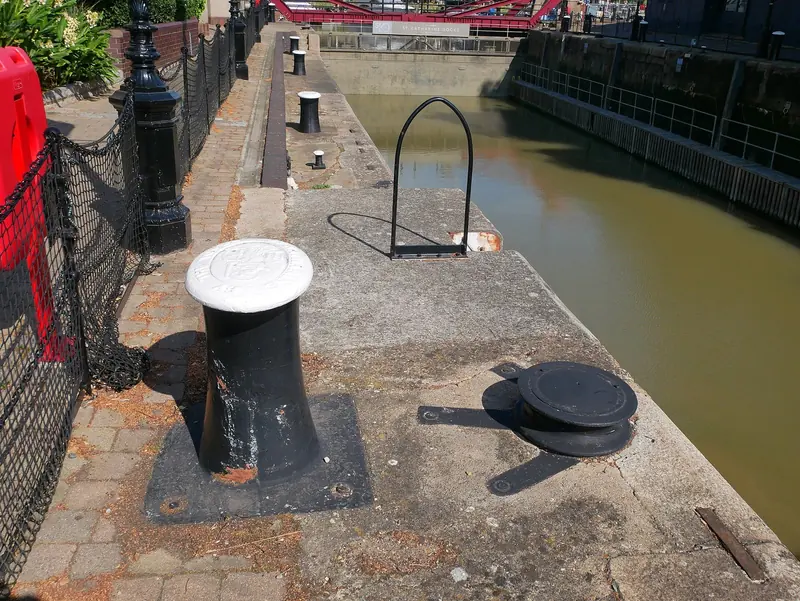
Those two windows interact, and the result is a window of three and a half hours around each high water, inside the fixed daily hours. The marina publishes locking times by month on its website. In the lock most boats are asked to tie starboard side to a floating pontoon or to another boat, with fenders about a metre above the waterline. When the lock is busy you may be put against the wall on the port side, where bolts and chains take your first lines before you move to bollards. In southerly wind the guide wants a stern line or midships line ready first. Once the outer gate is raised the lock levels up to the dock, which can take up to 30 minutes, and one person from each boat walks to reception to register and collect a map with the berth. The guide also warns that during high spring tides locking may be suspended for safety.
If you arrive before the lock is ready the marina keeps five yellow mooring buoys downstream of the entrance for boats up to 15 metres and 25 tonnes. Thames Visitor Moorings lists six, so trust the guide's five and ask. If the buoys are full you stem the tide, keep out of the way of traffic at Tower Bridge Quay and keep a listening watch on 68 and 14. For departure, book your lock-out time with reception the day before and be flexible, because the marina groups yachts together to use the window. About 15 minutes before locking a dockmaster calls on channel 80 with the order. Yachting Monthly's Dick Durham described the other side of it in 2007: on a 7.3 metre tide he chose to leave two hours before high water, found the river running at roughly five knots and tied to a PLA rubbish lighter to wait for slack.
Tower Bridge, Teddington and the upriver approach
The visitor guide says that at Richmond you can avoid the lock if you pass between two hours before and two hours after high water, and that the Richmond lock keeper answers on channel 80. Between Putney and Richmond you share the river with rowers, and at Hammersmith and Westminster you check the headway gauges against the height of tide. The Port of London Authority sets the rule for the last obstacle: a vessel with an air draft of 9 metres or more wishing to pass Tower Bridge must request a lift at least 24 hours ahead through the bridge's booking page, and the bridge sets a listening watch on VHF 14 from 30 minutes before the booked time. The lift is free.
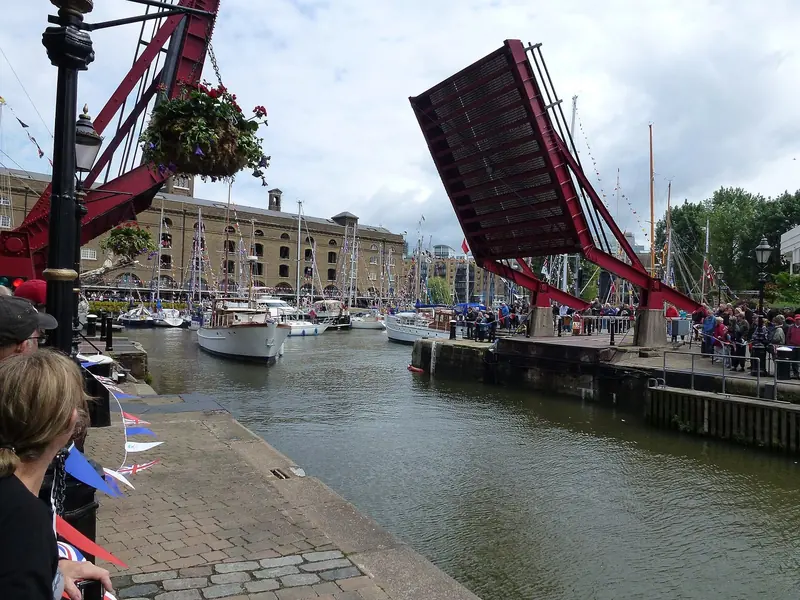
The PLA references each bridge's clearance to mean high water springs, so a tall mast has to be judged against the tide as well as the book. The marina publishes no air draft figure for the lock approach. Note that the marina itself has bridges that lift to let you reach your berth once the inner gate opens, so ask reception about your mast when you book.
What a berth costs in 2026
Visitor prices are set by length band. Up to 8 metres is GBP 105 a night peak and GBP 84 off peak; 8.1 to under 10 is GBP 160 and GBP 112; 10.1 to under 12 is GBP 205 and GBP 144; 12.1 to under 14 is GBP 255 and GBP 178; 14.1 to under 16 is GBP 295 and GBP 207; and 16.1 to under 20 is GBP 435 and GBP 305. Above 20 metres every column reads price on application. Weekly and monthly rates are cheaper per night: a peak week for the 10.1 to 12 band is GBP 820, which is four nights' price, and a month is GBP 2,300. Off peak, in January to March and October to December, rates run roughly 20 to 30 per cent below peak. Catamarans are accepted only subject to adjacent berth availability and, in the 2026 tariff, at twice the standard rate, where an older listing said one and a half times. Charter, commercial and high usage vessels pay a 25 per cent surcharge by prior agreement, and high usage is defined in the conditions as more than 50 nights in the period booked.
Electricity is metered and billed when you leave. The tariff gives no rate, and the figure in circulation is 40.5 pence per kilowatt hour including VAT and standing charge, quoted by boats.com in 2024 and by Thames Visitor Moorings. A pump-out is listed by Thames Visitor Moorings at GBP 35, a wash in the laundry is GBP 3 and GBP 1 buys 30 minutes of drying. A voluntary GBP 1 carbon offset is added to each stay and removed on request. There is also a winter offer, three months paid for four, for stays of three months or more between October and March, a discount of 10 to 25 per cent for group bookings of two or more boats, and a referral scheme worth up to GBP 500 on an annual contract. Annual berths are limited and quoted individually, with no price published.
Conditions, insurance and the small print
The document the marina publishes under its 2026 file name is headed 2025 Conditions of Mooring, so check which edition you are signing. It says the berth is a licence and not a tenancy, that the marina can terminate on 14 days' notice for any reason with a pro rata refund, and that a boat left more than seven days after expiry can be moved and charged. Black water must be discharged only through the marina's pump-out. Noise between 2200 and 0800 can get you ordered out of the marina. The marina guide adds that swimming, fishing, drone photography and repairs with power tools are not allowed, and that boats should have at least two bow lines and a stern line with one line to the perimeter pontoon.
Events with ten or more people require you to arrange security at your own cost and alcohol service needs stewards at the gangway. Payment is by debit or credit card only and American Express is not accepted. Reception can lend a free electrical adaptor, which you return in the lock when you leave, and the marina asks you to hand over international food waste if it is your first port in the UK. Boats arriving from outside the UK should look at the Border Force guidance the marina links to.
Ashore: eating, walking and after dark
The marina's guide lists a good run of places by the water: the Dickens Inn on Marble Quay, The Melusine for seafood with berth delivery for boat owners, Vicinity at the Tower Hotel, Emilia's Crafted Pasta, Bravas Tapas, Zizzi, Cote Brasserie, Honest Burger, a Mexican and a Turkish restaurant, a wine bar and several cafes. The SKD Porter Card, issued at reception, gives discounts across the Docks. Tesco Express to the west opens 0600 to 2400 daily and Waitrose to the east opens 0730 to 2200 on weekdays, 0730 to 2100 on Saturday and 1100 to 1700 on Sunday. Pippa Shaw's verdict was that the Tesco suits a lunch more than a provisioning run.
On foot, Tower Bridge is about 4 minutes away, the Tower of London 8 and HMS Belfast 13. Tower Hill underground station is a 5 to 10 minute walk and the DLR at Tower Gateway is also close. After dark the pontoons are gated, with access cards that turn a blue reader light green, CCTV, SOS bollards that raise an alarm and a 24 hour security control. The marina's emergency rendezvous points are Marble Quay, Elephant Gate and the Piazza. The dated fixture is the Classic Boat Festival, held on 12 and 13 September in 2026 with entry free and Thames sailing barges, historic tugs and vintage motor boats in the central and west basins; the next date is not yet published.
What the marina does not publish
Several basic numbers conflict between sources. Maximum length is 40 metres on the marina's site and 42 metres on IGY's. Maximum draft is 3.5 metres on IGY's page and 4 metres at the berths and approach in a 2017 Practical Boat Owner guide, which gave the figure at mean low water springs and does not say how it was measured. Power is variously 16 A to 125 A or up to 63 A three phase. The mooring buoy count is five or six and the catamaran multiplier is one and a half or two.
Yotters could not find an independent report from the captain or owner of a yacht on any of the 16 megayacht berths, nor an occupancy or waiting list figure for annual contracts. The marina says advance reservations are strongly recommended and that berthing is not guaranteed without one. Ask in writing for the berth number, the depth and the electricity rate, tell reception your air draft and confirm the lock-out time the day before you leave.
Ashore, access and booking
| Getting there | The nearest underground station is Tower Hill on the District and Circle lines, a 5 to 10 minute walk, and the DLR at Tower Gateway is also close. Liverpool Street is a 26 minute walk for National Rail and the Elizabeth line. There is a taxi rank at the Tower Hotel beside the lock, normally staffed around the clock. River boats leave from Tower Bridge Quay and Tower Pier, and Thames Clippers run to Greenwich and west London. Marina reception is at Unit C3, Ivory House, E1W 1AT. |
|---|---|
| Arriving by water | From Sea Reach No. 4 it is about 45 nautical miles, from Gravesend 24 and from Teddington 17. Use VHF 68 for London VTS below Crayford Ness and 14 from there; ask for a Thames Barrier span at Margaretness. The river speed limit is 12 knots from Margaretness to beyond the marina. Call St Katharine's on channel 80 or +44 (0)20 7264 5312 once Tower Bridge is in sight. Vessels with an air draft of 9 m or more passing Tower Bridge need to request a lift 24 hours ahead. |
| The lock and the tide | The lock runs from about 2 hours before to 1.5 hours after high water at London Bridge, 0600 to 2030 in April to October and 0800 to 1800 in November to March, with monthly times on the marina's website. Locking may be suspended in high spring tides. Book your lock-out time the day before. Waiting buoys: five yellow ones downstream, for boats up to 15 m and 25 tonnes. |
| How you reserve | Use the book a berth form on the marina's website, which asks for boat name, length, beam, draft and dates, or email [email protected] or telephone. Reception is open 0900 to 1700 daily, subject to locking. IGY says advance reservation is strongly recommended and berthing is not guaranteed without one. |
| What a berth costs | 2026 visitor tariff including VAT, peak (April to September) and off peak (January to March, October to December): up to 8 m GBP 105 and 84 a night; 8.1 to under 10 m GBP 160 and 112; 10.1 to under 12 m GBP 205 and 144; 12.1 to under 14 m GBP 255 and 178; 14.1 to under 16 m GBP 295 and 207; 16.1 to under 20 m GBP 435 and 305; 20 m and over on application. Peak weekly rates run GBP 525 to 1,750 and monthly GBP 1,470 to 4,880 for the same bands. Catamarans at twice the rate; charter, commercial and high usage vessels at plus 25 per cent. |
| Metered fluids and extras | Electricity is metered at each berth and settled on departure; the rate is not in the tariff, and 40.5 pence per kWh was quoted in 2024. Drinking water is from the pontoon taps and you need your own hose. Pump-out is operated by the marina and listed at GBP 35. Laundry: GBP 3 a wash and GBP 1 for 30 minutes of drying, with an iron. Trolleys need a GBP 1 or EUR 1 coin. The marina is cashless and takes no American Express. |
| Fuel and supplies | The marina guide lists no fuel berth in the basin. Thames Marine Services runs a fuel barge under 500 m outside the lock, to be booked ahead, and the marina guide lists a second approved supplier, with both allowed to deliver by fuel barge by prior arrangement. A 24 hour fuel station on The Highway is a 15 minute walk. Chandlery, gas and engineering contacts are listed in the marina guide. |
| Eating and shopping | Dickens Inn on Marble Quay, The Melusine, Vicinity at the Tower Hotel, Emilia's Crafted Pasta, Bravas Tapas, Zizzi, Cote Brasserie and Honest Burger are all in the guide. Tesco Express opens 0600 to 2400 every day and Waitrose 0730 to 2200 Monday to Friday. There are cash machines at both supermarkets and in the Tower Hotel. |
| After dark | Pontoon gates and washrooms open with the access card. Security control is staffed 24 hours on +44 (0)20 7264 5296. Out of reception hours, call VHF 80 or 16. Noise between 2200 and 0800 can lead to an order to leave. |
| Fixed dates | The Classic Boat Festival ran on 12 and 13 September 2026 and Dunkirks at the Docks on 1 August 2026. Next year's dates are not yet published. The lock season changes in April and November. |
| What is not published | Annual berth prices, rates above 20 m, the depth at each berth, the amperage supplied, the current electricity rate in the tariff, occupancy and annual waiting lists and any air draft limit for the inner bridges. |
What owners and crew report
A scary river and a peaceful basin
Pippa Shaw took the 28 foot sailing yacht Sudana to the marina in September 2023 with two people and a cat. She called the entrance incredibly bumpy and frankly scary, put it down to the river's sharp sides reflecting wash from commercial and passenger traffic, and said the police came to tell her crew they were on the wrong side after Erith. Inside, she found it surprisingly peaceful, with an almost cove-like protection from wind and waves. She called the pontoons a little short but wide and stable, and the hotel-standard showers a little smaller than she wanted.
Pippa Shaw, boats.comExpensive for a marina, cheap for the address
The same review says the marina is pricy compared with others in the UK but that the postcode speaks for itself, and that nothing comparable in the area costs less. She lost her SKD Porter Card, and a receptionist lent her own for the weekend. She added that the Tesco Express suits a lunch break more than a full shop.
Pippa Shaw, boats.comLeaving on a big tide is a different job
Dick Durham asked the harbourmaster to let him out two hours before high water on a 7.3 metre tide at London Bridge, so as to avoid two hours of ebb. The river was running at about five knots, he could hardly make way under power, and he tied up to a PLA rubbish lighter to wait for slack. Tree trunks, pallets and railway sleepers hit his topsides and the wash from fast ferries rolled him against the lighter. The account is from 2007 and predates the 2017 reconfiguration, but the tide has not changed.
Dick Durham, Yachting MonthlyThe tides in the lock decide the day, in the marina's own words
The marina's visitor guide tells skippers to expect up to 30 minutes in the lock while it levels, to be ready for rafting or a port side wall berth, to have a stern or midships line first in southerly wind, and to be flexible about departure because the marina groups yachts together. It also states that locking may be suspended in high spring tides. This is the operator's guidance and not an owner report, but it is the clearest description of what a transit is like.
SKD Marina visitor guideNo report from the megayacht berths could be found
Yotters could not find an independent account from a captain or owner on any of the 16 megayacht berths IGY lists, an occupancy figure or a waiting list for annual contracts. A 2017 Practical Boat Owner guide gave 4 m depth and promoted the marina as London's Best Kept Secret, which is a brochure and not a trial. Anyone above 30 metres should treat the published maximum as a reason to enquire.
Yotters desk
What is good, and what to watch
Strong points
- The address is unmatchedA secure, lock-protected berth a few minutes' walk from Tower Bridge, the Tower of London and Tower Hill station, with Waitrose and a run of restaurants on the dock. Pippa Shaw called it one of her favourite marinas of all time.
- The tariff is public and clear to 20 metresNightly, weekly and monthly rates for six length bands are in the 2026 tariff, peak and off peak, with VAT included.
- It is calm and well guarded insideBehind the lock the basin is protected from wind and river wash, the pontoons are gated and carded, and there are CCTV, SOS bollards and 24 hour security control.
- The marina publishes how to do the hard partsThe visitor guide walks through the Thames passage, the Barrier, the bridge lift, the buoys and the lock, with channels and telephone numbers.
- Winter and group discounts are realThree months for four in October to March, and 10 to 25 per cent off for two or more boats booking together.
What to watch
- You live by the tideThe lock operates only around high water and inside fixed hours, locking can be suspended in high springs, and a lock-out has to be booked the day before.
- The passage is hard on small boatsThe River Thames, with fast ferries, commercial traffic and strong streams, is the toughest part of the stay. Pippa Shaw called her entrance scary.
- Large yachts get no published priceEverything at 20 metres and over is on application, and sources disagree on maximum length, draft, power and buoy numbers.
- It is expensive and strictA 12 metre boat pays GBP 205 a night in summer, electricity is extra, charter and high usage carry a 25 per cent surcharge and residential use is banned.
- No fuel in the basinThe marina lists no fuel berth: fuel comes by barge outside the lock or from a 24 hour station a 15 minute walk away.
Who it is for: A skipper or owner who wants to be moored in the middle of London for a night, a week or a season, who can plan a passage around the tide and who accepts a lock and a strict set of conditions in exchange for the address. It is a poor fit for anyone who needs to leave at short notice, wants to live aboard (residential use is banned), or needs a published guarantee of a berth above 20 metres.